Etsy or Printify: Which Is the Better Place to Set Up Shop? (Trick Question — They Do Completely Different Jobs)
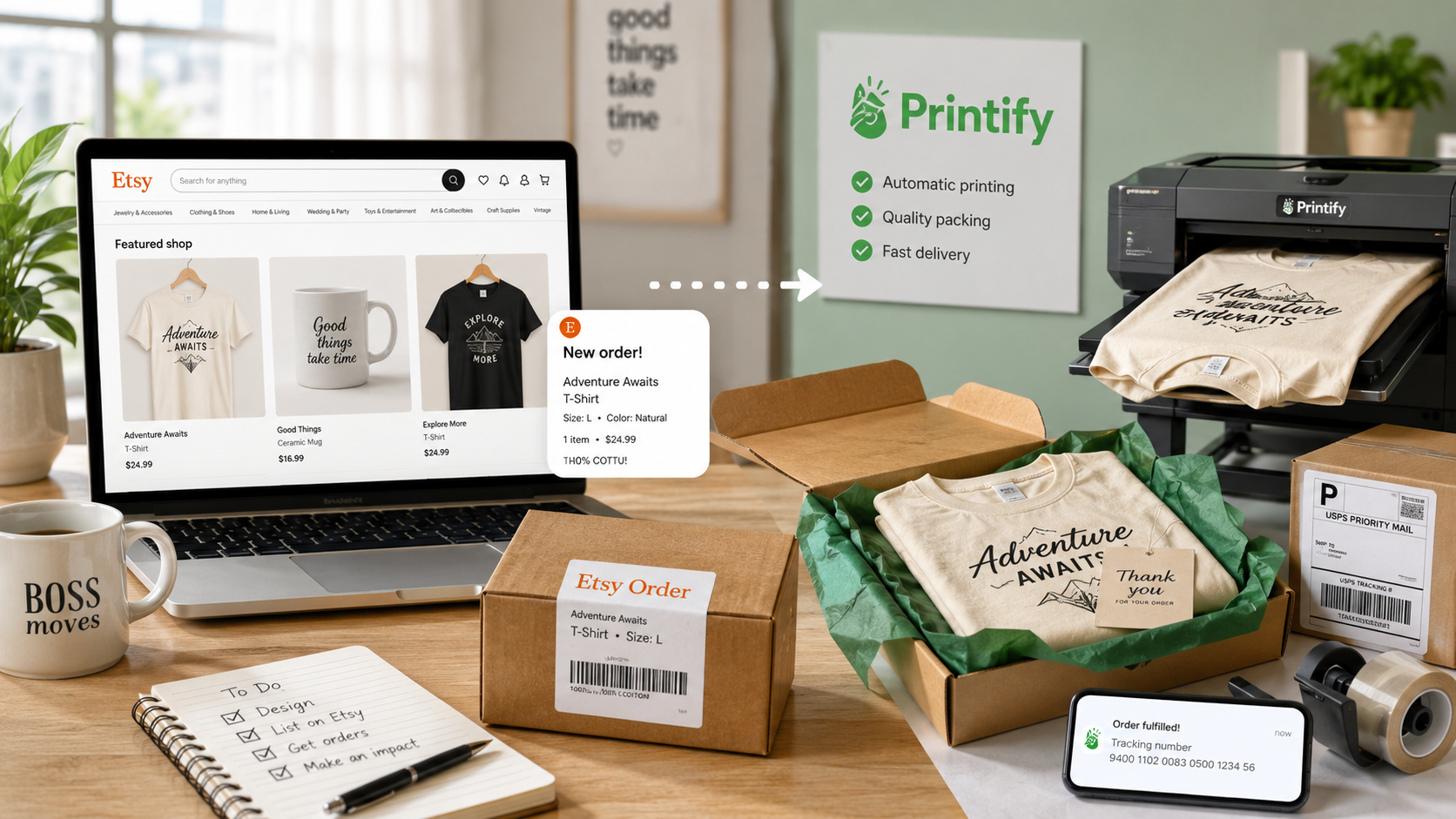
Here's the answer that untangles the whole thing, because this is one of the most common points of confusion for new sellers:
Etsy and Printify aren't competitors. They're two different layers of the same business. Etsy is a marketplace — the storefront and the crowd of buyers walking past it. Printify is a print-on-demand fulfillment service — the factory and shipping department. Printify produces and ships your custom products, while Etsy provides the storefront where customers buy them — which is why the real answer to "which one?" is usually both, connected together.
And to your second question — does either of them handle the printing and shipping when you sell things with designs?— yes, emphatically: that is precisely what Printify exists to do. You upload a design, pick products, and publish listings; when an order comes in, it routes automatically to a print provider who prints the item, packs it, and ships it straight to your customer. You never touch inventory. Etsy, on its own, fulfills nothing — it brings you the buyers.
So the real decisions aren't "Etsy or Printify." They're: which fulfillment service (Printify vs. Printful vs. Gelato), and which storefront (Etsy vs. your own website vs. both). This post walks through the whole stack — how the automated design-to-doorstep workflow actually works, how the platforms compare, what the fees do to your margins, and the setup we'd recommend depending on where you are.
The Two Layers: Storefront vs. Fulfillment
Think of any physical retail business. There's the storefront — location, foot traffic, the register — and there's the supply chain — whoever makes the product and gets it to the customer. Online, those layers got unbundled, and each has its own players:
The storefront layer answers: where do buyers find and purchase your designs?
Etsy — a marketplace with a massive built-in crowd (roughly 86 million active buyers) specifically hunting for unique, custom, made-to-order goods. The marketplace is a natural fit for print-on-demand sellers, because buyers there are actively searching for exactly what POD produces.
Your own website (Shopify, Squarespace, WooCommerce) — no built-in crowd, but full control, your brand, your customer data, and better economics at scale.
Printify's Pop-Up store — a simple standalone storefront Printify can generate for you; fine as a link-in-bio page, too limited to be a real home base.
The fulfillment layer answers: who prints the design, packs the box, and ships it?
Printify, Printful, Gelato and similar POD services. All work the same way at the core: made-to-order production with no upfront inventory, no minimums, and no warehousing — the platform prints, packs, and ships each item only after a customer orders it.
The confusion exists because both layers let you "set up a shop" in their dashboards. But an Etsy shop with no fulfillment plan means you're printing and mailing everything yourself — and a Printify account with no storefront means you have a factory with no customers. The business is the two layers snapped together.
How the Combined Setup Actually Works (Design to Doorstep, Hands-Free)
Here's the workflow you're asking about, start to finish, once Etsy and a POD service are connected:
1. Create the design. Artwork, typography, patterns — made in whatever tool you like. (If AI is involved anywhere in the design, remember Etsy's disclosure rules now have real teeth — takedowns ran about 12,000 listings in Q1 2026 alone.)
2. Mock it up on products inside the POD platform. Upload the design to Printify (or Printful/Gelato), place it on t-shirts, mugs, posters, tote bags, phone cases — Printify's catalog runs over 900 products — and the platform generates the product mockup images.
3. Publish to Etsy with one click. The integration pushes the product — mockups, variants, sizes, colors — into your Etsy shop as a listing. Both major POD services integrate natively with Etsy, and Printify's official Etsy partnership provides streamlined automatic order routing. You edit the title, tags, description, and price like any Etsy listing.
4. A customer orders — and the machine takes over. The order automatically routes to your print provider, who prints, packs, and ships directly to the buyer. Tracking syncs back to Etsy. Your involvement in a normal order: nothing. Average production time runs about 2–7 days before shipping.
5. You keep the spread. The customer pays your Etsy price; Printify charges you the base product + shipping cost; the difference (minus Etsy's fees — more below) is your margin.
That's the "help you fulfill the order and send to print and ship easily" you asked about — it's not just easy, it's automated. Your actual job in a POD business isn't production at all. It's design, listing quality, and marketing. Which is both the appeal and the catch: the upfront cost is minimal, but "low cost to start" doesn't mean "low effort to succeed" — the sellers who win treat keyword research, niche validation, and listing quality like a real business.
Choosing Your Fulfillment Layer: Printify vs. Printful vs. Gelato
Since Etsy isn't the fulfillment decision, here's the actual fulfillment decision:
Printify — the marketplace of printers, optimized for margin. Printify doesn't own printers; it's a network of 90+ independent print providers you choose between, which drives base costs 20–40% lower than Printful for identical products — a serious advantage in Etsy's price-competitive search results. The catalog is huge (over twice Printful's range), and the official Etsy partnership makes the integration seamless. The trade-off: different providers mean different equipment, ink, and packaging — so quality can vary between providers, which makes ordering samples before launch non-negotiable.
Printful — in-house network, optimized for consistency. Printful runs its own fulfillment centers, which buys you steadier print quality and branding options at higher base costs, plus the widest set of integrations — 21 platforms and marketplaces. The common wisdom holds: the choice comes down to margin optimization (Printify) versus quality consistency (Printful).
Gelato — a strong third option with a globally distributed network that prints close to the customer, often winning on international shipping speed and cost.
For a first Etsy shop selling design-based products, Printify is the default recommendation — it's generally preferred for Etsy specifically because the lower base costs preserve margin in Etsy's competitive pricing environment — with the caveat that you sample every product/provider combo before you sell it. And know that whichever you pick, returns policy is still yours to manage: POD platforms reprint or refund genuine print defects, but "changed my mind" returns are your call and your cost.
Choosing Your Storefront Layer: Etsy, Your Own Site, or Both
Start on Etsy when you're new. The math is simple: Etsy gives you marketplace traffic, lower setup friction, and faster validation — you're placing products inside a crowd that's already shopping, which no brand-new independent site can replicate. It's the cheapest possible way to find out if strangers will pay for your designs.
Know what Etsy costs you. The fees stack: $0.20 per listing, a 6.5% transaction fee, ~3% + $0.25 payment processing, and 12–15% Offsite Ads fees on qualifying sales — Etsy's overall take rate reached about 24% in 2025. You're also renting the audience: no customer email list, no control over search placement, and policy changes (like the Creativity Standards and AI disclosure crackdowns) arrive on Etsy's schedule, not yours. One rule you must follow from day one: Etsy's production partner policy requires disclosing your POD provider on applicable listings — POD is allowed, hidden POD is not.
Add your own site when the designs are validated. This is the graduation path nearly every successful POD seller walks: Etsy for discovery and early sales, your own store for brand-building, email marketing, customer ownership, and better long-term economics — with the same POD service fulfilling both channels from one dashboard. The marketplace proves the product; the owned site builds the business. As one comparison puts it: Etsy can scale in revenue, but not in control.
If that two-door structure sounds familiar, it's the same digital front door principle we apply to every business: marketplaces and platforms are entrances you rent; your own site plus search visibility is the entrance you own.
The Money Math (So the Margins Don't Surprise You)
A quick worked example, because the fee stack is where POD dreams meet arithmetic. Say you sell a t-shirt on Etsy for $24.99 with $4.99 shipping:
Printify base cost + shipping: roughly $12–15 depending on provider and print
Etsy fees: ~6.5% transaction on item + shipping (~$1.95) + processing (~$1.15) + $0.20 listing
Your margin: roughly $6–9 per shirt — before any advertising, and before Offsite Ads takes 12–15% of sales it drives
That's a fine per-unit spread for a validated design with steady organic traffic, and a brutal one if you're paying for every click. It's why the optimistic "40–60% margins" pitch you'll see around POD should be read as a ceiling for well-priced digital-adjacent products, not a floor for t-shirts. The levers that actually move POD profitability are all upstream of fulfillment: niche selection, design differentiation, listing SEO, and — eventually — owned traffic that doesn't pay a marketplace toll.
Frequently Asked Questions
Is Printify a marketplace like Etsy?
No — and this is the core confusion. Etsy is a marketplace: a storefront platform with tens of millions of active buyers browsing and searching. Printify is a print-on-demand fulfillment service: it connects you to a network of 90+ print providers who produce and ship your custom products after each sale. Printify has no meaningful buyer audience of its own (its Pop-Up store is a simple standalone page, not a marketplace). The standard setup uses both together: Etsy supplies the customers, Printify supplies the printing and shipping.
Does Etsy print and ship products for sellers?
No. Etsy is purely the sales channel — it hosts your listings, processes payments, and takes its fees, but it has no printing or fulfillment operation for custom products. Every Etsy order is fulfilled either by you personally (printing and mailing items yourself) or by a production partner you connect, such as Printify, Printful, or Gelato. When a POD service is integrated, orders route to it automatically and it prints, packs, and ships directly to your buyer with tracking synced back to Etsy. Note that Etsy requires you to disclose production partners on applicable listings.
How does Printify work with Etsy exactly?
You create a free Printify account, connect it to your Etsy shop through the official integration, and design products in Printify's mockup tool — uploading your artwork onto items from a 900+ product catalog. Publishing pushes the listing (with mockup images and variants) into your Etsy shop. When a customer orders, the order routes automatically to your chosen print provider, who produces the item (typically 2–7 days), ships it to the customer, and syncs tracking to Etsy. You pay Printify the base cost per order; your profit is your Etsy price minus that base cost and Etsy's fees.
Should I use Printify or Printful for my Etsy shop?
Printify is the usual recommendation for Etsy specifically, because its marketplace of independent print providers delivers base costs commonly 20–40% lower than Printful's — and margin matters enormously in Etsy's price-competitive search results. Printful's in-house fulfillment network offers more consistent quality and stronger branding options at higher cost, making it popular for standalone brand stores. Whichever you choose, order physical samples of every product-and-provider combination before listing it: with Printify especially, quality varies by provider, and your reviews will be built on what actually arrives.
Do I need an LLC or business license to sell with Etsy and Printify?
No — both platforms let you start as an individual, and in the U.S. anyone earning income in their own name is automatically a sole proprietor with no registration required. You'll provide personal tax information (like an SSN on a W-9-style form) and report earnings as self-employment income. An LLC becomes worth discussing with an accountant once revenue and liability grow — the same logic we covered for AdSense publishers applies here. What you do need from day one is compliance with platform rules: production partner disclosure and, where applicable, AI disclosure.
How much money can you make with Etsy print on demand?
Honestly: anywhere from nothing to a real income, with the median closer to nothing — not because the model is broken, but because entry is nearly free, so competition is enormous. Per-unit margins on apparel typically land around $5–10 after base costs and Etsy's fee stack (which totals roughly 24% take rate platform-wide). Sellers who earn real money share the same traits: a specific niche audience, genuinely differentiated designs, disciplined listing SEO, sampled-and-verified product quality, and eventually owned traffic channels beyond Etsy. Treat the viral income-claim videos as course marketing, not audited data.
When should I move beyond Etsy to my own website?
When your designs are validated — meaning consistent organic Etsy sales prove people want them — and marketplace economics start binding: fees eating margin, no customer list, rankings at the mercy of algorithm and policy shifts. The standard graduation isn't leaving Etsy; it's adding an owned store (Shopify, or a site built for your brand) fulfilled by the same POD service, then building search visibility and an email list so a growing share of sales pays no marketplace toll. Etsy becomes your discovery channel; your site becomes the business you actually own.
The Bottom Line: It Was Never Etsy vs. Printify
The question answers itself once the layers are visible. Printify (or Printful, or Gelato) is the machine that prints and ships your designs — automatically, per order, no inventory. Etsy is the crowded street you set your stall on. For a new design-based shop, snap them together: Printify for fulfillment, Etsy for buyers, samples ordered before launch, production partners disclosed, and your energy spent where POD businesses are actually won — niche, design, and listing visibility.
Then, when the designs prove out, build the layer neither platform gives you: a front door you own. Your own store, your own search presence, your own customer list — with the marketplace demoted from landlord to channel.
That's the part we build. Ritner Digital helps e-commerce and DTC brands graduate from marketplace-dependent to owned-audience — conversion-engineered websites, SEO, and AI search visibility that make your shop findable everywhere your buyers look, on real estate no platform can repossess.
👉🏼 Get your free e-commerce visibility audit →
We'll map your current channels and show you the fastest path from renting traffic to owning it.
Sources: Insight Agent Printify/Etsy guide, Marmalead Etsy print-on-demand 2026 guide, Printful Shopify-vs-Etsy comparison, Style Factory Printful-vs-Printify review, Learnmandu 2026 POD platform comparison, Print on Demand Business Shopify-vs-Etsy analysis, and Etsy fee documentation as compiled in current marketplace statistics roundups.