Have AI Images Actually Increased Etsy Sales? Here's What the Data Really Says
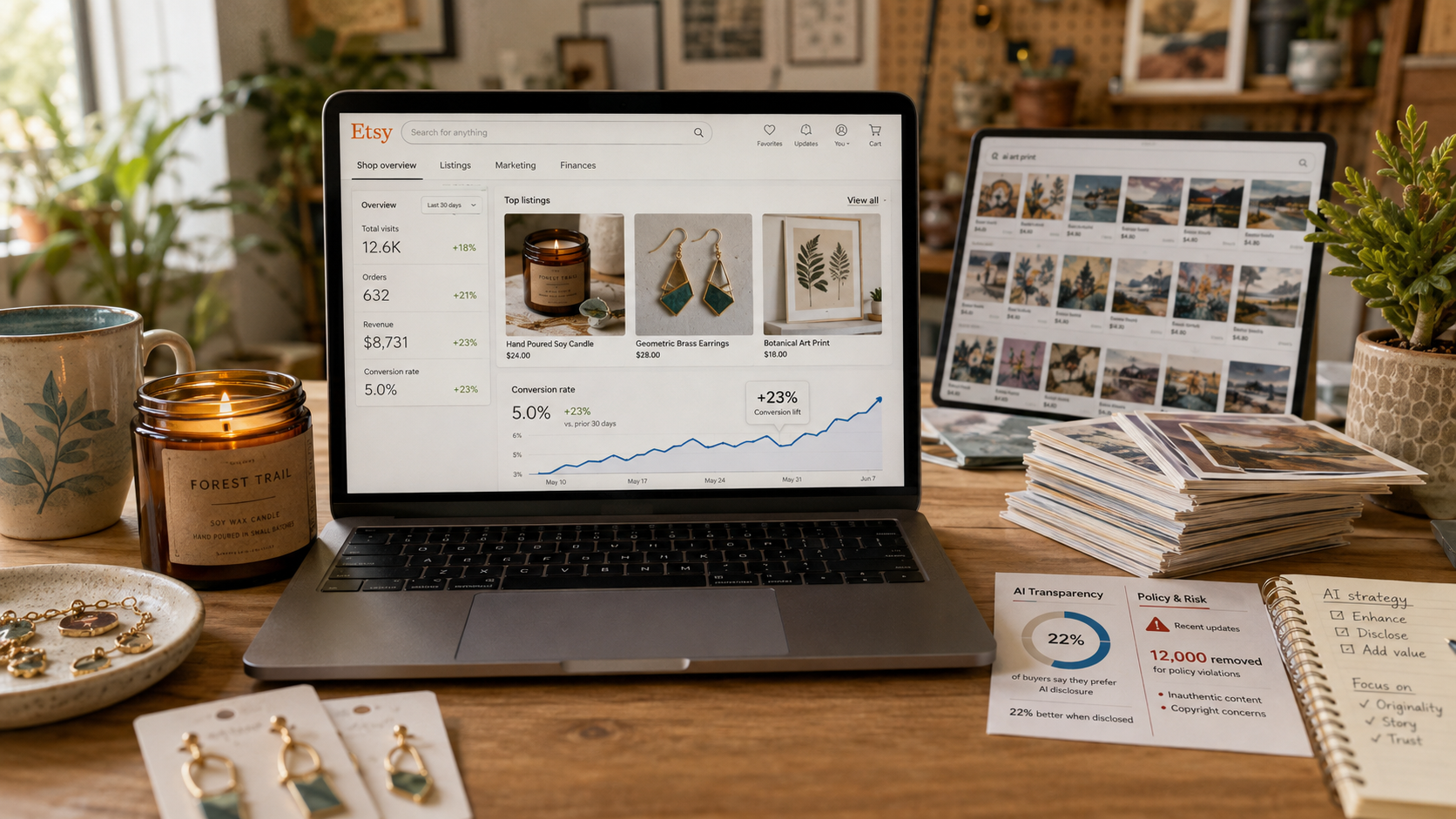
Spend ten minutes in Etsy seller forums or on YouTube and you'll hear two completely opposite stories about AI images.
Story one: AI is a gold rush. Anyone with Midjourney and a free afternoon can spin up a shop, and the internet is full of claims about sellers hitting five figures a month with AI-generated art and printables.
Story two: AI is killing Etsy. The marketplace is flooded with machine-made listings, real artists are watching their sales collapse, and Etsy is now removing thousands of listings a quarter over its new AI disclosure rules.
Here's the uncomfortable truth: both stories are pointing at real data — about two different things. The question "have AI images increased Etsy shops?" is actually three separate questions wearing one trench coat:
Does using AI to improve your product imagery (photos of real products) increase sales? The data here is strongly yes.
Does selling AI-generated products (AI art as the product itself) make money? Some shops, yes — but the risk profile changed dramatically in 2026.
Has Etsy's own platform AI grown the marketplace sellers operate in? Measurably, yes.
Let's take them one at a time, with the actual numbers — including the ones the gold-rush YouTubers skip.
Question 1: AI-Enhanced Product Imagery — Where the Conversion Data Is Strongest
First, the version of "AI images" that applies to every Etsy shop, whether you sell hand-thrown ceramics or digital planners: using AI tools to produce more, better, and more varied images of a real product — lifestyle scenes, mockups, background swaps, seasonal variations — without a photography budget.
The baseline fact is that imagery is the single biggest conversion lever on a listing. Roughly 75% of online shoppers say they rely on product photos when deciding on a purchase, and listings with high-quality images see up to 94% more views than those with poor visuals. On a marketplace with over 100 million active listings, the thumbnail is the storefront — it's the digital front door of the individual listing.
And the recent data on AI-assisted imagery specifically is striking:
Lifestyle and in-context images lift conversion 15–30% over plain product shots — and AI makes generating lifestyle context nearly free, versus the $150–$500 per SKU that traditional photoshoots can run.
In apparel specifically, on-model imagery versus flat-lays is associated with 30–40% higher conversion and 20–40% fewer returns — the kind of image coverage small sellers simply couldn't afford before AI generation.
Two honesty notes before you extrapolate. First, much of this data comes from AI-photography vendors and platform studies, so treat the exact percentages as directional, not gospel. Second — and this is the insight that separates winners from noise — AI images don't lift conversion because they're AI-generated; they lift conversion when they're clearer, more accurate, more persuasive, or more varied than the images they replace. AI's real gift to a small shop is coverage and testing speed: more angles, more contexts, more seasonal refreshes, more variations to test per SKU than a solo seller could ever shoot. Used that way — to reduce buyer uncertainty about a real product — the data says AI imagery is one of the highest-ROI upgrades available to an Etsy shop.
One Etsy-specific catch we'll come back to: even AI-edited photos of real products can trigger Etsy's disclosure requirements. Hold that thought.
Question 2: Selling AI-Generated Products — Real Money, Real Flood, Real Crackdown
Now the version of the question the gold-rush content is about: shops where the AI image is the product — AI art prints, clip art bundles, printables, POD designs.
The opportunity is real, at the category level. Etsy is a digital-products powerhouse — digital downloads represent a multi-billion-dollar slice of the marketplace, with near-total margins and instant delivery, and AI tools collapsed the production cost of entering it to nearly zero. That's precisely why the flood happened. (Treat the "$15K/month with 20 listings" case studies with heavy skepticism, though — they're marketing for courses far more often than they're audited numbers.)
But the flood produced three consequences the hype videos don't mention:
Saturation crushed the median seller. When production costs hit zero, everyone shows up. AI-generated listings now flood Etsy search results, which means the average AI shop is competing against thousands of near-identical shops using the same tools and prompts, in a price war toward $2 downloads. Zero-cost production means zero-moat business — a dynamic that's also pushed some handmade sellers off the platform entirely and given rise to human-made-only competitor marketplaces.
Enforcement got teeth in 2026. Etsy allows AI-generated products — but the rules tightened hard. The June 2025 Creativity Standards update required "Made by the seller" items to be genuinely created by the seller, hitting template-based and minimally-modified-AI shops retroactively. Then, beginning January 14, 2026, Etsy started enforcing mandatory AI disclosure — and in Q1 2026 alone removed roughly 12,000 listings and issued about 8,500 warnings for missing or incorrect disclosure. Enforcement runs on three layers — automated detection, manual review, and member reports — and repeated violations can end an account.
Most sellers are unknowingly exposed. Here's the stat that should get every seller's attention: one industry audit found roughly 68% of Etsy listings containing AI-touched imagery lacked proper disclosure — mostly not from deception, but because sellers don't realize how broadly "AI" is defined. Running a real product photo through AI background removal, upscaling, or lighting correction can count as an AI-altered image requiring disclosure under Etsy's rules. That's the catch from Question 1: the disclosure regime covers far more shops than the "AI art" shops.
So does selling AI-generated products "increase" a shop? For a minority who treat it like a real business — differentiated niche, human curation and editing layered on top, disciplined compliance — yes, there's documented money in it. For the majority chasing the tutorial playbook, the honest data picture is saturation, price collapse, and a meaningful takedown risk they don't know they're carrying.
The Plot Twist: Disclosing AI May Actually Help Sales
Buried in the compliance story is the most counterintuitive data point in this whole topic — and the one we'd put on a poster.
Sellers hide AI involvement because they assume the label kills conversion. The available data suggests the opposite: Etsy listings with proper AI disclosure labels saw 22% higher add-to-cart rates than undisclosed AI listings, per internal data reported by Retail Dive. Buyers aren't stupid — they can usually sense AI-flavored content, and an unlabeled listing that pattern-matches to AI triggers exactly the distrust the seller was trying to dodge. A clear, confident disclosure resolves the uncertainty and lets the buyer judge the product on its merits.
If that dynamic sounds familiar, it should — it's the same trust economics we talk about across SEO and AI search visibility: transparency signals are increasingly rewarded by both humans and algorithms, and the sellers treating disclosure as a scarlet letter are optimizing for a buyer psychology that's already outdated. Honesty, it turns out, converts.
Question 3: Etsy's Own AI Has Quietly Grown Every Shop's Ceiling
The third meaning of "AI images and Etsy" is the one sellers benefit from without doing anything: the platform's own AI investment in how shops and products get discovered.
Etsy invested over $200 million in AI and machine learning in 2024, aimed at search relevancy, personalized recommendations, and AI-powered seller tools. The headline result: Gift Mode — Etsy's AI feature that suggests gifts based on recipient profiles — generated over $1 billion in GMS in its first year. And the discovery improvements appear to be pulling buyers in: gross buyer additions hit 11.9 million in Q1 2026, up 4.8% year over year, with Etsy crediting improved discovery and personalization.
For an individual shop, this cuts two ways. The AI-driven marketplace routes more qualified buyers toward well-optimized listings than ever — but "well-optimized" is doing heavy lifting in that sentence. When an algorithm mediates all discovery, the shops that win are the ones whose titles, tags, attributes, images, and reviews give the machine clean signals to work with. Which is, not coincidentally, the same discipline as ranking anywhere else: structured, trustworthy, intent-matched content wins algorithmic distribution, whether the algorithm belongs to Google, ChatGPT, or Etsy.
The Practical Playbook (What the Data Says to Actually Do)
Pulling the three threads together into a strategy any shop can run:
Use AI on your imagery aggressively — for real products. This is where the conversion data is strongest and the controversy weakest. More angles, lifestyle contexts, seasonal refreshes, and variant coverage per listing; test thumbnails like a media buyer. The 23% conversion lift and 73% faster listing creation numbers live here.
Disclose like it's a feature, because it is. Flag AI-generated and AI-edited imagery per Etsy's disclosure rules, keep records of your workflow, and write the disclosure confidently. The 22% add-to-cart premium for disclosed listings says transparency is a conversion asset, not a tax.
If you sell AI-generated products, build a moat the tools can't replicate. Niche expertise, human editing and curation, a recognizable style, bundled value, and off-Etsy audience channels. Anything a stranger can recreate with one prompt is not a business — it's a listing fee donation.
Diversify beyond the marketplace's walls. The deeper lesson in the seller-flight stories is platform dependence: rising take rates and algorithm shifts hit hardest when Etsy is your only front door. The durable move for a growing shop is pairing the marketplace with your own site and search presence — owned traffic, owned customer list, owned margins — so Etsy is a channel, not a landlord.
Frequently Asked Questions
Do AI images actually increase Etsy sales?
It depends which use of AI you mean. For imagery of real products — AI-generated lifestyle scenes, mockups, background edits, variant coverage — the data is strongly positive: studies and platform research associate AI-assisted product photography with roughly 23% higher conversion, 73% faster listing creation, and 15–40% lifts from lifestyle and on-model imagery, largely because sellers can afford far more image coverage per listing. For AI-generated art as the product itself, results are polarized: a minority of differentiated shops earn real money while the median shop fights extreme saturation, price erosion, and new enforcement risk.
Is it allowed to sell AI-generated art on Etsy in 2026?
Yes, with conditions. Etsy permits AI-generated and AI-assisted products, but since January 14, 2026 it enforces mandatory disclosure: listings that used generative AI in the product, imagery, or design must say so, and be categorized correctly. Enforcement is real — roughly 12,000 listings were removed and 8,500 warnings issued in Q1 2026 alone — and runs through automated detection, manual review, and member reports. Separately, the Creativity Standards require "Made by the seller" claims to be genuine, which has hit minimally-modified AI and template-based shops. Compliant AI selling is allowed; hidden AI selling is a takedown risk.
Do I have to disclose AI if I only used it to edit photos of my handmade product?
Very possibly, yes — and this is the requirement most sellers miss. Industry auditing found about 68% of listings with AI-touched imagery lacked proper disclosure, largely because sellers didn't realize that AI-powered edits such as background removal, upscaling, and lighting correction can count as AI-altered images under Etsy's rules. The product being genuinely handmade doesn't exempt the imagery. The safe workflow: classify every image before upload, use the disclosure field whenever AI meaningfully shaped the visual, and keep records of your process in case a listing is flagged.
Will labeling my listing as AI-made hurt my conversion rate?
The available evidence points the other way. Internal marketplace data reported by Retail Dive showed listings with proper AI disclosure labels earning 22% higher add-to-cart rates than undisclosed AI listings. The likely mechanism: buyers frequently sense AI-styled content anyway, and an unlabeled listing that looks AI-made triggers distrust, while a clear disclosure resolves the uncertainty and lets the product be judged on its merits. Combined with the enforcement risk of non-disclosure — takedowns, warnings, and potential account closure — hiding AI involvement is a lose-lose against disclosing it confidently.
How much can you really make selling AI images on Etsy?
Be skeptical of the headline numbers. The viral "$15K a month with 20 listings" claims come overwhelmingly from people selling courses about doing it, not from audited shop data. What's verifiable: Etsy's digital-download category is genuinely large and high-margin, some differentiated AI-assisted shops earn real income, and the barrier to entry is near zero — which is exactly why the median outcome is poor. Zero production cost means maximal competition, aggressive price erosion, and search results crowded with near-identical output. Earnings correlate with differentiation, curation, niche expertise, and marketing — not with access to the AI tools everyone else also has.
How has Etsy's own AI changed things for sellers?
Substantially, and mostly upstream of any individual listing. Etsy invested over $200 million in AI and machine learning in 2024, and its Gift Mode feature — AI-driven gift recommendations — generated over $1 billion in gross merchandise sales in its first year. Buyer acquisition has responded too, with 11.9 million gross buyer additions in Q1 2026, up 4.8% year over year, credited partly to improved discovery and personalization. For sellers, the implication is that an algorithm now mediates nearly all discovery: shops with clean, complete, well-structured listings — accurate titles, tags, attributes, strong imagery, healthy reviews — capture disproportionate benefit from the platform's AI improvements.
Should my shop rely on Etsy, or do I need my own website too?
The events of the last two years are a case study in platform risk: take rates rising to over 24%, retroactive policy changes, automated enforcement errors, and algorithm shifts that reorder search overnight. None of that makes Etsy a bad channel — its buyer base and AI-driven discovery are assets few shops can replicate alone. It makes Etsy a bad sole channel. The resilient structure treats the marketplace as one front door alongside an owned website with its own search visibility, email list, and full-margin sales — so a policy change or ranking shift dents a channel instead of the whole business.
The Real Answer: AI Didn't Change What Wins. It Changed What's Cheap.
Here's the through-line in all the data. AI collapsed the cost of producing images — which made great product imageryaccessible to every shop (clear win, with the conversion numbers to prove it) and simultaneously made generic productsworthless at scale (the flood, the price wars, the crackdown). Meanwhile the things that always determined which shops grow — differentiation, trust, discoverability, owned audience — didn't get cheaper at all. They got more valuable, because they're now the only scarce inputs left.
That's not just an Etsy lesson. It's the whole 2026 playbook: when content is free, distribution and trust are the business.
That's the part we build. Ritner Digital helps e-commerce and DTC brands grow the owned side of that equation — search visibility, AI search citations, and websites engineered to convert — so marketplaces like Etsy become one profitable channel in a business you control, instead of a landlord you rent your future from.
👉🏼 Get your free e-commerce visibility audit →
We'll look at where your buyers come from today — and what it takes to own the front door tomorrow.
Sources: Etsy Q4/full-year 2025 and Q1 2026 results as reported by Skillademia, Printful, Thunderbit, and PrintKK statistics roundups; ngini and Inkfluence AI disclosure-policy analyses; XHBT 2026 Etsy AI policy guide; Rewarx AI product photography and disclosure-compliance research (incl. Retail Dive-reported internal data); Nightjar, Twiink, AI Magicx, and BMI Studios product imagery conversion research; Neura Market seller-migration reporting. Vendor-reported conversion figures should be treated as directional.