Good SEO Is Really Just a Good Information System. Here's What That Means for Your Business.
Here's a reframe that changes how most people think about SEO.
Stop thinking about it as a ranking game. Stop thinking about it as a keyword game. Stop thinking about it as a traffic game. Start thinking about it as an information architecture problem — one where the goal is to build a structured, organized, comprehensive system of content that tells search engines, AI tools, and prospective clients exactly what your business does, who it does it for, where it does it, and why it's the right choice.
When you think about SEO that way, something interesting happens. The strategy becomes intuitive in a way it never quite is when you're staring at a keyword difficulty score trying to figure out what to write next. The priorities become obvious. The gaps become visible. And the question of whether your SEO is working becomes answerable in a way that "we need more backlinks" never quite is.
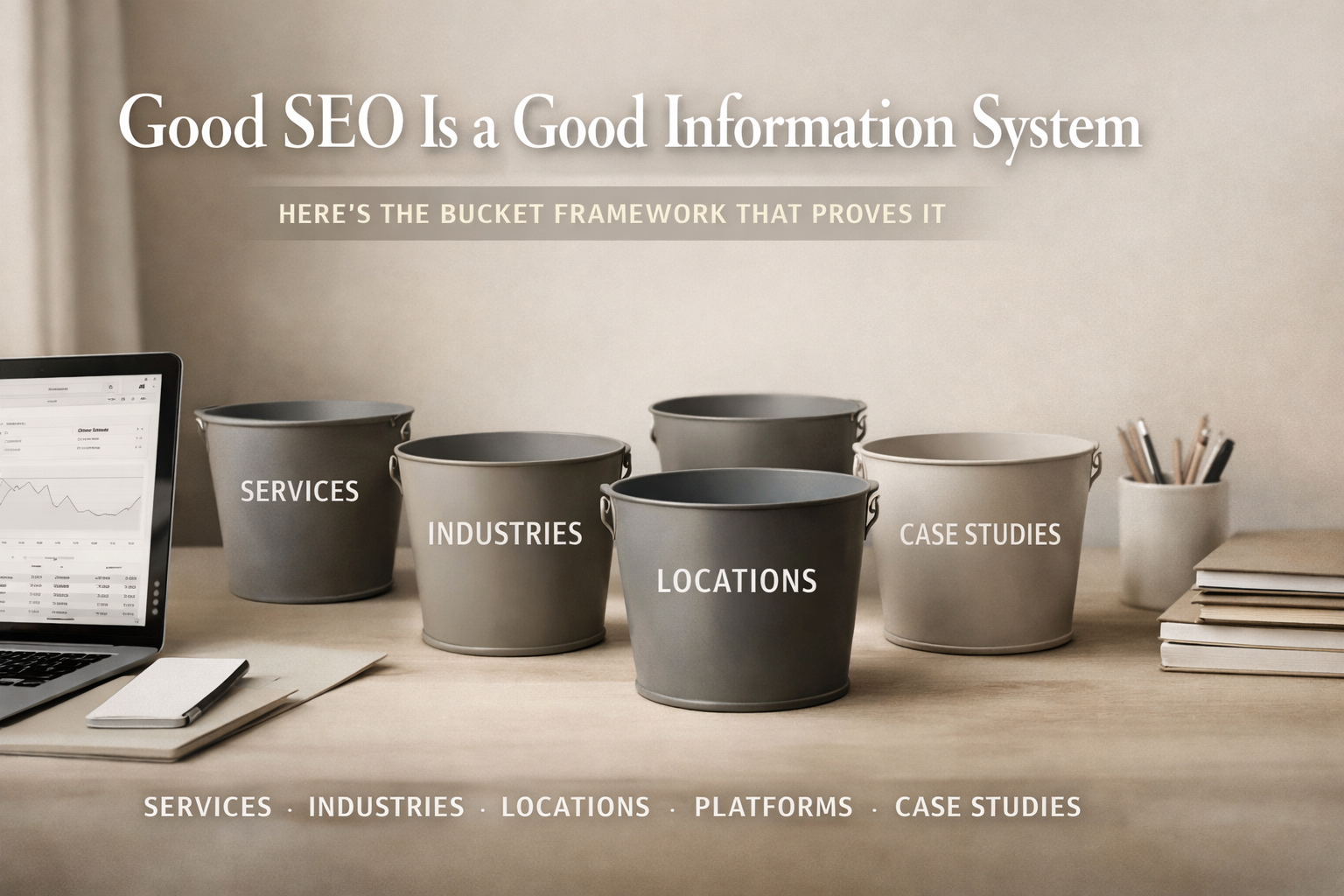
The frame is this: good SEO is a good information system. And a good information system is built from buckets.
What a Bucket Actually Is
A bucket, in this context, is a category of content that addresses a specific dimension of your business — a dimension that a specific type of prospective client is searching from.
Not everyone who might hire your business is searching the same way. Some people know they need a specific service and are looking for who provides it. Some people know they're in a specific industry and are looking for someone who understands it. Some people are in a specific geographic location and are looking for someone nearby. Some people are using a specific tool or platform and are looking for someone who knows it. Some people have heard about a specific result you produced and want to know more.
Each of those search behaviors originates from a different place. Each of them requires a different type of content to intercept and convert. And each of them represents a bucket — a structured category of content in your information system that speaks directly to that search dimension.
The business that has built content across all of its relevant buckets has built an information system that meets prospective clients wherever they're searching from. The business that has only built content in one or two buckets — usually services and maybe location — is invisible to everyone searching from every other dimension.
The Services Bucket: What You Do, In Depth
This is the bucket most businesses build first and it's the right place to start. Service pages — one dedicated page per service, with enough depth to actually rank and convert — are the foundation of any SEO information system.
But the services bucket has a second layer that most businesses don't build: subtopics.
A service page for "SEO" is a bucket. But "local SEO," "technical SEO," "content strategy," "Google Business Profile optimization," and "GEO" are subtopic buckets within it — each addressing a more specific search query from a more specifically qualified prospective client. The person searching "technical SEO audit" is different from the person searching "local SEO for small business" — and both are more qualified than the person searching the generic head term.
Subtopic buckets do two things simultaneously. They capture long-tail search traffic that the top-level service page can't rank for. And they deepen the topical authority signal for the parent service — because Google sees a site that has covered a subject comprehensively across multiple interconnected pages as more authoritative than one that has a single page on the topic.
The question to ask about your services bucket: do you have a dedicated page for every distinct service you offer, and do you have subtopic content that goes deeper on the specific aspects of those services that your clients are actually searching for?
The Industry Bucket: Who You Do It For
This is the bucket that most businesses either never build or build inconsistently — and it's one of the highest-leverage content opportunities available.
Here's the insight behind it: most businesses serve clients across multiple industries. And clients, when they're looking for a service provider, almost universally prefer someone who understands their specific industry over someone who is generic across all of them.
A marketing agency that works with veterinary practices, med spas, law firms, automotive businesses, and restaurants is a general marketing agency until it builds industry-specific pages and content that speak to each of those verticals in their own language. The page that says "marketing agency for veterinarians" — with content that addresses the specific search behavior of pet owners, the specific competitive dynamics of the veterinary market, the specific compliance considerations of veterinary advertising — captures a search that the generic "marketing agency" page never will.
Industry bucket content also does something valuable for conversion that service content alone can't: it signals to a prospective client in a specific vertical that you understand their world. That recognition — the feeling of "this agency gets what it's like to be a med spa owner" — is a trust signal that accelerates the decision to reach out in a way that service descriptions alone don't.
The question to ask about your industry bucket: do you have dedicated content for each of the major verticals you serve, written in the language of that industry, addressing the specific challenges and search behaviors of clients within it?
The Location Bucket: Where You Do It
Local search is not a single search. It's a matrix of searches — every service you offer, crossed with every geographic market you serve, crossed with every variation in how people describe those locations.
A law firm serving Bucks County, Pennsylvania isn't just competing for "law firm Bucks County." It's competing for "attorney Newtown PA," "criminal defense Doylestown," "divorce lawyer Langhorne," "estate planning Yardley," and dozens of other location-specific variations that prospective clients in different parts of the county are actually typing.
Each of those location variations is a bucket. And the businesses that build dedicated, locally specific content for each market they serve — not thin pages that swap out a city name, but pages with genuinely local content that addresses the specific context of that market — consistently outperform businesses that rely on a single location page or their Google Business Profile alone.
The location bucket also interacts powerfully with the services bucket. "Veterinary SEO Philadelphia" and "veterinary SEO Cherry Hill NJ" are different pages from "veterinary SEO" — and they capture different searches from different people in different places. Building the full matrix of service-by-location content is the long game of local SEO, and the businesses that build it comprehensively build geographic moats that are genuinely hard for competitors to close.
The question to ask about your location bucket: have you built dedicated content for every significant geographic market you serve, and have you built service-by-location content for your highest-value service and market combinations?
The Technology and Platform Bucket: How You Do It
This is the bucket that specialized service businesses often overlook entirely — and it's frequently the source of some of the most qualified search traffic available.
Many clients aren't just searching for a type of service. They're searching for expertise with a specific tool, platform, or technology they're already using or evaluating. A business owner who has already decided they want to build on Squarespace isn't searching for "web design agency." They're searching for "Squarespace web design agency." A business that has already invested in HubSpot isn't looking for a generic CRM consultant. They're looking for a "HubSpot implementation specialist."
These searches are extraordinarily qualified because the person has already narrowed their criteria before they've typed a single word. They know what they want. They're looking for who can deliver it. A business that has built a dedicated page — or better, a cluster of content — around its expertise with a specific platform is the obvious answer to that search in a way that a generic service page never is.
Technology and platform bucket content also builds credibility with the specific vendor ecosystems that can generate referral traffic. Platform-specific expertise content gets noticed by the platforms themselves — and businesses that are visibly knowledgeable about a platform often end up in that platform's partner directories, agency listings, and referral networks.
The question to ask about your technology and platform bucket: are there specific tools, platforms, or technologies that you have genuine expertise with, and have you built dedicated content that makes that expertise visible to the people searching for it?
The Case Studies Bucket: Proof That You Do It Well
This bucket is the one that sits at the intersection of SEO and conversion — and it's dramatically underbuilt on most business websites.
Case studies serve two functions in an information system. The first is obvious: they provide social proof. A prospective client who is evaluating whether to hire you wants evidence that you've produced results for people like them. A well-structured case study — with a clear before-and-after, a specific articulation of the challenge, a description of the approach, and measurable results — is one of the most persuasive pieces of content a business can publish.
The second function is less obvious but equally important: case studies capture a category of search behavior that no other content type addresses. People search for case studies. They search for "[service] results," "[service] success story," "[industry] marketing results," and variations that are specifically looking for evidence of outcomes rather than descriptions of services. Someone deep in the evaluation phase — who has already identified that they need your service and is now deciding who to hire — is often searching in exactly this way.
Case studies also generate the kind of specific, data-rich, outcome-oriented content that AI systems love to cite. A case study with specific numbers — "organic traffic increased by 340% in eight months" — is exactly the kind of citable claim that AI systems pull when generating answers to questions about what results a particular type of service can produce.
The question to ask about your case studies bucket: have you published dedicated case studies for your most significant client results, organized in a way that's findable by industry, service type, and outcome?
How the Buckets Work Together: The Information System in Action
Here's where the framework gets genuinely powerful.
Each bucket on its own is useful. But the real value of the bucket framework is in how the buckets interact — because a well-built information system doesn't just answer individual searches. It creates multiple entry points that funnel prospective clients toward the same conversion destination from completely different starting points.
A prospective med spa client in Philadelphia might enter your information system through the industry bucket — they found your "marketing for med spas" page. A prospective automotive client in South Jersey might enter through the location bucket — they found your "marketing agency Turnersville NJ" page. A prospective law firm client might enter through the technology bucket — they found your "HubSpot for law firms" content. A business owner in Alpharetta might enter through the services bucket — they found your "GEO optimization" page.
All of them, from completely different starting points, arrive at the same place: a business with a comprehensive, credible, authoritative digital presence that clearly knows what it's doing.
This is the information system working as designed. And it's why the businesses that build across all of their relevant buckets consistently out-convert the ones that have only built two or three — because they're visible to a wider range of search behaviors, they meet prospective clients wherever the search journey starts, and they provide enough surrounding content to build trust through the research process regardless of which bucket the client entered from.
The Intelligence Layer: Which Bucket Is Actually Driving Leads
Here's the part of this framework that most people don't think about until they're deep into a content program — and it's one of the most valuable things a well-built information system produces.
When you have dedicated content across multiple buckets, you can see which buckets are driving leads. Not just traffic. Leads.
This is intelligence that changes how you allocate content investment going forward. If your location bucket is generating significantly more lead conversions than your industry bucket, that's a signal to build more location-specific content and potentially reassess whether the industry bucket is being built correctly. If your case studies bucket has the highest conversion rate of any content on the site — which is common, because people reading case studies are deep in the evaluation phase — that's a signal to prioritize more case study content regardless of its search traffic volume.
If your technology and platform bucket is pulling surprisingly qualified traffic with high conversion rates, that's a signal that your platform-specific expertise is a stronger differentiator than your generalist positioning — and that the content strategy should reflect that.
The bucket framework turns your content library from a collection of pages into an information system with genuine analytical value. You're not just publishing. You're running an experiment across multiple dimensions of your business — and the data it produces tells you where to invest next.
The Meta-Point: SEO as Business Intelligence
Here's the reframe we started with, brought full circle.
The businesses that think about SEO as a ranking game are asking: how do we get to page one? The businesses that think about SEO as an information system are asking: what does our content architecture tell us about where our growth is coming from and where it should go next?
The second question is more interesting, more answerable, and more directly connected to business outcomes than the first. Rankings are a means. Leads and revenue are the end. A well-built bucket architecture makes the connection between the two legible in a way that "we need to rank for this keyword" never quite does.
When you can look at your analytics and see that your industry bucket for veterinary practices is driving forty percent of your inbound leads from five percent of your total traffic, you know something genuinely valuable about your business — something that should shape your content investment, your sales positioning, your service development, and potentially your entire go-to-market strategy.
That's not SEO as a marketing tactic. That's SEO as business intelligence. And it's available to any business willing to build the information system that makes it possible.
This Is How Ritner Digital Thinks About Every Client's Content Strategy
We don't build content calendars. We build information systems — structured across services and subtopics, industries, locations, technologies and platforms, and case studies — designed to meet prospective clients wherever they're searching from and produce the analytical intelligence that tells us where to invest next.
For every client we work with, the bucket framework is the foundation. We map the full search landscape across every relevant dimension. We identify which buckets exist, which are underdeveloped, and which don't exist yet. We build the architecture that connects them. And we track the lead generation performance by bucket so that content investment is always pointed at the highest-return opportunities.
If your SEO feels like it's producing traffic but not intelligence — if you're ranking but not sure why or whether the rankings are connecting to actual business growth — that's a sign the information system isn't complete. It's also the most common problem we see in businesses that have been publishing for a year or more without a clear bucket architecture underneath it.
Reach out. Let's map your buckets and see what's missing.
Frequently Asked Questions
How many buckets does a typical business need?
It depends on the complexity of your business — how many services you offer, how many industries you serve, how many geographic markets you operate in, and how many platforms or technologies you have genuine expertise with. A simple local service business might have four or five meaningful buckets. A multi-service, multi-location professional services firm might have twenty or more. The right number is determined by the actual dimensions of your business and the search behaviors of your prospective clients — not by an arbitrary content volume target.
Do all buckets need the same amount of content?
No — and this is where the intelligence layer becomes valuable. Some buckets will have larger addressable keyword spaces than others. Some will have higher search volume but lower conversion rates. Some will have lower volume but extremely high conversion rates because they're capturing deep-funnel searches from highly qualified prospective clients. The content investment in each bucket should reflect both the search opportunity and the lead generation potential — which is something you can only assess accurately once you have enough data from the buckets you've already built.
How does the bucket framework connect to GEO and AI search?
AI systems evaluate topical authority when deciding what content to cite — and a well-organized bucket architecture is one of the clearest signals of topical authority available. A site that has built comprehensive, interconnected content across services, industries, locations, technologies, and case studies looks like an expert resource to both traditional search engines and AI systems. The bucket framework doesn't just optimize for what people are searching today — it builds the kind of authoritative, structured content presence that AI tools increasingly look to when generating recommendations.
What's the most common bucket that businesses forget to build?
The case studies bucket, almost universally. Businesses invest in service pages and location pages and sometimes industry pages — and then produce no case study content at all, or produce it in a format that isn't findable through search. Case studies capture the highest-intent searches in the evaluation phase of the buying journey, produce the most persuasive conversion content on the site, and generate the kind of specific, outcome-oriented content that AI systems cite. Building them out as a dedicated, searchable bucket rather than hiding them in a portfolio section is one of the fastest wins available to most businesses.
How long does it take to build a complete bucket architecture?
For most businesses, building a genuinely comprehensive bucket architecture across all relevant dimensions takes twelve to twenty-four months of consistent content production. The highest-priority buckets — core services and primary locations — get built first and start producing results while the rest of the architecture develops. The full system compounds over time as the buckets interact, internal links strengthen, and topical authority deepens across every dimension. It's a long game — but it's one where the advantages built compound in a way that paid advertising and short-term tactics never can.