"That's Not for Me" — The Most Common Reasons Business Owners Write Off Marketing Agencies
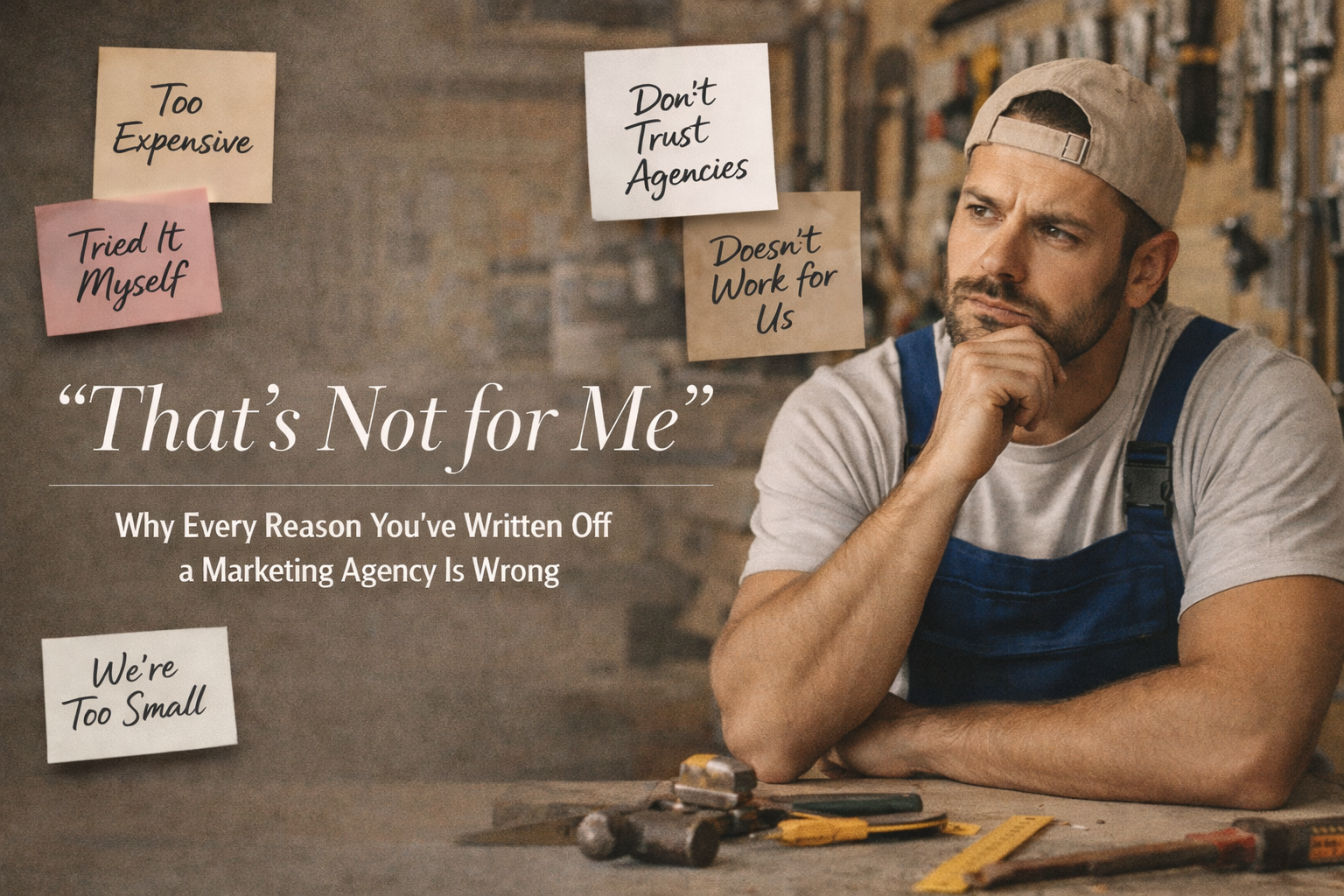
Think about the last time you saw an ad for a marketing agency — or got a cold email from one, or heard someone mention they'd hired one — and felt that immediate, instinctive, slightly defensive reaction. The one that sounds something like: that's not really for businesses like mine.
Maybe it was the price. Maybe it was a bad experience you had with an agency three years ago that still stings. Maybe you genuinely believe you can handle it yourself. Maybe you think your industry is too niche, too local, too weird, or too whatever for an agency to actually get it.
Whatever the specific flavor of your objection, you are not alone. These are the most common reasons business owners talk themselves out of hiring a marketing agency — and they come up in almost every first conversation we have with a prospective client.
They're also, almost universally, wrong. Not wrong in a condescending way. Wrong in a way that's worth unpacking — because the belief that marketing agency help isn't for you is costing a lot of businesses real growth every single day.
Let's go through them one by one.
"It's Too Expensive."
This is the objection that shows up first and most often. And look — we're not going to pretend that working with a good marketing agency is free. It isn't. There's real cost involved, and for a small or mid-size business owner who is already watching every dollar, that cost is not invisible.
But here's the question the "too expensive" objection usually skips: expensive compared to what?
Compared to the revenue you're leaving on the table every month because your website isn't ranking, your Google Business Profile isn't optimized, your content isn't converting, and the customers who were searching for exactly what you offer found your competitor instead? That's not a hypothetical cost. It's a real one. It just doesn't show up as a line item on a P&L because it's the absence of revenue rather than the presence of an expense.
The mental model that treats marketing as a cost rather than an investment is the one that keeps businesses perpetually underfunded on growth and perpetually dependent on referrals, word of mouth, and whatever organic growth they can scrape together without a real strategy. Some businesses sustain themselves fine that way. Most leave significant growth on the table.
There's also a practical point worth making: good agencies build strategies that are scoped to what's actually achievable within a realistic budget. A $2,000 per month engagement that focuses on the two or three highest-leverage activities for your business is dramatically more effective than trying to do everything poorly. The conversation about what's possible at different investment levels is one any honest agency should be willing to have in the first meeting — and if they won't, that tells you something.
The "too expensive" objection usually dissolves when it's reframed as a question: what is it costing you to not do this? Run that number honestly and see how the math looks.
"I've Had a Bad Experience With an Agency Before."
This one deserves genuine empathy first, because it's real and it's common and it genuinely hurts.
You hired an agency. You paid them real money. They were great on the pitch — enthusiastic, full of ideas, promising results that sounded almost too good. And then six months later you were chasing someone for a status update, the traffic numbers weren't moving, the content sounded nothing like your business, and you felt like you'd handed your account to someone who had already mentally moved on to the next client.
That experience is legitimate. It happens. The agency industry has a significant quality gap between the good operators and the ones who are better at selling than delivering — and if you landed with the latter, the scar tissue is understandable.
But here's what the bad experience objection does if you let it run unchecked: it punishes the good agencies for the sins of the bad ones, and it leaves your business without the marketing support it needs because of what one vendor did wrong.
The right response to a bad agency experience isn't to swear off agencies forever. It's to get better at evaluating them. Ask to speak with current clients, not just references they've curated. Ask specifically who will be working on your account day to day — not just who's in the room for the pitch. Ask what happens when something isn't working and how they communicate about it. Ask for realistic timelines and honest assessments rather than optimistic projections.
The agencies worth working with can answer all of those questions directly and without defensiveness. The ones that can't are the ones to avoid. Learning to tell the difference is more useful than deciding the category doesn't work.
"I Can Do It Myself."
Okay. Can you, though?
We're not asking that dismissively. Some business owners genuinely can — and do — run effective digital marketing programs themselves. If you have the time, the expertise, the tools, and the ability to stay current on an industry that changes constantly, DIY marketing is a legitimate path.
But let's be honest about what "doing it yourself" actually involves in 2025.
It means understanding local SEO well enough to optimize your Google Business Profile, build citations, develop a keyword strategy, create content that actually ranks, and monitor technical site health. It means understanding GEO well enough to optimize for AI-generated search results that didn't exist three years ago. It means running paid ad campaigns without wasting budget on targeting that doesn't convert. It means designing and maintaining a website that loads fast, converts visitors, and doesn't fall apart on mobile. It means producing consistent social media content across multiple platforms. It means building and executing an email program. It means knowing when to update, consolidate, or delete content that's no longer serving your strategy.
Now ask yourself: how much of your week is left over for running your actual business?
The "I can do it myself" objection is often less about capability and more about control — the feeling that handing marketing to someone else means losing visibility into something important. That's a reasonable concern, and the solution is finding an agency that gives you genuine transparency rather than one that treats reporting as a black box. But the desire for control isn't the same as the ability to execute at the level a dedicated team with specialized expertise can.
Most business owners who try to do it all themselves end up doing most of it at a level that's good enough to exist but not good enough to compete. In a market where your competitors are working with people who do this full time, "good enough to exist" is not a growth strategy.
"It Doesn't Work for My Industry."
This one is fascinating because it's almost always held by people who have never actually tested the premise.
"We're a niche B2B manufacturer — our buyers don't use Google like that." They do. The procurement manager looking for a supplier types searches just like everyone else. "We're a local service business — our customers all come from referrals." They do — until they don't, or until a competitor builds an organic presence that starts intercepting those customers before the referral happens. "We're in a heavily regulated industry — there's too much we can't say." There's more you can say than you think, and the businesses in regulated industries that have figured out compliant content marketing are eating the lunch of the ones that decided it was too complicated.
The "doesn't work for my industry" belief is usually formed from one of three places: a genuine unfamiliarity with how digital marketing applies to the specific category, a bad experience with generic marketing that didn't account for industry nuance, or a competitor landscape where nobody is doing it well and therefore it looks like nobody is doing it at all.
That last one is worth lingering on. If nobody in your industry is doing digital marketing well, that's not evidence that it doesn't work. That's an enormous competitive opportunity with a wide open window. The businesses that move first in an undermarketed industry don't just win incrementally — they build authority advantages that take competitors years to close.
Name an industry. Construction. Veterinary. Legal. Automotive. Medical aesthetics. Manufacturing. Agriculture. Funeral services. Pest control. Every single one of those categories has businesses that have built meaningful, measurable growth through digital marketing. Every single one of them also has businesses that are convinced it doesn't work for them — and those businesses are, quietly, losing ground to the ones that figured it out.
"We're Too Small to Need a Marketing Agency."
There's a version of this that's actually true: a brand new business with no customers, no product-market fit, and no clarity on what it's selling probably shouldn't be spending money on a marketing agency. Get the fundamentals right first. Figure out what you're selling and to whom before you amplify it.
But for a small business that has product-market fit — that has customers, delivers real value, and is trying to grow — the "too small" objection usually means something different. It means: I don't think the ROI math works at my scale.
Here's why that's usually wrong.
Small businesses are often the exact clients that benefit most from smart digital marketing — because the leverage is enormous. A local service business that generates $5,000 in revenue from a new customer relationship doesn't need much new business to justify a marketing investment. A small professional services firm that closes one additional client per month from an improved organic presence doesn't need to be operating at enterprise scale for that to be a meaningful return.
The "too small" objection also often underestimates how much being small in a local market is actually an advantage in digital marketing — particularly in local SEO and GBP optimization, where a well-positioned small business can consistently outrank larger competitors that aren't managing their local presence carefully. The playing field in local search is more level than most small business owners realize. You don't need a big budget to win it. You need a smart strategy and consistent execution.
The businesses that invest in digital marketing while they're small build the organic authority and brand recognition that makes growth faster and cheaper over time. The ones that wait until they're big enough often find that "big enough" keeps moving — and that the competitors who started earlier have built advantages that are genuinely hard to close.
"I Don't Trust Agencies."
This is the most honest objection on the list and in some ways the most understandable.
The marketing agency industry has a transparency problem. Reporting that looks impressive but measures nothing meaningful. Deliverables that are technically completed but produce no results. Contracts that are hard to exit. Account managers who know less about your business than you do. Strategies that feel suspiciously similar to whatever the agency is doing for every other client.
None of that is unfair criticism. It's a real pattern that enough business owners have experienced to make categorical distrust feel rational.
But here's the thing about trust: it's not binary. It's earned — or it isn't — through specific behaviors. An agency that gives you full ownership of all assets and accounts from day one has earned a point of trust. An agency that provides transparent reporting on metrics that actually connect to business outcomes has earned another. An agency that tells you when something isn't working, changes the approach, and explains why has earned several more.
The trust problem in the agency industry is fundamentally a transparency and accountability problem. The solution is demanding both before you sign anything — and walking away from any agency that treats either as optional.
What you trust isn't "agencies" as a category. What you trust or don't trust is specific behaviors from specific people. Evaluate those. Ask the questions that surface them. And don't let distrust of the category keep you from finding the partner that's actually worth trusting.
What All Six Objections Have in Common
Here's the thread that runs through every one of them: they're all ways of protecting the status quo.
That's not a criticism. The status quo is comfortable. It's known. It doesn't require a new vendor relationship, a new line item in the budget, or the vulnerability of admitting that your current marketing situation isn't what it should be.
But the status quo has a cost too. It's just invisible — in the leads that didn't come in, the rankings that didn't build, the customers that found someone else, the growth that didn't happen. Those costs accumulate quietly, without sending an invoice, which makes them easy to ignore until the gap between where you are and where you could be becomes impossible to miss.
The businesses that grow consistently don't wait until the cost of not acting is obvious. They make the investment when the math makes sense and find partners they trust to execute it well.
Why Ritner Digital Is Worth the Conversation
We're going to be direct here because we've earned it by being straight with you for this entire blog.
Ritner Digital works with small and mid-size businesses across industries — from veterinary practices and med spas to law firms, automotive businesses, and professional service firms — across New Jersey, Pennsylvania, and beyond. We offer fully integrated digital marketing: SEO, GEO, web design, paid ads, email, social media, branding, graphic design, photography, and CRM.
We're not the agency that disappears after the pitch. We're not the agency that sends you a monthly report full of metrics that don't connect to revenue. We're not the agency that treats every client as a variation of the same template.
We're the agency that has the honest conversation about what's realistic, builds the strategy around your actual goals, and does the work with enough craft that you can tell the difference.
If any of the objections in this blog sounded like something you've said to yourself — we'd genuinely like to talk. Not to sell you something. To have the conversation and let you decide if the math makes sense.
Reach out. Let's see where you stand.
Frequently Asked Questions
How do I know if I'm actually ready to hire a marketing agency?
You're ready when you have a business that delivers real value to customers, some clarity on who those customers are, and a genuine desire to grow — and when the thing standing between you and that growth is visibility, lead generation, or digital presence rather than product or operations. You don't need to be a certain size. You don't need a big budget. You need a clear enough picture of what you're trying to accomplish that a good agency can build a strategy around it.
What should I look for to avoid hiring a bad agency?
Transparency is the primary filter. Ask who specifically will be working on your account. Ask what metrics they'll report on and how those connect to revenue. Ask what happens when something isn't working. Ask for examples of work produced for clients in similar categories. Ask for current client references — not curated testimonials. Any agency that hedges on these questions or makes them feel uncomfortable to ask is telling you something important.
Is digital marketing really different for different industries?
Yes — significantly. The search behavior of a patient researching a medical procedure is different from the search behavior of a business owner looking for a B2B software vendor is different from a homeowner searching for a contractor. The content that builds trust in a law firm is different from the content that converts for an e-commerce brand. A good agency understands these differences and builds strategy around them. A bad one applies the same playbook to every client regardless of category.
What's a realistic budget to start with?
It depends on your goals, your market, and what channels you're prioritizing. For most small businesses, a focused engagement starting at $1,500 to $2,500 per month — concentrated on the two or three highest-leverage activities for your specific situation — produces meaningful results. Spreading a small budget across every channel simultaneously is usually less effective than going deep on the channels with the clearest ROI for your business first.
How long before I see results from working with a marketing agency?
It depends on the channel. Google Business Profile optimization and paid advertising can produce visible results within weeks. Organic SEO typically takes three to six months to show meaningful movement. Content authority and GEO positioning build over twelve to twenty-four months. Any agency promising dramatic results in thirty days across all channels is not being honest with you. The right framing is: some wins come fast, the compounding ones take time, and the businesses that stay consistent are the ones that build sustainable advantages.