How to Market a Government Contracting Business (When Your Buyer Is the Government)
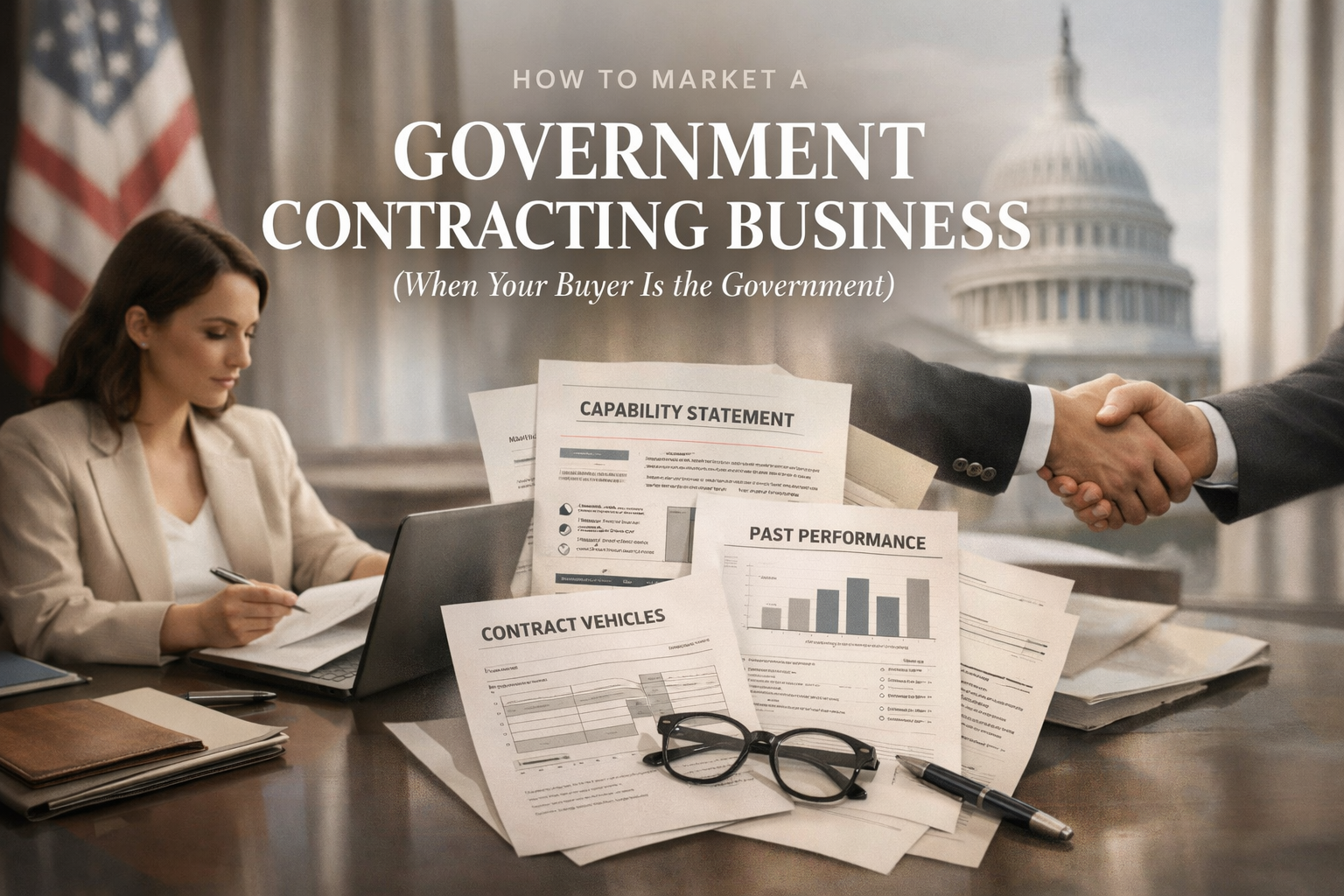
Marketing a government contracting business is a fundamentally different exercise than marketing almost any other kind of business, and most of the advice available to small businesses — build a brand, grow your social media following, invest in SEO, run ads — is either irrelevant or actively misleading when your buyer is a government agency.
Your buyer doesn't browse Instagram. They don't Google "best IT services provider" and call whoever shows up first. They don't read your blog. They don't care about your logo, your tagline, or your mission statement. They care about whether you can do the work, whether you've done it before, whether you're compliant with a dense web of regulations, and whether your proposal is responsive to exactly what they asked for. The decision isn't made by a consumer scrolling on their phone. It's made by a contracting officer working through an evaluation criteria matrix in a government office, bound by procurement rules that dictate how they can and can't choose vendors.
This means that most of what passes for "marketing" in the commercial world doesn't apply. But it doesn't mean marketing doesn't matter. It means the marketing that matters looks different — and most government contractors either don't do it at all or do the wrong kind.
This guide is about what actually works when your customer is the government. How to get found. How to get known. How to position yourself to win work. And how to build a pipeline that doesn't depend on refreshing SAM.gov and hoping something matches.
Understanding the Buyer
Before we talk about tactics, we need to understand who we're actually marketing to — because the government isn't one buyer. It's thousands of buyers operating under hundreds of different rule sets with different priorities, different procurement vehicles, and different cultures.
The Federal Market
Federal procurement is the most structured and rule-bound buying environment in the world. The Federal Acquisition Regulation — the FAR — governs how agencies buy goods and services, and it runs to thousands of pages. Agencies have their own supplements to the FAR. Procurement is conducted through contracting offices staffed by warranted contracting officers who have legal authority to bind the government to contracts. Everything is documented. Everything is auditable. The process is designed to be fair, competitive, and transparent — which also makes it slow, bureaucratic, and frustrating for businesses that are used to commercial sales cycles.
Federal buyers find contractors through several channels. SAM.gov is the primary database where contractors register and where opportunities are posted. Agencies use vehicles like GSA Schedule contracts, Government-Wide Acquisition Contracts (GWACs), and agency-specific indefinite-delivery/indefinite-quantity (IDIQ) contracts to pre-qualify pools of vendors and then compete specific task orders among them. Small business set-asides — reserved for small businesses, and often further restricted to specific socioeconomic categories like 8(a), HUBZone, Service-Disabled Veteran-Owned, or Women-Owned — represent a significant portion of federal contracting dollars.
The key thing to understand about federal marketing is this: by the time an opportunity appears on SAM.gov, the marketing window is largely closed. The agency has already defined the requirement. They may already have a preferred vendor. The solicitation is the end of the marketing process, not the beginning. If you're discovering an opportunity for the first time when it hits SAM.gov, you're almost certainly behind.
The State and Local Market
State and local government procurement varies enormously — from states with sophisticated electronic procurement systems to small municipalities that post RFPs on a bulletin board in the clerk's office. The rules are less uniform than federal procurement. Some states follow procurement codes modeled on the federal FAR. Others have their own frameworks. Many local governments have simplified procurement rules for contracts below certain thresholds.
The buying culture is also different. State and local buyers are often more accessible than federal buyers. A county purchasing director might attend a local business networking event. A state agency program manager might be available for a phone call. The relationship dimension is more prominent at the state and local level — not because the procurement is less competitive, but because the community is smaller and the opportunities for legitimate, ethical pre-solicitation engagement are greater.
State and local governments also have small business preferences, minority-owned and women-owned business programs, and local preference policies that create opportunities for businesses that qualify. Many municipalities have cooperative purchasing agreements that allow them to buy through contracts negotiated by other entities — which means a single contract can open access to hundreds of government buyers.
The Decision-Maker Isn't Who You Think
In commercial marketing, you're often trying to reach the end user or the economic buyer — the person who experiences the pain point and the person who controls the budget. In government contracting, the picture is more complex.
The program manager is the person who needs the work done. They define the requirement. They evaluate whether the deliverable meets their needs. They're your champion inside the agency if you do good work and your critic if you don't.
The contracting officer is the person who can legally commit the government to a contract. They run the procurement process, evaluate proposals (or oversee the evaluation), and make the award decision. They don't always have deep technical knowledge of what's being purchased — they're procurement professionals, not subject matter experts.
The technical evaluation panel is the group of people who score your proposal against the evaluation criteria. They may include program staff, subject matter experts, and sometimes outside reviewers. These are the people who read your proposal in detail and assign it a rating.
The small business office (at the federal level, the Office of Small and Disadvantaged Business Utilization, or OSDBU) is the office responsible for ensuring the agency meets its small business contracting goals. These offices are specifically tasked with connecting small businesses with contracting opportunities, and they're one of the most underutilized resources available to government contractors.
Marketing in government contracting means reaching all of these people — not simultaneously, and not with the same message, but with an understanding of what each one cares about and how they influence the buying decision.
The Marketing That Actually Works
Government contracting marketing isn't about awareness in the traditional sense. It's about positioning — making sure the right people at the right agencies know who you are, what you do, and why you're qualified, before the solicitation drops. Everything below serves that purpose.
Capability Statements: Your One-Page Sales Tool
A capability statement is to government contracting what a business card is to networking — except it's actually useful. It's a one- or two-page document that summarizes who you are, what you do, who you've done it for, and what qualifies you to do more of it.
Every government contractor needs one. Most have one that's mediocre — a cluttered page with too much information, no visual hierarchy, and a wall of text that no contracting officer is going to read carefully. The capability statement that works is clean, scannable, and specific.
What belongs on it: your company name and logo, your NAICS codes, your UEI number, your socioeconomic designations (8(a), HUBZone, SDVOSB, WOSB, etc.), your cage code, your contract vehicles (GSA Schedule, GWACs, relevant IDIQs), a concise description of your core competencies (three to five, not fifteen), three to five past performance examples with agency names, contract values, and brief descriptions of what you delivered, your differentiators — the specific things that make you better qualified than a generic competitor — and your contact information.
What doesn't belong on it: your mission statement, a paragraph about your company's values, vague language like "innovative solutions" or "best-in-class service," or a list of twenty capabilities that makes you look like you're claiming to do everything rather than demonstrating that you're excellent at something.
The capability statement is a leave-behind for meetings with government contacts, an attachment in introduction emails, a handout at industry events, and the document that a small business office pulls up when they're looking for a contractor that fits an upcoming requirement. Make it excellent. Update it regularly. Have it ready to hand to anyone, anytime.
Relationship Building That's Legal and Effective
In commercial sales, relationship building is intuitive — take a client to dinner, play golf, send a gift. In government contracting, most of that is either illegal or heavily restricted. Government employees are bound by ethics rules that limit what they can accept from contractors and how they can interact with potential vendors, particularly during an active procurement.
But relationship building in government contracting is not only legal — it's essential. The key is understanding the rules and operating within them.
Before a solicitation is released — during what's called the pre-solicitation phase — you can generally engage with government program managers and contracting officers to learn about upcoming requirements, introduce your capabilities, and provide information about your past work. This is called market research from the government's perspective, and the government actually wants contractors to engage during this phase because it helps the agency understand what the market can offer.
The appropriate channels for this engagement include:
Industry days and pre-solicitation conferences. Many agencies hold formal events to brief industry on upcoming procurements. Attend these. Ask questions. Introduce yourself to the program staff. These events are explicitly designed for the kind of engagement that builds relationships and positions your company.
One-on-one meetings with agency contacts. You can request a meeting with a program manager or OSDBU representative to introduce your company and learn about their needs. This is normal, expected, and welcomed — particularly by small business offices, whose job is to connect small businesses with opportunities. Come prepared with your capability statement, a clear understanding of what the agency does, and specific questions about where your capabilities align with their mission.
Requests for information (RFIs) and sources sought notices. When an agency is early in the procurement process, they often issue RFIs or sources sought notices to gauge market interest and capability. Responding to these is a form of marketing — it puts your company on the agency's radar, demonstrates your capability, and may influence how the requirement is defined. Take these seriously. A well-written RFI response can shape a solicitation in your favor.
Professional conferences and trade shows. Government procurement professionals attend industry conferences — both government-hosted events and commercial conferences relevant to their mission area. These are opportunities for face-to-face introductions in a setting where engagement is expected and appropriate. Bring your capability statements. Have your thirty-second introduction polished. Be prepared to talk about what you do and who you've done it for, not about what you want from them.
The rule of thumb: be helpful, be professional, be transparent about who you are and what you're looking for, and never engage in conduct that could create even the appearance of impropriety. If a solicitation is active, communication with the government about that procurement should generally go through the contracting officer as specified in the solicitation. When in doubt, consult the ethics rules for the specific agency or, if you have one, your company's contracts counsel.
Teaming and Subcontracting as a Marketing Strategy
If your company is small — particularly if you're newly entered into government contracting — teaming with a larger prime contractor may be the most effective way to build the past performance and agency relationships that will eventually allow you to win prime contracts on your own.
Large government contractors are required to meet small business subcontracting goals on many of their contracts. They need small business teammates, and they're actively looking for capable ones. For a small business, a subcontracting role on a large contract provides revenue, past performance, and agency exposure — all of which are marketing assets for future opportunities.
Finding teaming partners requires proactive outreach. Identify the prime contractors who work in your capability area and your target agencies. Review their subcontracting plans (which are sometimes publicly available or can be requested through the agency's small business office). Attend the same industry events they attend. Reach out directly — with your capability statement, your past performance, and a clear articulation of what you bring to the team.
Be specific about your value. A large prime contractor doesn't need another generic subcontractor. They need a partner who fills a specific gap — a niche capability, a socioeconomic designation that helps with set-aside requirements, a geographic presence in a location the prime doesn't cover, or deep expertise in a subject area that the prime lacks. Know what you bring and articulate it clearly.
The teaming relationship, done well, is marketing in its purest form: you're demonstrating your capability through the work itself, building relationships within the agency, and creating a track record that positions you for larger opportunities down the road.
Your SAM.gov Profile: The Database That Matters
SAM.gov is the federal government's primary contractor database. Registration is required for any company that wants to do business with the federal government, and your SAM profile is the first place many contracting officers and small business specialists look when they're researching potential vendors.
Most contractors register in SAM because they have to and then forget about it until their annual renewal. That's a missed opportunity. Your SAM profile is searchable, and government buyers use it to find contractors — particularly for small purchases, set-asides, and market research. An incomplete or poorly configured profile means you're invisible in those searches.
Optimize your SAM profile the way you'd optimize any other searchable listing. Make sure your NAICS codes are accurate and comprehensive — list every code that legitimately applies to your business, not just the obvious one. Write a clear, specific capabilities narrative. Keep your point of contact information current. Ensure your socioeconomic certifications are up to date and properly reflected.
If you hold GSA Schedule contracts, GWACs, or agency-specific vehicles, make sure those are reflected in your profile. Government buyers often search SAM by contract vehicle to find contractors who are already pre-qualified for the type of purchasing mechanism they intend to use.
Your Website: Different Audience, Different Purpose
Your website matters in government contracting, but it serves a different purpose than it does in commercial marketing. Government buyers aren't going to find you by Googling your service category — they're going to find you through SAM, through agency small business offices, through industry events, and through referrals from other contractors or government staff. When they do look at your website, it's for validation and due diligence, not discovery.
This means your website needs to do a few specific things.
Look professional and current. A government buyer who checks your website and finds a site that looks like it was built in 2012 — or worse, one that doesn't load properly — will question whether your company is still active and capable. Your website doesn't need to be elaborate. It needs to look like a real, operating business.
Clearly state what you do and who you do it for. Your core capabilities, your target agencies, your contract vehicles, your past performance — this information should be easy to find and presented clearly. A government buyer visiting your site should be able to determine in thirty seconds whether your company is potentially relevant to their needs.
Feature your past performance prominently. In government contracting, past performance is the strongest differentiator. Your website should feature detailed case studies of your most relevant contract work — the agency, the contract scope, what you delivered, the outcomes. These case studies serve double duty: they validate your capability for government buyers doing due diligence, and they provide the narrative material you'll draw on when writing proposals.
Include your contract vehicles and certifications. GSA Schedule number, GWAC references, socioeconomic certifications, security clearance facility level if applicable — this information helps government buyers quickly determine whether you're accessible through the purchasing vehicles they use.
Don't invest in SEO for government-related keywords. This is one area where the commercial marketing playbook will steer you wrong. Government contracting officers don't Google "IT services provider for federal agencies" and hire the first result. Your website's search visibility doesn't drive government sales. Your relationships, your contract vehicles, your past performance, and your proposals drive government sales. Your website supports those activities but doesn't replace them.
Proposal Writing as Marketing
In government contracting, the proposal is your primary marketing document. It's the vehicle through which you persuade the buyer — the evaluation team and the contracting officer — that your company is the best choice for the work. Everything else you do is positioning to get invited to the table. The proposal is what you do once you're at the table.
Proposal writing is a discipline unto itself, and a detailed treatment is beyond the scope of this guide. But a few marketing-relevant principles are worth noting.
The proposal is about the government's mission, not your company. The most common mistake in government proposals is leading with the contractor — our capabilities, our experience, our team, our approach. The evaluators don't care about you. They care about their mission and whether you can help them accomplish it. Frame everything in terms of the benefit to the agency, the risk reduction for the program, and the outcomes the government will receive. Your experience matters as evidence that you can deliver, not as a story about how great you are.
Compliance is the price of entry. A proposal that doesn't meet the solicitation's requirements — that's missing a section, that doesn't address the evaluation criteria, that exceeds the page limit, that fails to include a required certification — will be eliminated regardless of how good the content is. Compliance isn't a competitive advantage. It's a minimum standard. Treat it with the rigor it requires.
Past performance is your most powerful proof point. When you describe how you'll perform the work, the evaluators want evidence that you've done similar work successfully. Specific, detailed, relevant past performance — with contract names, agency names, dollar values, and measurable outcomes — is the difference between a credible proposal and one that reads like promises without evidence. This is why building past performance through teaming, subcontracting, and smaller contracts is so important early in a government contracting business. Without past performance, you're asking the government to take a risk on an unproven entity, and government buyers are structurally averse to that risk.
Price matters, but not always the way you think. Many government procurements are evaluated on a "best value" basis, where technical capability and past performance are weighted against price. The lowest price doesn't automatically win — the best overall value does. Understanding the evaluation criteria and weighting for each procurement tells you how to calibrate your proposal. A procurement that weights technical capability at 60 percent and price at 40 percent is a different competitive environment than one that's lowest price technically acceptable.
Getting on the Right Contract Vehicles
A contract vehicle — a GSA Schedule, a GWAC, an IDIQ — is essentially a pre-qualification. It tells the government that you've already been vetted, that your pricing has been reviewed, and that they can buy from you through a streamlined process. For many government buyers, having the right contract vehicle isn't just an advantage — it's a requirement. If the buyer is ordering through GSA Schedule and you're not on GSA Schedule, you're not in the competition.
Getting on the right vehicles takes time and effort. GSA Schedule applications require detailed pricing proposals, past performance documentation, and compliance with GSA's terms and conditions. GWACs and agency-specific IDIQs are competed — you have to submit a proposal and be selected. The process can take months to a year.
But the marketing value is substantial. Once you're on a vehicle, you're visible to every government buyer who shops through that vehicle. GSA Advantage — the online marketplace for GSA Schedule holders — is used by thousands of government buyers to find products and services. Being listed there is the government contracting equivalent of being in the local pack on Google — it puts you where the buyer is already looking.
Research which vehicles are most relevant to your capability area and your target agencies. Talk to the agencies' small business offices about which vehicles they use most frequently. Prioritize the vehicles that give you access to the greatest volume of relevant buying activity, and invest the time to get on them.
Building a Pipeline: The Ongoing Work
Marketing in government contracting isn't a campaign you run and then move on from. It's an ongoing discipline — a continuous process of identifying opportunities, building relationships, positioning your company, and competing for work. The contractors who build sustainable businesses are the ones who treat pipeline development as a core business function, not a side activity.
Track opportunities systematically.
Use a tool — GovWin, Bloomberg Government, Deltek, or even a well-maintained spreadsheet — to track upcoming procurements in your target agencies and capability areas. Monitor sources sought notices, RFIs, and pre-solicitation notices. Track which agencies are buying what you sell, when their current contracts expire, and when they're likely to re-compete. The earlier you identify an opportunity, the more time you have to shape it through pre-solicitation engagement.
Invest in agency relationships continuously.
Don't wait until an opportunity appears to engage with an agency. Meet with small business offices annually. Attend industry days even for procurements you might not bid on. Stay visible to the contracting community in your target agencies. The relationship you build today is the referral you receive eighteen months from now when a program manager asks the small business office "do you know anyone who does X?"
Build your past performance deliberately.
Every contract you perform is a past performance reference for the next contract you pursue. Deliver excellent work, document the outcomes, and ask for strong performance evaluations. Over time, your past performance portfolio becomes your most powerful marketing asset — the accumulated evidence that you deliver what you promise.
Maintain your certifications and vehicles.
Certifications expire. Contract vehicles have option years and re-competition timelines. SAM registrations need annual renewal. Staying current on your administrative obligations isn't glamorous, but a lapsed certification or an expired SAM registration can disqualify you from opportunities you've spent months positioning for.
What Not to Spend Money On
Government contracting is full of vendors selling marketing services that don't deliver value. A few things to be skeptical of.
Paid lead databases that just repackage SAM.gov data. Several companies sell "government opportunity alerts" that are essentially filtered feeds of data that's freely available on SAM.gov. Some add value through analytics, relationship mapping, and pipeline tools — GovWin and BGOV are legitimate examples. Others are overpriced newsletters. Before paying for a lead service, check whether the opportunities they're highlighting are ones you could find yourself with a well-configured SAM.gov search.
Social media marketing aimed at government buyers. Government contracting officers don't choose vendors based on Instagram posts or Facebook ads. LinkedIn has some relevance — it's a legitimate professional networking platform where government and industry professionals connect — but even LinkedIn's value in government contracting is in relationship building, not content marketing. Spending money on social media advertising to win government contracts is almost always a waste.
Generic branding and awareness campaigns. The government buyer doesn't care about your brand. They care about your capability, your past performance, your price, and your compliance. A $20,000 branding exercise that produces a new logo and a tagline has zero impact on your ability to win government contracts. Invest that money in a capability statement, a proposal writer, or a GSA Schedule application instead.
"We'll get you government contracts" consultants who promise results. Be cautious of any consultant who guarantees contract wins or claims special relationships with government buyers. Ethical, effective government contracting consultants exist — they help with proposal writing, compliance, market research, and strategy. But no one can guarantee a contract award, and anyone who claims otherwise is either misrepresenting the process or operating outside the boundaries of legal procurement.
The Long Game
Government contracting is a long game. The sales cycle is measured in months and years, not days and weeks. The relationships that lead to contract wins are built over multiple interactions, multiple events, and multiple demonstrations of capability. The past performance that differentiates your proposals is accumulated over multiple contracts, multiple agencies, and multiple years.
This is frustrating for businesses accustomed to commercial marketing, where you can run an ad today and get a lead tomorrow. Government contracting doesn't work that way. But the payoff for patience and persistence is substantial: government contracts provide predictable revenue, long-term relationships, and the kind of stable, recurring business that's rare in the commercial market. A single IDIQ contract can generate work for five to ten years. A strong relationship with an agency can produce multiple contracts across multiple program offices over decades.
The marketing that builds a government contracting business isn't flashy. It's methodical. It's showing up to the industry day. It's writing a strong response to the RFI. It's meeting with the small business office. It's delivering excellent work on the contract you have so you can win the next one. It's maintaining your capability statement, your SAM profile, your certifications, and your relationships with the same consistency and discipline you bring to the work itself.
It's not glamorous. But it works.
Frequently Asked Questions
We're New to Government Contracting. Where Do We Start?
Start with three things: register in SAM.gov, identify your NAICS codes, and determine whether you qualify for any socioeconomic certifications (8(a), HUBZone, SDVOSB, WOSB, economically disadvantaged WOSB). Then research which agencies buy what you sell — the Federal Procurement Data System (FPDS) lets you search historical contract awards by NAICS code and agency. Identify two or three target agencies and contact their OSDBU or small business office to introduce your company and learn about upcoming opportunities. Build your capability statement. Start attending industry days for your target agencies. And consider pursuing a subcontracting role with an established prime contractor to build past performance. The first year is about laying the groundwork. The contracts come in year two and beyond.
How Important Is the GSA Schedule for Small Businesses?
It depends on your market, but for most service-based government contractors, a GSA Schedule is a significant competitive advantage. Many government buyers prefer — and some are required — to purchase through GSA Schedule because it simplifies the procurement process. Being on Schedule puts you in front of buyers who are ready to purchase without running a full competitive procurement, and it lists you in GSA Advantage, which functions as the government's online marketplace. The application process is demanding and can take six to twelve months, but the access it provides to government buyers is substantial. If your target agencies buy through GSA frequently, it should be a priority.
Can We Use Our Commercial Marketing Materials for Government?
You'll need to adapt them significantly. Commercial marketing materials focus on brand, emotion, and persuasion. Government buyers want facts: what you do, who you've done it for, what the outcomes were, what certifications you hold, what contract vehicles you're on, and how to buy from you. Your capability statement should read like a concise dossier, not a sales brochure. Your website should present your past performance as detailed case studies with agency names, contract values, and measurable results — not vague testimonials about "great service." The tone should be professional, specific, and substantive. Marketing to the government isn't about convincing someone to feel good about your company. It's about giving them the evidence they need to justify selecting you.
How Do We Find Subcontracting Opportunities With Prime Contractors?
Start by identifying the primes that hold contracts in your capability area at your target agencies. FPDS and USAspending.gov let you see who won specific contracts. GSA's Subcontracting Directory lists large businesses that have subcontracting plans and are looking for small business partners. Many prime contractors also post subcontracting opportunities on their websites. Attend the same industry events the primes attend — agency industry days, trade shows, and small business matchmaking events (many agencies and organizations like APTAC host these regularly). When you reach out, lead with what you bring to the team — your niche capability, your certifications, your relevant past performance — not with what you need from them. A prime contractor wants a partner who makes their team stronger, not a company looking for a favor.
Is LinkedIn Worth Investing In for Government Contracting?
LinkedIn has more relevance in government contracting than other social platforms, but the value is in networking, not content marketing. Government program managers, contracting officers, and industry executives are on LinkedIn. Connecting with them, engaging thoughtfully with their content, and building genuine professional relationships has value — particularly at the state and local level, where the community is smaller and the relationships more personal. Posting original content about your area of expertise can build credibility over time. But paid LinkedIn advertising, aggressive connection campaigns, and the kind of content-for-content's-sake posting that commercial marketers recommend is unlikely to generate government contract leads. Use LinkedIn as a relationship tool, not a marketing channel. The distinction matters.
Related Reads
〰️
Related Reads 〰️
How Small Business Set-Asides Create a Marketing Opportunity Most Contractors Miss
Every certified small business government contractor lists their certifications as badges on their website. Almost none of them build content around those certifications — and they're leaving leads on the table. Government buyers and prime contractors search for certified firms by certification and capability. The contractors who create content for those searches get found. The ones who list a badge in their footer don't. Here's the certification-by-certification content strategy most contractors are missing.
SEO for Government Contractors Near the Beltway: Ranking for the Searches That Actually Win Work
Nobody wins a government contract because they ranked first on Google. But primes searching for subcontractors, contracting officers doing due diligence, and program managers researching the market all use search — and the contractor who's visible in those moments has an advantage the invisible one doesn't. Here's the SEO strategy for government contractors in the NCR, targeting the specific searches that actually influence teaming decisions, source selections, and contract awards.

The Best Networking Events for GovCon Companies in Northern Virginia (And How to Actually Follow Up After)
Northern Virginia has the richest calendar of government contracting networking events in the country — AFCEA NoVA, the Fairfax County Chamber's GovCon Connect, NVTC, ACT-IAC, the Reston Chamber, and dozens of agency-hosted events. The opportunities to meet the right people are abundant. The problem is what happens after. Here's where to be, how to prepare, and the follow-up system that turns event conversations into teaming arrangements and contract wins.