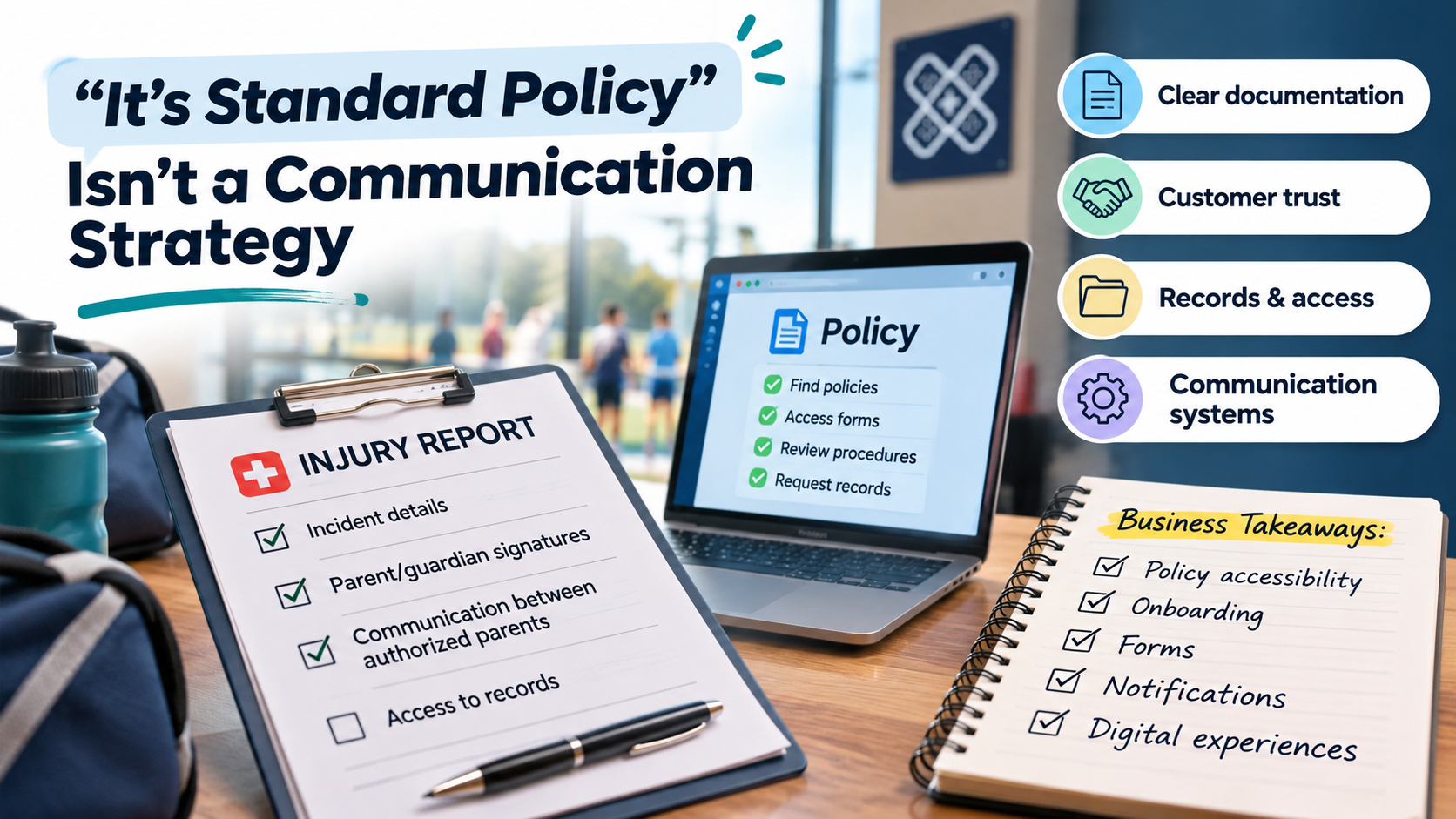
An unexpected experience as a parent made me think differently about organizational communication, customer experience, documentation, and the systems businesses expect people to trust. The lesson goes far beyond one form: having a policy is not the same as communicating it.
I spend a lot of time thinking about marketing.
Websites. Content. Branding. Customer journeys. Business systems. The information people need before they decide to trust an organization.
At Ritner Digital, much of that work comes down to a relatively simple question:
Does your organization make it easy for people to understand what you do, what to expect, and what happens next?
Recently, I found myself asking that question from a very different perspective.
Not as someone evaluating a website.
Not as a marketer thinking about conversion rates.
But as a parent trying to understand a routine administrative procedure involving my child.
What began as a small conversation about an injury report turned into a series of questions about written policies, signatures, recordkeeping, and communication between an organization and the families it serves.
The situation wasn't particularly dramatic.
There was no reason for me to assume that documenting a visible injury was inappropriate. In fact, I understood why an organization responsible for children would want to record what staff observed.
My concern was something else entirely.
I was being asked to participate in a documented procedure without having been provided a clear explanation of the written policy governing it.
And the more I tried to understand the process, the more it reminded me of a problem I see in businesses of every size.
Organizations spend considerable time building systems.
They develop forms.
Establish procedures.
Train employees.
Create records.
And decide how things should work.
But sometimes they overlook the experience of the person standing on the other side of that system.
The person being asked to sign.
The customer trying to locate a policy.
The parent requesting a record.
The client wondering what information has been collected.
The employee expected to explain a procedure that may not be readily accessible.
This is a story about one of those gaps.
It's also a larger lesson about why branding, marketing, operations, and customer communication cannot be treated as completely separate functions.
To protect the privacy of everyone involved, I'm not identifying the organization, its employees, its location, or my child. I'm also omitting exact dates and certain identifying details. This account reflects the communications and documents available to me when I wrote it; it isn't a conclusion that the organization violated a law or policy.
It Started With a Scratch and a Form
During a conversation with a staff member at my child's educational program, I was informed that a visible scratch on my child's face would need to be documented.
I explained the circumstances as I understood them.
The staff member told me that completing the documentation was standard procedure and that a parent's signature was required.
That explanation initially seemed straightforward.
Organizations responsible for children's care have legitimate reasons to document observations and maintain records.
A form recording an injury noticed upon arrival may help distinguish a condition observed before the child entered the program from an incident that occurred while the child was in its care.
Documentation can support continuity, communication, and accountability.
I wasn't opposed to any of those things.
But I hadn't previously been made aware of this particular procedure.
And I didn't understand what signing the form actually meant.
Was I acknowledging that staff had observed a scratch?
Was I confirming that I had reviewed their description?
Was I agreeing with the explanation recorded?
Was my signature required to complete the report?
What would happen if I disagreed with the wording?
Those seemed like reasonable questions.
At the time, I didn't have the written policy to answer them.
So I began asking.
Then I Learned There Had Been an Earlier Report
After that conversation, I contacted my child's other parent.
We share parenting responsibilities.
That's when I learned that a similar form had already been completed on an earlier occasion.
The other parent had been asked to sign it.
I hadn't known the earlier report existed.
I didn't know when it had been prepared.
I hadn't reviewed its contents.
And I hadn't received a copy.
This changed the nature of my questions.
I was no longer trying to understand a single form.
I wanted to understand the larger communication and recordkeeping process.
If the organization created a report concerning my child, how was that information communicated to the appropriate parents?
Was notification supposed to happen automatically?
Was it communicated only to the parent present at the time?
Did the organization maintain a process for identifying which authorized contacts should receive information?
And did that process depend on staff members assuming parents would share information privately?
Those questions matter because creating a record and communicating that a record exists are two different actions.
A form can be completed.
Signed.
Filed.
And stored.
But that doesn't establish that every person who should receive the information has been appropriately notified.
The distinction is especially important for organizations serving families with different household and caregiving arrangements.
It also has a direct parallel in business.
A company may document a customer interaction in its CRM without ensuring the appropriate team has been notified.
A client may sign a form without receiving a copy.
A membership organization may update a policy without communicating the change to affected members.
The system can technically record an action while failing to complete the communication surrounding it.
I Asked for the Written Policy
My first written request was direct.
I asked for the policy requiring these reports.
I wanted to understand its purpose and the meaning of the parental signature.
I also requested copies of the earlier report and the new one.
And I asked how records were stored, accessed, shared, and communicated.
The response I received was courteous.
The staff member explained that the procedure was considered standard policy and that a supervisor had confirmed this.
I was told I could contact the supervisor directly with questions about the policy itself.
The staff member also explained that the forms helped establish awareness that the injuries had not occurred during the program's care.
That purpose made sense to me.
I appreciated the explanation.
The staff member was also kind in describing my child, acknowledged that I hadn't been notified of the earlier report, apologized, and said both parents would be included in future communications of that kind.
I don't want to minimize any of that.
A professional can be caring, responsive, and genuinely trying to follow a procedure.
But there was still a gap.
I had asked for the written policy. I had received an explanation that the policy was standard.
Those are not the same thing.
I was also provided copies of the completed reports.
That was helpful.
I could now review what had been recorded.
But again, the distinction remained.
A completed form shows how a particular process was carried out.
It doesn't necessarily explain the written requirements governing the process.
This wasn't about demanding an exception.
It was about understanding the expectations I was being asked to follow.
The Welcome Materials Made Me Think About Information Architecture
After reviewing the correspondence, I went back through the information provided at the beginning of the program year.
I had retained photographs of the welcome materials.
They covered numerous practical subjects.
Arrival procedures.
Dismissal expectations.
Parking instructions.
Classroom information.
Calendars.
Health-related requirements.
And other details families needed to know.
Those documents demonstrated that the organization understood the value of communicating important procedures in writing.
There were instructions for ordinary daily activities.
Useful logistical information.
And clear operational expectations.
But in the materials I had received and reviewed, I couldn't locate the specific written policy governing the injury documentation and parental signatures.
That doesn't establish that no policy existed.
It may have been distributed separately.
It may have been maintained in a different handbook.
It may have been accessible through another channel.
Those were precisely the possibilities I wanted clarified.
But the experience raised a broader question:
Why is it sometimes easier to find an organization's parking instructions than the explanation of a form you're being asked to sign?
That question immediately made me think about website architecture.
Because a similar problem happens in business all the time.
A company has an attractive homepage.
Its services are beautifully presented.
Its navigation is thoughtfully styled.
But important information is scattered across unrelated documents.
Terms are buried.
Policies are difficult to find.
Customer expectations are inconsistently explained.
And people are expected to know where information lives without ever being shown.
From the organization's perspective, the information may exist.
From the customer's perspective, it may be practically inaccessible.
That's an information architecture problem.
And it deserves the same attention businesses give their marketing pages.
The Form Raised More Questions Than It Answered
When I reviewed the two completed reports, I noticed that the form described documentation of newly observed signs of injury.
It also distinguished injuries observed when a child arrived from incidents occurring during the program's care.
That helped clarify the apparent purpose of the document.
But it didn't resolve every question.
The form included a place for a parental signature.
I still wanted to understand precisely what that signature acknowledged.
The form also contained distribution instructions identifying a copy for the child's file, a copy for a parent or guardian, and a scanned copy for a health-related staff role.
That raised a second group of questions.
Where were the records maintained?
Who could access them?
How long were they retained?
Were they considered educational records, health records, or another category of administrative documentation?
What procedures existed for correcting inaccurate information?
And how did the organization determine which authorized people received copies?
I wasn't asserting that any particular storage or sharing practice was improper.
I was trying to understand the actual process.
This is an important distinction.
Asking how information is managed isn't the same thing as accusing an organization of mismanaging it.
A well-designed system should make reasonable questions answerable.
Especially when records involve personal information.
The Part That Stayed With Me: An Assumption About Communication
One explanation stood out.
The staff member indicated that they believed the parents had a good communication relationship and had therefore assumed the earlier information would be shared.
The staff member apologized for not reaching out and said communication would include both parents going forward.
I appreciated that response.
But as someone who thinks about systems, I couldn't stop thinking about the assumption.
A communication procedure shouldn't necessarily depend on how well two external people are believed to communicate with each other.
The organization's responsibilities should be defined by applicable policies, authorizations, legal requirements, and the information it actually has.
And those responsibilities should be understandable to the employees carrying them out.
This does not mean every organization is required to send every document to every listed contact.
Notification rights and obligations depend on the setting, the type of information, applicable law, custody orders, permissions, and other circumstances.
But whatever the relevant requirements are, the system should account for them intentionally.
Think about how this applies to business
A client account may have several authorized contacts.
A project might involve multiple decision-makers.
An organization could maintain a primary billing contact and a separate operational contact.
A customer may designate an authorized representative.
A company might have internal teams responsible for different parts of a service.
If one person receives an important update, should the organization assume they'll forward it to everyone else?
Sometimes that may be consistent with the agreed process.
Other times it may not.
The point is that the communication arrangement should be defined.
Not improvised from assumptions about personal relationships.
A reliable system knows who needs the information, what they're entitled to receive, and how the communication is completed.
Good Intentions Don't Replace Clear Systems
I want to be careful about this point.
My experience wasn't primarily about someone's tone.
The communication I received was respectful.
The staff member appeared to be trying to carry out established practices and responded to my concerns.
I don't think every documentation question should become a personal criticism of an employee.
Employees often work within systems they didn't create.
They may be trained to complete a form without being responsible for distributing the underlying policy.
They may understand how a procedure works in practice without having immediate access to its written requirements.
They may believe a supervisor is the appropriate person to answer detailed questions.
Those boundaries can be legitimate.
But they also reveal where system design matters.
Does the employee know where the current policy is?
Can they direct someone to it?
Is there a documented process for questions?
Can a supervisor provide a definitive explanation?
Are responsibilities clearly assigned?
These are management and operational questions.
And the answers can affect how customers experience the entire organization.
Marketing Creates Expectations. Systems Determine Whether They're Met.
This is where the experience connects directly to Ritner Digital.
Businesses invest substantial resources in communicating trust.
They develop polished websites.
Write reassuring service descriptions.
Publish testimonials.
Create welcome packets.
Build onboarding experiences.
And describe themselves using words like transparent, reliable, responsive, and customer-focused.
Those words create expectations.
But what happens after someone becomes a customer?
Can they find the applicable terms?
Do they understand what they're signing?
Are records and acknowledgments handled consistently?
Does the appropriate person receive important updates?
Can the business explain its own procedures?
What happens when someone requests documentation?
These are not separate from the brand experience.
They are the brand experience.
A business can spend thousands attracting a customer and then weaken that relationship through a confusing administrative process.
The marketing may have worked perfectly.
The customer may have been a strong fit.
The website may have communicated exactly the right message.
But if the operational experience feels unclear, confidence can decline.
Marketing tells people what to expect. Operations, communication, and recordkeeping determine whether those expectations are credible.
That is why I don't think marketing strategy should end at the point of conversion.
The Difference Between a Form and the Policy Behind It
This distinction is worth making explicit.
A form is a tool.
A policy establishes or communicates the rules governing a process.
A procedure explains how a process is carried out.
An acknowledgment records a particular action or response.
A record documents information that may need to be maintained and protected.
These components are related.
But they aren't interchangeable.
Imagine a customer receives a form to sign.
The form has a title, some fields, and a signature line.
That tells the customer what information is being collected.
It may not explain why.
It may not establish whether signing is mandatory.
It may not identify what the signature legally or operationally means.
And it may not explain where the information goes afterward.
An organization should consider whether the form itself, its surrounding instructions, and the relevant policies together provide the information people need.
Where a signature has legal consequences, the language and process should receive appropriate professional review.
A business should not rely on marketing copy to determine the legal effect of a document.
But good communication design can make the legally reviewed process easier to understand.
Business Requirements Should Be Documented, Not Simply Remembered
Not every operational practice has to be placed in a publicly available handbook.
Some internal procedures legitimately contain confidential, sensitive, or security-related information.
Some businesses have legal obligations requiring specific policies and notices.
Others have more flexibility in how they design their processes.
The requirements vary by industry.
But for material customer-facing processes, businesses should be able to identify the governing rules and how they're communicated.
A clear operational system should answer:
Who owns the procedure?
Which version is current?
When was it implemented or revised?
Which people need to know about it?
What information must be provided?
What actions are required?
What happens when someone disagrees or declines?
Which records are created?
Where are they maintained?
Who may access them?
And how are errors or questions handled?
These questions shouldn't require an expensive enterprise platform.
A small organization can answer them through appropriate documentation and clear responsibilities.
The important thing is that the process exists beyond one employee's memory.
Recordkeeping Is a Customer Trust Issue, Too
The moment an organization creates a record about someone, additional questions can become relevant.
What information is necessary?
Why is it being collected?
Who can access it?
How long will it be maintained?
How is it secured?
What happens if the information is inaccurate?
How is it shared with authorized parties?
These questions are not unique to education.
Businesses collect information through contact forms, booking systems, customer relationship management platforms, contracts, application forms, and service records.
The Federal Trade Commission's guide to protecting personal information recommends knowing what information a company holds, retaining only what's necessary, protecting it, disposing of it appropriately, and preparing for security incidents.
The NIST Privacy Framework also provides a voluntary approach to identifying and managing privacy risks through organizational policies and controls.
Neither resource means that every business has identical legal obligations.
But they reinforce the importance of knowing how information moves through an organization.
For a customer, privacy isn't just a paragraph in a website footer.
It's also how the organization actually handles the information.
When Multiple People Are Involved, Notification Needs Deliberate Design
Many organizations serve customers whose decisions or responsibilities involve more than one person.
Families.
Business partners.
Joint account holders.
Authorized representatives.
Property owners and managers.
Corporate purchasing teams.
Clients working with several advisers.
These arrangements can create communication complexity.
The solution isn't to automatically copy everyone on every message.
Doing so could create privacy or authorization problems.
Instead, the organization should determine who is authorized to receive what information, what notices are required, and how those communications are recorded.
In educational settings, there are additional legal considerations
For covered educational institutions, the federal Family Educational Rights and Privacy Act provides certain rights regarding education records.
The U.S. Department of Education explains that, generally, custodial and noncustodial parents alike have rights concerning their children's education records unless a qualifying court order, state law, or other legally binding document specifically provides otherwise.
That does not automatically answer every question about simultaneous notification of routine incidents.
Access rights, disclosure rules, notification duties, and the classification of a particular record are distinct issues.
The applicable rules must be evaluated in context.
For me, that distinction was part of why I wanted the written procedures rather than an assumption.
I wasn't looking for someone to declare that every administrative practice was wrong.
I wanted to know what the requirements actually were.
What I Would Have Found Helpful From the Beginning
Looking back, I can identify several things that would have made the experience easier to understand.
A clear explanation at enrollment that visible injuries observed on arrival may be documented.
A reference to where the applicable policy could be reviewed.
A simple explanation of what a parental signature means.
Consistent information about whether completed reports are distributed to authorized parents.
A description of where the records are maintained.
And an identified contact for questions about the process.
Those are not statements about what the law necessarily required in this particular situation.
They're observations about the information that would have helped me participate confidently.
And they illustrate a larger customer experience principle:
An organization can prevent a surprising amount of confusion by explaining a process before people encounter it unexpectedly.
That is useful far beyond the educational setting.
It's relevant to a client onboarding process.
A healthcare intake workflow.
A membership agreement.
An agency contract.
An employee acknowledgment.
A customer complaint procedure.
Or any business interaction involving information, obligations, and trust.
Why Documentation Should Be Designed for Real People
A policy can be technically accurate and still be difficult to understand.
It may use internal terminology.
Refer to another document.
Assume the reader knows organizational roles.
Or describe requirements without explaining what they mean in practice.
The answer isn't necessarily to eliminate formal language.
Some policies require precision.
But organizations can often provide supporting explanations that make the process understandable.
A short introductory page.
A useful FAQ.
An accessible document library.
Clear definitions.
Simple instructions.
A current contact point.
And appropriate notices when requirements change.
The W3C Web Accessibility Initiative emphasizes clear instructions, understandable error messages, and support for people completing forms.
Its Web Content Accessibility Guidelines also establish standards relevant to accessible web forms and information.
A business's documentation system should be designed for the people who actually use it.
Not only the employees who already understand the terminology.
The Marketing Opportunity Most Businesses Overlook
When companies think about customer experience, they often focus on visible interactions.
The homepage.
The sales process.
The first consultation.
The service delivery.
The customer support conversation.
But many trust-building moments happen in less glamorous places.
A confirmation email.
A policy link.
A record request.
A signature explanation.
A notification setting.
A customer portal.
A well-organized document library.
These touchpoints rarely appear in a marketing campaign.
But they can influence whether people feel the organization is dependable.
And this is where digital strategy can create meaningful value.
A website can help
A well-organized website can make appropriate customer-facing documents easier to locate.
Content strategy can help
Plain-language explanations can reduce confusion around common procedures.
Onboarding systems can help
Relevant expectations can be communicated before a customer is asked to act.
Communication workflows can help
Notifications can be assigned to the appropriate authorized recipients.
Record management can help
Organizations can develop clearer responsibilities for access, retention, corrections, and secure handling.
Not all of these tasks belong to a marketing agency.
Some require legal, compliance, administrative, or information technology specialists.
But the customer-facing communication should be coordinated with the systems behind it.
That's the opportunity I see for businesses.
Not just making things look better.
Making the experience make more sense.
A Practical Systems Audit for Any Customer-Facing Organization
If I were evaluating an organization's communication experience, I wouldn't begin by asking whether its website looked modern.
I'd begin with the processes customers are expected to follow.
Step 1: Identify high-impact interactions
Which processes require customers to provide information, acknowledge terms, sign documents, or make decisions?
These deserve careful review because misunderstanding them can have consequences.
Step 2: Locate the governing documents
Can the organization identify the current written policy or procedure?
Is the version clearly dated and maintained?
Step 3: Review customer-facing explanations
Do people know what the process is for?
Can they find the information at the appropriate time?
Is it understandable?
Step 4: Check notification responsibilities
Who must receive information?
Who is authorized?
How are relevant permissions or preferences maintained?
What happens when responsibilities involve multiple people?
Step 5: Examine the forms
Does each form explain what information is required?
What does a signature or acknowledgment mean?
What happens if someone disagrees or needs clarification?
Step 6: Review recordkeeping
Where does information go?
Who maintains it?
Who can access it?
What retention and correction procedures apply?
Step 7: Test the experience
Ask someone who wasn't involved in designing the process to follow it.
What questions do they ask?
Where do they become confused?
Which explanations are missing?
Step 8: Assign ownership
Someone should be responsible for maintaining the process, updating customer-facing information, and making sure staff know where to find current instructions.
The purpose is not to create paperwork for its own sake.
It's to reduce unnecessary ambiguity.
A good system supports employees as well as customers.
What This Experience Changed About How I Think About Marketing
I've always believed that useful marketing begins with understanding the customer.
But this experience made that principle feel more concrete.
It's easy to discuss clarity when you're evaluating a homepage.
It's different when you're the person asking a question and trying to understand a process involving someone you care about.
You notice how much information depends on assumptions.
You notice the difference between a polite explanation and an actual governing document.
You notice how quickly a small question becomes complicated when records, responsibilities, and communication pathways aren't immediately clear.
And you notice that even when everyone is trying to be helpful, the system may still be difficult to navigate.
That was the larger lesson for me.
I wasn't asking an organization to stop maintaining records.
I wasn't asking anyone to abandon a legitimate safety process.
I wasn't asking for special treatment.
I was asking to understand the process being applied.
That's a reasonable expectation for customers in many industries.
And it should be a consideration when businesses design their own systems.
Because people aren't always questioning the organization itself.
Sometimes they're simply asking for clarity.
A request for documentation shouldn't automatically be treated as resistance to the process. It may be an opportunity to make the process more understandable.
Where Ritner Digital Fits Into This Conversation
Ritner Digital is a digital marketing business.
We're not a school administration consultancy, a records custodian, or a law firm.
We don't determine an organization's legal obligations or replace qualified compliance professionals.
But the experience of trying to locate information is directly relevant to the work we do.
Websites are information systems.
Content establishes expectations.
Forms create interactions.
Onboarding materials influence the customer experience.
Brand messaging makes promises.
And digital communication connects all of those elements.
A business can improve its advertising while leaving the customer journey confusing.
It can rank better in Google while failing to explain its services.
It can publish impressive social media content while important policies remain difficult to locate.
That's why the most valuable digital strategy isn't always the one that generates more attention.
Sometimes it begins with organizing the information the business already has.
Clarifying what customers need to know.
Making relevant documentation accessible through appropriate channels.
And examining whether the communication experience matches the brand's promises.
Ritner Digital's SEO services, web design, and content systems can support the customer-facing parts of that work.
Other areas, such as legally required policies, access controls, records retention schedules, and regulated recordkeeping, need the appropriate organizational and professional oversight.
The objective is alignment.
Your website should communicate clearly. Your business processes should support what the website says. And customers shouldn't have to guess where those two things meet.
Frequently Asked Questions
1. Why is “it's standard policy” sometimes an inadequate explanation?
Because it identifies a procedure as established without necessarily explaining its purpose, requirements, or governing documentation. People may reasonably need to know what they're expected to do and why. A clear explanation or access to the applicable written policy can help prevent confusion.
2. Does every business have to publish all of its internal policies?
No. Legal requirements vary, and some internal policies appropriately remain confidential. The important distinction is between internal operational material and information customers need to understand their rights, obligations, or interactions. Relevant customer-facing requirements should be communicated as applicable.
3. What's the difference between a form and a written policy?
A form collects or records information. A written policy generally establishes rules or expectations. A procedure describes how those rules are carried out. A completed form doesn't necessarily establish the requirements governing its use.
4. Why should a business explain what a signature means?
Because a signature may serve different purposes, including acknowledging receipt, confirming review, granting authorization, or agreeing to terms. The actual effect depends on the document and applicable law. Clear language helps people understand what action they're being asked to take.
5. Can a customer request a copy of a company's written policy?
A customer can ask, but the organization's legal obligation to provide a particular policy depends on the setting, the type of document, applicable laws, contractual rights, and other circumstances. Even where disclosure isn't legally required, businesses should consider whether customer-facing procedures are explained clearly.
6. Why is parental notification an example of a larger business systems issue?
Because it illustrates the importance of identifying authorized recipients and assigning communication responsibilities. Businesses face similar questions when accounts involve multiple contacts, decision-makers, or representatives. The proper distribution rules depend on consent, authority, privacy, and applicable requirements.
7. Does FERPA give both parents rights to educational records?
Generally, for institutions covered by FERPA, custodial and noncustodial parents have certain rights concerning their children's education records unless a qualifying court order, law, or legally binding document specifically provides otherwise. Those access rights don't automatically resolve every question about routine notification procedures.
8. Is a health-related form always considered an education record?
Not necessarily. Classification depends on the setting, how the information is maintained, and the applicable legal framework. In covered educational settings, FERPA's definition of education records may be relevant. The specific form and circumstances need to be evaluated rather than assumed.
9. Why do records retention and access procedures matter?
Organizations need to know what information they maintain, who may access it, how it is protected, and when it can or must be disposed of. The FTC recommends appropriate data inventories, limited collection, security, and retention practices. Specific legal obligations vary by sector.
10. Can a business have excellent employees but poor communication systems?
Yes. Employees may be knowledgeable and caring while working within processes that aren't documented or communicated consistently. A system review can identify gaps in information access, staff guidance, and notification responsibilities without treating every problem as an individual employee failure.
11. What is a single source of truth in business operations?
It's an authoritative location or system for maintaining current information, such as approved policies, procedures, or service details. Its purpose is to reduce confusion caused by outdated copies or inconsistent explanations. Access should be managed according to the sensitivity of the information.
12. How does policy transparency connect to branding?
Branding creates expectations about how an organization operates. When customer-facing requirements are difficult to understand, the actual experience may conflict with promises of transparency, reliability, or responsiveness. Clear communication helps make those promises more credible.
13. Can better website design improve policy communication?
Yes. Thoughtful information architecture, accessible document pages, descriptive navigation, and plain-language explanations can help authorized users locate appropriate information. However, a website redesign cannot determine which policies are legally required or replace the organization's responsibility for maintaining accurate documents.
14. What role does accessibility play in online forms and documentation?
Accessible design helps people understand instructions, identify required fields, navigate forms, and correct mistakes. The W3C's Web Content Accessibility Guidelines provide standards relevant to websites and form interactions. Specific accessibility obligations depend on the organization and applicable rules.
15. Should an organization send every record to every contact?
Not automatically. Distribution should reflect the recipients' authority, privacy obligations, applicable policies, and legal requirements. A good system identifies who should receive particular information and avoids relying solely on assumptions about personal relationships.
16. How can businesses audit their customer communication systems?
Review important procedures, forms, onboarding documents, notification workflows, recordkeeping practices, and customer-facing website information. Identify where people repeatedly ask questions or receive inconsistent answers. Assign responsibility for maintaining accurate information and involve legal or compliance professionals when necessary.
17. Is customer experience only a marketing responsibility?
No. Customer experience is shaped by marketing, operations, technology, support, administration, and management. Marketing can communicate expectations and help organize information, but the organization must also deliver the procedures and services it promises.
18. Can Ritner Digital help businesses improve communication and content systems?
Ritner Digital offers website design, SEO, content strategy, and related digital marketing services. Those capabilities can help businesses organize customer-facing information and create clearer digital experiences. Legal policies, regulated records, privacy requirements, and compliance decisions must remain under the oversight of appropriately qualified professionals.
Final Thoughts: The Question Was Never Just About the Form
What stayed with me most wasn't the scratch.
It wasn't even the fact that a form existed.
I understood why documentation might be necessary.
The part I kept returning to was the communication around it.
The earlier report I hadn't known about.
The explanation that a procedure was standard.
The difference between receiving completed reports and receiving the written policy governing them.
The questions about what a signature meant.
And the need to understand where records were maintained and how information was shared.
Those questions were specific to my experience.
But the underlying challenge is much broader.
Organizations routinely ask people to trust their processes.
To provide information.
To sign documents.
To accept terms.
To follow procedures.
And to assume that someone has considered what happens next.
Sometimes that trust is well supported by clear systems.
Other times the process may be more difficult to understand than it needs to be.
For me, this experience reinforced something I believe about digital marketing and business systems.
Transparency isn't a brand adjective. It's something an organization has to make possible through its everyday processes.
You demonstrate it by explaining what people need to know.
By maintaining accurate information.
By making appropriate documentation accessible.
By communicating consistently.
And by taking reasonable questions seriously.
A beautiful website can establish a positive first impression.
A strong SEO strategy can help someone find your organization.
Clear content can explain what you offer.
But the experience people have after that first interaction ultimately determines whether the brand promise holds up.
That's why I believe better business communication deserves as much strategic attention as customer acquisition.
Because sometimes the question that reveals the biggest systems problem is a very simple one.
“Can I please see the written policy?”
And an organization should have a thoughtful way to respond.
Explore Ritner Digital's web design, content strategy, and digital marketing services.
Contact Ritner Digital to discuss clearer customer-facing content and website experiences.
Sources and Further Reading
U.S. Department of Education — Family Educational Rights and Privacy Act. Information about education records, parental access rights, record amendment procedures, and confidentiality requirements for covered institutions. Read the FERPA guidance.
U.S. Department of Education — Do Both Parents Have Rights Under FERPA? Explains the general rights of custodial and noncustodial parents and the effect of applicable legal restrictions. Read the official FAQ.
Federal Trade Commission — Protecting Personal Information: A Guide for Business. Practical guidance on knowing which information an organization maintains, limiting retention, securing data, and planning for incidents. Read the FTC guide.
National Institute of Standards and Technology — Privacy Framework. A voluntary framework for managing privacy risks through policies, processes, and organizational accountability. Explore the framework.
W3C — Developing for Web Accessibility. Recommendations for clear web forms, understandable instructions, error messages, and usable customer interfaces. Read the guidance.
W3C — Web Content Accessibility Guidelines. Established standards for accessible digital information and interfaces. Explore WCAG.
Ritner Digital — SEO Services. Search visibility, technical foundations, and useful content. Explore SEO.
Ritner Digital — Web Design. Business-focused website structure, usability, and digital experiences. Explore web design.
Ritner Digital — Content Systems. Organizing and developing useful digital content. Explore content systems.