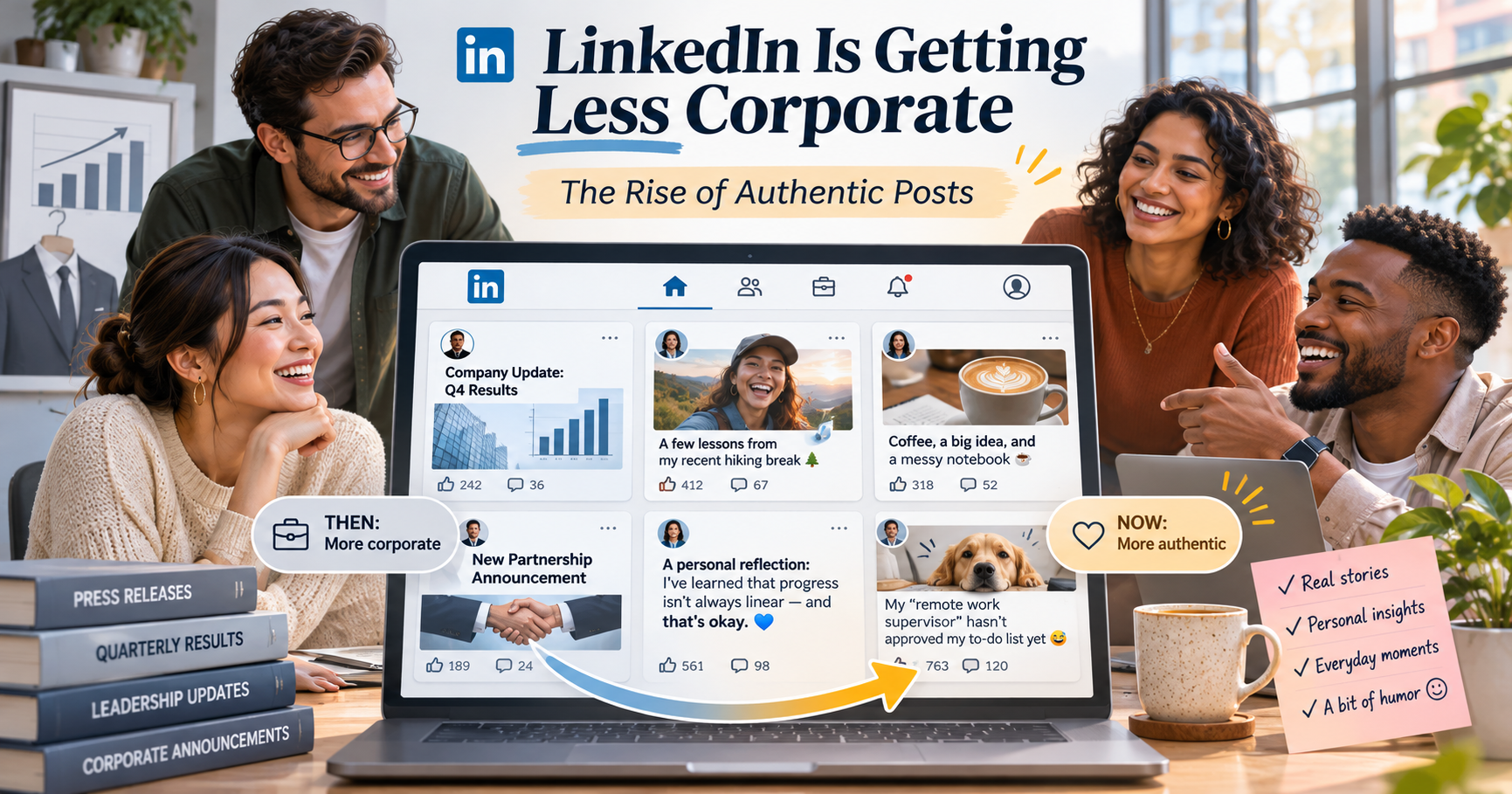
LinkedIn used to feel like the place where everyone had a promotion to announce, a conference to celebrate, or a leadership lesson to share. Now the feed is filling with personal reflections, coffee photos, unfiltered opinions, humor, and reminders that professional people are still human. Here's what this shift means for personal branding, business marketing, and the future of professional content.
There was a time when posting on LinkedIn felt like writing an email to your entire company's executive team.
Everything needed to sound important.
Every accomplishment required a formal announcement.
Every photograph featured a conference badge, a handshake, or a carefully arranged group of smiling professionals.
And every career update seemed to begin with some variation of:
"I'm thrilled to announce…"
Or:
"I'm humbled and honored…"
Or the classic:
"After much reflection, I'm excited to share…"
You know the posts.
Perfectly polished.
Professionally approved.
And sometimes so carefully written that you couldn't tell who the person behind them actually was.
But LinkedIn in 2026 feels different.
There are still job announcements and industry articles.
People still discuss business strategy, career development, and professional accomplishments.
But mixed into that content are ordinary photographs, personal experiences, funny observations, emotional reflections, and posts that would once have seemed more natural on Instagram.
Someone shares a morning coffee.
A founder admits that building a business has been harder than expected.
A professional talks about getting rejected from a job.
A marketer makes a joke about another meeting that could have been an email.
Someone else shares a reminder about being proud of their progress.
And instead of sounding like a press release, the caption sounds like something a person would actually say.
LinkedIn hasn't stopped being professional. But the definition of what looks professional is becoming less rigid.
That shift creates an interesting opportunity for businesses, founders, freelancers, and professionals.
Because a personal brand no longer has to consist entirely of credentials, achievements, and polished company announcements.
It can include perspective.
Humor.
Personality.
Real experiences.
And moments that make people feel understood.
But there's a catch.
Authenticity is not simply posting something personal.
And being relatable doesn't automatically make something useful.
The real opportunity is finding the space between professional expertise and genuine human connection.
The question for businesses isn't whether LinkedIn is becoming more casual. It's how to become more human without becoming less credible.
A Coffee Cup That Explains the New LinkedIn
Consider this simple image.

Not every professional milestone comes with a promotion, a new title, or a public announcement. Sometimes progress is quieter than that.
The image shows a cup of coffee photographed from above.
Across the coffee is a short reflection:
"how silly of me to forget how far ive come, just because I still have far to go."
No corporate logo.
No sales pitch.
No elaborate production.
No announcement about record-breaking quarterly results.
Just a simple thought about progress.
And that's precisely why an image like this can fit into today's more conversational LinkedIn culture.
It expresses something many professionals recognize.
The feeling of always looking toward the next goal.
The temptation to compare your current position with where you eventually want to be.
The tendency to overlook everything you've already accomplished because the work isn't finished.
For entrepreneurs, the message can feel especially relevant.
There's always another client to acquire.
Another project to finish.
Another skill to develop.
Another milestone to reach.
Another version of your business you haven't built yet.
It's easy to become so focused on what's missing that you forget what you've already done.
The image doesn't need a complicated explanation.
It offers a recognizable human feeling.
And sometimes, that creates more connection than another paragraph about professional excellence.
Of course, this particular image isn't evidence that every similar post performs well on LinkedIn. It's an example of a content style, not a verified case study.
Its value is in illustrating how personal reflection can coexist with professional identity.
A founder could share it while talking about business milestones.
A freelancer might connect it to building a career independently.
A recent graduate may see it as encouragement during a difficult job search.
A marketer could use it to discuss the pressure of constant performance metrics.
The image provides the emotional starting point.
The accompanying perspective gives it context.
That combination is increasingly recognizable on LinkedIn.
What Actually Changed on LinkedIn?
The platform hasn't formally announced that users should abandon professionalism.
It hasn't turned into Instagram.
And it hasn't stopped prioritizing career-relevant information.
But the kinds of professional conversations visible on LinkedIn have broadened.
In June 2026, The New York Times examined LinkedIn's growing social-media identity in an article titled “Is LinkedIn Entering Its Post-Cringe Era?”.
The reporting described a feed that increasingly features celebrities, creators, personal stories, career commentary, and content that doesn't fit the traditional résumé-style model.
In October 2026, Business Insider reported on professionals using selfies and unscripted videos to build relationships and create career opportunities.
These are examples of a broader change in how some professionals use the platform.
LinkedIn is becoming more than a place to document career history.
For many active users, it's also a place to communicate personality, develop a public voice, share opinions, and build professional relationships in a less formal way.
That doesn't mean every industry, age group, or professional community uses LinkedIn identically.
A corporate attorney may approach the platform differently from a creative founder.
A recruiter may have different goals from a small-business owner.
An executive may prefer a more reserved style than an independent consultant.
And some users understandably dislike the increasingly personal tone.
But the rigid distinction between "professional content" and "personal content" has become less useful.
Professional identity includes more than a job title.
It includes how someone thinks, communicates, works, and relates to other people.
1. The Old LinkedIn Was Built Around Credentials
LinkedIn began with a clear professional purpose.
Profiles displayed employment history, education, skills, and connections.
The platform helped people explore career opportunities and build professional networks.
Much of the content reflected that function.
People announced promotions.
Shared company news.
Published industry articles.
Celebrated certifications.
Posted conference photographs.
And congratulated one another on career milestones.
There's nothing wrong with those posts.
Professional achievements deserve recognition.
And information about jobs, industries, and expertise remains central to LinkedIn.
The problem appears when accomplishments become the only acceptable public expression of professional identity.
If every post must communicate success, the result can feel artificial.
A person might be building an interesting business while having nothing dramatic to announce that week.
A professional could be learning important lessons without earning a new credential.
Someone may have valuable insight from a difficult project but feel pressure to turn it into a polished success story.
When a platform rewards visible professional identity, people can begin presenting an overly edited version of their careers.
And audiences eventually learn to recognize that pattern.
A career is more than its announcements.
That realization helps explain why less formal content can feel refreshing.
2. People Are Tired of Reading the Same Corporate Voice
One of the biggest challenges in modern content marketing is sameness.
Every company wants to sound professional.
Every founder wants to appear knowledgeable.
Every brand wants to communicate credibility.
But those goals can produce remarkably similar language.
"Thrilled to announce."
"Proud to share."
"Honored to be part of this journey."
"Excited about the incredible opportunities ahead."
"Grateful for the amazing team that made this possible."
These expressions aren't inherently bad.
They become less meaningful when they're used automatically.
A reader may encounter several posts that sound nearly identical, despite coming from completely different people.
And the rise of generative AI has intensified that challenge.
It is now possible to produce large quantities of polished professional content quickly.
But polish doesn't necessarily create a distinctive voice.
In its June 2026 update, LinkedIn explicitly acknowledged the increase in generic AI-generated content.
The company said it was working to reduce repetitive, low-substance material while supporting content grounded in real perspectives and expertise.
That is an important distinction.
LinkedIn isn't simply encouraging people to be more emotional.
It's emphasizing genuine contributions over generic language and manufactured engagement.
For businesses, the lesson is that sounding professional isn't enough.
Your audience should be able to recognize something of you in the content.
3. Authenticity Has Become a Form of Professional Differentiation
Imagine two marketing consultants.
Both have similar qualifications.
Both offer relevant services.
Both maintain professional LinkedIn profiles.
The first consultant publishes generic advice.
"Consistency is key to marketing success."
"Always provide value."
"Never stop learning."
The second consultant shares a specific experience.
They describe a confusing client brief, explain how they approached it, and discuss what they learned about asking better questions.
The second post provides something the first doesn't.
A recognizable perspective.
The reader can begin to understand how that person thinks.
That matters because professional relationships involve judgment.
Clients aren't only evaluating whether someone knows the vocabulary of an industry.
They're also evaluating whether they trust the person's approach.
LinkedIn's 2025 guidance on authentic content emphasizes that B2B audiences need credible, human communication rather than impersonal content that sounds interchangeable.
Authenticity can contribute to that credibility when it reveals real experience and useful thinking.
But it shouldn't be confused with constant personal disclosure.
A professional can be authentic while remaining private.
They can be warm without sharing intimate details.
And they can be conversational without abandoning standards.
The value of authenticity isn't that everyone gets access to your personal life. It's that people can recognize the person behind your work.
4. Personal Posts Can Create Connection Before Someone Needs Your Services
Not every LinkedIn connection begins with an immediate business need.
Someone may follow a founder because they enjoy their perspective.
A potential client could recognize a consultant's name from several thoughtful posts.
A recruiter might notice how a professional communicates.
A future collaborator could become familiar with someone's work long before an opportunity arises.
This is one reason personal branding can matter.
A person might not need a web designer today.
Or a marketing strategist.
Or a business consultant.
But they may encounter a post that resonates.
They remember the writer.
Later, when a relevant need arises, the name feels familiar.
That's not a guarantee of a future inquiry.
And it would be misleading to suggest that a coffee photograph automatically turns into new customers.
But professional familiarity can develop through repeated, relevant exposure.
This also helps explain why every post doesn't need to be a sales pitch.
A company announcement may demonstrate activity.
An educational post may demonstrate expertise.
A relatable reflection may communicate personality.
Different posts contribute different information about the person or business.
A thoughtful LinkedIn strategy gives each type of content a role.
5. The Most Relatable Posts Aren't Always About Business
This may be the biggest cultural change.
A post doesn't necessarily need to mention your job in order to connect with your professional audience.
Consider the coffee-cup image.
Its message is about appreciating progress.
That feeling applies to many parts of life.
But it also has clear relevance to work.
Professionals can spend years developing skills while feeling as though they aren't moving quickly enough.
Entrepreneurs may build substantial foundations while remaining focused on future revenue goals.
Someone changing careers may feel behind despite making meaningful progress.
A person growing a business may compare their early stages with another company's established success.
The image captures a shared experience without mentioning quarterly reports or networking.
That is part of its appeal.
But there's an important distinction between personal content with professional resonance and unrelated content posted simply to attract engagement.
A business owner sharing a genuine reflection on progress may help the audience understand their perspective.
Posting an endless stream of generic inspirational graphics without any connection to the person's work or interests may offer less value.
The difference is context and intention.
A single image can start the conversation.
The writer's perspective makes it meaningful.
6. LinkedIn's Algorithm Is Not Simply Rewarding Vulnerability
This is where social media advice often becomes misleading.
Someone notices that personal posts appear to receive attention.
An agency turns that observation into a universal rule.
"Post vulnerable stories."
"Share your struggles."
"Use an emotional hook."
"Never write formal content again."
But LinkedIn's ranking systems are more complicated than that.
In March 2026, LinkedIn announced changes to its feed ranking.
The company described using more advanced models to understand content relevance and members' changing professional interests.
It also emphasized reducing recycled posts, artificial engagement, and content created primarily to manipulate distribution.
LinkedIn's own explanation of feed ranking describes the use of numerous signals related to the member, content, network, and activity.
There isn't a published rule saying that personal photographs automatically receive more reach.
Nor is there a guarantee that emotional storytelling will outperform technical advice for every audience.
An engineer's detailed technical explanation may be highly relevant to their network.
A founder's personal reflection might resonate with business owners.
A recruiter may benefit from straightforward career information.
Different audiences value different content.
Being authentic is not an algorithm trick. It's a way to contribute something recognizably yours.
That is a more useful principle than trying to reverse-engineer a magic posting formula.
7. Research Suggests Personal Stories Can Perform Well—But Context Matters
There is some evidence supporting the appeal of personal storytelling.
In October 2026, LinkedIn content company Flypost published an observational study of more than 116,000 posts from over 2,400 B2B creators.
The research announcement reported that personal stories and image-based posts were associated with stronger reaction counts in the sample.
But those findings need context.
Flypost sells LinkedIn content tools.
Its research is observational.
Engagement is not the same as qualified leads, trust, or sales.
And the posts studied may not represent all LinkedIn users.
Similarly, a 2026 analysis by LigoSocial reported stronger engagement for storytelling and firsthand experiences in its sample of more than 134,000 posts.
The researchers explicitly acknowledged limits involving causation, selection, and how content was classified.
The reasonable takeaway is not that everyone should post personal stories four times a week.
It is that firsthand experiences and recognizable human perspectives can be worth testing.
A business should evaluate whether those posts attract relevant conversations.
Not simply whether they receive more reactions.
8. A Less Formal Tone Can Make Expertise More Accessible
Some professional writing is difficult to engage with because it sounds unnecessarily complicated.
Consider a hypothetical consultant explaining a common business problem.
Formal version:
"Our organization remains committed to leveraging cross-functional strategic alignment to optimize stakeholder engagement."
Conversational version:
"We realized everyone was working toward a different goal, so we got the team in one room and agreed on what success actually looked like."
The second version is easier to understand.
It also sounds more like something a person would say.
That doesn't mean every topic should be casual.
Technical, legal, financial, and regulated information may require specific language.
But clarity is not the opposite of professionalism.
A brand can communicate expertise in plain English.
It can use humor when appropriate.
It can explain difficult ideas through real examples.
And it can acknowledge uncertainty instead of pretending to know everything.
A less formal voice may make information more approachable.
The expertise still needs to be real.
9. The Rise of Founder-Led Content Makes Sense
For small businesses, founders are often the people best positioned to explain the company.
They understand why the business exists.
They know what customers ask.
They make decisions.
They experience challenges.
And they have perspectives that aren't always captured in a brand's polished marketing language.
A founder's LinkedIn profile can therefore serve a different purpose from the official company page.
The company page
Can explain services, share business news, present useful resources, and maintain an official presence.
The founder's profile
Can communicate personal experience, industry perspectives, business lessons, and the thinking behind decisions.
The two should be connected without becoming copies of each other.
For example, a web design company might publish an article about improving website inquiries.
The founder could then share a short post explaining why they think businesses often focus on appearance before usability.
The company provides the structured resource.
The founder provides the perspective.
Neither needs to pretend the other doesn't exist.
People can connect with a person's reasoning while still relying on the company's website for the details.
10. Your Personal Brand Doesn't Have to Match Your Corporate Brand Exactly
A business can maintain a polished visual identity while its founder communicates casually.
These aren't necessarily contradictions.
A luxury interior design studio may have an elegant website.
Its owner might share an informal observation about the creative process.
A professional services firm may use precise language in client documents.
Its founder could post a funny story about learning to delegate.
A digital marketing agency may maintain structured service pages.
Its owner might share a relatable coffee photograph and talk about the realities of building a business.
The voice changes according to the context.
The underlying values should remain consistent.
A professional who promises thoughtful service shouldn't post content that treats customers disrespectfully.
A business emphasizing confidentiality shouldn't share private client stories without permission.
And an expert whose credibility depends on accuracy shouldn't publish sensational claims simply because they're trending.
Being less formal doesn't mean becoming inconsistent.
The strongest personal and business brands can have different tones while remaining recognizably connected.
11. There's a Difference Between Being Vulnerable and Performing Vulnerability
As personal storytelling becomes more common, another problem appears.
Vulnerability itself can become a formula.
A person shares an ordinary inconvenience.
Then adds dramatic line breaks.
Then turns it into an exaggerated life lesson.
Then ends with a question designed to encourage comments.
Suddenly, every coffee spill becomes a business strategy revelation.
Every missed train teaches leadership.
Every difficult Monday becomes a masterclass in resilience.
And every personal experience is packaged as proof of entrepreneurial wisdom.
It's understandable why audiences sometimes make fun of LinkedIn.
The content can feel emotionally staged.
The lesson seems forced.
And the writer may appear more interested in engagement than honest expression.
LinkedIn itself has acknowledged the tension.
A September 2026 LinkedIn News discussion about oversharing explored the boundaries between personal branding, authenticity, and revealing too much.
The important lesson is that authenticity doesn't require exposing everything.
You can choose what to share.
You can wait before discussing difficult experiences.
You can keep private matters private.
You can decide that some parts of life aren't content.
Authenticity is not a competition to see who can reveal the most.
Sometimes it simply means communicating in your own voice.
12. You Don't Need to Turn Every Personal Moment Into a Business Lesson
This point deserves emphasis.
If someone shares a meaningful reflection about appreciating progress, the post doesn't always need to end with:
"And that's why you should hire me to improve your marketing strategy."
The connection would feel forced.
An uplifting image doesn't need to become an advertisement.
A thoughtful observation doesn't have to conclude with five sales lessons.
And a personal milestone doesn't require an immediate call to action.
People can recognize that a professional has a life beyond the services they sell.
A personal post may be valuable because it expresses something sincere.
A business-oriented post may be valuable because it provides useful expertise.
Both can belong on the same profile.
The challenge is maintaining a coherent overall identity.
An individual post doesn't need to explain everything about you.
Your body of content should give people a recognizable understanding of your interests, perspectives, and work.
13. Business Owners Should Still Have Boundaries
Less formal content can create opportunities for connection.
It can also create risks.
A professional might share something while angry.
Reveal a confidential customer situation.
Post a photograph containing private information.
Discuss a workplace conflict that hasn't been resolved.
Or disclose personal circumstances they later wish had remained private.
The pressure to be authentic can make those decisions harder.
But boundaries are not evidence of dishonesty.
They're part of responsible communication.
Questions to ask before publishing
Am I comfortable with this remaining public?
Does it reveal information about someone who hasn't agreed to be included?
Am I discussing a client or colleague fairly?
Could the post create an inaccurate impression of my work?
Am I sharing this because I genuinely want to, or because I feel pressure to produce content?
Would I still stand behind the message if it received no engagement?
These questions don't mean every post needs a corporate approval process.
They simply encourage intentional sharing.
You can be relatable without making your entire life available for public interpretation.
14. Humor Has Become an Important Part of Professional Personality
The increasingly casual LinkedIn feed has made room for humor.
Not every post needs to be motivational.
Some can simply recognize the absurdities of professional life.
The meeting that should have been an email.
The endless software subscriptions.
The phrase "quick question" followed by a 45-minute conversation.
The client who wants a complete redesign without changing anything.
The awkwardness of networking.
The experience of spending an entire afternoon on a task that was supposed to take ten minutes.
These situations are recognizable.
They can help people feel connected through shared experiences.
But the humor should fit the professional.
A lighthearted marketing consultant may naturally use memes.
A highly regulated firm may prefer a more measured tone.
And a brand should avoid humor that ridicules clients, exposes private information, or minimizes serious harm.
The goal isn't to become a comedian.
It's to communicate personality where appropriate.
For many professionals, humor can make an otherwise formal environment feel more approachable.
15. The Coffee-Cup Post Works Because It Doesn't Pretend to Be Bigger Than It Is
Let's return to the image.
A cup of coffee.
A reminder about progress.
No complicated design.
The message is simple.
That's an advantage.
A business owner could post it with a short reflection like this:
I spend so much time thinking about what I still need to build that I sometimes forget what I've already built.
Not every milestone comes with a big announcement. Some progress is just becoming more capable, more confident, and more consistent than you were a year ago.
A reminder I needed today.
That example doesn't claim that the writer achieved specific milestones.
It doesn't manufacture a dramatic struggle.
It doesn't force the moment into a sales message.
And it doesn't promise that the post will go viral.
It gives a simple image a genuine, professional context.
For an independent founder, that might be enough.
Someone else might choose a different perspective entirely.
The important thing is that the caption should reflect what the writer actually thinks.
Not what a content template says authenticity is supposed to sound like.
16. Personal Branding and Thought Leadership Are Related, but Different
Personal branding concerns how people recognize and understand you.
Thought leadership concerns the ideas and expertise you contribute.
They overlap.
But they aren't identical.
A personal photograph may help an audience feel familiar with you.
A detailed analysis of an industry issue may help demonstrate your knowledge.
A story about a difficult decision may communicate both personality and professional judgment.
A useful content strategy can combine these functions.
Personal perspective
What are you learning, noticing, or reflecting on?
Professional expertise
What can you explain from real experience?
Evidence of work
What have you genuinely created, completed, or contributed?
Community engagement
Which relevant conversations can you participate in meaningfully?
Business information
What does your company offer, and how can people learn more?
Not every post needs to serve every purpose.
But an account made entirely of motivational graphics may not communicate much professional expertise.
Likewise, an account made entirely of technical articles may leave little room for personality.
A thoughtful balance makes the professional identity more complete.
17. LinkedIn Is Still Relevant to B2B Trust
The casual tone doesn't mean LinkedIn has lost its business value.
In fact, human communication can be relevant to how people evaluate professional relationships.
The 2026 Edelman–LinkedIn B2B Thought Leadership Impact Report examined how original thinking and trusted perspectives influence business buying decisions.
The research draws on more than 1,100 management-level professionals.
Its findings emphasize the role of credible expertise in helping businesses become easier to discover, trust, and consider.
That doesn't mean a personal quote graphic is equivalent to an expert report.
The two do different jobs.
But they can contribute to a broader brand experience.
A relatable post may make someone interested in the person.
A substantive article may demonstrate the company's expertise.
A useful website may explain the services.
And a conversation may help determine whether there's a fit.
For B2B companies, those experiences can reinforce one another.
The opportunity is not to choose between being approachable and being knowledgeable.
It's to demonstrate both.
18. How Small Businesses Can Use a More Casual LinkedIn Style
Small businesses don't necessarily need large production budgets to participate.
In fact, a less formal style may reduce some of the pressure to create elaborate content.
A useful post could begin with a real observation.
Something a customer asked.
A decision the business owner made.
A moment from the workday.
A lesson learned through experience.
Or a reflection on what building the business feels like.
For a creative studio
Share an authentic process photograph and explain what you're working through.
For a marketing agency
Discuss a real problem businesses face and how you think about solving it.
For a consultant
Explain a question that changed your approach to a project.
For a founder
Share a meaningful lesson without pretending every setback was secretly a triumph.
For a professional service provider
Offer an informed perspective in language your audience can understand.
The content should remain accurate and respectful of confidentiality.
And the business doesn't need to disclose sensitive internal matters to appear genuine.
The simplest strategy is to let actual experience supply the material.
19. Use AI to Help Write Without Replacing Your Voice
Generative AI can be useful for LinkedIn.
It can help organize thoughts.
Condense a long draft.
Suggest clearer wording.
Catch repetitive phrasing.
Or turn a substantial article into a shorter social post.
But there is a difference between editing your perspective and inventing one.
A tool can make a post sound polished.
It cannot supply firsthand experience that never happened.
And when AI generates generic personal reflections, the result may feel less authentic than a simple sentence written by the person.
LinkedIn's June 2026 authenticity update specifically addressed the problem of repetitive, low-effort AI content.
The platform said AI writing assistance can be acceptable, but posts should represent the user's real voice and perspective.
For businesses, that's a useful standard.
A practical workflow
Begin with what you actually want to say.
Use AI to help organize or refine it.
Review the final text.
Remove phrases you wouldn't naturally use.
Verify factual claims.
And make sure any personal story is true.
Don't manufacture customer testimonials, professional achievements, or emotional experiences for engagement.
AI can help you express a thought. It shouldn't pretend to have lived your life.
20. The Best LinkedIn Strategy May Be More Sustainable Than You Think
Many professionals avoid posting because they assume it requires constant activity.
Daily updates.
Complicated content calendars.
Perfect photographs.
Regular videos.
Thought-leadership essays.
Immediate replies to every comment.
That can become exhausting.
But there isn't one universal posting frequency that guarantees success.
The appropriate cadence depends on the person's goals, audience, capacity, and quality of ideas.
For a small-business owner, a manageable approach may involve sharing an occasional genuine reflection, a useful professional insight, and relevant business information.
The exact mix can change.
The important thing is avoiding content that exists solely because a calendar needs filling.
A carefully considered post may contribute more to professional identity than several generic updates.
And a professional who rarely posts can still be thoughtful and credible.
Social media activity is not the only measure of expertise.
21. Don't Measure Authenticity by Likes Alone
A personal post may receive considerable engagement.
People recognize themselves in it.
They respond emotionally.
They share it.
That's useful information about the post's resonance.
But it doesn't automatically establish professional influence or commercial results.
A business should distinguish several kinds of outcomes.
Reach and engagement
Are relevant people seeing and responding to the content?
Recognition
Are people beginning to understand the professional's identity and areas of expertise?
Conversations
Are meaningful connections, questions, or discussions developing?
Website interest
Are appropriate readers exploring more detailed resources?
Qualified opportunities
Are relevant consultations, collaborations, or business inquiries emerging?
Long-term business value
Can the company reasonably connect its LinkedIn activity to meaningful outcomes, while recognizing attribution limitations?
Not every result will be measurable.
Someone may recognize a founder's name months after seeing a post.
Another person might discover a company through several channels.
And an emotional post may get more likes than a useful industry article without contributing as much to the business's objectives.
That's why a content strategy should evaluate quality, relevance, and outcomes—not just popularity.
22. LinkedIn and Your Website Should Have Different Jobs
A professional's LinkedIn profile can communicate personality and perspective.
But the business website still needs to provide clear, organized information.
Someone may enjoy a founder's posts.
Then become curious about the company.
What services does it provide?
Who does it serve?
What does an engagement involve?
How can someone get in touch?
LinkedIn may introduce the person.
The website can explain the business.
That distinction matters.
A company shouldn't rely entirely on social media for essential service information.
Likewise, a website doesn't need to imitate every informal social post.
The two can maintain different tones while supporting a coherent identity.
A connected example
A founder publishes a relaxed LinkedIn reflection about building a business.
Later, they share a useful article about an issue they work on professionally.
The article lives on the company website.
Interested readers can explore the relevant service information.
When appropriate, they can contact the business.
This creates a natural relationship between personality, expertise, and commercial information.
Not every post needs to lead directly to a form.
But the overall digital presence should be easy to navigate when someone wants to learn more.
A Practical Content Strategy for the New, More Human LinkedIn
For a founder or small business, a useful LinkedIn strategy can be built around several recurring themes.
1. Real reflections
Share thoughtful observations from your professional life.
These can be encouraging, funny, or reflective.
The coffee-cup image fits here.
2. Things you're learning
Discuss what you've been studying, testing, or reconsidering.
Explain why the lesson matters.
Avoid pretending every insight is a groundbreaking discovery.
3. Professional expertise
Answer genuine questions.
Explain complicated topics.
Offer practical perspectives grounded in experience.
4. Behind-the-scenes work
Share what goes into an actual project, when appropriate.
Respect client privacy and professional obligations.
5. Business developments
Announce relevant launches, new services, and milestones.
Use a natural voice rather than automatically reaching for corporate clichés.
6. Relevant humor
Share observations that reflect your personality and connect with your professional community.
Don't make humor mandatory.
7. Meaningful conversation
Respond to people thoughtfully.
Ask genuine questions when you want to learn something.
Avoid automated comments and engagement schemes.
Together, these themes can help create an account that feels both professional and human.
The exact proportions should depend on the person.
A serious technical expert may emphasize educational content.
A creative entrepreneur may naturally share more personal observations.
Neither needs to follow a universal formula.
A 30-Day Experiment for a More Authentic LinkedIn Presence
If your current LinkedIn presence feels overly formal, you don't need to change everything overnight.
A small experiment can help identify what feels natural and what your audience finds useful.
This is an illustrative content plan, not a guarantee of engagement growth or new business.
Week 1: Review your current voice
Look at your recent posts.
Do they sound like something you would actually say?
Are they full of generic announcements?
Do they explain your perspective?
Would someone unfamiliar with you understand what you care about?
Identify one or two things you'd like to change.
Week 2: Share a genuine reflection
Publish a personal observation with appropriate professional relevance.
It could be a photograph, a short written reflection, or a lesson from your experience.
Avoid forcing a sales message.
Your coffee-cup image is one example of this type of post.
Week 3: Share something useful from your work
Explain a problem you've encountered professionally.
Describe how you think about it.
Offer a relevant takeaway.
Make sure the content reflects real expertise.
Week 4: Evaluate and adjust
Review the conversations and interactions.
Did the posts sound like you?
Did the audience respond meaningfully?
Did the content attract people relevant to your interests and work?
What felt sustainable?
Which topics would you genuinely want to explore again?
The experiment isn't about discovering a secret posting formula.
It's about finding a public voice you can maintain.
Common Mistakes Businesses Make When Trying to Sound Authentic
Mistake 1: Using personal stories that aren't true
Fabricated experiences undermine the trust authenticity is supposed to create.
Mistake 2: Treating vulnerability as a content requirement
People are entitled to privacy.
Sharing selectively can still be genuine.
Mistake 3: Turning every post into a sales pitch
A personal reflection doesn't always need a commercial conclusion.
Mistake 4: Copying someone else's personality
A humorous founder shouldn't become the template for every executive.
Mistake 5: Publishing generic AI-generated inspiration
A polished quote without a meaningful perspective may contribute little to professional identity.
Mistake 6: Sharing confidential client or workplace information
A good story isn't worth compromising trust or privacy.
Mistake 7: Chasing reactions instead of relevant relationships
Large engagement numbers don't automatically represent business value.
Mistake 8: Abandoning professional expertise
Personality can support credibility, but it doesn't replace useful knowledge.
Mistake 9: Posting during an unresolved emotional conflict
Waiting before sharing can protect both the writer and others involved.
Mistake 10: Assuming everyone wants the same content
LinkedIn audiences vary by industry, professional interests, and individual preferences.
The best approach is intentional.
Not performative.
What the Shift Means for Marketing Agencies
For marketing agencies, the rise of conversational LinkedIn content creates both an opportunity and a responsibility.
Clients may want help sounding more human.
But an agency cannot manufacture a genuine voice by choosing random inspirational quotes.
It needs to understand the person.
How do they actually speak?
What do they believe about their work?
Which experiences are relevant?
What kinds of stories are they comfortable sharing?
Which details should remain private?
And how does their personal identity relate to the business?
This requires more than a standard content calendar.
It may involve interviews.
Thoughtful editing.
Content planning.
Approval processes.
And a clear understanding of professional boundaries.
An agency should also distinguish between the founder's personal profile and the company's official account.
The founder may want to share personal reflections.
The company page may be better suited to service information, expertise, and business updates.
Both can be valuable.
But they shouldn't be managed as interchangeable channels.
The goal of authentic content marketing isn't to make every client sound casual. It's to help each client sound recognizably like themselves.
How Ritner Digital Approaches Authentic Social Media Content
At Ritner Digital, content should reflect the business behind it.
That includes more than producing attractive graphics or filling scheduled posting slots.
It means understanding what the company actually does.
Who its customers are.
How the founder communicates.
What expertise deserves attention.
And how different platforms contribute to the overall digital presence.
Ritner Digital's social media management services include content strategy, writing, publishing, engagement, and performance evaluation.
Its content systems services focus on building useful content from genuine expertise, ideas, and existing business knowledge.
For LinkedIn, that may involve developing a clearer professional voice.
Creating thoughtful founder-led posts.
Turning relevant business experiences into useful content.
Or connecting personal perspectives with deeper articles on the company website.
The right strategy won't look identical for every business.
Some founders naturally communicate through humor.
Others prefer detailed analysis.
Some are comfortable sharing personal reflections.
Others want to keep their public content closely focused on professional experience.
All of those approaches can be valid.
Authenticity should never require someone to perform a personality that isn't theirs.
And it shouldn't be treated as a guarantee of reach, leads, or sales.
A strong strategy helps businesses communicate more clearly while maintaining their credibility.
Frequently Asked Questions
1. Is LinkedIn becoming less formal in 2026?
For many active users, yes. LinkedIn increasingly features personal stories, humor, casual photographs, videos, and reflections alongside traditional career updates and business content. Reporting from 2026 describes this broader social-media identity. However, LinkedIn remains a professional network, and content preferences vary by audience and industry.
2. Why are people posting more personal content on LinkedIn?
Personal content can help communicate personality, real experiences, and perspectives that don't appear in a résumé. Some professionals find that this creates recognition and more meaningful conversations. The rise of polished AI-generated content may also increase interest in posts that feel distinctive and human.
3. Is it okay to post inspirational quotes on LinkedIn?
Yes, provided they comply with platform rules and are appropriate to your audience. A quote may be most meaningful when accompanied by a genuine reflection or relevant context. Repeatedly publishing generic inspirational content isn't necessarily an effective substitute for sharing professional expertise.
4. Can a coffee photograph be appropriate for LinkedIn?
Yes. An ordinary photograph can support a relevant personal or professional reflection. The image doesn't have to show a conference, office, or business activity. However, the photograph itself doesn't guarantee engagement or commercial value. The accompanying perspective and audience relevance still matter.
5. Does LinkedIn's algorithm prefer personal posts?
LinkedIn has not published a simple rule stating that personal posts automatically receive greater distribution. Its feed uses many signals to assess relevance, quality, and member interests. The company has emphasized reducing generic content and engagement manipulation while supporting genuine professional perspectives.
6. Do authentic LinkedIn posts get more engagement?
Some observational studies of LinkedIn content have found associations between personal storytelling, images, and stronger engagement. However, those findings don't establish universal causation or guarantee results for every account. Businesses should evaluate audience relevance, meaningful conversations, and commercial outcomes where appropriate.
7. What's the difference between being authentic and oversharing?
Authenticity means communicating honestly and consistently with your actual values and experiences. Oversharing may involve disclosing information you later regret, exposing other people's private details, or posting during unresolved conflicts. A person can be authentic while maintaining strong boundaries.
8. Should founders post on LinkedIn instead of their company pages?
Both can play useful roles. Founder profiles may communicate personal perspective and professional experience, while company pages can provide official news, resources, and service information. The best approach depends on the business and the founder's comfort with public content. The two channels should support rather than duplicate each other.
9. Does humor belong on LinkedIn?
It can. Relevant humor may make a professional more approachable and encourage shared recognition. But tone should fit the person, business, and audience. Avoid jokes that undermine client trust, reveal confidential information, or minimize serious issues.
10. Can a business use AI to write authentic LinkedIn posts?
AI can help organize, edit, and refine genuine thoughts. But it shouldn't invent experiences, achievements, or personal opinions. LinkedIn has emphasized the importance of real perspectives and has taken steps to limit repetitive, low-substance AI content.
11. How often should a small business owner post on LinkedIn?
There is no universal frequency that guarantees success. A sustainable schedule with relevant, useful content may be more appropriate than frequent generic posts. Owners should consider time, audience needs, professional goals, and the quality of conversations generated.
12. Are selfies and casual videos appropriate for professional branding?
They can be, particularly when they help communicate the person behind the professional profile. October 2026 reporting from Business Insider described professionals using casual visual content to create recognition and opportunities. But no individual format is required, and users should choose an approach that fits their comfort and goals.
13. Is LinkedIn becoming more like Instagram?
Certain aspects of LinkedIn are becoming more social and visual, including personal photographs, short videos, and informal storytelling. However, LinkedIn continues to emphasize professional relevance, expertise, careers, business relationships, and trusted conversations. The platforms are not identical.
14. Should every LinkedIn post contain a business lesson?
No. A personal reflection can be appropriate without being converted into a forced sales message. Over time, however, a professional profile should still communicate relevant interests, expertise, and identity if those are the account's goals.
15. How can businesses sound more human on LinkedIn?
Use clear language, share authentic experiences, explain how decisions were made, and allow the writer's real personality to appear. Avoid excessive jargon, invented anecdotes, generic AI-generated phrasing, and exaggerated emotional storytelling. Authenticity should reflect the person rather than a content template.
16. How do you measure whether personal LinkedIn content is working?
Review meaningful conversations, relevant profile interest, professional connections, website visits, qualified inquiries, and other outcomes aligned with your goals. Reach and reactions provide context, but they don't automatically establish trust, customer acquisition, or revenue.
17. Should regulated or highly professional industries use casual LinkedIn content?
Potentially, but with appropriate boundaries. Lawyers, healthcare providers, financial professionals, and others may have regulatory, confidentiality, and advertising obligations. A conversational tone doesn't remove those responsibilities. Content should be reviewed according to the profession's requirements.
18. Can Ritner Digital help a founder develop a more authentic LinkedIn presence?
Ritner Digital offers social media management, content strategy, brand voice development, and content repurposing services. Founders and businesses can discuss their professional identity, audience, current LinkedIn content, and marketing goals to determine whether focused content support or an ongoing engagement is appropriate.
LinkedIn Doesn't Need Everyone to Sound Like a Press Release Anymore
A professional identity is more than a job title.
It's more than a list of accomplishments.
And it's more than a carefully written announcement about the next big milestone.
It's also the person learning.
Building.
Making decisions.
Figuring things out.
Celebrating small improvements.
And occasionally staring at a cup of coffee while realizing how far they've come.
That's part of what makes the increasingly conversational LinkedIn feed interesting.
The platform still has a professional purpose.
Expertise still matters.
Credibility matters.
And business relationships still depend on trust.
But people don't have to abandon personality to demonstrate those qualities.
A thoughtful reflection can coexist with an industry article.
A funny observation can sit alongside a serious professional insight.
A founder can acknowledge that building a company is difficult without turning the experience into a dramatic motivational speech.
And a simple image can communicate something meaningful without becoming a pitch.
The opportunity for businesses is to stop treating professionalism and personality as opposing forces.
They can work together.
At Ritner Digital, we believe effective content should be useful, recognizable, and connected to the real people behind a business.
That means creating social media strategies that support genuine expertise without making every post sound like it came from a corporate communications department.
If your LinkedIn content feels overly formal, repetitive, or disconnected from your actual voice, it may be worth reconsidering how your personal and business brands communicate.
You don't necessarily need more posts.
You may need posts that sound more like you.
And perhaps the coffee-cup reminder is an appropriate place to end.
There's always another milestone to reach.
Another project to finish.
Another version of the business to build.
But progress doesn't become meaningless simply because you're not finished.
LinkedIn is getting more human. Maybe that's a reminder that our professional lives have always been human, too.
Sources and Further Reading
This article combines current LinkedIn platform guidance, reporting on professional content trends, and broader B2B marketing research available through November 2026. The coffee-cup photograph is used as an illustrative visual example, not as evidence of a verified LinkedIn campaign or measured performance. Hypothetical posts and business scenarios are examples, not documented client results.
LinkedIn — How LinkedIn Is Improving the Feed to Show More Relevant, Authentic Professional Content.March 12, 2026 announcement detailing content ranking, reducing engagement bait, and supporting genuine perspectives. Read the official announcement.
LinkedIn — Keeping Conversations Real on LinkedIn. June 4, 2026 update on generic AI content, automated engagement, and maintaining authentic professional conversations. Read the update.
LinkedIn Marketing Solutions — How to Create Authentic Content That Builds Trust. August 2025 guidance on human-centered B2B communication and authentic content strategy. Read the article.
LinkedIn Help — Build Your Voice by Sharing Content on LinkedIn. Official guidance on expertise, authenticity, useful perspectives, and available posting formats. Read the guidance.
LinkedIn Help — How the Feed Ranks Content. Official explanation of personalized ranking and the many signals influencing what members see. Read the documentation.
LinkedIn News — When Does Being Real Become Oversharing? September 25, 2026 discussion of personal branding, boundaries, and the risks of excessive disclosure. Read the discussion.
The New York Times — Is LinkedIn Entering Its Post-Cringe Era? June 4, 2026 reporting on LinkedIn's growing social-media identity, creators, and more personal professional content. Read the article.
Business Insider — LinkedIn Pros Have Found a New Key to Getting Opportunities: Selfies. October 5, 2026 reporting on professionals using less formal images, videos, and personal storytelling. Read the article.
Edelman and LinkedIn — 2026 B2B Thought Leadership Impact Report. Research involving more than 1,100 management-level professionals on original thinking, trust, and business decision-making. Explore the report.
Edelman and LinkedIn — 2025 B2B Thought Leadership Impact Report. Research on professional credibility, the role of thought leadership, and hidden buying-group decision-makers. Explore the report.
Flypost — What Actually Works on LinkedIn? October 2026 observational research involving more than 116,000 posts. The findings should be interpreted in light of the company's commercial interests and the study's limitations. Read the research announcement.
LigoSocial — State of LinkedIn 2026. Observational analysis of more than 134,000 posts with explicit discussion of methodological limitations. Explore the study.
Ritner Digital — Social Media Management. Services covering content strategy, brand voice, publishing, engagement, and performance measurement. Explore social media services.
Ritner Digital — Content Systems. Information about original content, repurposing, and developing an identifiable brand voice across platforms. Explore content systems.
Ritner Digital — Contact. Direct inquiry page for LinkedIn, content, and digital marketing strategy. Contact Ritner Digital.