One Brand Is a Single Point of Failure: Why Smart Business Owners Are Building Sister Sites and What It Takes to Do It Right
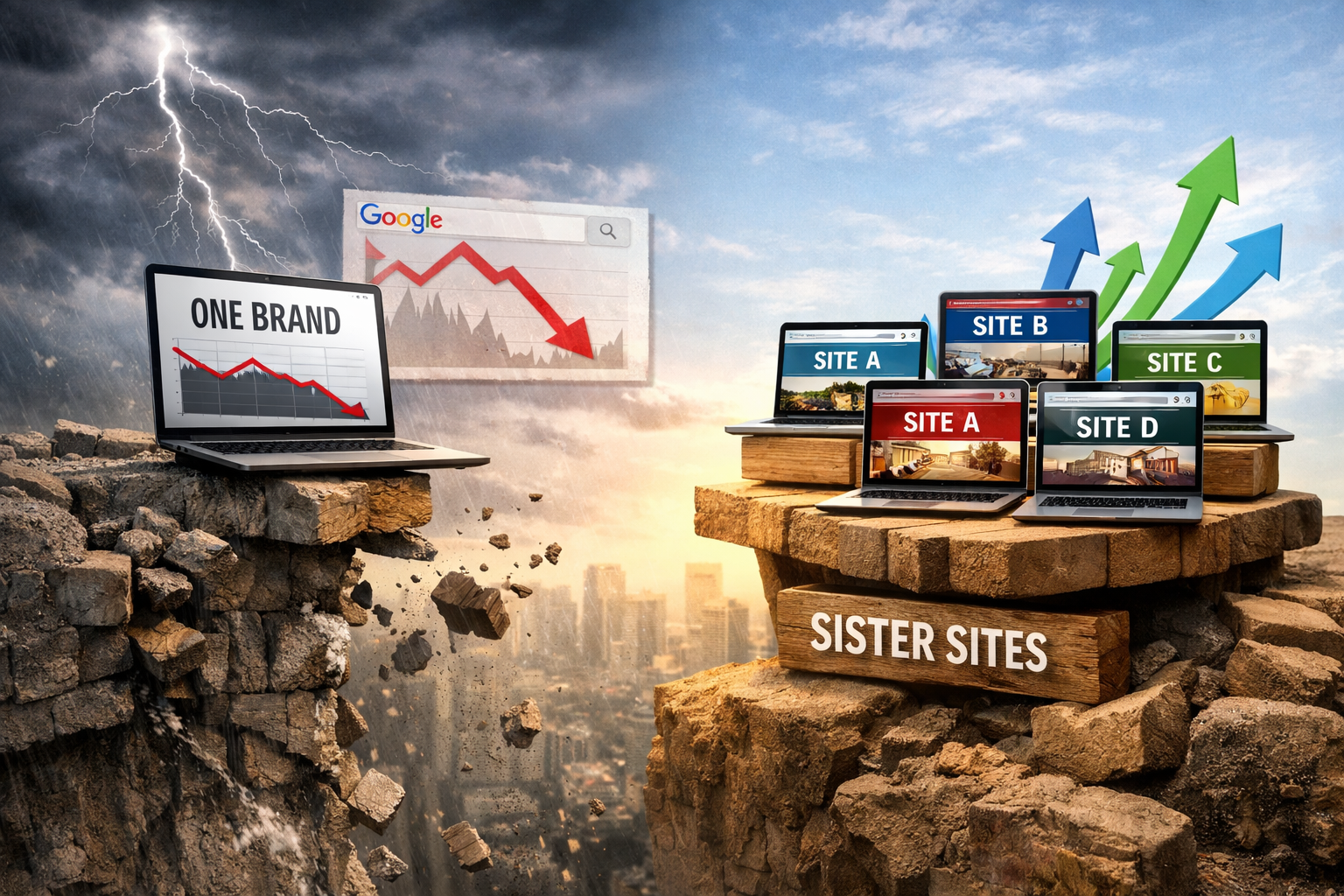
Most businesses treat their website like their only digital asset. One domain, one brand, one presence — everything riding on a single URL. It feels efficient. It feels focused. And for a while, it works.
Then the algorithm updates. Or a competitor moves into the space with more domain authority and deeper pockets. Or the market shifts and the single brand that was built around one customer segment stops reaching the next one. Or a Google core update rolls through and organic traffic drops 40% in a week with no warning and no clear path back.
One brand is a single point of failure. The businesses that figure this out early build around it deliberately. The ones that figure it out after the fact scramble to rebuild what they should have diversified before they needed to.
At Ritner Digital, we're increasingly working with business owners and marketing leaders who are thinking about their digital presence the way smart investors think about a portfolio — not as a single bet, but as a set of interconnected assets that distribute risk, capture different segments of the market, and compound value over time. They come to us with sister brands, subsidiary concepts, and expansion ideas, and they want to know how to build them without cannibalizing what they've already built.
This is what that strategy actually looks like, why it matters, and what it takes to execute it correctly.
Why Single-Brand Digital Dependency Is a Risk Most Businesses Don't See Coming
The Algorithm Problem
Organic search is one of the highest-value acquisition channels available to most businesses — high intent, relatively low cost per acquisition compared to paid media, and compounding returns over time as domain authority builds. It is also entirely dependent on the ongoing goodwill of a platform whose priorities shift without notice.
Google runs multiple core algorithm updates per year alongside a continuous stream of smaller adjustments. Any one of them can materially change the search visibility of a domain that hasn't violated any rules, built any bad links, or done anything wrong. A business that has built its entire digital acquisition strategy around a single domain's organic rankings is fully exposed to that volatility with no hedge.
The businesses that weather algorithm updates best are the ones with diversified digital footprints — multiple domains with independent authority profiles, traffic distributed across properties, and no single point where a ranking shift creates a crisis. When one property takes a hit, the others hold. When one recovers and gains ground, the portfolio improves. The logic is identical to financial diversification and the outcome is identical: lower volatility, more predictable growth.
The Market Segment Problem
A single brand architecture makes a set of implicit choices about who the business is for. The tone, the positioning, the price signals embedded in the design, the vocabulary used throughout the site — all of it communicates a specific identity that resonates with some segments of the market and creates friction with others.
A premium service business that has built a brand around high-end clients in one vertical will find that same brand creates resistance when it tries to move into adjacent markets, serve different price points, or capture segments that don't see themselves as the target customer for what that brand communicates. The brand that is an asset in one context becomes a liability in another — not because anything is wrong with it, but because branding is inherently exclusionary. Every signal that attracts one audience implicitly repels another.
Sister brands solve this problem by allowing the same underlying business to operate authentically across different market contexts without forcing a single brand identity to do work it wasn't built for. A contractor that serves both high-end residential remodels and commercial clients doesn't have to choose between a brand that speaks to homeowners and one that speaks to property managers. They can have both — each optimized for its audience, each building its own authority, each generating its own pipeline.
The Revenue Concentration Problem
Revenue that flows through a single digital channel from a single brand is revenue that is fully exposed to whatever disrupts that brand or that channel. Businesses that have experienced this — a primary domain penalized, a flagship product category disrupted, a brand reputation event that requires distance — know how fast a single-brand digital dependency can become a single-brand digital crisis.
The same business logic that drives product diversification, geographic expansion, and customer segment diversification applies to digital brand architecture. Multiple properties generating revenue from independent traffic sources and serving differentiated audiences create a revenue base that is structurally more resilient than one built on a single brand, regardless of how strong that brand is.
What Sister Site Strategy Actually Means
It Is Not Just Building Another Website
The mistake most businesses make when they decide to expand their digital presence is treating the new property as a copy of the first one with different branding applied. Same structure, same content strategy, same keyword targeting approach, same conversion architecture — just a new name and a new color palette. This produces a duplicate that neither the market nor Google treats as meaningfully distinct, and it generates none of the strategic value that a properly architected sister brand creates.
A genuine sister brand strategy starts with a clear answer to three questions: Who is this for that the primary brand isn't reaching? What does this brand say about itself that the primary brand can't credibly say? And what does this domain need to build authority around that is genuinely independent from the primary domain's authority profile? The answers to those questions define the architecture — and getting the architecture right is what determines whether the second property becomes an asset or a liability.
The Three Models That Work
The Segment Brand — a second property that targets a specific customer segment with its own positioning, its own content strategy, and its own conversion path. A financial services firm that serves both individual investors and institutional clients might operate two brands — one built around the language, concerns, and decision-making process of the individual investor, and one built around the vocabulary and priorities of the institutional client. Same underlying firm, same expertise, completely different brand experience.
The Vertical Brand — a second property that goes deep in a specific industry or service category that the primary brand covers too broadly to own. A digital agency that serves a dozen industries might build a dedicated vertical brand for healthcare clients — its own domain, its own content, its own case studies, its own SEO footprint built around the specific search behavior of healthcare decision-makers. The vertical brand captures market share in a category where the primary brand's generalist positioning creates a ceiling.
The Geographic Brand — a second property built for a specific market where the primary brand either doesn't have strong local relevance or where local search competition requires a dedicated presence. A business that operates nationally but wants to dominate specific metropolitan markets builds properties optimized for those markets — with local content, local authority signals, and local conversion architecture — rather than trying to force a national brand to compete in local search contexts it wasn't built for.
What Separates a Sister Brand From a Doorway Page
Google's guidelines are clear about the line between legitimate multi-site strategy and manipulative doorway page tactics, and understanding that line is essential before building anything. Doorway pages — thin sites created purely to capture search traffic and redirect it to a primary domain, with no genuine independent value for the user — are a violation that creates risk rather than reducing it.
The legitimate sister brand strategy creates independent value. Each property exists to serve a specific audience with content, positioning, and a user experience that is genuinely built for them — not as a shell that exists to game rankings. The test is simple: if a user arrived at the sister site from a search and never visited the primary brand, would the experience serve them? If the answer is yes, the site is real. If the answer is no, it's a doorway page and it's a liability.
The SEO Architecture of a Multi-Site Strategy
Domain Authority as a Portfolio Asset
Domain authority — the accumulated strength of a domain's link profile, content depth, and search history — is built slowly and lost quickly. A primary domain that has been building authority for five or seven years has an asset that took years of consistent investment to create. The strategic question in a multi-site build is how to grow the portfolio's total authority without diluting the primary domain's accumulated strength.
The answer is intentional link architecture. Internal linking between sister brands needs to be structured to pass authority in the directions that serve the portfolio's long-term strategy — which is not always the most obvious direction. Cross-linking between properties that are too similar in topic can trigger topical overlap signals that hurt both. Cross-linking between properties that serve clearly distinct audiences and topics can build authority for both without creating cannibalization risk. Getting this right requires understanding how search engines interpret site relationships, which is a technical and strategic discipline that most businesses don't have in-house.
Keyword Cannibalization: The Most Common Multi-Site Mistake
Keyword cannibalization — where two properties owned by the same business compete against each other for the same search queries — is the failure mode that turns a multi-site strategy from a risk diversification tool into a self-inflicted wound. When two domains target the same keywords with similar content, Google has to choose which one to rank, and the result is often that neither ranks as well as one of them would have if the other didn't exist.
Avoiding cannibalization requires clear keyword ownership at the strategy level — before either domain publishes a word. Each property needs a defined keyword territory that doesn't overlap with the other properties in the portfolio. This means understanding not just the primary keywords each site will target but the full topical footprint each site will build over time, and ensuring those footprints are genuinely distinct rather than superficially differentiated.
Technical Infrastructure for Multi-Site Management
Running multiple properties efficiently requires infrastructure that most single-brand businesses haven't needed to build. Separate hosting environments, separate analytics configurations, separate Google Search Console properties, separate crawl monitoring, and separate content calendars — all of which need to be managed with enough coherence that the portfolio strategy is actually being executed rather than drifting.
The operational overhead of a multi-site portfolio is real, and underestimating it is one of the most common reasons sister brand strategies fail. A second domain that is built and then neglected — that stops receiving fresh content, stops building new links, and stops being actively managed — deteriorates. Search engines interpret neglect as declining relevance, and a dormant second domain often becomes a weaker version of what it was at launch rather than a strengthening asset.
Brand Architecture: Making the Portfolio Work Together
When to Keep Brands Separate and When to Connect Them
The relationship between sister brands in a portfolio is a strategic decision, not a default. Some multi-site portfolios benefit from visible connection — sister brands that reference each other, that share testimonials or case study content, that allow clients who know one brand to find the other easily. Others benefit from clean separation — brands that operate entirely independently in the market with no visible connection to each other, because the connection would undermine one or both brands' credibility with their respective audiences.
A luxury residential contractor and a commercial construction brand owned by the same company might benefit from clean separation — the luxury residential client doesn't want to feel like they're hiring a commercial firm, and the commercial client wants a partner who operates at commercial scale, not one whose primary identity is custom homes. A law firm that operates a general practice brand and a specialized personal injury brand might benefit from the same clean separation for different reasons — the specialized brand builds more trust in a competitive category if it isn't diluted by a generalist identity.
The decision about visible versus invisible brand relationships should be made on the basis of how each target audience will interpret the connection — not on the basis of what's operationally convenient.
Tone, Positioning, and Visual Identity as Distinct Assets
Each brand in a portfolio needs to be genuinely differentiated at the level of tone, positioning, and visual identity — not just at the level of name and color. A sister brand that sounds like the primary brand written in a slightly different voice, that makes the same claims in slightly different language, and that looks like a reskinned version of the primary brand's website is not a genuinely distinct brand. It is a variant that neither the market nor search engines treat as meaningfully different.
Genuine brand differentiation requires making real choices about each brand's personality, its vocabulary, its visual language, and the specific promise it makes to its specific audience. Those choices need to be maintained consistently across every touchpoint — the website, the content, the social presence, the sales materials — or the differentiation erodes and the portfolio loses the strategic value that made it worth building.
The Content Strategy Across Multiple Brands
Content is the mechanism through which each brand builds authority, attracts organic traffic, and moves buyers through the decision process. In a multi-brand portfolio, content strategy needs to be coordinated at the portfolio level to prevent cannibalization while being executed independently at the brand level to maintain authentic differentiation.
This means each brand has its own content calendar, its own topical authority roadmap, and its own editorial voice — but the portfolio-level strategy ensures those roadmaps don't overlap in ways that create internal competition. It also means understanding which content opportunities are better served by the primary brand's existing authority and which are better served by a sister brand's more focused positioning. That allocation decision, made well, accelerates the authority-building of every property in the portfolio.
How Ritner Digital Works With Multi-Brand Businesses
Where We Come In
The clients who come to us with multi-brand questions are usually at one of three points in the process. Some are still in strategy — they know they want to expand their digital footprint but haven't decided on the architecture, and they want a partner who can help them think through the structure before they build anything. Some have already built a second property and are watching it underperform, often because the architecture wasn't thought through at the outset. And some are running multiple properties reasonably well but have hit the operational ceiling of managing them without the infrastructure and process to do it efficiently at scale.
All three situations are ones we work through. The approach is different for each — a strategy engagement looks different from a turnaround looks different from a scale engagement — but the underlying discipline is the same: understanding what each property is trying to accomplish, auditing what's working and what isn't, and building the system that makes the portfolio grow rather than just exist.
What We Actually Build
For businesses starting a sister brand from scratch, we handle the full build — brand architecture and positioning, visual identity and web design, technical SEO infrastructure, content strategy, and the ongoing management that keeps the property growing. The goal is a property that is genuinely distinct from the primary brand, built on a technical foundation that supports long-term authority growth, and managed with enough consistency that it compounds rather than stagnates.
For businesses with existing multi-brand portfolios that aren't performing as expected, we start with an audit — pulling the search data from every property, mapping the keyword footprints against each other to identify cannibalization, assessing the authority profile of each domain, and identifying where the portfolio strategy is leaking value. The audit almost always surfaces specific, fixable problems that the client didn't know to look for. Fixing them doesn't require rebuilding — it requires the right diagnosis and the right sequence of interventions.
For businesses managing multiple properties at scale, we build the operational infrastructure — the content systems, the reporting frameworks, the technical monitoring, and the strategic coordination layer — that allows a portfolio to grow without the operational overhead growing proportionally. A business running five properties shouldn't need five separate agencies or five separate internal teams. It needs one partner with the systems to manage the portfolio coherently.
What We've Learned From Doing This
The businesses that build the most successful multi-brand portfolios are the ones that treat each property as a genuine long-term investment — not a quick experiment that gets abandoned if it doesn't generate leads in the first 90 days. Sister brand strategy is compounding. The properties that are worth the most are the ones that have been consistently built over time, and the businesses that understand this allocate resources accordingly.
The businesses that struggle with multi-brand strategy are the ones that build the second property without resolving the strategic questions that determine whether it will be genuinely distinct, and then wonder why it isn't generating the results they expected. The questions aren't complicated — who is this for, what does it say, what does it own in search — but they have to be answered before the first page is published, not after the first year of underperformance.
The Bottom Line
One brand is one bet. It might be a good bet — a well-built primary brand with strong authority, a clear position in the market, and a healthy organic traffic profile is a genuine asset. But it's still one bet, and the businesses that have been around long enough have usually had at least one moment where they wished they hadn't put everything on a single number.
The multi-brand portfolio is not a complicated idea. It is the same risk management logic that applies to every other aspect of running a business — applied to the digital assets the business depends on for growth. More than one property. More than one authority profile. More than one traffic source. More than one audience. Built correctly, managed consistently, and coordinated strategically so the portfolio grows as a whole rather than as a collection of independent experiments.
If you're thinking about building a sister brand, expanding your digital footprint, or getting more strategic about a portfolio you've already started building — that's a conversation worth having. We've had it enough times to know what works and what doesn't, and we'd rather have it before the architecture is set than after it's already producing the wrong results.
Ritner Digital is a Philadelphia-based digital agency specializing in SEO, web design, and digital growth strategy. We work with businesses building single brands and multi-brand portfolios across industries nationwide.
Frequently Asked Questions
What exactly is a sister site and how is it different from just having two websites?
A sister site is a strategically distinct digital property — its own domain, its own brand identity, its own positioning, and its own content strategy — built to serve a specific audience or market segment that the primary brand isn't optimally built to reach. The difference between a sister site and just having two websites is intentionality. Two websites with no strategic architecture behind them are two overhead items. A properly built sister brand is an independent asset that builds its own authority, captures its own audience, and generates its own pipeline — while being coordinated at the portfolio level to avoid cannibalization and maximize combined value.
Won't having two sites that cover similar topics hurt both of them in search?
It can — and it will, if the strategy isn't built correctly from the start. Keyword cannibalization, where two properties owned by the same business compete against each other for the same search queries, is the most common failure mode in multi-site strategy and one of the most damaging. The way to avoid it is to define clear keyword territory for each property before either one publishes content — ensuring that the topical footprints are genuinely distinct rather than superficially differentiated. When each property owns its own search territory and the content strategies don't overlap, both properties build authority independently without undercutting each other.
How does Google treat multiple websites owned by the same business?
Google's concern is user value, not ownership structure. Multiple sites owned by the same business are perfectly legitimate — the line Google draws is between genuine independent properties that serve distinct audiences with real value and doorway pages that exist only to capture search traffic with no authentic purpose. A sister brand that is genuinely built for a specific audience, with its own content, its own positioning, and its own user experience that serves visitors independently, is a legitimate property. A thin site that exists only to rank and redirect traffic to the primary domain is a doorway page and a liability. The test is simple: if a visitor arrived and never found the primary brand, would the experience serve them? If yes, it's real. If no, it's a risk.
How much does it cost to build and maintain a sister brand properly?
It depends on the scope of the build and the ongoing management required, but the honest framing is this: a sister brand is a long-term investment, not a one-time expense. The initial build — brand architecture, visual identity, website, technical SEO foundation, and initial content strategy — is a defined project with a defined cost. The ongoing management — content production, link building, technical monitoring, and strategic coordination with the primary brand — is a recurring investment that determines whether the property compounds in value or stagnates. A sister brand that is built and then neglected deteriorates. The businesses that get the most value from multi-site strategy are the ones that budget for both the build and the sustained management from the start.
Should the sister brand be visibly connected to our primary brand or kept completely separate?
It depends entirely on how each target audience will interpret the connection. Some multi-brand portfolios benefit from visible connection — where the relationship between properties builds credibility for both and makes it easy for clients who know one brand to find the other. Others benefit from clean separation — where the connection would undermine one or both brands' positioning with their respective audiences. A luxury residential brand and a commercial brand owned by the same contractor might benefit from clean separation because the luxury client doesn't want to feel like they're hiring a commercial firm. A regional brand and a national brand owned by the same business might benefit from visible connection because the national credibility reinforces the regional brand's authority. The decision should be made on audience psychology, not operational convenience.
We already have a second site that isn't performing. What's usually wrong?
Almost always one of three things. First, the keyword footprints of the two properties overlap significantly, creating internal competition that limits both. Second, the second property was built without a genuinely distinct positioning — it sounds like the primary brand in a different color scheme, which means it doesn't own a clear space in the market or in search. Third, the property was built and then underinvested — content stopped being published, links stopped being built, and the property stagnated while the primary brand kept growing. The fix depends on which problem is actually present, which is why we start underperforming multi-site situations with an audit before recommending any changes. The diagnosis has to come before the intervention or you're guessing.
How do we decide what the sister brand should focus on?
Start with the gaps the primary brand can't fill. Who is searching for solutions you can provide but not finding your primary brand because the positioning doesn't speak to them? What keyword territories are adjacent to your core business that your primary domain can't own without diluting its existing positioning? What market segments are you losing to competitors who are more specifically built for that segment? The answers to those questions define the opportunity. The sister brand is built around the clearest, most valuable gap — the one where a dedicated presence would capture meaningful revenue that the primary brand is currently leaving on the table.
Can a sister brand strategy work for small businesses or is it only for larger companies?
It works at any size where the underlying business has the capacity to serve more than one distinct market segment. The operational requirements scale with the ambition of the strategy — a single focused sister brand targeting a specific local market or a specific service category is a manageable investment for a small business with the right partner. Where small businesses get into trouble is treating a sister brand as a shortcut to more traffic rather than as a genuine long-term investment that requires sustained management. A second property that a small business can't commit to managing consistently is a worse investment than doubling down on the primary brand's authority. The honest conversation before building anything is whether the business has the capacity — in budget, in content, in management attention — to do the second property right.
How long before a sister brand starts generating meaningful traffic and leads?
The same timeline that applies to any domain building authority from scratch — meaningful organic traction typically takes three to six months of consistent investment, with compounding returns building from there. The timeline can be accelerated by a strong initial link building strategy, a highly focused keyword territory with realistic competition levels, and a content strategy that publishes enough depth quickly enough to establish topical authority. It can also be extended significantly if the keyword territory is too competitive, the content strategy is too thin, or the technical foundation has problems that limit crawlability and indexation. Businesses that expect a new sister brand to generate significant traffic in the first 60 days are going to be disappointed regardless of how well it's built.
What's the first conversation we should have with Ritner Digital if we're thinking about a sister brand?
The strategy conversation, before the build conversation. The most expensive mistakes in multi-site strategy happen when the architecture decisions are made too quickly — when the domain is registered, the site is built, and content is published before the fundamental questions about positioning, keyword territory, and brand differentiation have been answered. We'd rather spend time at the front end making sure the strategy is sound than spend time later diagnosing why a property that cost real money to build isn't producing what it should. If you're thinking about a sister brand, start by telling us what problem you're trying to solve — what the primary brand isn't reaching, what revenue you're leaving on the table, what risk you're trying to diversify. That conversation shapes everything that comes after it.