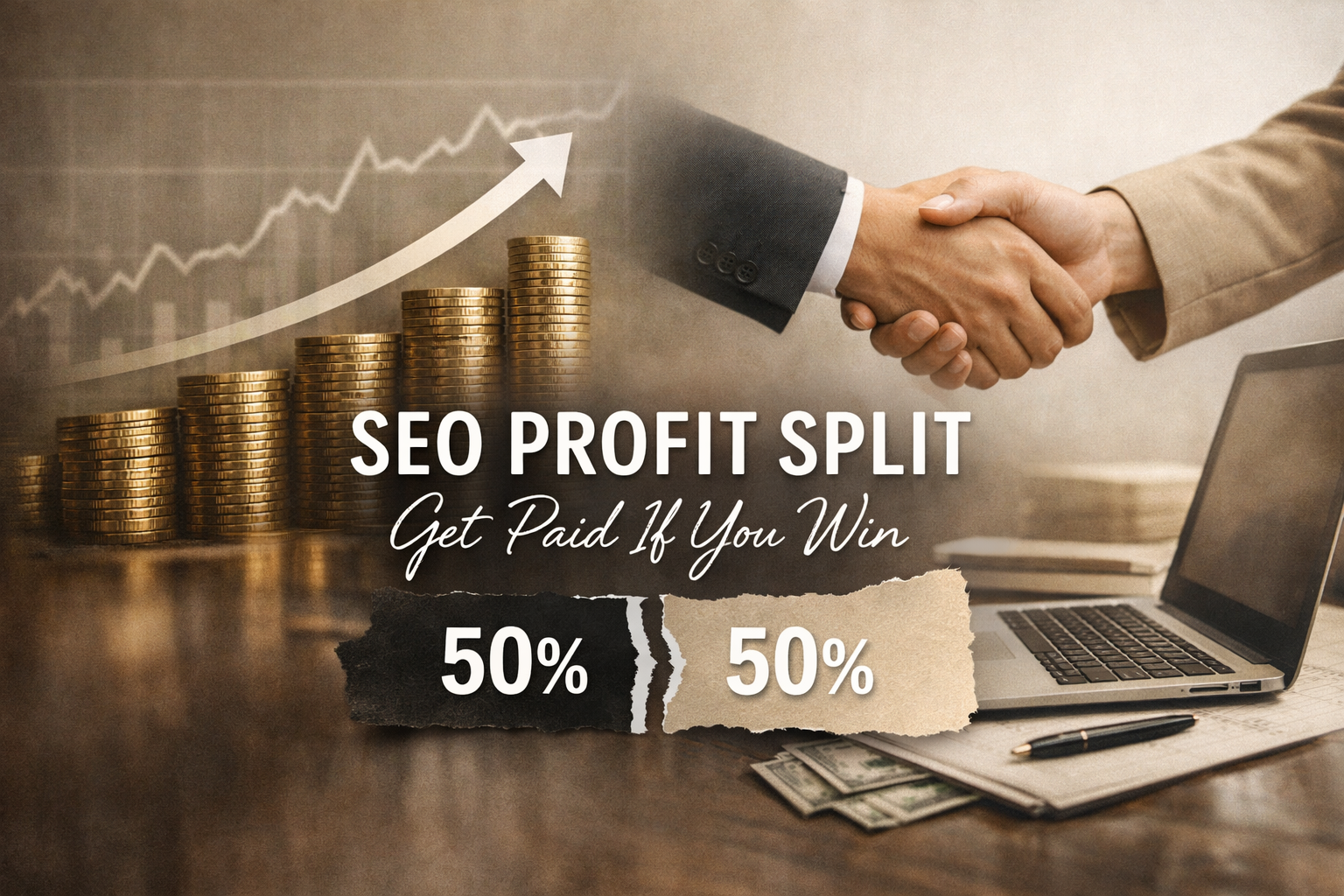
SEO for Profit Split: When “We Only Get Paid If You Win” Is a Power Move (and When It’s a Trap)
If an SEO agency ever tells you they’ll work for a percentage of the profit they generate, your first reaction is probably:
“Why isn’t everyone doing this?”
Your second reaction should be:
“Okay… what’s the catch?”
Because SEO for profit split is one of the most misunderstood pricing models in digital marketing. When it works, it creates freakishly aligned incentives and long-term growth. When it doesn’t, it quietly drains margin and creates arguments over spreadsheets no one enjoys.
Let’s unpack what SEO for profit split actually is, how it works in the real world, and who should (and absolutely should not) touch it.
What Is SEO for Profit Split (Really)?
At its core, SEO for profit split is a performance-based partnership.
Instead of paying a fixed monthly retainer, the business agrees to share a percentage of SEO-attributed revenue or profitwith the agency. The agency fronts the strategy, execution, and often the content costs, betting that their work will generate meaningful organic growth.
In other words:
The agency takes on the risk.
The business gives up a slice of upside.
This isn’t “free SEO.” It’s deferred, variable-cost SEO.
Why Agencies Offer Profit Splits (and Why Most Don’t)
From the outside, profit split SEO sounds generous. From the inside, it’s risky.
SEO requires:
Time
Talent
Content
Technical resources
Agencies offering profit splits are essentially investing those resources upfront with no guarantee of return. That’s why most agencies avoid this model entirely—and the ones that don’t are extremely selective.
Profit split SEO is usually offered when:
The business already converts well
Organic traffic has clear upside
Revenue attribution is airtight
Margins can support sharing
If you’re wondering why your brand-new startup isn’t getting these offers, this is why.
The Big Appeal: Why Businesses Love This Model
SEO for profit split gets attention for three main reasons:
1. Lower Upfront Cost
No large retainers. No heavy cash burn while waiting for rankings to move.
For bootstrapped or cash-conscious businesses, this is huge.
2. Incentive Alignment
The agency doesn’t get paid for “effort.”
They get paid for results.
That alignment can lead to:
Smarter prioritization
Stronger CRO collaboration
Less busywork, more impact
3. Shared Long-Term Vision
Because payment depends on performance, both sides are incentivized to think in years, not months.
That’s rare in marketing—and powerful when it works.
The Part No One Puts on the Sales Page
Now for the tradeoffs.
Profit Is a Slippery Word
Before anything else, both sides need to agree on:
What counts as SEO traffic
How revenue is attributed
Whether profit means gross or net
How refunds, churn, and repeat customers are handled
If these aren’t defined with painful clarity, the relationship won’t scale.
SEO Compounds (Which Cuts Both Ways)
SEO doesn’t stop working when the agency stops working.
That means:
A blog written today could drive revenue for years
Profit sharing may continue long after execution slows
Great for growth. Potentially expensive for the business.
Strategy Control Is Tighter
Agencies in profit split models tend to:
Push harder on high-intent keywords
Avoid “brand” or awareness content
Prioritize speed over experimentation
That’s not bad—but it does mean the strategy is less flexible.
Who SEO for Profit Split Is Best For
This model shines when the business already has momentum.
Established, Revenue-Generating Companies
If you already know:
Your customer lifetime value
Your conversion rates
Your sales cycle
SEO becomes a scaling lever, not a guessing game.
High-Margin Businesses
Profit splits work best when margins can absorb variable costs.
Common fits include:
SaaS
Professional services
Education and info products
High-ticket eCommerce
If margins are thin, the math breaks quickly.
Businesses With Clean Attribution
You need to confidently answer:
Where does organic traffic convert?
How does it move through the funnel?
What is it worth?
No vibes. No “best guesses.”
Who Should Avoid SEO for Profit Split
This is not the move if:
You’re pre-revenue or pre-product-market fit
Your site has little to no traffic history
Your funnel or conversion rates are still unstable
You want full creative control over SEO priorities
In these cases, fixed-fee SEO is usually cheaper, faster, and far less risky.
Profit Split vs Retainer SEO: The Real Difference
This isn’t about which model is “better.” It’s about timing.
Profit Split SEO
Lower upfront cost
Higher long-term cost if successful
Strong incentive alignment
Less flexibility
Retainer SEO
Predictable spend
Full ownership of upside
More strategic freedom
Requires patience and budget
One optimizes for cash flow.
The other optimizes for control and lifetime ROI.
So… Is SEO for Profit Split Worth It?
Here’s the honest take:
SEO for profit split is not a shortcut—it’s a commitment.
When both sides have:
Clear expectations
Clean data
Long-term thinking
It can outperform traditional SEO models.
But when fundamentals aren’t in place, it becomes expensive confusion disguised as “no risk.”
At Ritner Digital, we look at profit split SEO as a tool, not a default. Sometimes it’s the smartest move in the room. Other times, it’s a distraction from fixing what actually drives growth.
Knowing the difference?
That’s the real competitive advantage.
FAQs
What exactly is an SEO profit split agreement?
An SEO profit split agreement is a performance-based partnership where an SEO agency is paid a percentage of revenue or profit generated from organic search, instead of a fixed monthly fee.
The agency typically handles:
SEO strategy
Content planning and execution
Technical SEO guidance
Ongoing optimization
Payment is tied directly to results, not activity.
Is SEO profit split based on revenue or profit?
It can be either—but this is where things get serious.
Some agreements are based on:
Revenue from organic traffic
Gross profit
Net profit after expenses
Each option dramatically changes the economics. Revenue-based splits are simpler to track, while profit-based splits are more precise—but harder to define. If this isn’t clearly outlined, the agreement will get messy fast.
How are SEO-driven results tracked?
Reliable tracking is non-negotiable.
Most profit split models rely on:
GA4 organic traffic attribution
Keyword-to-page mapping
CRM or backend sales data
Defined attribution windows (first-touch, last-touch, or blended)
If SEO revenue can’t be clearly isolated, the model breaks down.
How long does it take to see results from SEO profit split?
SEO is not instant—profit split or not.
Most businesses see:
Early traction: 3–6 months
Meaningful revenue impact: 6–12 months
Compounding gains: 12+ months
Because agencies take on upfront risk, most profit split contracts are designed for long-term partnerships rather than short wins.
How long do SEO profit split contracts usually last?
Typical contract lengths range from 12 to 36 months.
Longer terms exist because:
SEO compounds over time
Results may continue after execution slows
Agencies need time to recoup their investment
Short-term profit split deals are rare and usually come with stricter conditions.
Can startups use SEO profit split models?
In most cases, no—and that’s not a knock on startups.
Early-stage companies often lack:
Stable traffic patterns
Conversion data
Predictable revenue
Proven funnels
Without those, there’s no reliable way to measure “profit from SEO.” Startups are usually better served by fixed-fee SEO until traction exists.
Is SEO profit split really “lower risk”?
It lowers upfront financial risk, but it doesn’t eliminate risk entirely.
For businesses:
Less cash spent early
Variable cost tied to performance
For agencies:
High upfront investment
No guaranteed return
Risk isn’t removed—it’s redistributed.
What happens if we stop working together?
This depends entirely on the contract, but common structures include:
A sunset period where profit sharing continues
Ongoing splits for pages created during the partnership
A clean cutoff after a defined term
This should be spelled out clearly before work begins—no assumptions.
Can SEO profit split become more expensive than a retainer?
Yes—and that’s often the goal.
If SEO performs well:
Revenue grows
Profit sharing increases
Lifetime cost can exceed a traditional retainer
This model trades predictable cost for performance-based upside.
Do businesses lose control with profit split SEO?
Not necessarily, but control is more limited.
Agencies in profit split models typically prioritize:
High-intent keywords
Revenue-driving pages
Faster ROI paths
Brand-building or experimental content may take a back seat unless it clearly supports revenue.
Is SEO profit split better than traditional SEO pricing?
It’s not better—it’s situational.
SEO profit split works best for:
Established businesses
High-margin offers
Clear attribution
Long-term growth goals
Traditional retainers work better when:
You want predictable costs
You want full upside ownership
You’re still testing positioning or funnels
The best model is the one that fits where your business is right now.
How do I know if my business is a good candidate?
You’re likely a strong fit if:
You already generate consistent revenue
You can track organic conversions accurately
Your margins support revenue sharing
You’re comfortable with long-term partnerships
If those boxes aren’t checked yet, SEO profit split may be premature.
Related Reads
〰️
Related Reads 〰️
Why SEO Feels Like a Scam (And How to Tell If It Is)
SEO has a trust problem. Not because it doesn’t work—but because it’s often oversold, poorly explained, and measured with metrics that don’t matter. This post breaks down why SEO feels scammy and how to tell if you’re dealing with real strategy or just expensive noise.

How to Tie Marketing Spend to Revenue
Marketing teams spend money. Finance wants proof. This guide breaks down how to tie marketing spend to real revenue using clean tracking, attribution models, and data your leadership team will actually trust.
Why Organic Traffic Is the Most Sustainable Growth Strategy in 2026
Paid ads deliver short-term results. Organic traffic compounds. Learn why SEO and content marketing are the most sustainable growth strategies for businesses in 2026 — and how to build traffic that converts long after campaigns end.