The Bakery That Sells Out Every Week (And Is Still Invisible): SEO for Micro-Bakeries and Cottage Food Businesses
Last time we wrote about a kind of company we'd love to work with, it was a century-old firm whose products are literally under your feet — iron, poured at industrial scale. This time it's a business that fits in a paper bag.
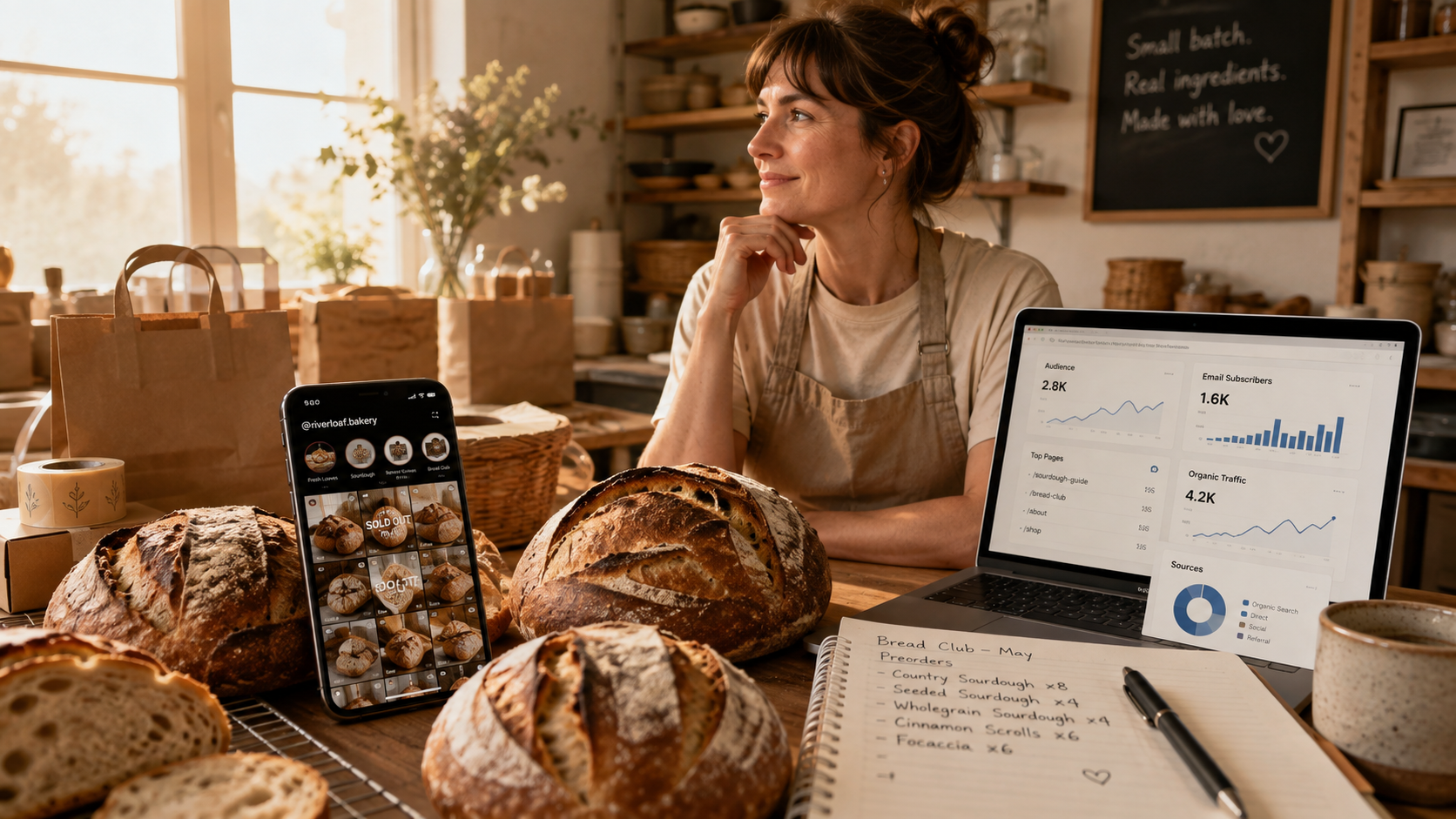
You know this bakery, or one like it. It started in a home kitchen sometime around 2020, when a sourdough starter got a name and a personality. Now there's a weekly bake schedule posted to Instagram stories, a porch-pickup system or a farmers market table, loaves that photograph like magazine covers — and a sellout, every single week, usually within hours. Regulars text on Thursdays to beg. The waitlist has a waitlist. By every visible measure, it's a roaring success.
And here's the thing we'd say to that baker across the table, with genuine respect for what they've built: you sell out every week, and you're still invisible — and those two facts are more connected than you think. The sellout is real. So is this: if Instagram disappeared tomorrow — hacked, suppressed, or just quietly de-ranked by an algorithm change — the entire business would disappear with it, because the whole operation lives on one rented channel. And meanwhile, every single day, people in your own town search "sourdough bread near me" and get sent to a grocery store, because the actual best answer has no page.
This post is the case for fixing that — the space by the numbers, why "sold out" is not "maxed out," and the exact playbook, sources linked as always. And yes, this is an inbound post; this is a kind of business we'd love on the roster, same as we said about the foundries — the audition is free either way.
The space: a real industry hiding in home kitchens
Start with what cottage food actually is now, because it stopped being a hobby economy a while ago. Home-based food businesses generated an estimated $2 billion nationally in 2024, with the number of registered producers roughly doubling since 2020 — driven in no small part, the industry's own analysts note, by pandemic-era bakers who discovered they could monetize their sourdough. It's legal everywhere: all 50 states now allow some form of homemade food sales, with more than 30 states loosening their laws since 2019 — rising revenue caps, expanding product lists, the whole trend running toward more freedom, not less. Fifteen states have no sales cap at all; the capped ones range from $25,000 to $250,000 a year. And bread — sourdough specifically — is the category's star: legal in every state, no special treatment required, and one of the best-selling products at any farmers market.
One more fact with a local edge for our corner of the map: New Jersey was the last state in the country to enact a cottage food law, in 2021. Every home bakery in the state is, legally speaking, five years old or younger — which means the local searches, the "best sourdough in [town]" answers, and the AI recommendations are a land that has barely been claimed. Somebody's going to own "sourdough [your town]" for the next decade. Right now, in most towns, it's nobody.
"We sell out every week" — the objection, taken seriously
Every baker reading this has the same fair objection the police chiefs had and the foundry owners had: why would I market a product I can't keep in stock? It deserves a straight answer, and the answer has three parts.
First: sold out isn't maxed out — it's sold out at this price, through this channel, to this audience. A weekly sellout to the same 400 Instagram followers tells you demand exceeds supply inside that bubble. It says nothing about the price the broader market would pay, the bread-club subscriptions that would replace Thursday chaos with predictable revenue, the classes that would sell at ten times a loaf's margin, or the café that would take a standing wholesale order. Sellouts feel like a ceiling. They're actually a signal — the strongest possible evidence that the business is ready for its next shape, and every next shape needs an audience bigger than a story view.
Second: the whole business is renting from one landlord. We've written the rent-vs-own math for every kind of business, and the Instagram-only micro-bakery is the purest rent case we've ever described. The bake schedule, the preorders, the customer list, the entire storefront — all of it lives inside an app whose algorithm decides daily who sees it, whose DM inbox is the order system, and whose account-recovery process is the only thing standing between the business and zero. This isn't hypothetical doom-saying; it's the same 200-followers physics every fire company knows, plus a single point of failure. The businesses that survive platform weather are the ones with a home address on the open web and — above all — an email list, the one audience asset no algorithm can repossess. A bakery with 300 emails is sturdier than one with 3,000 followers, because Thursday's bake announcement lands in 300 inboxes at a 100% delivery rate, forever, free — while the same announcement as a story reaches whatever fraction the landlord permits that day.
Third: the searches are happening tonight, without you. "Sourdough bread near me." "Fresh baked bread [town]." "Sourdough classes near me." "Where to buy real sourdough Philadelphia suburbs." Real people, real intent, every night — currently being answered by grocery chains, a national bakery's location page, and increasingly by AI. Ask ChatGPT where to buy genuine sourdough in your town and see who it names; most small businesses have never run that check, and for a bakery whose entire presence is an Instagram bio link, the honest answer is usually nothing — because a linktree is invisible to the systems that answer questions. The best bread in town, losing the "best bread in town" search to a supermarket. That's the whole problem in one sentence.
The ten-minute test any baker can run tonight
Same prescription we hand every business we write about: before believing us, run your own audit, phone in one hand, flour on the other.
Round one, the stranger's search: Google "sourdough bread near me" and "fresh baked bread [your town]" in an incognito window. Note who wins — and specifically whether it's a supermarket bakery section or a national chain's location page sitting on demand you could take. Round two, the referral handoff: search your own bakery's name, then a fuzzy version of it ("that sourdough lady in [town]"), because that's how the dinner-party guest actually searches three days later. If the trail dead-ends at a bio link or an unclaimed knowledge panel, you've found where your best marketing — the loaf itself — leaks. Round three, the robot: ask ChatGPT where to buy real sourdough near your town, whether there are any bread subscriptions locally, and who teaches sourdough classes nearby. Grade it for your absence.
Most micro-bakeries score the same way: dominant inside the Instagram bubble, nonexistent everywhere else — while the searches run nightly and the answers get handed to whoever published anything at all. The good news is the flip side of the bad news: in a market where every competitor is also just a bio link, the first bakery with a real address on the open web wins by default, and keeps winning as it compounds.
The customer's journey — you already know the first step
The micro-bakery journey starts in the best possible place: the loaf itself, at someone else's table. A dinner guest tears off a piece and asks the question every baker lives for — "okay, where did you get this?" What happens next decides whether that moment compounds or evaporates.
The guest searches the bakery's name later that week. Best case today: they find the Instagram, follow it, and maybe catch a story before Thursday's dropped. Worst case, and it's common: they can't quite remember the name, search "that sourdough bakery in [town]," find nothing, and buy the grocery boule. Now run the owned version: the search finds a real site — this week's bake schedule and a preorder page, the bread club ("never miss a week — first pick, every Friday"), the classes page, the starter's story. The dinner-table moment converts to a subscriber instead of a maybe. Multiply by every loaf that leaves the kitchen — each one is a walking referral engine currently pointed at a channel that may or may not show the follow-up. The bread is already doing the marketing. The web presence just has to stop dropping the handoff.
The growth levers — and why each one needs owned visibility
Here's what makes this space genuinely fun to strategize: the micro-bakery has four distinct next shapes, and every one of them runs on searchable, ownable demand.
The bread club. Subscriptions convert sellout chaos into planned production and predictable revenue — and they're sold on a page, not a story: what members get, when, how pickup works, what it costs. The Thursday texting horde is a subscription list that hasn't been offered one yet.
Classes and workshops. The margin king. "Sourdough class near me" is one of the most consistently searched phrases in food — the same national obsession that doubled the producer count is still minting students — and a Saturday workshop grosses what several bake days do, on flour. The baker who publishes real teaching content (see below) doesn't just rank for the class; they walk in pre-trusted.
Holiday preorders. Thanksgiving loaves, holiday gift boxes, the December rush — the seasonal-deadline math applies in miniature: the preorder page for November needs to exist, on a permanent URL, in early fall, and it compounds every year it returns.
The leap — wholesale or the storefront. The café owner deciding whether to stock your bread will Google you first, exactly like every modern B2B buyer. And the storefront decision — the biggest bet a baker ever makes — gets radically safer with proof in hand: an email list in the four figures, a subscription base, ranked local searches, and a town that demonstrably knows where to find you. Owned audience isn't just marketing; it's the underwriting.
The unfair advantage: the story is the product
And now the part where the micro-bakery holds better cards than businesses a thousand times its size. Search engines and AI engines have spent years learning to reward exactly one thing above all: content that could only have come from the person who actually does the thing. A sourdough baker is made of that content. The starter with a name and a lineage. The 24-hour ferment, photographed honestly. The local flour and why it matters. The troubleshooting wisdom — why the crumb did that, what the weather does to proofing — that home bakers search for in the tens of thousands every day.
Publish it, and two flywheels start at once. Locally, the entity signals and story content make you the answer to "real sourdough near me" and the name AI gives when your town asks. Nationally, the teaching content ranks far beyond your delivery radius — and harvests emails, sells classes, and builds the authority that makes the local flywheel spin faster. It's the hometown-guys thesis at its smallest and purest scale: nothing to fake, everything to translate. Honestly, it's the lemonade stand from our explainer, grown up and holding a bench scraper — good lemonade, clear sign, neighbors vouching, easy to find. The bread's already perfect. The other three are just work.
The honest part
Four things, said plainly — including one most agencies would never say. We don't have a bakery on the roster; same disclosure as every space we enter, and the first one in gets the founder's full attention. The math has to be honest at cottage scale: if you're under a state revenue cap and happily staying there, $1,000 a month may genuinely not make sense yet — and we'll tell you so on the free check rather than take the money. The engagement earns its keep when you're reaching for a next shape: the club, the classes, wholesale, the storefront, or a no-cap state trajectory where the ceiling is your oven, not your marketing. Until then, the check itself plus this post's playbook is a legitimate DIY starting line, and we'd rather you run it than rent more reach. Keep the Instagram — this isn't either/or; the feed stays the community's living room while the site becomes the address, and every post should point home. And nothing here fixes bad bread — same as every vertical: visibility amplifies what's real. Yours is real. That's rather the point.
The bottom line
Four sentences, like always. The cottage food economy is $2 billion and doubling, legal in all 50 states, and its best businesses are selling out weekly through a single rented algorithm while their towns' "sourdough near me" searches go to grocery stores. Sold out isn't maxed out — it's the signal that the bread club, the classes, the holiday preorders, and eventually the storefront are ready, and every one of those runs on owned visibility and an email list no platform can repossess. The story is the product, and it's the exact content search and AI engines reward most — untranslated, it's worth nothing online; translated, it owns the town. The loaf already converts everyone who tastes it; the job is making sure the search that follows finds you.
Frequently Asked Questions
Our bakery sells out every week — do we really need marketing?
You need it because you sell out: a weekly sellout proves demand exceeds supply inside your current bubble, and says nothing about the subscription revenue, class income, wholesale accounts, or storefront viability waiting outside it. Sold out is a signal, not a ceiling. The question isn't "can we sell this week's bake" — it's "what does this business become next," and every next shape (club, classes, wholesale, storefront) runs on an audience bigger than a story view and owned instead of rented.
Isn't Instagram enough for a small bakery?
It's a great living room and a terrible foundation. The algorithm decides daily who sees the bake schedule, the DM inbox is a fragile order system, and one hack or suppression event separates the business from zero — with a customer list you can't take with you. Keep the Instagram; add the address: a real site with the schedule, preorders, club, and classes, plus an email list, so every platform moment deposits into something no landlord controls. Party at their house; sleep at yours.
Can a home-based cottage bakery even have a Google Business Profile?
Generally yes — as a service-area or by-appointment business with the home address hidden, or anchored to your regular market presence, depending on your setup and state rules. What matters is existing somewhere Google and AI can read: a profile, a real site, consistent name-and-town signals. Right now most cottage bakeries are a bio link, invisible to every system that answers "sourdough near me" — which is why the grocery store wins a search the micro-bakery deserves.
What should a micro-bakery's website actually include?
Five pages carry the whole business: this week's bake schedule with preordering (ends the DM chaos), the bread club, classes and workshops, the story page — starter, process, flour, you — and a seasonal preorder page on a permanent URL that returns every holiday and compounds. Add the teaching library as it grows: guides and troubleshooting content that rank far beyond your delivery radius and harvest the email list. Every page written the way your customers talk, not the way marketing talks.
How do classes and subscriptions change the economics?
Completely — they're the difference between selling hours-of-labor at loaf margins and selling expertise at teaching margins. A weekend workshop can gross what multiple bake days do, "sourdough class near me" is one of food's most durable searches, and a subscription base converts sellout volatility into planned production and predictable monthly revenue — the exact proof a lender, landlord, or your own nerves want before the storefront leap. Both are sold by pages and email, not stories that expire in 24 hours.
Is $1,000 a month realistic for a cottage bakery?
Honestly: sometimes no, and we'll say so. Under a state revenue cap with no plans to grow, the flat rate may not pencil yet — take the free check, use this playbook yourself, and come back when you're reaching for the next shape. It pencils when the club, classes, wholesale, or storefront are on the table, because those run on exactly what the engagement builds. An agency that won't tell a small business "not yet" is telling you something about its other advice, too.
Find out who's winning "sourdough near me" in your town
Here's the offer, plainly: we'll run your bakery through the free visibility check — what ChatGPT, Gemini, and Claude say when your town asks where to buy real bread, who currently ranks for the searches you deserve, and a plain-English read on your presence beyond the bio link — with what we'd build first, in order, and an honest answer about whether you even need us yet. Yours whether or not you ever hire us, with a real reply from the founder within one business day. No pressure, no pitch deck.
Get your free visibility check → — mention "bakery" in the form.
Sources
ShelfLifePro — Cottage food operations: ~$2B in 2024 revenue; producer count roughly doubled since 2020
PermitDeck — Cottage food laws, all 50 states: legality, caps from $25K–$250K, 15 no-cap states
Homegrown — 30+ states loosening cottage laws since 2019; the trend toward flexibility and selling bread from home: legal in all 50 states, sourdough's market strength
Dishtrack — New Jersey: the last state to enact a cottage food law (2021)
Castiron — Cottage food law guide across all 50 states