The Biggest AI and SEO News in May 2026: Google I/O, the May Core Update, and a Billion-User Milestone
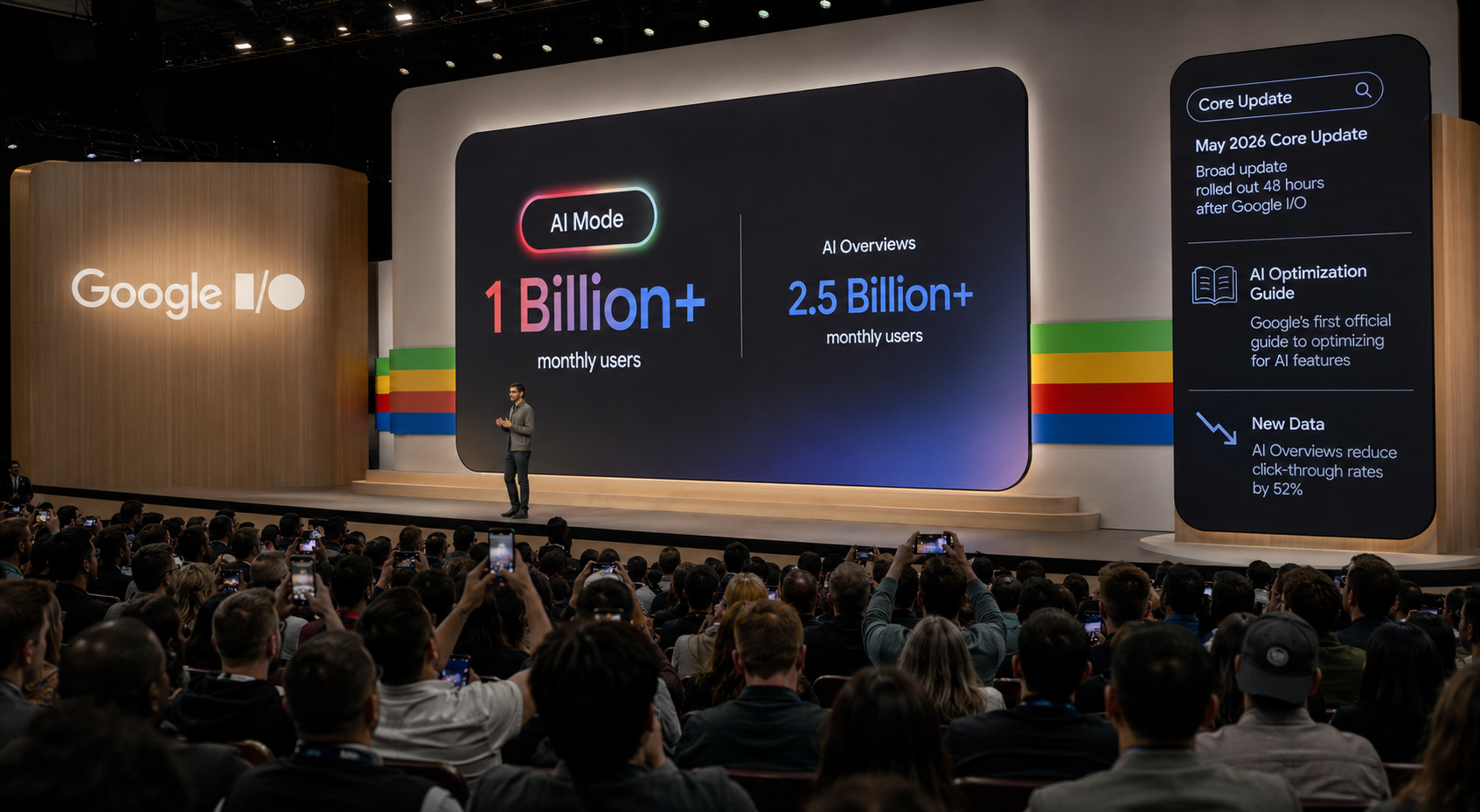
We don't usually do news roundups. Our blog leans toward original data and analysis — our own benchmark reports, our single-day deep-dives, our holiday-curve breakdowns. But May 2026 was different. So much landed in a single month — and so much of it compounds — that it's worth stepping back and laying out the whole picture, with sources, so you can see the shape of where search is going.
Because that's the real story of May: not any single announcement, but how tightly they stack on top of each other.
Google I/O 2026: "the biggest Search overhaul in 25 years"
The month's center of gravity was Google I/O, May 19–20. Google I/O 2026 brought the biggest Search overhaul in 25 years, and the framing wasn't hyperbole. Liz Reid, VP and Head of Search, called the redesigned search box the biggest upgrade to Google's iconic search box since its debut over 25 years ago — the new box dynamically expands and accepts text, images, files, video, and Chrome tabs. LumarDigital Applied Team
The headline number, though, was about adoption. Sundar Pichai opened the May 19 keynote with the news that AI Mode has surpassed 1 billion monthly active users, up from roughly 100 million a year ago. That's a 10x jump in a single year. And it's worth being precise here, because the coverage routinely muddles it: AI Overviews separately reached 2.5 billion monthly active users — a distinct surface from AI Mode with a distinct figure. Do not conflate the two. AI Overviews are the passive summaries that appear above results; AI Mode is the deliberate, conversational ChatGPT-style experience you opt into. Both are now operating at a scale that makes "search" and "AI answer" nearly synonymous for a huge share of users. Digital Applied TeamDigital Applied Team
One more technical detail with real implications: AI Mode now runs on Gemini 3.5 Flash, which became its default model after general availability on May 19. Digital Applied Team
This is the world we've been writing toward since we launched — the one where discovery happens inside AI answers rather than ten blue links. A billion people using a conversational search interface is the thesis of how AI search is killing traditional SEO becoming simply how search works.
The May 2026 Core Update — and why its timing is the real story
Then, before the I/O dust settled, Google shipped a core update. The May 2026 Core Update began rolling out on May 21 and was expected to complete around June 4. It reinforces Google's existing E-E-A-T framework, with no new vertical-specific signals announced. Google confirmed it via the Search Status Dashboard on May 21 (incident ID wdAXJk6LRRihEjpzEeWE). It's a broad core update touching all regions, all languages, and most content categories, with volatility reported across news, e-commerce, and informational queries — some sites moved up, many dropped. Stratos Ally + 2
On its own, a core update is routine. What makes this one notable is when it landed. The May 2026 core update began rolling out on May 21 — one day after I/O Day 2 — and most SEO coverage has treated these as two separate stories, which misses the compounding effect. Think about the sequence: Google rewrites what "search" even means with a billion-user AI Mode redesign, and then 48 hours later recalibrates the ranking algorithm that decides which content feeds those AI surfaces. A core update that adjusts which content is considered "satisfying" and "relevant" lands at precisely the moment when the definition of search satisfaction has just been rewritten. Digital Applied TeamDigital Applied Team
For anyone managing a site, the takeaway is the same discipline we preach after every algorithm move: don't panic-edit mid-rollout. The practical response is structured, original, well-attributed content, not reactive rewrites — wait until the update completes and allow at least a week of stable data before drawing conclusions. That's exactly the patience we counsel in reading your Search Console correctly and the same reason we annotate seasonality in our own reports. Stratos Ally
Google's first official AI-optimization guide
Buried under the bigger headlines was arguably the most useful thing for practitioners: Google published its first official AI search optimization guide, covering crawlability, content structure, and technical SEO foundations for AI Mode and AI Overviews. The document is titled "Optimizing your website for generative AI features." Lumar
This matters because, for two years, optimizing for AI answers has been an exercise in inference — practitioners reverse-engineering what worked. Google putting its own guidance on paper is a milestone, even if much of it restates durable fundamentals. The through-line of the advice is unsurprising and validating: interlink high-performing pages with supporting content to build topical clusters, refresh posts with outdated statistics, and monitor which pages are cited in AI Overviews versus simply ranking. If you've read our work on entity optimization and what makes content citation-worthy to LLMs, none of this is new — but it's good to have Google saying it out loud. Stratos Ally
The click-pressure problem Google won't name
The backdrop to all of this is the metric publishers actually worry about: clicks. The data is stark. Ahrefs measured a 58% CTR drop from AI Overviews, and Pew confirmed an 8% versus 15% click rate — meaning users with an AI Overview present click through at roughly half the rate they otherwise would. SEO-Kreativ
Google's response came earlier in the month, and it's telling. On May 6, 2026, Hema Budaraju, VP of Product Management at Google Search, announced five updates for AI Mode and AI Overviews: inline links directly in the text, hover previews on desktop, a "Subscribed" label for news subscriptions, article suggestions at the end of the AI answer, and Community Perspectives with Reddit and forum quotes. Google framed these purely as better web discovery. The reading from the field was more pointed: these updates are the clearest indirect reaction Google has given yet to the documented click pressure — three are link-visibility tweaks, one is a subscription feature, one shows community quotes, and none changes the fundamental logic of the AI answer. SEO-KreativSEO-Kreativ
That last clause is the part to sit with. The visibility tweaks help, but the underlying dynamic — AI synthesizes the answer, and a huge share of users never click — is unchanged. This is precisely why we keep arguing that click-through rate is the wrong metric for the AI search era: if half your would-be clicks are being absorbed by the AI answer, then being cited inside that answer matters more than ranking to be clicked.
Two quieter announcements that signal where this is headed
Two more items rounded out the month, and both point at the agentic, AI-mediated future.
First, commerce. Google launched a cross-channel shopping cart experience across Search, Gemini, and YouTube — letting users save and manage products across platforms as part of a more agentic shopping journey. Reported elsewhere as "Universal Cart," it's an early sign of AI not just answering but transacting. Lumar
Second — and most relevant to anyone trying to measure AI's impact — Google Analytics added a new AI-assistant traffic channel in GA4, automatically grouping visits from tools like ChatGPT, Gemini, and Claude under a dedicated "ai-assistant" medium. This is genuinely big for practitioners. Until now, attributing traffic that originated from an AI assistant has been a manual, messy guessing game. A dedicated channel means you can finally see, in your own analytics, how much of your traffic is arriving via AI tools — the first step toward managing it. We'll have a hands-on breakdown of this soon, but it pairs naturally with the visibility tracking we describe in why your website isn't showing up in Perplexity. Lumar
The publisher question: is AI Mode about to become the default?
The anxiety underneath every one of these stories is whether Google flips AI Mode on as the default search experience. The May news offered, for now, a reprieve. Google's I/O updates stop short of making AI Mode the default for Search — described as a "small sigh of relief" for publishers, even as the changes present a further challenge to referral traffic and introduce AI agents users can delegate search tasks to. Press Gazette
So the direction of travel is unmistakable, but the most disruptive switch hasn't been thrown yet. That gap — between where search is clearly heading and where it is today — is the window businesses have to build their AI-search foundation before it's mandatory rather than optional.
What May 2026 actually means for your business
Strip away the individual headlines and the month tells one coherent story: search is now an AI-answer system at scale, and the rules for being surfaced inside it are being formalized in real time. A billion people use AI Mode. AI Overviews touch 2.5 billion. Half your potential clicks may be absorbed by an AI summary. Google has, for the first time, written down how to optimize for this — and added a GA4 channel so you can measure it.
The practical implications are the same ones we've been building our entire approach around, now reinforced by a month of evidence:
Being cited in an AI answer matters more than ranking to be clicked, because the click may never come. Structured, original, genuinely authoritative content is what both the core update and Google's new guide reward — there's no shortcut around it. And measurement is finally catching up, so "we can't track AI traffic" is no longer an excuse to ignore it.
None of this is a reason to panic. It's a reason to build deliberately. The businesses that treated AI search as a someday-problem spent May watching the someday arrive.
The honest caveat
A roundup like this compresses a fast-moving month, and a few of these stories are still developing as we publish. The core update wasn't projected to finish rolling out until around June 4, so the full ranking picture isn't settled yet — anyone claiming to know exactly who won and lost is guessing ahead of the data. The CTR-impact figures come from specific studies with specific methodologies, not universal laws; your mileage will vary by industry and query type. And the long-term effect of features like the GA4 AI channel depends on adoption and accuracy we can't yet assess. We've sourced everything here to the original reporting so you can read further, and we'll update our view as the data matures — because that's the build-in-public standard we hold ourselves to. Stratos Ally
Want to be ready for the search world May 2026 just made official?
Everything this month confirmed — AI answers at scale, citation over clicks, formalized AI-optimization rules — is the exact world we build businesses for. We help you create the structured, authoritative, citation-worthy content that gets you surfaced inside ChatGPT, Claude, Perplexity, Gemini, and Google AI Overviews, and we set up the measurement to prove it's working. We're doing it for our own domain in public. We can do it for yours.
Tell us where you are now and what you're trying to grow. You'll get clear next steps within one business day.
Frequently Asked Questions
What was the biggest SEO news in May 2026?
Google I/O 2026 (May 19–20), which delivered what Google called the biggest Search overhaul in 25 years. The headline figures: AI Mode surpassed 1 billion monthly active users (up from roughly 100 million a year earlier), AI Overviews reached 2.5 billion, and the search box itself was redesigned to accept text, images, files, video, and Chrome tabs. A broad core update followed just two days later, making the week of May 19 one of the most consequential in recent search history.
What's the difference between AI Mode and AI Overviews?
They're two distinct surfaces, and it's worth not conflating them. AI Overviews are passive AI summaries that appear automatically at the top of standard results for many informational queries — you don't opt in. AI Mode is a deliberate, conversational ChatGPT-style interface you enter to ask layered, follow-up questions across a research session. They reward different content: AI Overviews favor concise, direct answers, while AI Mode rewards depth and expert nuance that can sustain a multi-turn conversation. As of May 2026, AI Mode runs on Gemini 3.5 Flash.
When did the May 2026 core update roll out, and what changed?
It began rolling out on May 21, 2026 (confirmed via Google's Search Status Dashboard, incident ID wdAXJk6LRRihEjpzEeWE) and was projected to complete around June 4. It's a broad core update affecting all regions, languages, and most content categories, reinforcing Google's existing E-E-A-T framework with no new vertical-specific signals announced. The notable part is its timing — landing within 48 hours of the I/O AI Search overhaul, recalibrating rankings just as the definition of "search" was being rewritten.
Should I make changes to my site because of the core update?
Not mid-rollout. The consistent guidance — and ours — is to wait until the update completes and allow at least a week of stable data before drawing conclusions or making significant changes. The right response to a core update is structured, original, well-attributed content built for the long term, not reactive rewrites based on a few days of volatility. Panic-editing during a rollout tends to create noise you can't interpret, the same discipline we apply to reading Search Console data.
What did Google's first official AI optimization guide say?
Google published "Optimizing your website for generative AI features," its first formal documentation covering crawlability, content structure, and technical SEO foundations for AI Mode and AI Overviews. Much of it restates durable fundamentals: build topical clusters by interlinking strong pages with supporting content, refresh outdated statistics, and monitor which pages get cited in AI Overviews rather than just ranking. It's validating rather than revolutionary — but having Google state it directly is a milestone after two years of practitioners inferring the rules.
How much are AI Overviews actually hurting click-through rates?
The data is significant: Ahrefs measured a roughly 58% CTR drop for top-ranking pages when an AI Overview is present, and Pew found click rates of about 8% with an AI Overview versus 15% without. In short, users frequently get their answer from the AI summary and never click through. These figures come from specific studies with specific methodologies, so your exact impact varies by industry and query type — but the direction is clear, and it's why we argue CTR is the wrong metric for the AI search era.
What were Google's May 6 updates to AI Overviews?
On May 6, 2026, Google announced five changes: inline links within the AI text, hover previews on desktop, a "Subscribed" label for news subscriptions, article suggestions at the end of the AI answer, and Community Perspectives featuring Reddit and forum quotes. Google framed them as better web discovery. Many in the field read them as an indirect response to documented click pressure — three are link-visibility tweaks, but none changes the fundamental logic that the AI answer synthesizes the response and absorbs the click.
What is the new GA4 "ai-assistant" channel, and why does it matter?
Google Analytics added a dedicated traffic channel in GA4 that automatically groups visits arriving from tools like ChatGPT, Gemini, and Claude under an "ai-assistant" medium. It matters because, until now, attributing AI-assistant referral traffic was a manual, messy guessing game. A dedicated channel lets you finally see in your own analytics how much traffic is coming via AI tools — the first real step toward measuring and managing your AI-search visibility rather than estimating it.
Is Google about to make AI Mode the default search experience?
Not yet. The May I/O updates stopped short of making AI Mode the default for Search — described as a "small sigh of relief" for publishers — even as they introduced AI agents users can delegate search tasks to and added further pressure on referral traffic. The direction of travel is unmistakable, but the most disruptive switch hasn't been thrown. That gap between where search is heading and where it is today is the window businesses have to build their AI-search foundation before it becomes mandatory.
What should my business actually do about all this?
Build deliberately rather than panic. The month's coherent lesson: search is now an AI-answer system at scale, so being cited inside AI answers matters more than ranking to be clicked; structured, original, authoritative content is what both the core update and Google's new guide reward; and with the GA4 channel, you can finally measure AI traffic. The businesses that treated AI search as a someday-problem spent May watching someday arrive. If you want help getting surfaced in AI answers and measuring it, that's exactly what we do — book an AI Search Audit.