What 101 LinkedIn Followers Actually Told Us About Our Business — Including One Number We Didn't Expect
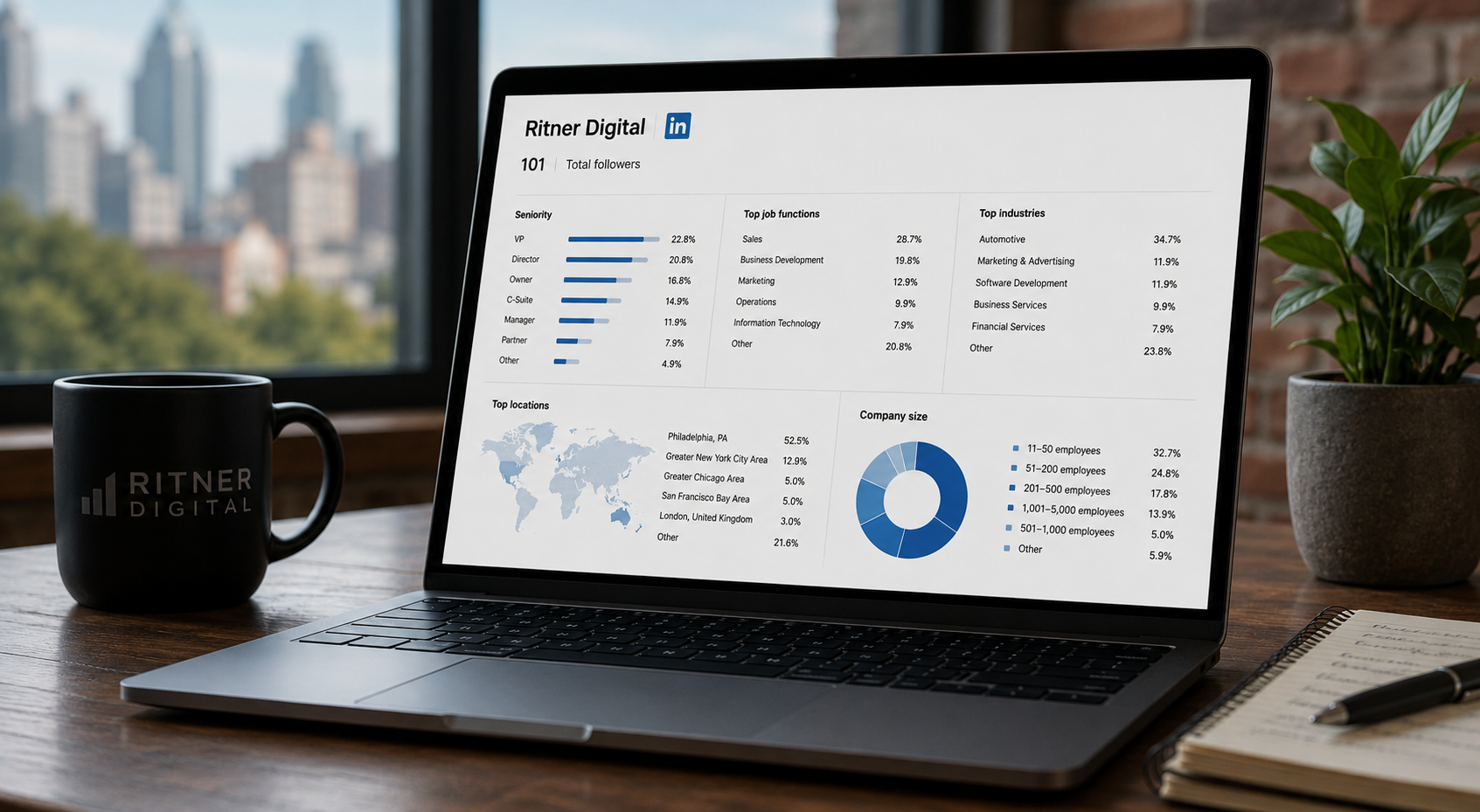
A hundred and one followers is not a milestone anyone brags about. We know that. But we also believe that data is worth reading at every scale, and that the habit of looking honestly at your own numbers — when they're small and when they're flattering — is the whole discipline we build in public to practice. We've done it with our search data, our biggest traffic day, and our holiday curve. So when LinkedIn's follower demographics crossed the threshold where they actually populate, we pulled them apart.
What we found was more useful than we expected — and it quietly reframed who we think we're really talking to. Here's the whole picture.
Who follows us: the seniority story
Start with the most encouraging finding, because it's the one that matters most for a young agency: we're reaching decision-makers, not juniors.
Breaking down our followers by seniority:
VP — 17.8%
CXO — 12.9%
Owner — 10.9%
Director — 9.9%
Partner — 2%
Senior (individual contributor) — 19.8%
Entry-level — just 5%
Add the top of that list together and roughly 44% of our followers are VP, C-suite, owner, or partner — the people who actually sign agency contracts. Stretch it to include directors and senior individual contributors and you're at about 73% senior-and-up. Only one in twenty is entry-level.
For an agency, that's the quality signal you want. It's easy to accumulate followers who are peers, students, or job-seekers. An audience weighted this heavily toward senior decision-makers means the content is reaching the people with buying authority — which is the entire point of showing up at all, a theme we dug into in why your follower count is sending a message before you say a word.
What they do: a revenue-side audience
The job-function data reinforces it. Our followers cluster hard on the revenue side of the business:
Business Development — 27.7%
Sales — 19.8%
Operations — 13.9%
Marketing — 6.9%
Everything else — the long tail
So nearly half (about 48%) of our audience sits in business development or sales roles, while only about 7% are in marketing. That's a meaningful insight for how we write. Our followers aren't marketing technicians who want to debate schema markup — they're growth-minded revenue leaders who care about one question: will this bring in customers? It's a quiet instruction to keep our content outcome-first and jargon-light, which is how we tried to frame pieces like our realistic dealership marketing budget breakdown.
Company size: we're an SMB story, with an enterprise tail
By company size, our following skews toward smaller organizations — but not exclusively:
1–200 employees (SMB): about 43%
1,000+ employees (enterprise): about 22%
The rest spread across the middle and "other"
The biggest single bucket is 11–50 employees (22.8%). So the core of our audience is the small-to-midsize business — owner-operated and lean — which matches how we've always described who we serve. But that 22% enterprise tail is worth noting: a fifth of our followers work at large organizations, which tells us the AI-search conversation isn't only an SMB concern. It's reaching people inside big companies too, the audience we write for in pieces like the enterprise SEO reporting problem.
The number we didn't expect: automotive
Here's the finding that genuinely surprised us. When we broke followers down by industry, one vertical towered over everything else:
Motor Vehicle Manufacturing — 19.8%
Retail Motor Vehicles — 15.8%
Marketing Services — 6.9%
Advertising Services — 5%
Software Development — 4%
…and a long, scattered tail of everything else
Put the top two together and more than a third of our entire following — about 36% — is automotive. Manufacturing and retail (dealerships) combined. No other industry is even close; the next-largest single category is under 7%.
We did not set out to be an automotive-focused agency. But the data is hard to ignore, and in hindsight it's not random. Some of our most substantive content has been built for that world — our car dealership advertising costs breakdown, our look at the AI companies reshaping dealership operations, our best CRM for an independent dealership guide. Those clearly found an audience, and that audience stuck around.
We're not going to overreact to it. At 101 followers, a single well-shared post can tilt an industry breakdown, and follower demographics aren't the same thing as paying-customer demographics. We remain a full-stack AI-search and SEO firm for owner-operated businesses across many industries — contractors, law firms, restaurants, local services — and that's not changing on the strength of one chart.
But we'd be foolish not to notice. When a third of the people choosing to follow you cluster in one vertical, that's the market telling you where your message is landing. It's a signal to lean into, to watch as we grow, and to potentially build more deliberately around if it holds. The smartest thing a young business can do is pay attention to where it's unexpectedly resonating — and then decide, with eyes open, whether to feed it.
Where they are: Philadelphia first, the world second
Geographically, the data confirms our home base and hints at our reach:
Greater Philadelphia — 14.9% (our single largest market by far)
New York City Metro — 5.9%
London, UK — 5%
San Francisco Bay Area — 4%
Washington DC–Baltimore — 3%
…then a wide scatter across Detroit, Seattle, Dallas, Tampa, Miami, Chicago, Boston, and beyond
And notably, about 12% of our followers are clearly international — London, Toronto, the Netherlands, Germany, Pakistan, Mexico City. That mirrors exactly the organic international spillover we keep seeing in our search data: topical authority doesn't respect borders. Philadelphia is our anchor, but our content travels further than our geography, which is something we wrote about when we looked at how far our reach extends beyond our local market.
What this changes about how we work
Pulling it together, here's the picture our first hundred followers paint: a senior, revenue-minded, small-to-midsize-business audience, anchored in Philadelphia, reaching internationally — with a surprisingly strong concentration in automotive.
That sharpens a few things for us without forcing a hard pivot:
We'll keep writing outcome-first content, because our audience is overwhelmingly revenue-side, not marketing-technical. We'll keep one eye on the automotive signal, producing more for that world while watching whether the concentration holds as we scale — leaning in without boxing ourselves in. And we'll keep Philadelphia as our spine while remembering that our best content reaches people who'll never set foot in the Delaware Valley.
None of this is a dramatic repositioning. It's the opposite — it's the small, honest course-correction that comes from actually reading your data instead of assuming you already know your audience. Most businesses never look at this breakdown at all, or look once and forget it. Reading it at 101 followers, and again at 1,000, and again at 10,000, is how you stay pointed at the people who actually want what you do.
We'll report back as the numbers grow. That's the point of building in public — you get to watch the picture sharpen in real time, including the parts we didn't see coming.
Want to know who's actually paying attention to your business?
Most companies guess at their audience. The data is usually right there — in your follower demographics, your search console, your analytics — telling you who you're really reaching and where you're unexpectedly resonating. We read it for our own business in public, and we help clients read theirs: turning audience data into sharper positioning, better content, and a clearer answer to "who are we actually for?"
Tell us where you are now and what you're trying to grow. You'll get clear next steps within one business day.
Frequently Asked Questions
Why analyze your audience at only 101 followers?
Because data is worth reading at every scale, and the habit of reading it honestly — when the numbers are small and when they're flattering — is the discipline, not the size of the number. Small audiences tell surprisingly clear stories. Reading our follower breakdown at 101, and again at 1,000, and again at 10,000, is how we stay pointed at the people who actually want what we do, rather than assuming we already know our audience.
What was the most surprising finding?
That more than a third of our followers — about 36% — are in automotive (Motor Vehicle Manufacturing at 19.8% plus Retail Motor Vehicles at 15.8%). No other industry is close; the next-largest single category is under 7%. We didn't set out to be automotive-focused, but several of our most substantive pieces were built for that world and clearly found a lasting audience. We're treating it as a strong signal to watch and lean into, not a reason to reposition the whole business.
Does this mean Ritner Digital is now an automotive-only agency?
No. We remain a full-stack AI-search and SEO firm serving owner-operated businesses across many industries — contractors, law firms, restaurants, local services. At 101 followers, a single well-shared post can tilt an industry breakdown, and follower demographics aren't the same as paying-customer demographics. The automotive concentration is a signal worth noticing and feeding, but it's not a hard pivot — we're leaning in without boxing ourselves in.
Who actually follows Ritner Digital?
In short: a senior, revenue-minded, small-to-midsize-business audience, anchored in Philadelphia and reaching internationally, with a notable automotive concentration. About 44% are VP, C-suite, owner, or partner; roughly 48% sit in business development or sales roles; about 43% work at companies under 200 employees. It's a buy-side audience of decision-makers, which is exactly who a young agency wants to be reaching.
Why does it matter that most followers are in sales and business development, not marketing?
Because it tells us how to write. Only about 7% of our followers are in marketing roles, while nearly half are in revenue roles. That means our audience doesn't want technical SEO debates — they want a clear answer to "will this bring in customers?" So we keep our content outcome-first and jargon-light, framed around business results rather than marketing mechanics.
What does the seniority data tell you?
That we're reaching the right people. Roughly 44% of followers are VP, CXO, owner, or partner, and about 73% are senior-and-up, with only 5% entry-level. For an agency, that's the quality signal that matters most — it's easy to accumulate followers who are peers or job-seekers, but an audience weighted toward senior decision-makers means the content is landing with the people who hold buying authority.
How international is your audience?
More than we expected for a Philadelphia-based firm. Greater Philadelphia is our single largest market at 14.9%, but about 12% of followers are clearly international — London, Toronto, the Netherlands, Germany, Pakistan, Mexico City. That mirrors the organic international spillover we keep seeing in our search data: topical authority doesn't respect borders, and our content reaches further than our geography does.
How should other businesses use their own follower data like this?
Read it, and read it repeatedly. Most companies never look at their follower demographics, or look once and forget. The highest-value move is spotting where you're unexpectedly resonating — like our automotive concentration — and then deciding, with eyes open, whether to feed it. Audience data is one of the cheapest, most honest sources of positioning insight you have, and it's usually sitting right there unused.
Can you help me figure out who my business is actually reaching?
Yes — it's part of how we work. The data telling you who you're really reaching is usually already there in your follower demographics, search console, and analytics. We read it for our own business in public and help clients read theirs, turning audience data into sharper positioning and better content. The fastest start is to book an AI Search Audit.