4 AI Companies Changing Dealership Operations Forever
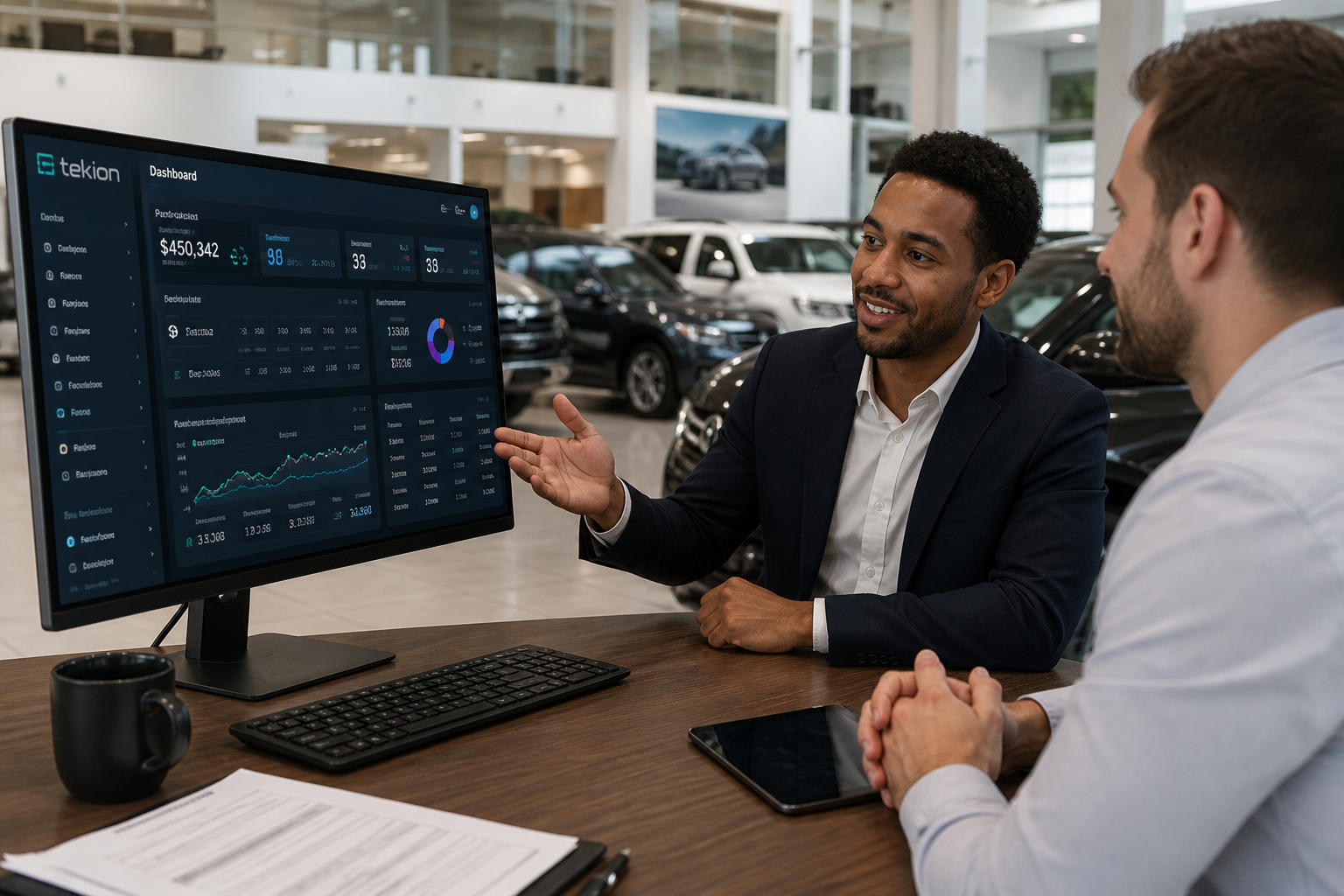
The car business has always been a game of inches. A few hundred dollars on a trade-in, a few percentage points on financing, a few more appointments booked on a Tuesday afternoon. For decades, the dealers who won weren't necessarily the ones with the best inventory or the lowest prices — they were the ones who ran the tightest operations.
That equation hasn't changed. But the tools available to run a tight operation? Those have changed dramatically.
We are in the middle of a genuine technological inflection point in automotive retail. Artificial intelligence isn't a buzzword being thrown around at NADA anymore — it's actively being deployed on showroom floors, in BDC offices, under vehicles in the service lane, and inside the accounting department. The dealerships paying attention are pulling ahead. The ones who aren't are going to feel it.
This post breaks down four companies that are leading that charge right now — and more importantly, what they actually do and why it matters for your store.
Why Now? The Backdrop That Makes This All Make Sense
Before we get into the companies, it's worth understanding the environment they're operating in.
The CDK Global ransomware attack of June 2024 was a watershed moment for the industry. On June 19, 2024, CDK experienced a ransomware attack that took most of its services offline, disrupting thousands of car dealerships across the US and Canada. The fallout was staggering. JD Power estimated that due to the outage, U.S. retail unit sales in June 2024 would decrease by up to 7.2% from June 2023. Within the first two weeks, affected dealers recorded financial losses amounting to approximately $605 million. WikipediaWikipedia
That event forced a hard conversation across the industry: how can a single point of failure — a 50-year-old legacy DMS platform — be allowed to bring thousands of rooftops to their knees simultaneously? The answer, for a growing number of dealers, is that it shouldn't. And that realization has accelerated the adoption of every tool on this list.
Meanwhile, consumer expectations are shifting. Buyers are researching online longer, engaging with dealerships at odd hours, and arriving at the showroom with more information than ever before. The dealership that responds to a 10:47 PM lead at 10:48 PM — automatically, intelligently, with VIN-specific information — is the dealership that books the appointment. The one that sends a generic drip email the next morning isn't.
Data wins. That's the theme. Here's who's building the tools to harness it.
1. Tekion: The DMS That Was Built for This Century
Founded by: Jay Vijayan, former CIO of Tesla What it is: A cloud-native, AI-powered Dealer Management System
There's a reason Jay Vijayan's background gets mentioned every time Tekion comes up. As Tesla's Chief Information Officer — reporting directly to Elon Musk — Vijayan had a front-row seat to what it looks like when a technology company disrupts an entrenched incumbent industry. When he left Tesla and looked at the DMS landscape, he saw exactly that opportunity: a foundational piece of software that most dealers run their entire business on, and that hadn't meaningfully evolved in decades.
He built Tekion to replace it.
Tekion's DMS is an AI-native platform that powers every core dealership function in one context-aware system. It eliminates the need for integrations with a seamless experience that connects sales, service, parts, and accounting out of the box — one real-time system with no duplicate entry or disconnects. Tekion
The practical results are significant. Dealers who have switched report cutting their monthly software costs from $50,000–$60,000 down to the low $30,000s. McDonald Automotive saw their Customer Satisfaction Index jump from 93% to 99% after moving to Tekion. Their staff immediately noticed the contrast with legacy systems, remarking on Tekion's unified platform and modern UI, which empowered them to deliver faster, smoother customer service. Tekion Corp
But the most compelling proof point came during the CDK outage. In a time when dealerships across the nation were paralyzed by the CDK Global outage, McDonald Automotive ran a radio ad to their customers on how they were unaffected. Their decision to adopt Tekion's secure, cloud-native platform not only shielded them from operational disruptions but also elevated their dealership performance. Tekion Corp
Think about that for a second. While thousands of rooftops were scrambling to process deals on paper, McDonald Automotive was running radio ads about how business was normal. That's not just a technology advantage — that's a marketing advantage, a customer trust advantage, and a competitive advantage all in one moment.
Tekion's agentic AI operates with the full context of how your dealership works — connecting sales, service, accounting, and analytics in real time. AI agents don't just improve internal efficiency — they enable faster transactions, greater transparency, and more seamless experiences for the customers you serve. Tekion
It's worth noting that Tekion isn't just disrupting CDK — they're actively fighting them. Tekion filed a federal antitrust lawsuit accusing CDK of engaging in a systematic scheme to thwart competition in the DMS market, claiming CDK had frequently refused to turn over data belonging to dealers looking to switch, effectively holding client information hostage. The data portability fight is real, and it matters: if you're considering a DMS switch, this legal battle is worth watching closely. Dealership Guy
Tekion unveiled its AI-native platform vision and new agentic AI capabilities at NADA 2026, signaling that this technology is not slowing down. Tekion
The bottom line: If your DMS was built before smartphones existed, the question isn't whether you should evaluate Tekion — it's why you haven't already.
2. Impel AI: The BDC That Never Clocks Out
Founded by: Devin Daly (originally launched as SpinCar in 2014) What it is: An AI operating system for dealership customer engagement
Every dealership has the same BDC problem. Your team is good — maybe great — but they're human. They work 8-hour shifts. They have good days and bad days. They miss leads. They give up on long-nurture prospects. They go home at 6 PM, and the customer who fills out a form at 8:15 PM doesn't hear back until the next morning, by which point they've already booked an appointment somewhere else.
Impel AI was built specifically to close that gap.
What started as SpinCar — a platform focused on vehicle photography and merchandising — evolved under Devin Daly's leadership into something far more expansive: a full AI operating system for dealership customer engagement. The platform responds to every inbound lead around the clock, handles VIN-level inventory questions with real specificity, books appointments directly into your CRM, and continues nurturing the leads your human team has long since stopped following up on.
The numbers are hard to argue with. Dealers using Impel see 27% more appointments booked and 26% higher lead-to-sale conversion rates. Bob Rohrman Kia saw a 43% jump in booked appointments after deploying the platform. Perhaps most strikingly, 37% of all customer engagement on the platform happens outside of normal business hours — meaning more than a third of your pipeline is being worked while your team is asleep.
This matters because of a simple truth about how car buyers behave today: they don't shop on your schedule. They browse inventory at 11 PM after the kids are in bed. They submit a lead form during their lunch break on a Wednesday. They have questions about specific vehicles — specific trim levels, specific option packages — and they want answers now, not when your BDC opens in the morning.
Impel's AI can handle all of that. It doesn't just auto-respond with a generic "thanks for your interest, someone will be in touch soon" message. It responds with actual information about the actual vehicle the customer was looking at, answers follow-up questions, and moves the conversation toward a scheduled appointment — all without a human touching it until the appointment is already on the books.
For dealers who have invested heavily in lead generation — paid search, third-party listings, social media — the ROI math here is compelling. You're already paying for those leads. The question is whether you're maximizing what you get out of them.
The bottom line: If any percentage of your leads go unanswered for more than five minutes, or if you've ever "given up" on a prospect after two or three attempts, Impel AI is worth a serious look.
3. Fullpath: The Customer Data Platform That Just Got a Whole Lot Bigger
Founded by: Aharon Horwitz, Eliav Moshe & Yishai Goldstein — out of a Jerusalem apartment in 2013 What it is: An AI-powered Customer Data Platform and marketing automation engine for dealerships
Here's the core problem Fullpath was built to solve: your dealership has years of valuable customer data, and it's completely fragmented.
Your CRM has some of it. Your DMS has more. Your website analytics are somewhere else. Your ad platforms are siloed. The customer who bought a vehicle from you four years ago, came back for service twice, clicked your email last month, and is now browsing your inventory page for a new truck — that person exists as half a dozen disconnected data points scattered across systems that don't talk to each other. You have no unified picture of who they are, where they are in their buying journey, or what the right message is to send them right now.
Fullpath fixes that. Fullpath's main strength is solving the fragmented customer data problem by uniting years of disconnected CRM and DMS data into a single usable profile. The cleaned data can then power AI-driven marketing campaigns, lead follow-ups, and the ability to trace a single customer's journey from the moment they click an ad to the moment they drive off the lot. Dealership Guy
The platform pulls your CRM data, DMS data, website behavior, and advertising performance into one Customer Data Platform, builds a unified customer profile, and then uses AI to determine the right message, the right channel, and the right moment for outreach. It's the difference between batch-and-blast email marketing and genuinely personalized communication at scale.
Now here's why this just got significantly more important: on April 23, 2026, Cox Automotive announced it has signed a definitive agreement to acquire 100% of Fullpath, subject to regulatory approval. The transaction is expected to close within 30 days. Morningstar
This is a massive deal. Cox's existing network of 40,000-plus dealer relationships gives Fullpath a distribution scale that no standalone platform could reach independently. The combination creates an opportunity to connect Fullpath's customer data platform with Cox Automotive's insights from Autotrader, Kelley Blue Book, and Dealer.com, reaching tens of millions of active car shoppers. Dealership GuyMorningstar
Think about the implications. Fullpath's AI engine, which already knows everything about your existing customers, will now be able to layer in data from tens of millions of active shoppers on Autotrader and KBB. The targeting precision that becomes possible is a different category of capability entirely.
Cox Automotive president Stephen Rowley described Fullpath as "AI first — a native AI origination" that won't be slowed by the acquisition. "You never pull back on a racehorse," Rowley said. Dealership Guy
For existing Fullpath clients, the same team, products, and service levels will remain in place following the close, with the near-term focus on growth and stability. PR Newswire
The bottom line: Fullpath was already one of the most sophisticated marketing tools in automotive retail. Being absorbed into the Cox Automotive ecosystem means this technology is about to be everywhere — and the dealers who get ahead of it now will have a meaningful head start.
4. UVeye: The AI That Sees What Your Service Advisors Can't
Founded by: Brothers Amir and Ohad Hever in 2016 What it is: An AI-powered automated vehicle inspection system
The origin story of UVeye is worth knowing: Amir and Ohad Hever initially built their tunnel-based scanning technology to detect threats hidden beneath vehicles — think security checkpoints, border crossings, government facilities. The underlying technology is essentially an AI-powered visual inspection system using high-resolution cameras and sensors to identify anomalies on a vehicle's undercarriage, tires, and exterior in seconds.
When they looked at automotive retail, they realized the same technology had a massive application in a completely different context: trade-in appraisals, service lane inspections, and pre-owned vehicle reconditioning.
Here's how it works in practice. A vehicle drives through UVeye's tunnel system. In seconds — not minutes, seconds — AI cameras complete a full scan of the undercarriage, all four tires, and the entire exterior. Service advisors receive a photo-backed report with documented findings before the customer has even walked into the building. Dealers report saving approximately $500 per trade-in by catching damage early that would otherwise be missed during a manual appraisal.
UVeye's AI-powered vehicle inspection systems scan car exteriors, underbodies, and tires using high-resolution cameras and sensors to identify damage in seconds, providing quick, consistent, and transparent condition reports. Fast Company
The scale of adoption is notable. More than 800 UVeye systems have been deployed worldwide, including at dealership behemoths such as AutoNation and Lithia, and the company scans more than 3 million vehicles every month. Fast Company
The investor roster tells you something important about where this technology is heading. Investors including General Motors, Toyota, Volvo, and CarMax have seen the potential — UVeye raised $191 million in its latest round, closed in January 2025, bringing its total funding to $380.5 million. When OEM partners are writing nine-figure checks into a company, they're not betting on a vendor — they're betting on infrastructure. Fast Company
UVeye's program with Subaru retailers across the US made advanced underbody, tire, and exterior inspection technology more accessible to Subaru service departments, and an integration with Cox Automotive's vAuto brought AI-powered inspection capabilities directly into the appraisal and inventory sourcing process, helping dealers make more informed decisions. PR Newswire
And the recognition is following the results. UVeye has been named one of Fast Company's World's Most Innovative Companies for 2026, earning the top spot in the Transportation category. That's not an award given to companies doing incremental things — that's recognition of a technology that's genuinely reshaping how an industry operates. UVeye
In July 2025, UVeye launched UV360, a "photo booth for cars" that leverages their drive-through scanners to instantly generate high-resolution, 360-degree images of vehicles, enabling dealerships to list vehicles online immediately, often before reconditioning is complete. That last part — listing vehicles before reconditioning is finished — directly attacks one of the biggest bottlenecks in used car operations. PR Newswire
The bottom line: Every trade-in your team appraises manually is a potential liability. Missed damage means margin erosion. UVeye closes that gap with data and speed that a human walk-around simply can't match.
What This All Has in Common
Look across these four companies and a clear pattern emerges.
Every one of them is attacking a problem that dealerships have lived with for so long it's become invisible. Legacy DMS software that hasn't evolved. Leads that slip through the cracks after hours. Customer data that exists but can't be activated. Trade-ins that get underappraised because nobody caught the damage.
These aren't new problems. They're old problems that now have new, genuinely better solutions — solutions built on AI, cloud infrastructure, and real-time data that simply didn't exist at scale five years ago.
The dealerships that win the next decade aren't going to win by outworking the competition. They're going to win by deploying better tools, making faster decisions, and using the data they already have more intelligently. The dealerships that treat technology as an afterthought are going to find themselves competing against stores that have effectively given every department a significant operational advantage.
The LinkedIn post below captures it well — and it's what inspired this deeper dive:
The Question Worth Asking Your Team This Week
What tools are you actually running right now?
Not what's on your vendor contract. Not what your previous manager set up three years ago that nobody uses properly. What tools are your people actively using, and are those tools generating measurable outcomes — more appointments, higher CSI, lower reconditioning costs, faster deal cycles?
If the honest answer is "I'm not sure," that's worth knowing.
The technology exists. The case studies are real. The ROI is documented. The only variable left is whether your store moves first or plays catch-up.
Ready to Talk Tech Strategy for Your Store?
At Ritner Digital, we work exclusively with automotive retailers to build digital strategies that drive measurable results — from digital marketing and lead generation to helping you think through the technology stack that powers your operation.
If you want to have a real conversation about where your store stands and what the path forward looks like, we'd love to connect.
Let's Talk → ritnerdigital.com/#contact
Sources: Tekion Corp (tekion.com), CDK Global Wikipedia, Fast Company Most Innovative Companies 2026, UVeye press release (prnewswire.com), Cox Automotive / Fullpath acquisition announcement (coxautoinc.com, prnewswire.com), Dealership Guy, CBT News, Automotive News
Frequently Asked Questions
What is a Dealer Management System (DMS) and why does it matter?
A Dealer Management System is the central operating software that runs a dealership — it touches sales, service, parts, F&I, accounting, and payroll. Think of it as the nervous system of your store. If it's slow, outdated, or siloed, every department feels it. If it goes down — as CDK demonstrated in June 2024 — your entire operation can grind to a halt. The DMS you choose isn't just a software decision, it's a business continuity decision.
How is Tekion different from CDK or Reynolds & Reynolds?
CDK and Reynolds & Reynolds were built on legacy architecture — in some cases, infrastructure that's decades old. Tekion was built cloud-native from day one, meaning it was designed the way modern software is designed: accessible from any device, updated continuously, and not dependent on on-premise servers that can be compromised by a ransomware attack. Tekion also unifies all dealership functions in a single platform rather than requiring layers of integrations between disconnected systems. The result is lower software costs, fewer workarounds, and a platform that actually improves over time as AI capabilities are added.
What exactly does Impel AI do that a human BDC rep can't?
It's less about capability and more about availability and consistency. A human BDC rep is excellent — but they work a shift, have good days and bad days, and can only handle so many conversations at once. Impel AI responds to every lead within seconds, at any hour, with vehicle-specific information tailored to what the customer was actually looking at. It doesn't forget to follow up. It doesn't get tired on a Friday afternoon. It handles the volume and the off-hours engagement that no human team can realistically cover — and it hands off warm, appointment-ready conversations to your people when the time is right.
Is AI-powered lead response going to feel robotic or impersonal to customers?
This is one of the most common concerns dealers raise, and it's a fair one. The short answer is: not with the tools that are actually working. Platforms like Impel are trained on enormous amounts of automotive retail conversations and are designed to communicate naturally, answer specific questions accurately, and recognize when a conversation needs a human touch. Many customers don't know they're talking to an AI — and frankly, what they care about is whether they got a fast, helpful, accurate response. That matters more than whether it came from a person or a platform.
What is a Customer Data Platform (CDP) and how is it different from a CRM?
Your CRM manages active leads and customer relationships — it's forward-looking. A CDP like Fullpath looks backward and sideways: it pulls together every data point your dealership has ever collected on a customer — purchase history, service records, website visits, email engagement, ad clicks — and unifies all of it into a single, accurate profile. That profile then powers smarter marketing. Instead of blasting your whole database with the same offer, you can identify, for example, customers who bought three years ago, have visited your inventory page twice in the last month, and are likely in-market — and reach them with a targeted, personalized message at exactly the right moment.
Why does the Cox Automotive acquisition of Fullpath matter for dealers who don't currently use Fullpath?
Because the scale of Cox Automotive's network means this technology is about to become far more widely deployed and far more powerful. Cox works with more than 40,000 dealers and owns Autotrader, Kelley Blue Book, VinSolutions, and Dealer.com. When Fullpath's customer data engine connects to the shopper data flowing through those platforms, the targeting and personalization capabilities expand dramatically. Dealers who aren't currently using Fullpath may find it integrated into tools they already use — and understanding how it works now puts you in a much better position to take advantage of it when it arrives.
How does UVeye actually work in the service lane?
A vehicle drives through UVeye's tunnel system at normal speed — no stopping required. High-resolution AI cameras simultaneously scan the full undercarriage, all four tires, and the entire exterior. Within seconds, the system generates a photo-backed inspection report that flags any identified damage, wear, or anomalies. That report is available to the service advisor before the customer has finished parking. There's no subjectivity, no missed blind spots, and no reliance on a technician having a good eye on a given day. Every vehicle gets the same thorough, documented inspection every time.
Can UVeye help with trade-in appraisals specifically?
Yes, and this is one of the clearest ROI use cases. Trade-in appraisals done manually are inherently imprecise — a quick walk-around and a look underneath can easily miss damage that costs your reconditioning team real money. UVeye's system catches underbody damage, tire wear patterns, and exterior issues that a human appraisal might overlook. Dealers report saving approximately $500 per trade-in by catching that damage at the point of appraisal rather than discovering it after the deal is already done. At any volume, that adds up fast.
Do these AI tools require replacing my entire tech stack?
Not necessarily. Some of these tools — like Impel AI and Fullpath — are designed to integrate with your existing CRM and DMS rather than replace them. UVeye integrates with tools like Cox Automotive's vAuto. Tekion, as a DMS, is a more significant undertaking since it does replace your core operating system — but it's designed to reduce the number of third-party tools you need, not add to them. The right approach is to audit what you currently have, identify where the biggest gaps are, and add tools that solve real, measurable problems. You don't need to do everything at once.
How do I know if my dealership is ready to invest in AI tools?
If your store is generating leads, selling vehicles, and doing trades, you're ready — the question is just which gaps are costing you the most. Start with the basics: How fast is your average lead response time? What percentage of leads convert to appointments? How much margin are you losing on trades due to missed damage? What does your software stack cost per month, and are you actually using all of it? The answers to those questions will tell you exactly where AI tools have the highest potential return. If you want help working through that assessment, that's exactly the kind of conversation we have at Ritner Digital.