The Main Line vs. South Philly Client: Same Product, Totally Different Buyer Journey
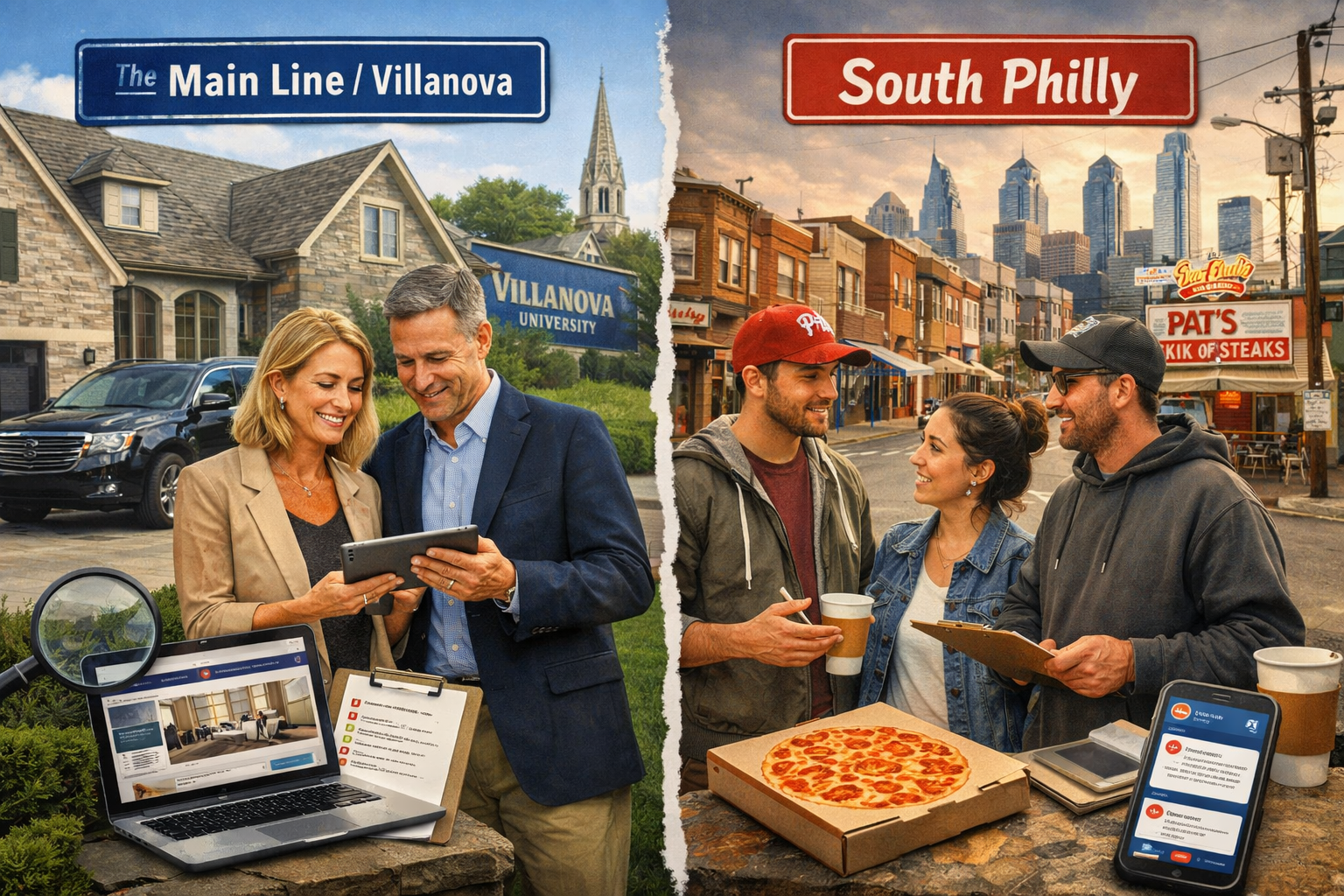
Here's a scenario that plays out constantly for businesses serving the Greater Philadelphia market.
You have two prospective clients. One lives in Villanova. One lives in South Philadelphia. They're both interested in the same service — let's say a home renovation, a financial planning consultation, a legal matter, or a marketing engagement. The product is identical. The price is the same. The outcome they're looking for is, broadly speaking, similar.
And yet everything about how they find you, how they evaluate you, how they decide, and what they need to feel confident enough to hire you is completely different.
If your marketing treats them the same way, you're leaving one of them — probably both of them — feeling like you don't quite get them. And in a market as distinct and identity-driven as Greater Philadelphia, that feeling is fatal to a sale.
This isn't about stereotypes. It's about understanding that geography in this region carries real, specific cultural meaning — and that meaning shapes buyer behavior in ways that smart marketers can't afford to ignore.
Let's map it out.
First, Let's Acknowledge What Makes Philadelphia Unique
Philadelphia is one of the most neighborhood-centric cities in America. Identity here is hyperlocal in a way that outsiders consistently underestimate. People don't just live in Philadelphia. They live in Fishtown, or Chestnut Hill, or Manayunk, or Point Breeze, or Bryn Mawr. And those distinctions carry enormous cultural weight.
The Main Line — that string of affluent communities stretching west along the old Pennsylvania Railroad corridor, from Ardmore through Haverford, Bryn Mawr, Wayne, and Paoli — has a distinct identity rooted in old money, institutional prestige, discretion, and a particular kind of understated affluence that's been cultivated over generations.
South Philadelphia — from the Italian Market through the rowhouse blocks of Passyunk, Packer Park, and beyond — has an equally distinct identity rooted in working-class pride, tight community bonds, directness, deep loyalty to local institutions, and a healthy skepticism of anything that feels too polished or too corporate.
These aren't just demographic differences. They're cultural ones. And they translate directly into buyer psychology and decision-making behavior.
How the Main Line Buyer Finds You
The Main Line buyer's discovery journey is heavily relationship and reputation driven — but it's a specific kind of relationship and reputation that matters.
Referrals are king on the Main Line, but they carry more weight when they come from the right circles. A recommendation from a neighbor in Wayne carries more weight than a Google review from a stranger. A mention at the club, at the school fundraiser, at the neighborhood association — these are the discovery mechanisms that move the needle for this buyer.
Digitally, the Main Line buyer is active and thorough in their research, but they research differently than you might expect. They're looking for signals of establishment and credibility — how long have you been in business, who else have you worked with, what does your professional presentation say about who you are. They'll visit your website and make significant judgments based on design quality, writing caliber, and whether you feel like a peer rather than a vendor.
Google reviews matter, but they're cross-referenced. LinkedIn presence matters. Industry recognition and affiliations matter. Being mentioned in local publications like Main Line Today or the Philadelphia Business Journal matters.
The discovery path for a Main Line buyer often looks like: referral from a trusted contact → light social media or LinkedIn check → thorough website visit → review of credentials and case studies → contact.
What they're doing throughout that journey is a form of social due diligence — confirming that you're the kind of business that someone like them should be working with.
How the South Philly Buyer Finds You
The South Philly buyer is also referral-driven — deeply so — but the referral network looks different and functions differently.
Here, the trusted referral is more likely to come from family, a longtime neighbor, or someone from the parish than from a professional network. The community is tighter and more insular in a way that's genuinely meaningful. If you've done good work for someone in the neighborhood, word travels fast and carries enormous weight. If you've done bad work, that travels even faster.
Digitally, the South Philly buyer is practical and direct in their research. Google reviews carry significant weight — not just the star rating but the volume and the specificity. They want to see that real people from their community have had real positive experiences. Facebook recommendations in neighborhood groups are genuinely influential. Nextdoor is a real discovery channel.
Website presentation matters, but differently. A website that feels too polished, too corporate, or too obviously expensive can actually undermine trust with this buyer — it signals that you're not for them, that you're going to be hard to deal with, or that you're going to charge too much. What builds trust here is clarity, directness, visible local roots, and authentic social proof from people who feel like peers.
The discovery path for a South Philly buyer often looks like: word of mouth from someone they trust → Google review check → practical website visit focused on services and pricing transparency → phone call.
Note that last step. The South Philly buyer is significantly more likely to pick up the phone than to fill out a contact form. If your phone isn't answered promptly and professionally, you've lost them at the last moment.
The Trust Signals Are Completely Different
This is where the marketing divergence gets really significant.
What builds trust with a Main Line buyer:
Longevity and establishment. The Main Line buyer is reassured by businesses that have been around for a long time and have a track record that can be verified. If you've been serving the area for twenty years, say so prominently.
Discretion and sophistication. This buyer values being handled with a certain level of care and professionalism. High-quality photography, polished copywriting, thoughtful website design, prompt and professional communication — all of these signal that you operate at their level.
Peer validation. Testimonials and case studies that feel authentic and come from clients they can relate to. Not generic five-star reviews, but substantive accounts of the experience of working with you.
Credentials and affiliations. Professional certifications, industry memberships, recognized awards, and affiliations with reputable institutions all contribute to the confidence of a Main Line buyer.
What builds trust with a South Philly buyer:
Community roots. Have you been in the neighborhood? Do you know the area? Do you sponsor local events or support local causes? Visible community connection is a powerful trust signal here.
Authentic social proof. Real reviews from real people who sound like them and live where they live. Volume matters — a business with 200 reviews feels more trustworthy than one with 20, regardless of the rating difference.
Transparency and directness. Clear pricing information, straightforward service descriptions, no jargon, no corporate-speak. This buyer wants to know what they're getting and roughly what it's going to cost before they invest time in a conversation.
Accessibility. Can they actually reach you? Is there a real phone number prominently displayed? Will a real person answer? The friction between interest and contact needs to be minimal.
The Decision-Making Process
The way these two buyers move from interest to decision is also fundamentally different — and understanding this changes everything about how you structure your marketing funnel and your sales process.
The Main Line Decision: Deliberate, Thorough, and Committee-Driven
The Main Line buyer takes their time. This isn't indecision — it's due diligence. They're thorough by nature and by habit, and they often involve other people in the decision. A spouse. A financial advisor. A trusted friend who's used similar services. They're building a case for the decision as much as they're making one.
This means your marketing needs to support a longer, more deliberate consideration process. Content that helps them build a complete picture. Case studies that answer the questions they'll be asked when they bring the decision to their partner. A consultation experience that respects their intelligence and their time.
Price sensitivity here is real but nuanced. The Main Line buyer is not necessarily looking for the lowest price — they're looking for the right value. They'll pay a premium for quality, expertise, and a premium service experience. But they'll do their homework to make sure the premium is justified, and they have well-calibrated instincts for whether it is.
Rushing this buyer or applying sales pressure is one of the fastest ways to lose them. They're making a considered decision, and anything that feels like it's trying to shortcut that process raises red flags.
The South Philly Decision: Faster, Gut-Driven, and Loyalty-Powered
The South Philly buyer moves differently. Once trust is established — once someone they respect has vouched for you or your reviews have made the case clearly enough — the decision can come relatively quickly. This buyer is more comfortable with a gut-level call once the basic boxes are checked.
What the basic boxes are matters here. Fair price. Local reputation. Someone who will actually show up and do what they said they'd do. These aren't complicated criteria, but they're non-negotiable ones.
Price sensitivity is more explicit here than on the Main Line. This doesn't mean the South Philly buyer is only looking for the cheapest option — loyalty and quality absolutely factor in — but they want to feel like they're being treated fairly, not upsold, and not charged more because of their zip code.
The South Philly buyer is also significantly more loyal once trust is established. If you do good work and treat them right, you don't just get a customer — you get a customer who tells everyone they know. The referral flywheel in tight-knit communities like South Philly is one of the most powerful growth mechanisms available to any local business. Earning it is worth everything.
The Digital Marketing Implications
All of this maps directly to specific, practical digital marketing decisions. Here's what it looks like in practice.
Website and Messaging
A single website trying to speak equally to both audiences is a website that speaks compellingly to neither. The most effective approach for businesses serving both markets is audience-aware messaging — either through separate landing pages, location-specific content, or a primary messaging hierarchy that can flex based on the entry point.
For Main Line-targeted messaging: lead with credibility, sophistication, and depth. Let your expertise and track record do the work. Use language that respects the buyer's intelligence and speaks to the value of a premium experience. Let the design quality speak for you.
For South Philly-targeted messaging: lead with community, transparency, and accessibility. Be direct about what you do and why people trust you. Let your reviews speak loudly. Make it easy to call.
SEO and Local Search
Geographic specificity matters enormously in a market this fragmented. Generic "Philadelphia" targeting misses both audiences. Main Line buyers are searching with Main Line context — Wayne, Berwyn, Haverford. South Philly buyers are searching with South Philly context — the neighborhood, the zip code, the nearby landmarks.
Local landing pages, neighborhood-specific content, and geographically targeted Google Business Profile optimization are all worth the investment for businesses serving distinct submarkets within the Philadelphia region.
Paid Advertising
Audience segmentation in paid search and social advertising should reflect these distinctions. Household income targeting, geographic radius precision, and interest-based audience layering all allow you to put different messages in front of different segments. The offer doesn't have to change. The framing, the imagery, the tone, and the proof points absolutely should.
Review Strategy
For Main Line audiences, focus on review quality and depth — detailed testimonials from clients who can speak specifically to the experience and outcome. These can live on your website as case studies as much as on Google.
For South Philly audiences, focus on review volume and recency on Google and Facebook — the platforms this buyer actually checks. Make it easy for satisfied customers to leave reviews, and respond to every one to demonstrate that you're engaged and accountable.
Social Media
The platforms and content that work differ significantly. LinkedIn has genuine relevance for reaching Main Line professionals. Facebook and Nextdoor are more effective in South Philly. Instagram can work in both contexts but requires very different creative approaches — aspirational and lifestyle-oriented for the Main Line, community-grounded and authentic for South Philly.
The Mistake Most Businesses Make
Here's where most businesses serving the Philadelphia market go wrong: they build one marketing presence and assume it will work everywhere.
They write website copy in a voice that splits the difference between sophisticated and accessible — and lands as neither. They run ads with a single message and wonder why the results are inconsistent across different neighborhoods. They collect reviews without thinking about which platforms matter most to which segments of their audience.
The result is a marketing presence that works adequately in some parts of the market and poorly in others — without ever being able to pinpoint why.
The fix isn't complicated, but it requires being willing to actually think about your different buyer segments as genuinely different people with genuinely different needs, values, and decision-making processes. And then building a marketing strategy that meets each of them where they actually are.
This Is Philadelphia Marketing Done Right
The Philadelphia market rewards local knowledge. Buyers in this region — from the Main Line to South Philly to Fishtown to Chestnut Hill — have finely tuned instincts for whether a business actually understands their community or is just targeting their zip code.
The businesses that get this right — that speak authentically to each part of the market in a way that feels genuinely relevant rather than demographically calculated — are the ones that build the kind of loyal, referral-generating client bases that grow almost on their own.
That's what local market expertise actually looks like in practice. And it's the difference between marketing that checks a box and marketing that actually builds a business.
Ready to build a marketing strategy that actually understands the Philadelphia market?
Ritner Digital works with businesses across the Greater Philadelphia region to build digital strategies rooted in real local market knowledge — the kind that speaks authentically to your specific audience rather than the generic version of them. If you're ready to stop splitting the difference and start connecting, let's talk.
👉🏼 Get in Touch at ritnerdigital.com
Frequently Asked Questions
Why does buyer behavior differ so much between neighborhoods in the same city?
Because geography in a market like Philadelphia carries genuine cultural meaning that goes far deeper than demographics. The Main Line and South Philadelphia aren't just different zip codes with different income levels — they're communities with distinct histories, values, social structures, and ways of making decisions. Those cultural differences translate directly into how people discover businesses, what makes them trust a vendor, how long they take to decide, and what they need to feel confident pulling the trigger. Treating them as the same buyer with the same marketing message is one of the most common and costly mistakes businesses serving the Philadelphia market make.
Is this just about income differences between wealthy suburbs and city neighborhoods?
Income is a factor but it's far from the whole story — and reducing it to income misses the most important distinctions. A Main Line buyer and a South Philly buyer at similar income levels still make decisions very differently, because the cultural values and community dynamics shaping their behavior are fundamentally different. The Main Line buyer is navigating a social landscape built around institutional prestige, discretion, and peer validation from specific circles. The South Philly buyer is navigating one built around tight community bonds, directness, and loyalty to people who've earned trust the hard way. Those differences exist largely independent of what's in the bank account.
What does "trust" look like for a Main Line buyer versus a South Philly buyer?
Almost completely different things. A Main Line buyer builds trust through establishment signals — longevity, professional credentials, sophisticated presentation, and peer validation from people in their social circle. They're doing a form of social due diligence, confirming that you're the kind of business that someone like them should work with. A South Philly buyer builds trust through community signals — local roots, authentic reviews from people who sound like them, transparent pricing, and genuine accessibility. They want to know you're real, you're fair, and you'll actually show up. Both buyers are asking "can I trust this business?" — they're just looking for the answer in completely different places.
Should I have a different website for different parts of the Philadelphia market?
Not necessarily a completely different website — but your messaging, landing pages, and content absolutely need to be audience-aware. A single website written in a voice that tries to speak to everyone equally tends to speak compellingly to nobody. The most effective approach for businesses serving multiple distinct Philadelphia submarkets is audience-specific landing pages, location-targeted content, and a messaging hierarchy that can flex based on where a visitor is coming from. The core offer doesn't have to change. The tone, the proof points, the imagery, and the framing should reflect the specific audience you're speaking to.
How does the referral dynamic differ between these two markets?
Both markets are heavily referral-driven — but the referral networks function very differently. On the Main Line, referrals carry the most weight when they come from the right social or professional circles. A recommendation from a neighbor in Wayne or a colleague at the firm matters more than a Google review from a stranger. In South Philly, the referral network is tighter, more community-based, and often centered around family, longtime neighbors, and local institutions. Both are powerful — but the way you earn referrals and the way you leverage them in your marketing needs to reflect how each community actually works.
What role do online reviews play for each type of buyer?
A significant one in both cases — but the platform, the volume, and the type of review that matters differs. For Main Line buyers, review quality and depth carry more weight than raw volume. A smaller number of detailed, substantive testimonials from clients they can relate to can be more persuasive than hundreds of generic five-star ratings. For South Philly buyers, volume and recency on Google and Facebook are particularly important — this buyer wants to see that a lot of real people from their community have had positive experiences. Responding to every review also matters more in this market, because it signals accountability and genuine engagement with the community.
Is the South Philly buyer really more price-sensitive than the Main Line buyer?
Price sensitivity is more explicit in the South Philly market — but the dynamic is more nuanced than simply "one buyer cares about price and the other doesn't." The South Philly buyer wants to feel like they're being treated fairly and not charged more because of where they live. Transparency about pricing builds trust, and a sense of being upsold or overcharged breaks it fast. The Main Line buyer is also price-sensitive, but in a different way — they're evaluating whether the premium is justified by the quality and experience, not just comparing numbers. Both buyers can absolutely spend significant money, but what makes them feel good about spending it is completely different.
How should paid advertising be structured differently for these two markets?
Through precise audience segmentation that goes beyond just geographic radius. Household income targeting, interest-based audience layering, and platform selection should all reflect the distinct profiles of each market. More importantly, the creative — the imagery, the tone, the proof points, the call to action — should be built specifically for each audience rather than running a single generic version across both. A Main Line-targeted ad should feel sophisticated and credential-forward. A South Philly-targeted ad should feel direct, community-grounded, and socially validated. Same offer, different framing, significantly different results.
What social media platforms actually work for reaching each of these audiences?
LinkedIn has genuine reach and relevance for Main Line professionals — particularly for B2B or higher-consideration purchases. Facebook and Nextdoor are more effective channels in South Philly, where community-based recommendation and neighborhood conversation are primary trust-building mechanisms. Instagram can work in both markets but requires very different creative approaches — aspirational and lifestyle-oriented for the Main Line, authentic and community-grounded for South Philly. The mistake most businesses make is picking one platform and one content style and hoping it translates across audiences that have genuinely different digital behaviors.
Does this kind of local market segmentation apply to other parts of the Philadelphia region beyond Main Line and South Philly?
Absolutely — Main Line and South Philly are illustrative examples of a dynamic that plays out across the entire Philadelphia region. Fishtown and Chestnut Hill. Northeast Philly and Center City. Cherry Hill and Haddonfield. Every submarket in this region has its own identity, its own trust signals, and its own buyer behavior patterns. The specific details change, but the principle is consistent: Philadelphia buyers have finely tuned instincts for whether a business genuinely understands their community, and the businesses that do — that market with real local knowledge rather than generic geographic targeting — consistently outperform the ones that don't.
How can Ritner Digital help my business reach different Philadelphia market segments more effectively?
Ritner Digital brings real local market knowledge to digital strategy — not just demographic data, but a genuine understanding of how buyers in different parts of the Philadelphia region think, decide, and respond to marketing. We build audience-specific messaging, location-targeted SEO and content strategies, segmented paid advertising, and review strategies tailored to what actually moves the needle in each part of the market you serve. If you're ready to stop splitting the difference and start speaking authentically to each segment of your audience, we'd love to have that conversation.