Social Media vs. SEO: How We Decide Which Channel to Lead With
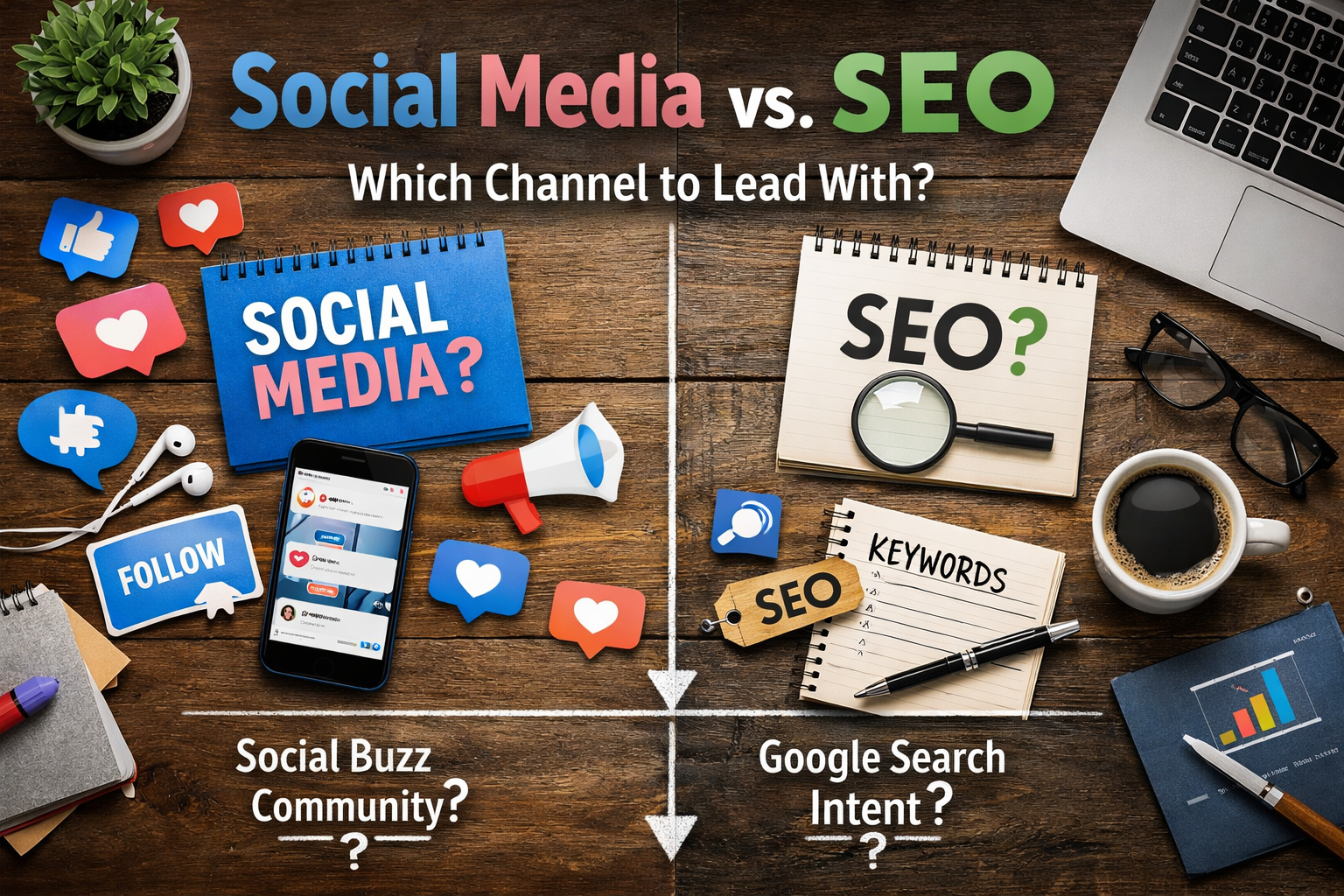
One of the most common strategic questions we get from prospective clients is some version of this: should we be focused on social media or SEO?
It's a fair question. Both channels require real investment — of time, budget, and organizational energy. Most businesses can't do both well simultaneously, especially at the start. And the wrong choice doesn't just waste resources — it can cost you six to twelve months of momentum while a competitor who made the right channel call pulls ahead.
The honest answer is that the right channel depends almost entirely on who you are, who your buyer is, and how your buyer actually makes decisions. There's no universal right answer. But there is a clear framework for thinking it through — and once you understand it, the right call for your specific business usually becomes pretty obvious.
Here's how we think about it.
First, Understand What Each Channel Actually Does
Before we get into the decision framework, let's be precise about what SEO and social media actually accomplish — because a lot of the confusion in this conversation comes from treating them as interchangeable when they're fundamentally different tools doing fundamentally different jobs.
SEO captures existing demand. When someone searches Google for "kitchen remodeler Baltimore" or "estate planning attorney Philadelphia," they already know they have a need and they're actively looking for someone to meet it. SEO puts you in front of that person at the exact moment they're looking. The intent is already there. Your job is to show up and be the most credible option.
Social media creates and nurtures demand. When someone scrolls past your Instagram post or watches your TikTok video, they weren't necessarily looking for you or what you offer. Social media interrupts — ideally in a welcome way — and plants a seed. It builds brand awareness, cultivates community, and keeps you top of mind so that when a need does emerge, you're the first business they think of.
These are genuinely different functions. One harvests intent. One builds it. Which one you lead with depends on which function is more valuable for your business right now.
When We Recommend Leading With SEO
SEO tends to be the right lead channel when several conditions are present.
Your Buyer Is Actively Searching for What You Offer
This sounds obvious, but it's the most important test. If your ideal customer, when they have the need you solve, types something into Google to find a solution — SEO is your highest-leverage channel.
Home services. Legal services. Medical and dental practices. Financial services. B2B professional services. Contractors of all kinds. These are categories where purchase intent is expressed through search behavior, and where showing up at the top of relevant searches translates directly into leads and revenue.
If you're a plumber and someone's basement is flooding at 10pm, they're not scrolling Instagram. They're Googling "emergency plumber near me." If you're not showing up there, the business goes to whoever is.
The Purchase Decision Is High-Consideration
Higher-stakes purchases — anything where the buyer is going to do significant research before making a decision — tend to play out heavily in search. The buyer is looking for information, comparing options, reading reviews, and trying to make a confident decision. That entire journey runs through search engines.
SEO that captures buyers at the research phase and guides them through the consideration phase to conversion is extraordinarily valuable for high-consideration purchases. A well-built SEO strategy in these categories doesn't just drive traffic — it shapes the entire buyer journey.
You're in a Geographically Bounded Service Business
Local service businesses — anything where you serve customers in a defined geographic area — are almost always best served by leading with local SEO. The combination of Google Business Profile optimization, local search ranking, and map pack visibility puts you directly in front of people in your market who are actively looking for exactly what you offer.
The ROI on local SEO for service businesses is often the highest of any digital marketing channel available — and it compounds over time in a way that paid advertising doesn't.
You Want Long-Term Compounding Returns
SEO is a long game. It takes time — typically four to six months before meaningful results materialize, and twelve to twenty-four months before a truly dominant position is built. But once built, it compounds. A strong organic search presence generates leads month after month without the ongoing spend that paid channels require.
Businesses that are thinking in terms of two to three year time horizons — that are building something rather than just generating short-term leads — are almost always better served by investing in SEO early.
When We Recommend Leading With Social Media
Social media tends to be the right lead channel under a different set of conditions — and they're just as clear once you know what to look for.
Your Product or Service Has High Visual or Lifestyle Appeal
If what you sell is inherently visual — if seeing it creates desire in a way that a search result never could — social media is your highest-leverage channel.
Interior design. Fashion and apparel. Food and beverage. Fitness and wellness. Travel and hospitality. Powersports and outdoor recreation. Home décor. Wedding services. These are categories where the product sells itself visually and where social media platforms are the natural habitat of the buyer.
People aren't just searching for a new dining room table — they're scrolling Pinterest and Instagram and falling in love with one before they knew they wanted it. If your product creates that kind of desire, social media leads.
Your Buyer Doesn't Know They Need You Yet
Some of the best businesses solve problems people don't know they have, or offer products people didn't know existed. If your buyer isn't typing anything into Google because they don't yet have the vocabulary or the awareness to search for you, SEO can't help you.
Social media is the tool for creating awareness and desire where none existed. It interrupts the scroll, introduces the product, tells the story, and builds the craving. Then — once awareness is established — SEO becomes relevant for capturing the demand that social media created.
You're Building a Brand in a Passion or Community-Driven Category
Some categories are fundamentally community-driven. Powersports. Craft beverages. Fitness and CrossFit. Local food culture. Outdoor adventure. Gaming. These are spaces where the buyer is an enthusiast who belongs to a community — and that community lives primarily on social media.
A business in one of these categories that ignores social media isn't just missing a marketing channel. It's absent from the primary space where its buyer lives, connects, and makes decisions. Social media isn't optional here — it's the arena.
Your Purchase Cycle Is Short and Impulse-Friendly
Lower price point, lower consideration, emotionally driven purchases respond extremely well to social media. If someone can see your product on Instagram and buy it within sixty seconds, social media is a conversion channel, not just an awareness one.
E-commerce brands, consumer products, experience-based businesses, and anything with a strong impulse purchase component should be leading with social media — particularly platforms like Instagram, TikTok, and Pinterest where discovery-to-purchase friction is minimal.
You Need to Build an Audience Before You Have Search Volume
New categories, innovative products, and businesses entering markets where the search volume doesn't yet exist for their specific offering need to build awareness before they can harvest it. Social media lets you build an audience, demonstrate value, and create demand — which eventually feeds into search behavior that SEO can then capture.
Think of it as a sequencing decision: social media builds the audience and creates the demand, SEO captures it once it exists.
When You Should Be Doing Both — and How to Sequence Them
Here's where the framework gets more nuanced. For most mature businesses, the answer isn't purely one or the other — it's a question of which to lead with and how to sequence the investment.
The most common high-performance approach we recommend is this: lead with the channel that drives revenue fastest for your specific business, then layer in the other channel once the first is performing.
For a local service business — a contractor, a professional services firm, a medical practice — that usually means leading with local SEO and Google Business Profile optimization, getting to a place where organic search is generating consistent leads, and then layering in social media to build brand depth, community, and referral flywheel.
For a visually driven consumer brand — a boutique, a restaurant, a lifestyle product — that usually means leading with social media to build awareness and desire, then investing in SEO once there's enough brand search volume and category awareness to make organic search meaningful.
The mistake most businesses make is trying to do everything at once before they have the resources to do any of it well. A mediocre presence on five channels is almost always worse than an excellent presence on two.
A Few Specific Client Types and What We'd Recommend
Rather than leaving this purely abstract, here's how the framework plays out for specific business types we work with regularly.
Local home services contractor. Lead with local SEO and Google Business Profile. The buyer is searching. The intent is explicit. The ROI on showing up at the top of local search for your category is enormous. Add social media later for brand building and referral amplification — but don't let it distract from the primary search opportunity.
Powersports dealership. Lead with social media and community building, supported by local SEO for in-market buyers. The powersports buyer is a passionate enthusiast who lives on social media. Brand presence in the community is a primary trust signal. But local SEO matters too for capturing buyers who are actively in the market — so both channels deserve investment, with social leading.
B2B professional services firm. Lead with SEO and content marketing, supported by LinkedIn. The B2B buyer researches extensively before making contact, and that research runs through search. Content that shows up during the research journey and demonstrates genuine expertise is the highest-leverage investment. LinkedIn supports this with relationship-building and thought leadership distribution.
E-commerce consumer product. Lead with social media — Instagram and TikTok in particular — for discovery and demand creation. Build SEO in parallel for branded and category searches. The purchase can happen directly from social, making it both an awareness and a conversion channel.
Restaurant or food and beverage business. Lead with social media and Google Business Profile in equal measure. Instagram and TikTok drive discovery and desire. Google Business Profile drives the "near me" search that happens when someone is actively deciding where to eat. Both are essential and neither can be ignored.
Local medical or dental practice. Lead with local SEO and review generation. Patients search for providers when they have a need. Showing up prominently in local search and having a strong review profile is the single highest-leverage investment available. Social media adds value for patient retention and community presence but rarely drives new patient acquisition as efficiently as search.
The Question We Ask Every Client
When we sit down with a new client to think through channel strategy, there's one question we always start with: when your ideal customer realizes they need what you offer, what do they do next?
If the answer is "they Google it" — SEO leads.
If the answer is "they ask their community, scroll their feed, or they didn't know they needed it until they saw it" — social media leads.
If the answer is somewhere in between or involves both — we sequence based on where the fastest revenue opportunity is and build from there.
It's not a complicated framework. But it's one that most businesses never apply rigorously — and the cost of not applying it is months of budget and energy invested in the wrong channel while the right one sits untouched.
Want a clear channel strategy built around how your specific buyer actually makes decisions?
Ritner Digital helps businesses cut through the noise and invest in the channels that actually move the needle for their specific market, buyer, and growth stage. If you're ready to stop guessing and start building a digital strategy with real strategic logic behind it, let's talk.
👉🏼 Get in Touch at ritnerdigital.com
Frequently Asked Questions
Do I really have to choose between social media and SEO, or can I do both?
Most businesses should eventually be doing both — but trying to do everything at once before you have the resources to do any of it well is one of the most common and costly mistakes in digital marketing. A mediocre presence on five channels is almost always worse than an excellent presence on two. The smarter approach is to identify which channel drives revenue fastest for your specific business, invest in doing that one well, and layer in additional channels once the first is performing consistently. The question isn't whether to do both — it's which to lead with and when to add the second.
What is the most important factor in deciding whether to lead with SEO or social media?
Start with one question: when your ideal customer realizes they need what you offer, what do they do next? If they open Google and search for it, SEO is your lead channel. If they ask their community, scroll their social feed, or they didn't even know they needed it until they saw it somewhere, social media leads. Everything else in the channel strategy decision flows from that single insight. It sounds simple, but most businesses never ask it rigorously — and end up investing heavily in a channel that doesn't match how their buyer actually behaves.
How long does SEO take to produce results and is it worth the wait?
SEO typically takes four to six months before meaningful results begin to materialize, and twelve to twenty-four months to build a truly dominant position in competitive markets. That timeline is real and shouldn't be sugarcoated. But what makes it worth the wait is what happens once that position is built — organic search generates leads consistently without the ongoing per-click spend that paid advertising requires. Unlike paid channels that stop producing the moment you stop spending, SEO compounds over time. For businesses with a two to three year horizon, it's often the highest-ROI digital marketing investment available.
What kinds of businesses are the best fit for leading with SEO?
Businesses where the buyer actively searches for the solution when a need arises. Local service businesses — contractors, plumbers, electricians, HVAC companies — are among the clearest cases. Legal, medical, dental, and financial services practices. B2B professional services firms. Any business in a category where purchase intent is expressed through search behavior and where showing up at the top of relevant searches translates directly into leads. If your ideal customer types something into Google when they have the problem you solve, SEO is almost certainly your highest-leverage channel.
What kinds of businesses are the best fit for leading with social media?
Businesses where the product has high visual or lifestyle appeal, where the buyer is part of a passion-driven community, or where awareness needs to be created before demand can be captured. Powersports dealers. Restaurants and food businesses. Fashion, fitness, and wellness brands. Interior design and home décor. E-commerce consumer products. Any business where seeing the product creates desire that didn't exist before the encounter. If your buyer lives in a community that exists primarily on social media, or if your product sells itself visually in a way a search result never could, social media leads.
Can social media ever drive the same kind of high-intent leads that SEO does?
In certain categories, yes — particularly for lower price point, impulse-friendly purchases where the path from discovery to transaction is short. An e-commerce brand can drive significant revenue directly from Instagram or TikTok because the purchase can happen within seconds of discovery. But for higher-consideration purchases — anything where the buyer needs to research, compare, and build confidence before committing — social media is better understood as an awareness and trust-building channel than a direct conversion channel. It plants seeds that search and direct channels harvest later.
What is the difference between how SEO and social media contribute to the buyer journey?
SEO captures existing demand — it puts you in front of buyers who already know they have a need and are actively looking for a solution. Social media creates and nurtures demand — it builds awareness, cultivates desire, and keeps you top of mind so that when a need eventually emerges, you're the first business the buyer thinks of. One harvests intent. The other builds it. Both are valuable, but they play different roles in the buyer journey and the decision about which to prioritize depends on where your specific buyer is in that journey when you're most likely to reach them.
We're a new business with a limited budget. Where should we start?
Start with whichever channel gives you the fastest path to revenue for your specific business type — and be ruthlessly focused on that one channel before adding anything else. For most local service businesses, that's Google Business Profile optimization and local SEO, which can produce meaningful visibility relatively quickly and with reasonable investment. For visually driven consumer brands or businesses in passion-driven categories, it's building an authentic social media presence in the community where your buyer lives. The worst thing a new business with a limited budget can do is spread that budget thinly across multiple channels simultaneously and do none of them well enough to see results.
How does content marketing fit into the SEO versus social media decision?
Content marketing is the engine that powers both channels, just in different forms. For SEO, content means blog posts, service pages, guides, and resources that target the search queries your buyers use during their research journey — building organic visibility and demonstrating expertise over time. For social media, content means visual posts, videos, stories, and community engagement that builds brand awareness and emotional connection. The businesses that perform best long-term are usually the ones that develop a content strategy designed to feed both channels — repurposing and adapting core content across SEO and social rather than treating them as completely separate efforts.
How do we know if we chose the wrong channel and need to pivot?
A few clear signals. If you've been investing consistently in a channel for six or more months and seeing no meaningful movement in leads, traffic, or engagement — and your execution has been genuinely solid — that's worth examining. Also watch for a consistent mismatch between channel activity and actual business outcomes. Lots of social media engagement but no leads is a signal that social media may be building awareness in the wrong audience or for a product that requires search intent to convert. Strong search rankings but low conversion is a signal that something in the website or offer needs attention before more SEO investment makes sense. The answer is rarely to abandon a channel entirely — it's usually to diagnose what's broken before deciding whether to pivot.
How does Ritner Digital approach channel strategy for new clients?
We start by understanding the buyer before we recommend any channel. That means a real conversation about who your ideal customer is, how they make decisions, where they spend their time digitally, and what the fastest path to meaningful revenue looks like for your specific business. From there we build a channel strategy with clear logic behind every recommendation — not a generic plan that could apply to any business, but one that reflects your specific market, buyer, and growth stage. If you want to understand exactly which channels we'd recommend for your business and why, the best starting point is a conversation.