Why Philly Businesses Keep Losing to Out-of-State Competitors on Google
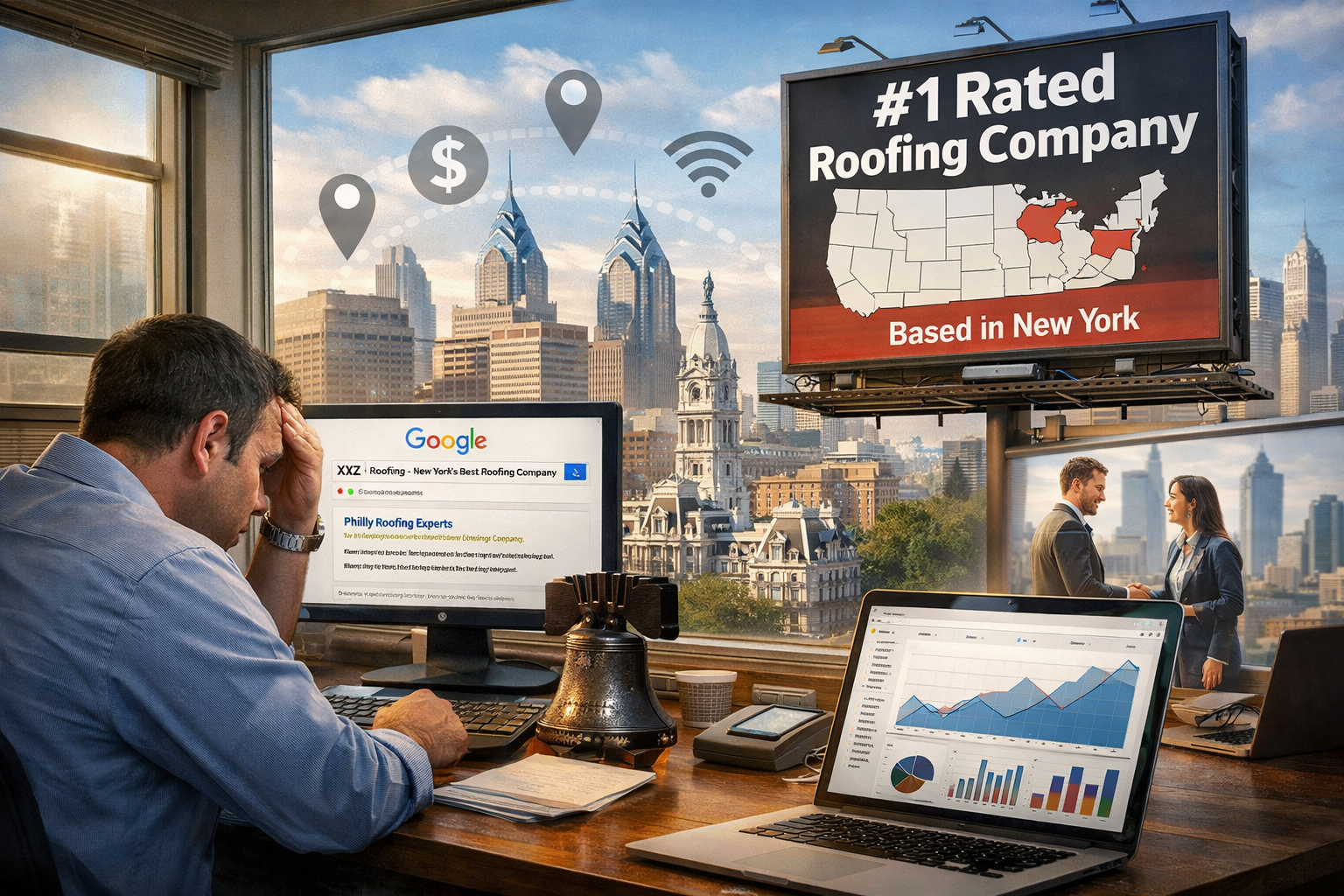
There's a frustrating pattern that plays out constantly across the Philadelphia market.
A local business — one that's been serving the community for years, that knows the market inside and out, that has real relationships and real results to show for it — gets routinely outranked on Google by a competitor headquartered in another state. Sometimes another time zone. A company that has never set foot in Philadelphia, doesn't know the neighborhoods, and couldn't tell you the difference between Fishtown and Frankford.
And yet there they are. Page one. Top of the map pack. Showing up exactly where your business should be.
It's maddening. And it's more common than it should be.
The good news is that it's not mysterious. The reasons local Philadelphia businesses lose to out-of-state competitors on Google are specific, identifiable, and — critically — fixable. But fixing them requires understanding exactly what's happening and why the algorithm is making the choices it's making.
Here's the honest breakdown.
Google Doesn't Care Where Your Heart Is
Let's start with the uncomfortable truth at the center of this problem.
Google doesn't reward loyalty to local businesses. It doesn't reward years of community service or authentic neighborhood knowledge or the fact that your owner coaches Little League in Roxborough. It rewards digital signals. Specific, measurable, technical signals that tell its algorithm which business is the most credible, relevant, and authoritative answer to a given search query.
And the painful reality is that a lot of local Philadelphia businesses — through no fault of their own — have weaker digital signals than out-of-state competitors that have invested heavily in building them.
That's the whole story, really. Everything else is just explaining which signals matter and why so many local businesses are losing ground on them.
Signal One: Domain Authority and Backlink Profiles
The first and often most significant reason out-of-state competitors outrank local businesses is domain authority — the accumulated weight of credibility that a website has built through years of earning links from other reputable websites.
Large national or regional companies have often been investing in link building and content marketing for years. They have links from industry publications, national news outlets, trade associations, and hundreds of other reputable sources pointing back to their website. Those links are votes of credibility in Google's eyes — and they add up to a domain that Google trusts deeply.
A local Philadelphia business that has never invested in content marketing or link building often has a website that Google trusts much less — regardless of how good the actual business is. The algorithm can't evaluate how good your work is or how satisfied your customers are. It can evaluate how many credible sources on the internet point to your website as a resource worth trusting.
The fix isn't complicated but it takes time: earn links from local Philadelphia publications, industry associations, local business directories, community organizations, and any reputable source that can point back to your website. The Philadelphia Inquirer, Billy Penn, local chambers of commerce, neighborhood business associations, industry trade publications — all of these are legitimate link opportunities that build the kind of local authority that helps level the playing field against national competitors.
Signal Two: Content Depth and Topical Authority
The second major reason local businesses lose to out-of-state competitors is content — specifically, the depth and breadth of content that covers the topics most relevant to their business.
National competitors often have entire content marketing teams producing comprehensive, well-optimized content that establishes topical authority in their category. They've written the definitive guides. They've answered every question their potential customers ask. They've covered the topic so thoroughly that Google recognizes them as an authoritative resource — not just for one or two keywords, but for the entire subject matter.
Local businesses, by contrast, often have thin websites. A homepage. A services page. Maybe an About page. A contact form. No blog. No resources. No content that demonstrates expertise or captures the long-tail searches that make up the majority of actual search volume.
Google's algorithm increasingly rewards topical authority — the sense that a website deeply and comprehensively covers a subject area. A national competitor with hundreds of pages of high-quality, relevant content has a massive advantage over a local business with five pages, even if the local business is genuinely more expert.
The fix here is a deliberate content strategy built around the questions your Philadelphia-area buyers are actually asking. Not just the high-intent transactional queries — though those matter — but the research-phase questions, the comparison questions, the "how do I know if I need this" questions. Content that builds topical authority over time while also capturing the local search intent that a national competitor can never fully replicate.
Signal Three: Technical SEO Fundamentals
Here's one that surprises a lot of local business owners: a significant percentage of the local Philadelphia businesses we audit have meaningful technical SEO problems on their websites that are silently undermining their ability to rank.
Slow page load times. Mobile responsiveness issues. Crawl errors that prevent Google from properly indexing pages. Duplicate content problems. Missing or misconfigured schema markup. Broken internal linking structures. Pages that should be ranking but aren't because of indexing issues that have never been identified or addressed.
National competitors with dedicated SEO teams or agency relationships typically don't have these problems — or they catch and fix them quickly. Local businesses running their own websites often don't even know these issues exist, let alone how to fix them.
Technical SEO is the foundation everything else is built on. Content and link building efforts are significantly less effective if the underlying technical health of the website is poor. A technical audit — a thorough examination of everything Google encounters when it crawls your website — is often where the most impactful early wins are found.
Signal Four: Google Business Profile Optimization
This one is particularly relevant for local search visibility — the map pack, the local results, the listings that show up when someone searches for a service "near me" or with a Philadelphia location qualifier.
The Google Business Profile is the single most important asset for local search visibility, and an alarming number of local Philadelphia businesses have profiles that are incomplete, inconsistently maintained, or simply never properly optimized after the initial setup.
Meanwhile, sophisticated national competitors with local operations have fully optimized profiles — every category filled in correctly, regular photo updates, active posting cadence, complete service and product listings, questions answered, attributes set. They're sending every possible signal to Google that their listing is current, credible, and comprehensive.
The gap this creates in local pack visibility is often dramatic. A national competitor with a well-optimized GBP and a physical address in the Philadelphia area can outrank a local business that's been operating here for fifteen years simply because their profile is better maintained.
The GBP is also one of the fastest levers to pull for local visibility improvement. Unlike domain authority and content, which build over months and years, GBP optimization can produce meaningful local search movement relatively quickly — making it usually the first priority in any local SEO engagement.
Signal Five: Review Volume, Recency, and Response Rate
Google treats reviews as a significant trust and relevance signal for local search ranking. And the review profile of most local Philadelphia businesses is weaker than it should be — not because customers aren't satisfied, but because most businesses have no systematic approach to generating reviews.
National competitors, particularly in service categories, often have dedicated review generation systems. They follow up with every customer. They make the review process frictionless. They respond to every review — positive and negative — in ways that signal active, accountable business management. And they do this consistently over time, producing a steady stream of recent, credible reviews.
The local business that hasn't asked a customer for a review in six months is starting from behind. And it's a gap that compounds — Google increasingly weights recency, which means a competitor generating ten new reviews a month is pulling further ahead every single month that your review profile stays static.
Systematic review generation isn't complicated but it requires intentionality. A follow-up process after every completed job or transaction. A frictionless path to leaving a review. A habit of responding to every review that comes in. Done consistently, this is one of the most reliable ways to close the gap with well-resourced national competitors.
Signal Six: Local Citation Consistency
Citations — mentions of your business name, address, and phone number across the web — are a foundational local SEO signal. Google uses citation data to build confidence in the identity and location of local businesses, and inconsistent citation data introduces doubt that suppresses ranking.
The typical local Philadelphia business has a citation mess. A profile on Yelp with one version of the address. A listing on an industry directory with an old phone number. A Facebook page with a slightly different business name. A dozen other listings across the web in various states of accuracy and completeness.
National competitors typically have clean, consistent citation profiles — either because they have systems to maintain them or because they've worked with agencies that have done the cleanup work. That consistency sends a confident signal to Google. The inconsistency in most local business citation profiles does the opposite.
A citation audit and cleanup — identifying every place your business is listed online and ensuring the information is accurate and consistent everywhere — is foundational work that often produces meaningful local ranking improvements and is frequently overlooked because it's unglamorous.
Signal Seven: Website Authority and Age
This one is harder to fix quickly, but important to understand. Domain age and the accumulated authority of a website over time are genuine ranking factors. A national competitor that has been operating their website for fifteen years, publishing content, earning links, and building authority has a head start that can't be eliminated overnight.
This is one of the reasons the local SEO gap widens over time when local businesses don't invest in their digital presence. Every year a national competitor is investing in content and links while a local business is standing still is a year the gap grows larger. And because authority is cumulative, catching up takes sustained investment over time — not a one-time sprint.
The implication is that the best time to start building your website's authority was five years ago. The second best time is now.
The One Advantage Local Businesses Actually Have
Here's where the story turns — because local Philadelphia businesses have one genuine, significant advantage over national competitors that the algorithm increasingly rewards.
Local authenticity.
A Philadelphia business that produces content demonstrating deep, specific knowledge of the local market — that references actual neighborhoods, actual local conditions, actual community context — can build a form of local topical authority that a national competitor writing generic content from an out-of-state office simply cannot replicate.
A law firm that writes about how Pennsylvania-specific regulations affect their clients. A contractor that covers the particular challenges of working with the older housing stock in neighborhoods like Germantown or West Philadelphia. A marketing agency that understands how the cultural dynamics of different Philadelphia submarkets affect buyer behavior. A financial advisor who speaks to the specific economic realities of building wealth in the Philadelphia region.
This is content that national competitors can't authentically produce — and it's the kind of content Google is increasingly sophisticated at recognizing as genuinely locally relevant. It's also content that resonates with Philadelphia buyers in a way that generic national content never will.
The businesses that understand this and build it into their content strategy are turning their local knowledge — which is a genuine asset — into digital authority. That's how you close the gap with better-resourced national competitors and eventually pull ahead of them in the markets that actually matter to you.
The Pattern We See Most Often
When we audit local Philadelphia businesses that are losing to national competitors on Google, the pattern is almost always the same. A website that hasn't been meaningfully updated in years. A Google Business Profile that was set up once and never touched. A review profile that grows sporadically at best. No content strategy. No link building. No technical SEO attention. And a vague sense that the website should be doing more without a clear understanding of why it isn't.
Meanwhile the national competitor has been quietly and consistently investing in every one of these signals — not because they're smarter, but because they treat their digital presence as a serious business asset that requires ongoing investment.
The good news is that this gap is closeable. It takes time, strategy, and consistent execution. But local Philadelphia businesses that commit to building their digital signals the right way — who treat their website and their online presence with the same seriousness they bring to the rest of their business — can absolutely compete with and beat national competitors in their own backyard.
This is your market. You understand it better than anyone headquartered three states away ever will. The goal is to make sure Google knows that too.
Tired of watching out-of-state competitors rank above you in your own market?
Ritner Digital helps Philadelphia-area businesses build the kind of local digital authority that turns their market knowledge into search visibility — and their search visibility into real leads and revenue. If you're ready to stop losing ground to competitors who don't know your market half as well as you do, let's have that conversation.
👉🏼 Get in Touch at ritnerdigital.com
Frequently Asked Questions
How is it even possible for an out-of-state company to outrank a local Philadelphia business in local search results?
Because Google ranks based on digital signals — not geographic loyalty or years of community service. An out-of-state competitor that has invested heavily in domain authority, content depth, technical SEO, and Google Business Profile optimization will outrank a local business with a stronger real-world reputation but weaker digital signals every single time. The algorithm can't evaluate how good your work is or how well you know the market. It evaluates specific, measurable technical and content signals — and whichever business has built stronger ones wins the ranking, regardless of where their headquarters is.
What is the single most impactful thing a local Philadelphia business can do to improve its Google ranking right now?
For most local businesses, fully optimizing the Google Business Profile is the fastest lever available. Unlike domain authority and content depth — which build over months and years — GBP optimization can produce meaningful local search visibility improvements relatively quickly. That means every category filled in correctly, accurate and consistent business information, regular photo updates, an active posting cadence, complete service listings, and a systematic approach to generating and responding to reviews. It won't close every gap overnight, but it's consistently the highest-impact starting point for local businesses that are losing ground to better-resourced competitors.
How important are online reviews for local search ranking, and how do I get more of them?
Extremely important — and most local businesses are significantly underinvesting in review generation without realizing it. Google weights review volume, recency, and response rate as meaningful local ranking signals. A competitor generating ten new reviews a month while your profile stays static is pulling further ahead in the algorithm every single month. Getting more reviews isn't complicated — it requires a systematic follow-up process after every completed job or transaction, a frictionless path to leaving a review, and a consistent habit of responding to every review that comes in. The businesses that do this well don't ask for reviews occasionally. They ask every time, without exception.
What is domain authority and why does it matter for competing against national companies?
Domain authority is the accumulated credibility signal that a website has built over time through earning links from other reputable websites. When credible publications, industry associations, local organizations, and other reputable sources link to your website, those links function as votes of trust in Google's eyes. National competitors with long-established content marketing programs often have hundreds or thousands of these links pointing to their websites — giving them a level of algorithmic trust that a local business with few or no inbound links simply can't match without deliberate investment. Building domain authority takes time, but it's one of the most durable competitive advantages available in organic search.
What does "technical SEO" mean and how do I know if my website has problems?
Technical SEO refers to the behind-the-scenes health of your website — the factors that determine how easily and accurately Google can crawl, understand, and index your content. Common technical problems include slow page load times, mobile responsiveness issues, crawl errors, duplicate content, missing schema markup, broken internal links, and indexing problems that prevent pages from appearing in search at all. Most local business owners have no idea these issues exist on their websites because the site looks fine to the human eye. A technical SEO audit — a systematic examination of everything Google encounters when it crawls your site — is usually the starting point for identifying what's silently suppressing your rankings.
What is a citation and why does citation consistency matter for local search?
A citation is any mention of your business name, address, and phone number on the web — on directories like Yelp, on industry-specific platforms, on social profiles, on local business listings, and dozens of other places. Google uses citation data to build confidence in the identity and location of local businesses. When your business information appears inconsistently across different platforms — slightly different address formats, an old phone number still listed somewhere, variations in your business name — it introduces doubt into the algorithm that suppresses local ranking. Auditing and correcting your citation profile across the web is foundational cleanup work that often produces meaningful local visibility improvements and is frequently overlooked.
How does content depth affect local search ranking, and what should a local business be writing about?
Google increasingly rewards topical authority — the sense that a website comprehensively and expertly covers a subject area. National competitors with content marketing teams have often built this authority across hundreds of pages of well-optimized content. Local businesses with thin websites — a homepage, a services page, and a contact form — are at a significant disadvantage. Local businesses should be creating content that covers the questions their Philadelphia-area buyers are actually asking throughout their research journey, combined with content that demonstrates deep, specific local market knowledge. Content about Pennsylvania-specific regulations, Philadelphia neighborhood contexts, local market conditions, and community-specific insights is content that national competitors genuinely cannot replicate — and that Google is increasingly sophisticated at recognizing as locally authoritative.
Is it realistic for a small local business to compete with large national companies on Google?
Yes — with the right strategy, the right channels, and realistic expectations about timeline. Local businesses have genuine advantages that national competitors can't replicate: authentic local knowledge, real community relationships, and the ability to produce locally specific content that feels genuinely relevant to Philadelphia buyers in a way generic national content never does. The key is channeling those advantages into digital signals that Google can measure — local content, local links, a strong GBP, a healthy review profile, and a technically sound website. It takes sustained investment over time, but local businesses that commit to building their digital presence the right way can absolutely compete with and outrank national competitors in their own market.
How long does it take to close the gap with a national competitor that has been investing in SEO for years?
Honestly, it depends on how large the gap is and how aggressively you invest in closing it. Technical fixes and GBP optimization can produce visible improvements within weeks to months. Content and topical authority build over six to twelve months of consistent publishing. Domain authority through link building is the longest game — meaningful improvements typically take twelve to twenty-four months of sustained effort. The important thing to understand is that every month you're not investing is a month the gap potentially widens. The businesses that start building their digital authority now are the ones that will be in a dominant local search position in two to three years. The ones that wait will be starting further behind.
Why do so many local Philadelphia businesses fall behind on their digital presence in the first place?
Usually because running a business is all-consuming and digital marketing is easy to deprioritize when you're focused on delivering your service and managing day-to-day operations. A website gets built once and never updated. A Google Business Profile gets set up and forgotten. Reviews accumulate sporadically. The gap between the local business and the national competitor widens gradually and invisibly — until the day the business owner notices they're not showing up where they used to and can't figure out why. It's not negligence. It's the entirely understandable consequence of prioritizing the work over the marketing of the work. The fix is treating your digital presence as a business asset that deserves the same ongoing attention as any other critical part of the operation.
How can Ritner Digital help Philadelphia businesses compete more effectively against national competitors in local search?
Ritner Digital starts with a thorough audit of where you stand — your technical SEO health, your GBP optimization, your citation profile, your review situation, your content depth, and your domain authority relative to the competitors outranking you. From there we build a prioritized strategy that addresses the highest-impact gaps first and builds toward the kind of comprehensive local digital authority that turns your market knowledge into search visibility. We understand the Philadelphia market, we understand what local buyers respond to, and we build strategies designed to help local businesses win in their own backyard. If you're ready to stop losing ground to competitors who don't know your market half as well as you do, let's talk.