The Website Content Nobody Thinks About Anymore — And Why That's a Mistake
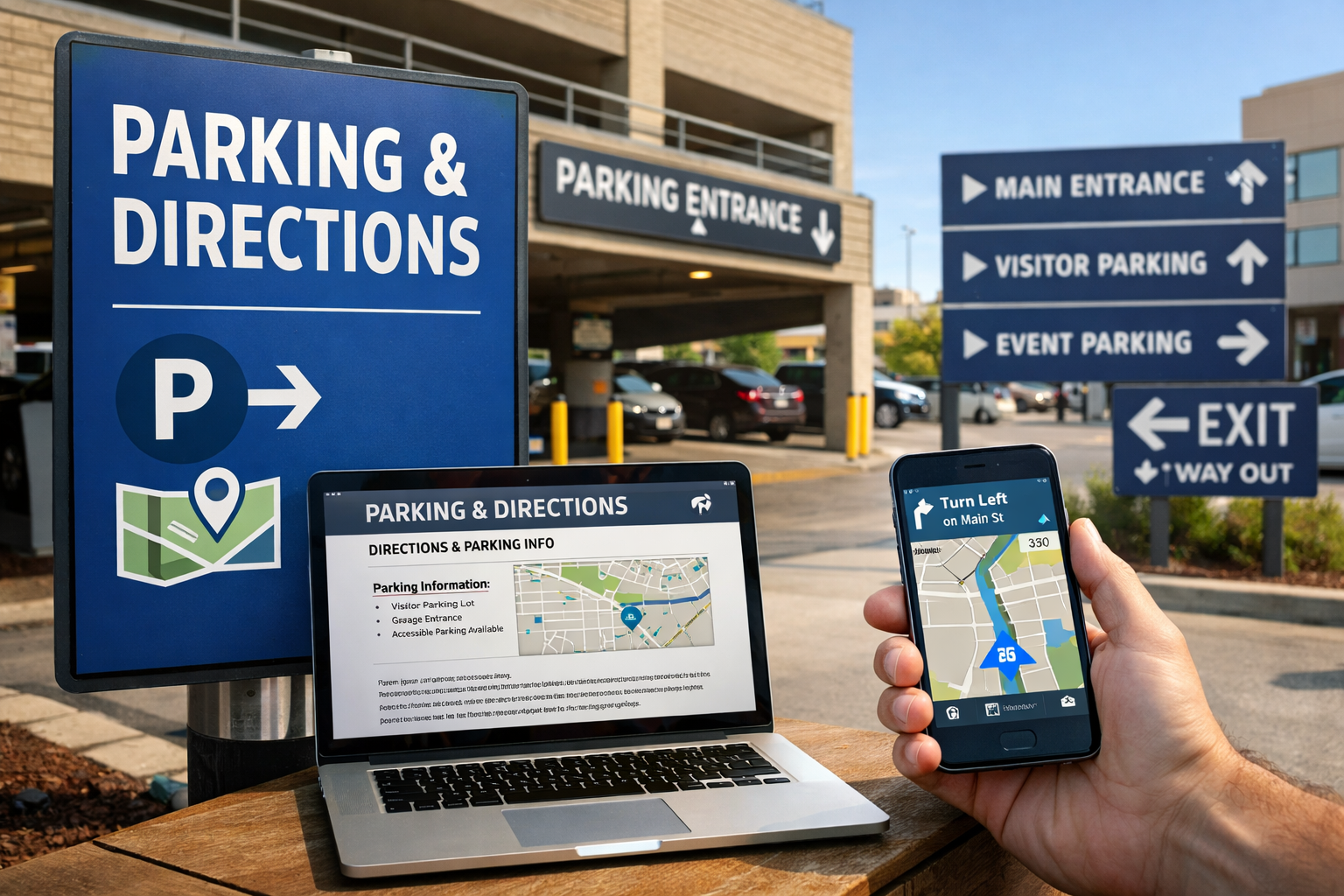
Here's a question worth sitting with for a moment: when was the last time you updated the parking and directions information on your website?
If your honest answer is "I'm not sure we have any" or "probably when the site was built" — you're in the majority. And you're leaving something on the table that costs you nothing to fix and produces real, measurable value for every person who visits your location for the first time.
Parking and wayfinding content — the practical, logistical information that helps someone physically get to your business — is one of the most overlooked categories on modern business websites. It wasn't always this way. In the early days of the commercial internet, "how to find us" pages were standard infrastructure. Every business with a physical location built one. It was considered a basic courtesy, the digital equivalent of giving someone directions over the phone.
Then something happened. The pages faded away. Google Maps got good. Mobile GPS became ubiquitous. The conventional wisdom hardened into received wisdom: people will just use their phones to navigate. We don't need to tell them how to get here.
That conventional wisdom is wrong — or at least significantly incomplete. And understanding why it's wrong, what it costs businesses that embrace it, and how to do wayfinding content correctly in 2026 is worth spending some time on.
The Early Internet Got This Right
If you used the web in the late 1990s and early 2000s, you remember the "Contact Us" and "Directions" pages that were standard on virtually every business website. They included written turn-by-turn directions from major highways, a small static map, parking instructions, and sometimes even notes about what the building looked like from the street. "Look for the red door" was a completely normal piece of website copy.
This wasn't accidental. It reflected the practical reality of the moment. GPS was not in everyone's pocket. MapQuest was useful but required printing. If you were driving somewhere new, you needed explicit instructions — and businesses that wanted customers to actually show up provided them.
As Google Maps became integrated into mobile devices and then became the default navigation tool for virtually everyone, the rationale for this content seemed to evaporate. Why write directions when the customer's phone gives them better directions than you ever could? Why describe parking when they can see the area on a satellite map? The "Directions" page came to feel redundant at best and quaint at worst.
By the mid-2010s the dedicated directions page had largely disappeared from modern website design. The canonical replacement was a Google Maps embed — a small map widget on the contact page that showed the business's location pin without any of the contextual information the old directions pages contained.
The embed is better than nothing. It is not a replacement for what was lost.
What Google Maps Can't Tell Your Customer
Google Maps is extraordinary at what it does. It will get someone to your general vicinity with a reliability that would have been miraculous twenty years ago. But there are specific categories of information that Google Maps either doesn't know, can't communicate in the right context, or presents in ways that don't help a first-time visitor navigate the last 200 feet of their journey.
The Parking Problem
Parking is the most significant gap. Google Maps can show a user that parking exists near a destination. It cannot tell them:
Which specific lot or garage is the right one for your building. Whether the street parking in front requires a permit. Whether the lot on the corner charges $35 for the first hour or $8 for all day. Whether there's a specific entrance from the lot to your building or whether they need to walk around. Whether the garage on the adjacent block is cheaper and has a skybridge. Whether there's validated parking available and how to get it. Whether the accessible parking spaces are in a specific location that isn't obvious from the street.
For urban offices, medical practices, law firms, accounting offices, restaurants with tight parking situations, and any business in a downtown corridor — these details are the difference between a visitor who arrives on time and relaxed and one who arrives fifteen minutes late and frustrated after circling the block three times.
The Building Identification Problem
In dense urban environments and office parks alike, getting to the right building is not always as simple as following a GPS pin. Office parks with multiple buildings. Medical campuses with several entrances. Historic buildings that don't display addresses prominently. Buildings where the street address places the pin on the wrong side of the structure. Suites and floors that aren't mentioned on any external signage.
"We're in Suite 400 of the Walnut Street building, which is the third building on the left as you enter from Market Street — not the tower you can see from the highway" is information that exists only if someone puts it on the website.
The Accessibility Information Problem
For visitors with mobility limitations, detailed wayfinding information isn't a convenience — it's a prerequisite for planning a visit at all. Which entrance is accessible. Whether the accessible parking is near that entrance. What the elevator situation is. Whether there's a step at a specific entrance that isn't obvious from the street view. This information matters enormously to a segment of your visitors and is consistently absent from most business websites.
The Public Transit Problem
Not every visitor arrives by car. For businesses in cities with functional public transit — Philadelphia being a clear example — the visitor arriving by SEPTA, by Uber, by bicycle, or on foot is navigating a different last-mile problem than the driver. Which subway stop is closest. Which exit from that stop puts you on the right side of the street. Where the nearest bike rack is. Which ride-share drop-off point doesn't leave you walking through a construction zone.
Google Maps handles transit directions reasonably well in the abstract, but site-specific context — "get off at Walnut-Locust and use the south exit, then walk half a block east" rather than just "take the Broad Street Line" — is information that only the business can provide.
The SEO Dimension: Why This Content Performs
Beyond user experience, parking and wayfinding content has a specific and underappreciated SEO value that makes it worth building for purely strategic reasons.
Hyper-Local Keyword Opportunities
When someone searches "parking near [your address]" or "how to get to [your neighborhood] office" or "parking for [your building name]" — these are queries with commercial intent attached to a specific location. They are being searched by people who are planning to visit a business in your area. They are low-competition in almost every local market because almost no businesses publish content targeting them.
A page that specifically addresses parking near your office, by name, with the names of the garages or lots, the street names, and the specific context — that page is positioned to rank for a set of queries that your competitors almost certainly aren't targeting. The traffic is small in absolute terms but the intent quality is extraordinarily high. Someone searching for parking near your office is seconds away from walking through your door.
Reinforcement of Local Entity Signals
Local SEO is built on signals that connect your business to a specific geographic location. Street addresses, neighborhood names, landmark references, transit stop names, parking garage names — all of these, appearing naturally in content on your website, reinforce the geographic entity signals that help Google understand where you are and for whom you are relevant.
A medical practice whose website mentions the specific SEPTA stop, the parking garage on the adjacent block, and the cross street for the accessible entrance is building a richer local entity profile than one whose site contains only an address and a Maps embed. Both will rank for branded searches. The one with richer local content will rank for a broader range of local discovery queries.
Long-Tail Query Capture
Wayfinding content naturally generates long-tail search traffic that adds up. "Where to park near [street name] Philadelphia" — "closest parking to [office building name]" — "accessible parking [your neighborhood]" — none of these individually drives significant search volume, but collectively and over time they produce a steady stream of high-intent local visitors who are specifically trying to get to your location or somewhere nearby. For businesses with significant walk-in or appointment traffic, this is genuinely valuable.
How the Disappearance Happened — And Why It Persists
Understanding why wayfinding content faded helps explain why it hasn't come back despite the clear value. The disappearance was driven by two forces that seemed reasonable individually but produced a bad outcome together.
The first was the genuine improvement of navigation technology. When Google Maps became reliable and ubiquitous, the case for detailed written directions genuinely weakened. The specific turn-by-turn content that "Directions" pages once provided was legitimately replaced by something better.
The problem is that the reaction to this was all-or-nothing. Businesses didn't replace written directions with the more specific, contextual content that Maps can't provide — the parking details, the building identification cues, the transit information, the accessibility notes. They replaced the entire category of wayfinding content with a Maps embed and considered the job done.
The second force was the rise of design minimalism as the dominant web aesthetic. Modern website design philosophy prizes clean interfaces, reduced content, and streamlined user journeys. A dedicated "Directions and Parking" page with several hundred words of logistical detail feels at odds with this aesthetic — it reads as cluttered and utilitarian compared to the spare, image-forward design language that became the standard.
Both of these forces are real. Neither of them justifies leaving practical visitors uninformed. The challenge is to provide the contextual information people need without designing a page that looks like a 2002 Mapquest printout — and that challenge is entirely solvable.
The Industries Where This Matters Most
While every business with a physical location should have some form of wayfinding content, certain industries have more to gain from doing it well and more to lose from neglecting it.
Medical and Dental Practices
Healthcare visits are already anxiety-producing for many patients. Adding the stress of not being able to find parking, entering through the wrong door, or arriving at the wrong building — especially for first appointments — creates a negative experience before the clinical interaction even begins. Detailed wayfinding content for medical practices reduces no-show rates, reduces late arrivals, reduces patient stress, and reduces the burden on front desk staff who field location questions every day.
The specific content that matters most for medical offices: which parking garage or lot to use and what it costs, where the accessible entrance is located, which entrance to use for specific departments, and how far in advance to arrive to account for parking.
Law Firms and Professional Services
First impressions are high-stakes in professional services. A new client arriving stressed and late because parking was harder to navigate than expected starts the meeting from a deficit. A first impression shaped by "this was incredibly easy to find and park" contributes to the general sense of competence and care that professional services clients are paying a premium to experience.
Law firms in particular, where initial consultations often involve clients who are already under stress about legal matters, benefit disproportionately from removing logistical friction before the meeting begins.
Restaurants With Difficult Parking Situations
Urban restaurants, in particular, lose a meaningful number of first-time visitors to parking frustration. Someone who planned to try your restaurant, circled the block three times, gave up, and went somewhere easier to park is a lost customer who has no particular reason to try again. A restaurant website with a specific, accurate, helpful parking guide — "valet available Thursday through Sunday after 5 PM, validated parking at the Chestnut Street Garage, street parking on Locust generally available before 6 PM" — is making a direct case for visiting that goes beyond the menu.
Event Venues, Wedding Venues, and Conference Centers
First-time visitors to event venues are often navigating an unfamiliar environment under time pressure — they're arriving for a specific event that starts at a specific time and they cannot be late. Wayfinding failures in this context are particularly damaging because the emotional stakes are high and the blame — fairly or not — often attaches to the venue.
Event venues that provide detailed, comprehensive wayfinding guidance — with parking maps, drop-off locations, accessible entrances, and specific instructions for different types of events — reduce the chaos of arrival day and create a better first impression of the venue's organizational competence.
Financial Advisors, Therapists, and Other Appointment-Based Services
For services where the client relationship depends on trust and comfort from the first moment of contact, everything about the initial visit experience matters. A client arriving at their first therapy session having spent twenty minutes lost in an office park is already activated and distressed before the session begins. A client who found the office easily, parked without frustration, and felt guided through the process arrives in a different frame of mind. The wayfinding content is doing relationship management work before the relationship has formally started.
Real Estate Offices and Model Homes
People visiting real estate offices or touring model homes are often unfamiliar with the geography they're considering. They're typically driving, often coming from outside the immediate area, and frequently time-sensitive around listing appointments. Clear wayfinding content — including what to do if GPS routes you to the wrong entrance, which roads to avoid, and where the model home lot is relative to the main street — reduces no-shows and late arrivals for time-sensitive appointments.
What Good Wayfinding Content Looks Like in 2026
The goal isn't to recreate the text-heavy directions pages of 2001. It's to provide the specific contextual information that Maps can't provide, in a format that serves modern visitors without cluttering the site's design.
A Dedicated Page or Section
Wayfinding content should live on a dedicated page or clearly delineated section of the contact page — not buried in a footer address or presented solely as a Maps embed. The page should be findable via site navigation and should be optimized for the specific local search queries it targets.
Layered Specificity
Start with the big picture — the general location and how to orient to the area — and move progressively to specific details. General neighborhood → specific street address → specific building identification → parking → entrance → floor and suite. Each layer answers the question of the visitor at a specific stage of their journey.
Separate Guidance by Transportation Mode
Separate instructions for drivers, transit riders, cyclists, and pedestrians demonstrate that you've thought about the full range of how people arrive. It also ensures that the content is legible to each type of visitor without requiring them to parse instructions that don't apply to their situation.
Current and Accurate Parking Details
Name the specific garages or lots, give realistic cost expectations, and indicate whether you offer validation. If the parking situation changes seasonally or by day of week — event nights in the neighborhood, street cleaning schedules, construction affecting normal routes — note it. Outdated parking information is almost worse than no parking information because it actively misdirects people who trusted it.
Accessibility Information
Always include a specific section on accessible entrances, accessible parking location, and any relevant accessibility considerations for your space. This information is essential for a specific population of visitors and demonstrates organizational attentiveness to everyone who reads it.
A Note on What to Look For
"Look for the blue awning" or "we're in the building with the green door, not the one with the glass entrance" is the kind of on-the-ground orientation cue that is extraordinarily helpful and completely unavailable from any mapping application. It also happens to be the kind of detail that only someone who has actually navigated to your location can provide — which is why it's valuable and why it should be on your website.
The Bottom Line
Wayfinding content is the website category that disappeared for the wrong reasons and hasn't come back despite those reasons no longer holding. It was replaced by a Maps embed that handles navigation but leaves a specific set of practical questions unanswered. The visitors who encounter those unanswered questions — and in certain industries, that's a significant portion of first-time visitors — experience a friction that costs businesses in ways that are real but hard to directly measure.
The solution is neither a return to 2001-era directions pages nor continued reliance on an embedded map. It's targeted, specific, current wayfinding content that provides what Maps can't: parking specifics, building identification cues, accessibility details, transit guidance, and the on-the-ground context that only the business itself can offer.
It's free to write. It's essentially free to maintain. It reduces friction for every first-time visitor. It produces local SEO value. And it's something almost none of your competitors have thought to do — which is exactly the kind of overlooked opportunity that tends to produce disproportionate returns.
Ritner Digital builds websites that think about the full visitor journey — from the first search to the front door. If your site isn't serving the people trying to find you, let's fix that.
Frequently Asked Questions
Doesn't everyone just use Google Maps to get to a business now? Why does this content still matter?
Google Maps gets people to the vicinity. It doesn't tell them which entrance to use, which parking garage is the right one for your building, how much parking costs, where the accessible entrance is, or how to identify your building when GPS drops a pin in the middle of a block with six similar-looking doors. The last 200 feet of a visitor's journey — the part that determines whether they arrive on time, find parking without frustration, and walk in the right door — is exactly what Maps handles poorly and what good wayfinding content handles well. The two aren't competing. They're complementary. Maps handles navigation. Your website handles context.
We're in a building with simple, obvious parking. Do we still need this content?
If parking is genuinely simple and obvious, a brief paragraph confirming that is still worth having — because your visitors don't know it's simple until someone tells them. "There's free parking directly in front of the building with no time limit" takes ten seconds to write and eliminates a category of uncertainty that a first-time visitor would otherwise be carrying until they arrive. The value of wayfinding content isn't only in complex situations. It's in removing uncertainty regardless of complexity. Even obvious logistics feel less obvious to someone who has never been to your location before.
What's the SEO value of parking and wayfinding content specifically?
Several distinct benefits. First, hyper-local keyword capture — queries like "parking near [your address]" or "how to get to [your building name]" are low competition and high intent, and a dedicated page can rank for them. Second, local entity signal reinforcement — content that naturally mentions specific street names, nearby landmarks, transit stops, and parking garages builds a richer geographic entity profile that helps Google understand and rank you for local discovery queries. Third, long-tail traffic accumulation — individually small query volumes that collectively produce a steady stream of high-intent local visitors over time. None of these is a massive traffic driver in isolation, but together they contribute meaningfully to local SEO performance in a category where your competitors almost certainly aren't competing.
How often does wayfinding content need to be updated?
Any time the practical reality changes — a parking garage closes or changes its rates, construction redirects traffic, a new entrance is added, accessible parking moves, your office relocates within the building. Beyond event-driven updates, a quick review twice a year is sufficient to catch anything that has drifted. Outdated wayfinding content is actively harmful — a visitor who follows your directions to a garage that no longer exists or relies on parking information that's two years old has been misdirected by content you put there. Keeping it current is minimal effort and the cost of not doing it is real.
We're a service business that goes to clients — we don't have visitors coming to us. Is any of this relevant?
If you have any kind of physical office — even one where visitors come occasionally for initial consultations, signings, or meetings — wayfinding content is worth having for those visits. For businesses that are genuinely 100% remote or field-based with no client-facing location, the parking and directions content doesn't apply. But for the large majority of businesses that have a physical presence and receive visitors even occasionally, the first time a client or prospect comes to your location is a brand moment. How easy or difficult that experience is shapes their perception of you before the meeting has started.
Should wayfinding content be its own page or part of the contact page?
Either can work, but dedicated pages tend to perform better for SEO because they allow the content to be specifically optimized for local wayfinding queries without competing with the general contact information on the contact page. The practical consideration is whether your wayfinding situation is simple enough to summarize in a section of a contact page — a paragraph on parking and a note about the entrance — or complex enough to warrant its own page with layered guidance by transportation mode. Urban offices, medical practices, event venues, and any business in a location with challenging parking should strongly consider a dedicated page. Simpler situations can be handled with a well-written section on the contact page. The key in either case is that the content is findable through site navigation and not buried so deep that a visitor in the parking lot can't locate it quickly on mobile.
What industries benefit most from investing in this content?
The industries with the most to gain are the ones where first impressions are high-stakes, where visitors are often unfamiliar with the location, and where arrival stress directly impacts the experience. Medical and dental practices — where a patient arriving late and frustrated is already in a worse frame of mind for an appointment. Law firms and professional services — where the first meeting sets the tone for an ongoing relationship. Restaurants with urban parking challenges — where friction before the meal affects the overall impression. Event and wedding venues — where guests arriving for a specific time can't afford to be late. Therapists and mental health providers — where calm arrival is part of the therapeutic experience. Financial advisors — where trust and competence are established before anyone sits down. In all of these categories, good wayfinding content is doing relationship management work before the relationship has formally started.
How detailed is too detailed for wayfinding content?
Err on the side of more rather than less — but organize it so visitors can find what's relevant to them quickly. The risk of too much detail is low because people navigating to your location are specifically looking for this information and will read it carefully. The risk of too little detail is high because the gaps are the ones that produce the friction you're trying to eliminate. Use clear headers to separate guidance by transportation mode — driving, parking, transit, accessible entrance — so a visitor can quickly find the section that applies to them without reading everything. A well-organized page with 400 words of specific, current, useful wayfinding information is more valuable than a sparse page with two sentences that leaves the most common questions unanswered.
Ritner Digital builds websites that work for the full visitor journey — not just the search. Let's make sure yours does.