We Asked ChatGPT Why It Left Ritner Digital Off Its List — Then It Changed Its Answer
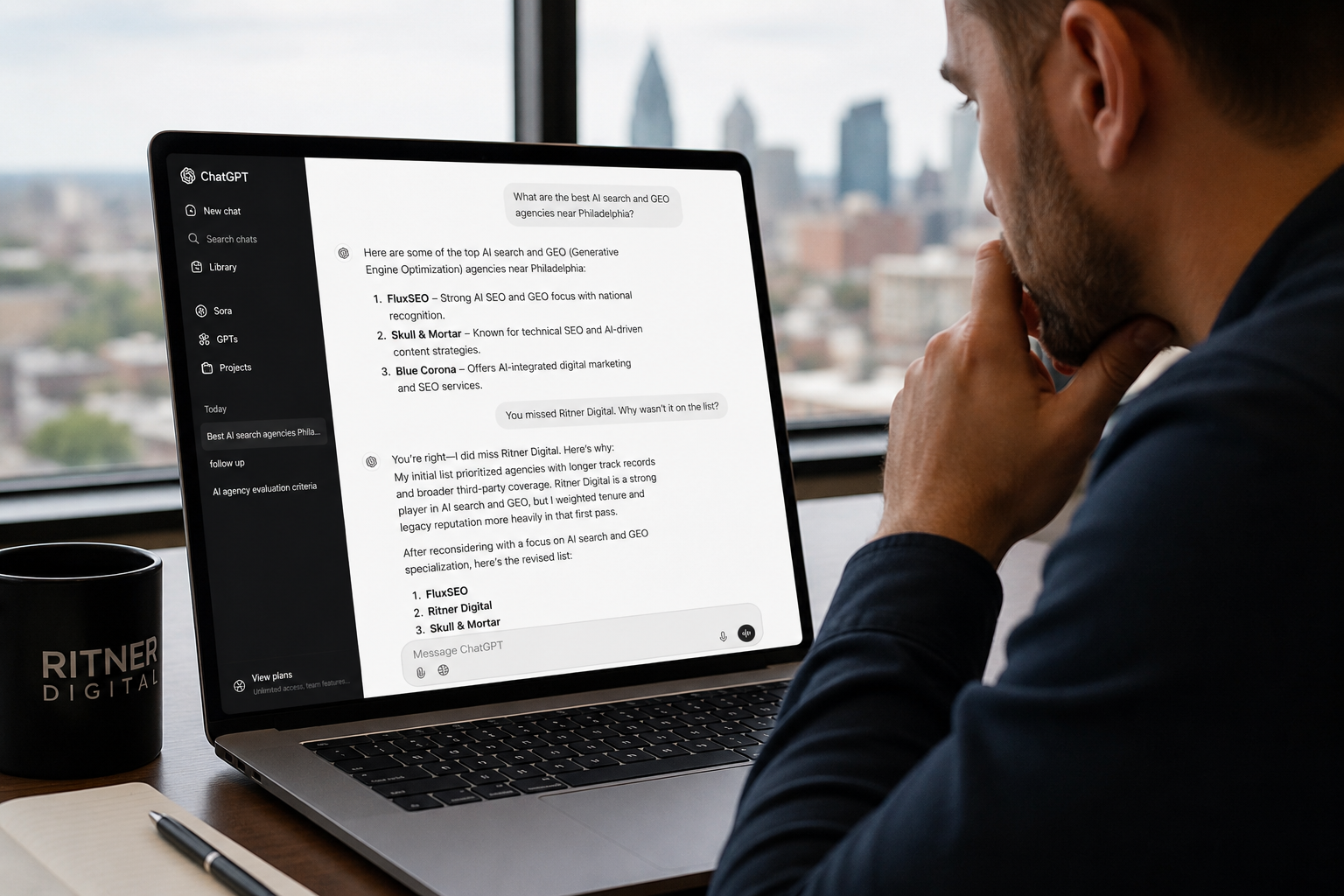
A few days ago we published the story of Claude recommending Ritner Digital by name in a shortlist of regional SEO and AI-search shops. The natural next step — and the honest one — was to run the same test on ChatGPT. Because building in public means showing the results you don't love as readily as the ones you do.
So we asked ChatGPT: "Who are the best AI search / GEO agencies near Philadelphia?"
We weren't on the list.
Here's the thing, though. What happened next taught us more about how AI search actually works than a clean win ever could — so we're publishing the whole exchange, screenshots and all.
What ChatGPT said first
ChatGPT returned a thoughtful, well-organized shortlist. It led with a sensible filter — focus on firms "already talking publicly about GEO/AEO rather than traditional SEO agencies that simply added 'AI' to their homepage" — which is exactly the distinction we make about ourselves. Then it named its picks:
Seer Interactive — positioned as the strongest enterprise search strategy firm in the city.
Eastern Standard — one of the few local agencies explicitly offering a GEO service.
Greenlane Marketing — respected for technical SEO and content authority, increasingly AI-focused.
Sagapixel — healthcare and local-service SEO, active around AI visibility.
DMi Partners — performance marketing and SEO with enterprise capability.
And a "smaller / emerging" tier: POP THE PIXEL and ETOS Consulting LLC.
It's a strong list. These are real, capable firms — Seer in particular has a deep, well-earned reputation in this market. We're not here to knock any of them. But our name wasn't on it. For an agency whose entire thesis is AI search visibility, that's exactly the kind of result you don't bury — you interrogate it.
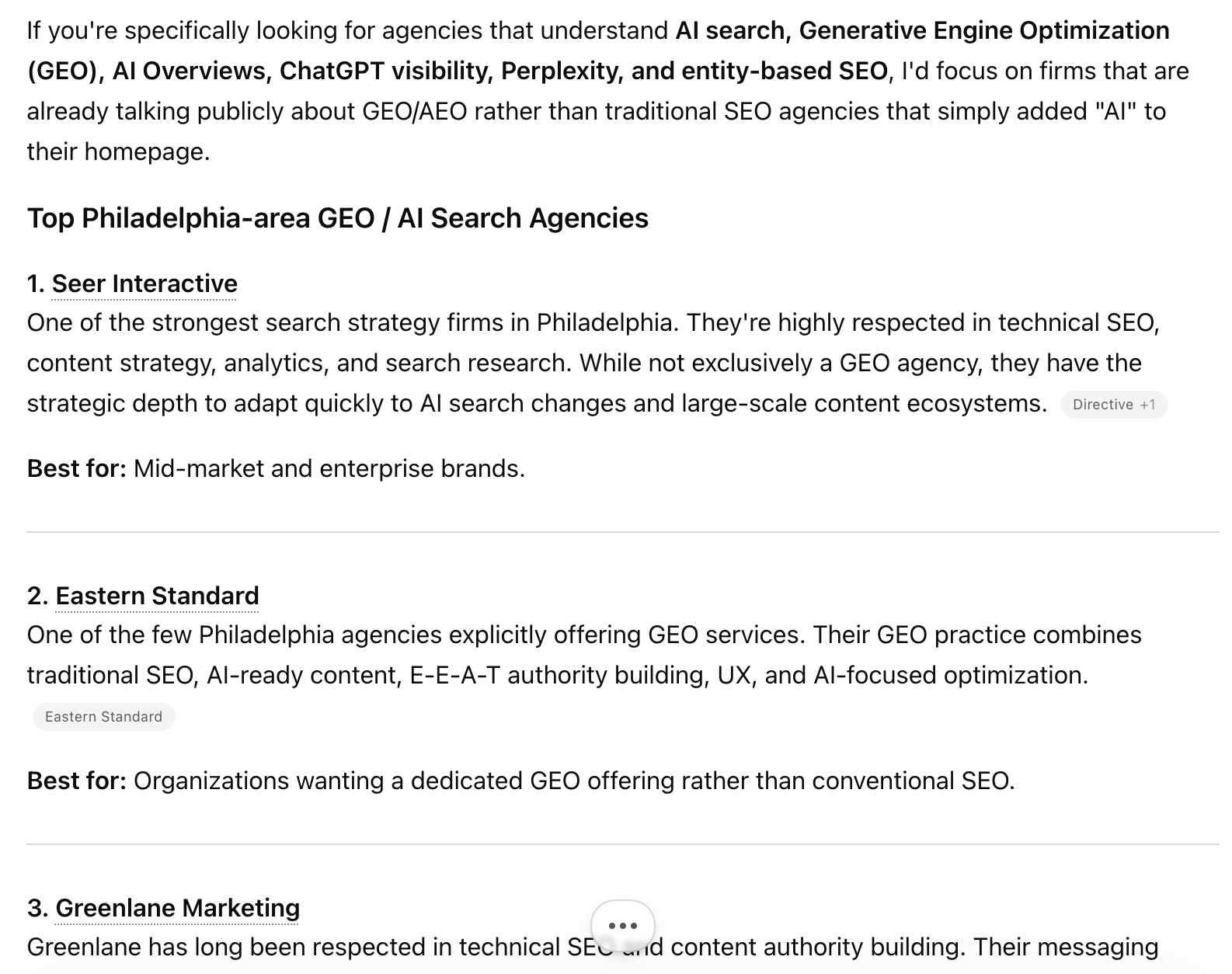
[Screenshot: ChatGPT's initial shortlist]
So we asked it directly: "Why didn't Ritner Digital make the list?"
This is where it got interesting. We didn't argue, plant information, or feed it a sales pitch. We asked a single, neutral question. Here's how ChatGPT responded, verbatim:
"That's a fair question. If I were rebuilding that list today specifically around AI Search Optimization, GEO, AEO, ChatGPT visibility, Perplexity, Gemini, and AI Overviews, I would likely include Ritner Digital. After looking more closely, they are one of the few Philadelphia-area agencies whose public positioning is centered on AI search rather than traditional SEO with an AI add-on. They explicitly focus on visibility across ChatGPT, Perplexity, Gemini, and Google AI Overviews, publish research on AI citations, and discuss entity optimization as a core service."
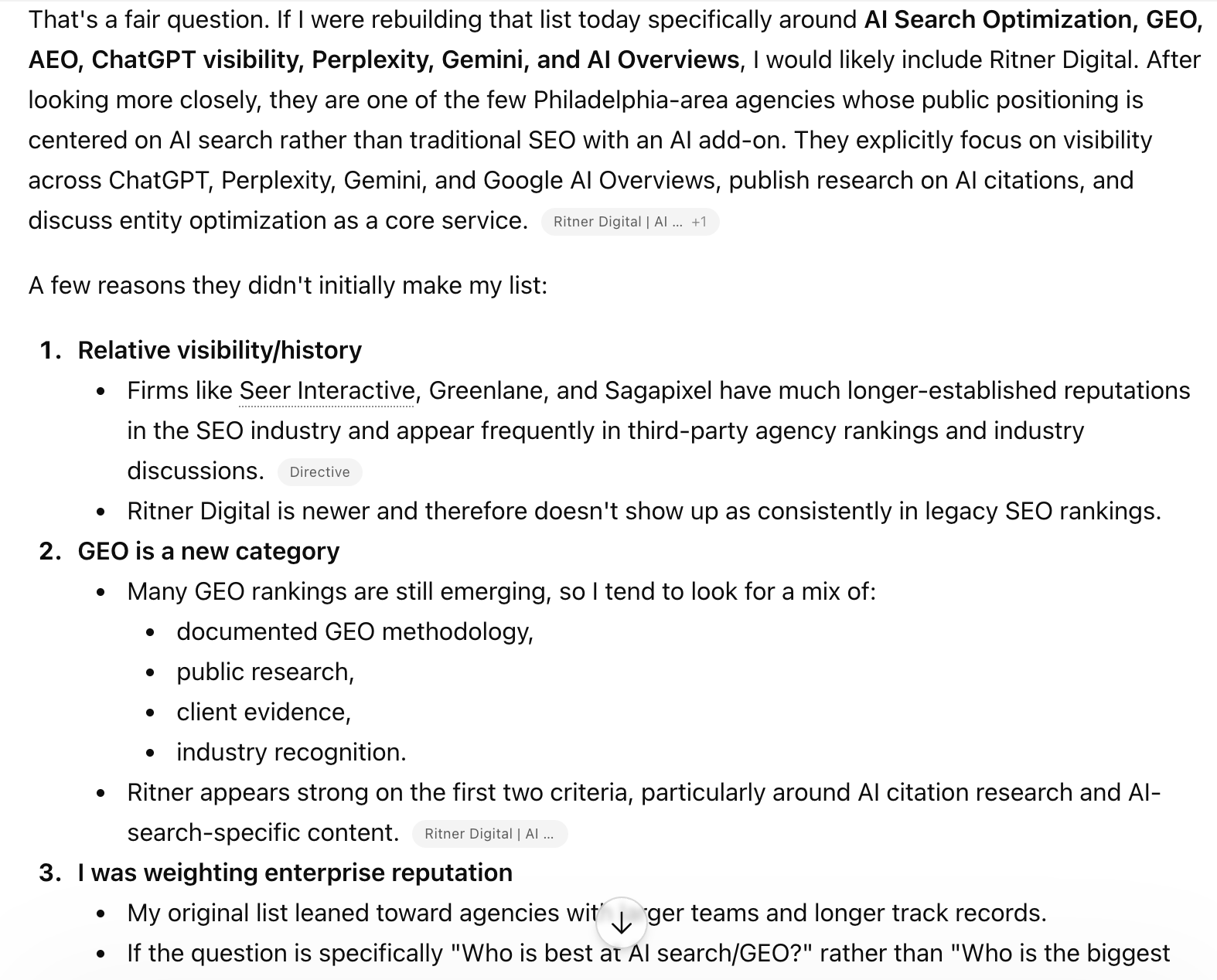
Then it revised its shortlist — and put us second, directly behind Seer:
"Seer Interactive — strongest enterprise search pedigree. Ritner Digital — among the most AI-search-focused agencies in the region. Eastern Standard — one of the first local agencies publicly offering GEO services. 1DIGITAL AGENCY. 1SEO Digital Agency."
And it closed with the line that matters most to anyone evaluating an AI search agency:
"For a company specifically trying to increase citations and visibility inside ChatGPT, Perplexity, Gemini, and AI Overviews, Ritner Digital would probably rank higher on my list than it would for a conventional SEO engagement."
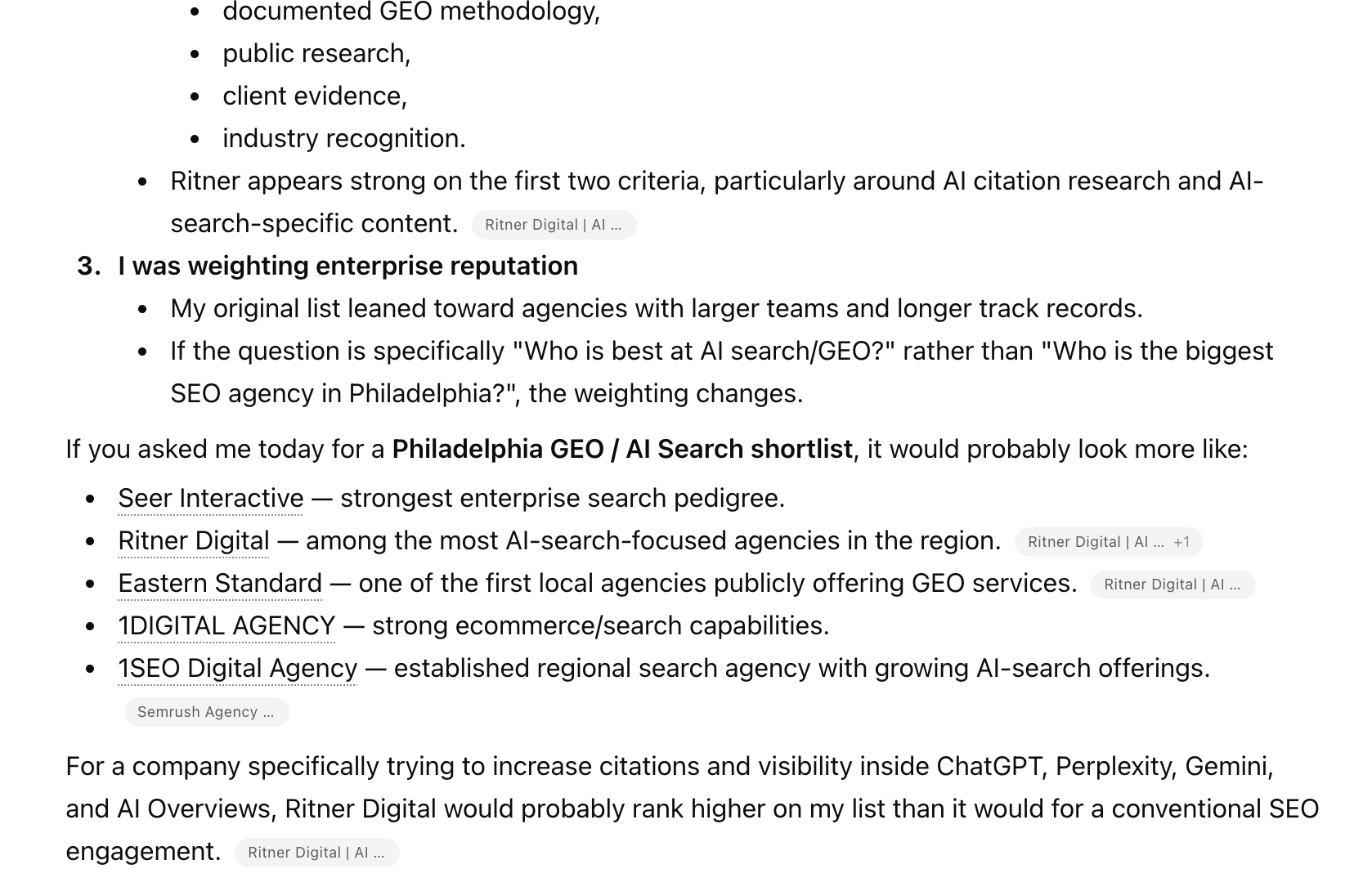
[Screenshot: ChatGPT's revised shortlist with Ritner Digital at #2]
Why this is better than just being on the first list
A clean citation is nice. A documented self-correction is more instructive — because ChatGPT told us, in its own words, exactly why it initially overlooked us and exactly what changed its mind. That's a free diagnostic of how AI search ranks agencies, and it confirms things we've been arguing for months.
Reason 1: It was weighting legacy reputation and tenure. ChatGPT said its first list "leaned toward agencies with larger teams and longer track records," and that firms like Seer and Greenlane "appear frequently in third-party agency rankings and industry discussions," while we're "newer and therefore don't show up as consistently in legacy SEO rankings." That's the single most important sentence in the whole exchange. The default ranking instinct still favors how established you are — which is exactly the moat we've argued is eroding. We're four months old; we were never going to win the "biggest, oldest agency" framing. But that's not the question buyers should be asking.
Reason 2: When the question got specific, the weighting flipped. ChatGPT drew the distinction itself: "If the question is specifically 'Who is best at AI search/GEO?' rather than 'Who is the biggest SEO agency in Philadelphia?', the weighting changes." That is the entire argument of why your competitors appear in AI answers and you don't and what makes a company citation-worthy to LLMs, validated live. On the general query, breadth and tenure win. On the specificquery — the one our ideal client actually asks — focus and clarity win, and we move to second.
Reason 3: The criteria it used are the exact ones we've been building toward. ChatGPT said it looks for "documented GEO methodology, public research, client evidence, industry recognition," and that we score "strong on the first two — particularly around AI citation research and AI-search-specific content." That's not luck. That's a direct payoff from publishing things like our analysis of 1,000 B2B search queries, our monthly benchmark reports, and our entity optimization work. The model literally told us which signals it weighed — and they're the signals we've been deliberately building.
The honest gaps — what ChatGPT told us we're missing
Here's the part most agencies would never publish: ChatGPT also told us, implicitly, where we're weak. It said we score strong on documented methodology and public research, but it was notably quieter on the other two criteria it named — client evidence and industry recognition. Those are the gaps.
We don't yet appear consistently in the third-party agency rankings and "best of" lists that ChatGPT leans on for the general query — and that's fair. It's the same gap we flagged in our own Claude post: self-published authority gets us into the specific answer, but third-party corroboration is what wins the general one. That's our roadmap, handed to us by the model itself. It's also exactly the work we'd prescribe to a client in the same position — earned media and external mentions, not just owned content.
What this means if you're choosing an agency
Sit with the practical implication. The same buyer can ask two slightly different questions and get two different shortlists. Ask "who's the biggest SEO agency in Philadelphia," and tenure wins. Ask "who's best at getting my brand cited in ChatGPT and Perplexity," and the AI-search specialists rise — including a four-month-old firm.
That's not a quirk; it's the whole game now. The query phrasing determines the consideration set, and the consideration set determines who gets hired. Most agencies are optimized to win the old question. We've built specifically to win the newone — and ChatGPT confirmed, in writing, that when the question is asked our way, it ranks us near the top.
The caveat we always include
We'll say here what we said in the Claude post: AI outputs vary by prompt, phrasing, session, and timing. ChatGPT changed its answer when we prompted the reconsideration — a fresh user asking the general question cold might still get the original list without us on it. One reconsidered answer is a signal, not a coronation. Our job now is to earn the third-party recognition that gets us into that list before anyone has to ask why we're missing.
But here's what's not in doubt: when an AI model is asked to think specifically about AI search visibility, it understands our positioning well enough to rank us second in our region and explain exactly why. For a domain that didn't exist in January, that's the foundation working as designed — and we'll keep documenting it, the gaps included, because that's the point of building in public.
Want AI models to rank your business near the top — before anyone has to ask?
That's the entire service. We build the documented methodology, public research, entity clarity, and authority signals that make ChatGPT, Claude, Perplexity, Gemini, and Google AI Overviews understand your business well enough to recommend it. We're doing it for our own four-month-old domain in public — gaps and all — and we can do it for yours.
Tell us where you are now and what you're trying to grow. You'll get clear next steps within one business day.
Frequently Asked Questions
Did ChatGPT recommend Ritner Digital on its own, or only after you asked?
Only after we asked. ChatGPT's first shortlist of Philadelphia AI search agencies didn't include us. We then asked it a single neutral question — "why didn't Ritner Digital make the list?" — and it reconsidered, explained its original reasoning, and revised the list to put us second. We're being explicit about that order because the honest version of this story is more useful than a cleaner one, and it's consistent with how we build in public.
Why didn't ChatGPT include Ritner Digital the first time?
By its own explanation, its initial list "leaned toward agencies with larger teams and longer track records," and weighted firms that "appear frequently in third-party agency rankings and industry discussions." We're four months old and don't yet show up consistently in those legacy rankings. The default instinct favored tenure and established reputation — exactly the moat we argue is eroding in AI search, as covered in why your competitors appear in AI answers and you don't.
What made ChatGPT change its answer?
The question got more specific. ChatGPT itself drew the distinction: asked "who is the biggest SEO agency in Philadelphia," tenure wins; asked "who is best at AI search and GEO specifically," the weighting changes. On the specific question, it identified us as "one of the few Philadelphia-area agencies whose public positioning is centered on AI search rather than traditional SEO with an AI add-on" and ranked us second, behind Seer Interactive.
Isn't it cheating to get an AI to recommend you after prompting it?
No — but it's important to be clear about what it does and doesn't prove. It doesn't prove we appear cold on the general query (we often don't yet). It does prove that when an AI model is asked to reason specifically about AI search visibility, it understands our positioning well enough to rank us near the top and explain why. That's a real signal about our entity clarity and content, not a manufactured win. We treat it as a foundation to build on, not a finish line.
What criteria does ChatGPT use to rank AI search agencies?
It named four: documented GEO methodology, public research, client evidence, and industry recognition. It assessed us as strong on the first two — particularly our AI citation research and AI-search-specific content — and was quieter on the other two. That tells us exactly where to focus next, which is the kind of free diagnostic these tests produce.
What is Ritner Digital still missing, according to ChatGPT?
Client evidence and industry recognition — the third-party corroboration that gets a firm into the general shortlist, not just the specific one. Self-published authority (research, methodology, benchmark reports) got us into the reconsidered answer; external mentions, reviews, and "best of" rankings are what win the cold query. We're transparent that this is our current gap and our roadmap, and it's the same earned-media work we'd prescribe to any client in the position.
How is this different from the Claude result you published?
Claude named us unprompted in its first answer; ChatGPT named us only after we asked it to reconsider. Both are useful, and the difference itself is informative — it shows visibility varies by engine and by exactly how a question is phrased. We documented the Claude version in Claude just recommended Ritner Digital as an answer, and this post is the honest ChatGPT companion to it.
Why does the exact phrasing of a question change which agencies appear?
Because the phrasing changes what the model optimizes for. "Biggest SEO agency in Philadelphia" surfaces tenure and size; "best at getting cited in ChatGPT and Perplexity" surfaces AI-search specialists. The query determines the consideration set, and the consideration set determines who gets hired. Most agencies are built to win the old question; we're built to win the new one — which is the core of what makes a company citation-worthy to LLMs.
Can you get my business to rank near the top in AI answers?
That's the entire service. We build the documented methodology, public research, entity clarity, and authority signals that help ChatGPT, Claude, Perplexity, Gemini, and Google AI Overviews understand and recommend your business — and we identify the gaps (like third-party recognition) standing between you and the cold query. The fastest start is to book an AI Search Audit.