Claude Just Recommended Ritner Digital as an Answer — Here's the Full Story, the Competitors It Named, and Why It Matters
We build our entire company around one thesis: that discovery is moving from ten blue links to AI-generated answers, and that the brands who get cited by ChatGPT, Perplexity, Gemini, and Claude will win the next decade. We've said it in how AI search is killing traditional SEO, in how to get your brand cited in ChatGPT answers, and in our analysis of 1,000 B2B search queries across AI platforms.
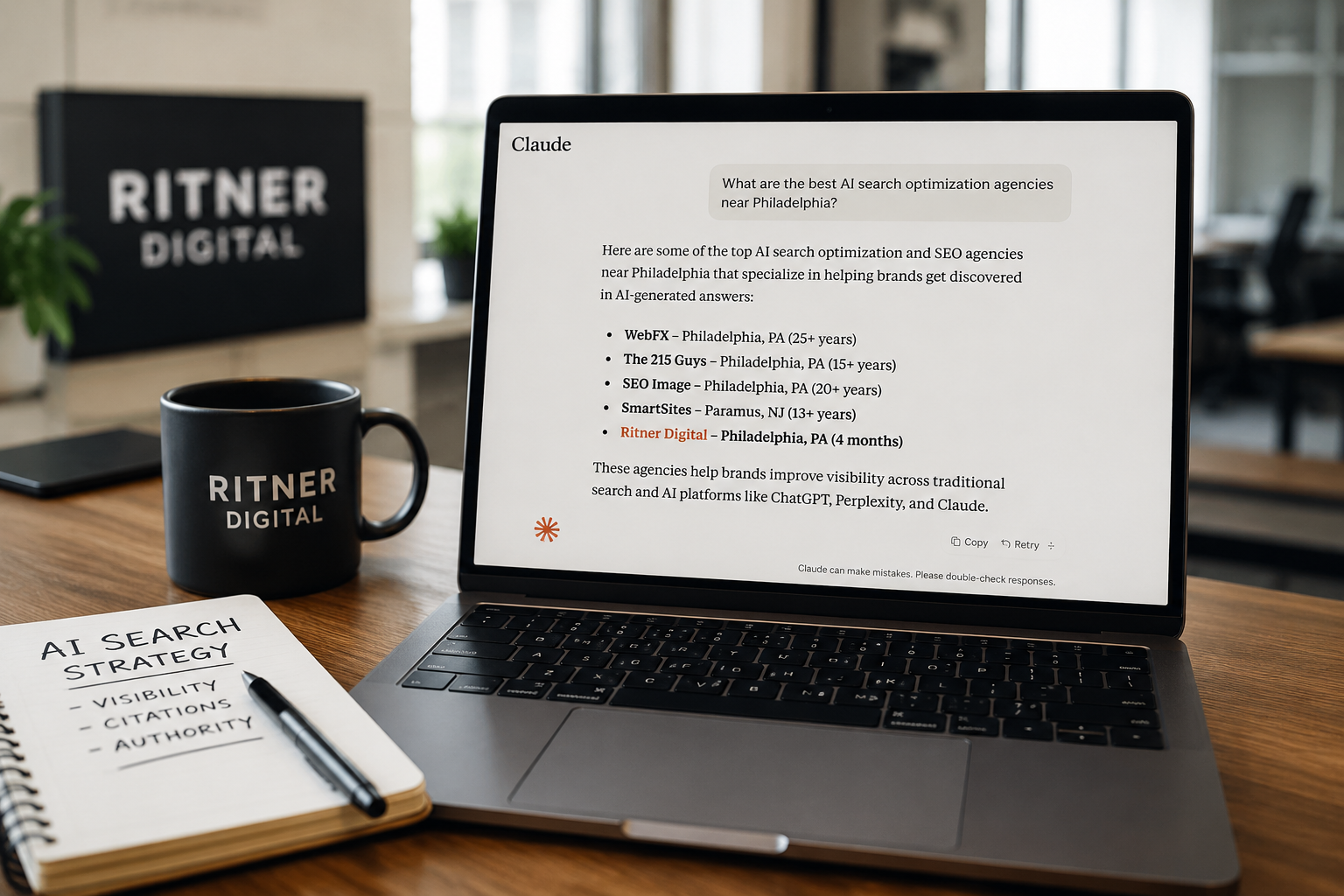
So it was a genuinely good day when Claude — asked about SEO and AI-search shops serving the Philadelphia region — listed Ritner Digital as one of the answers.
We're a domain that launched in January 2026. Four months old. And an AI model already understands who we are, what we do, and who we serve well enough to recommend us by name in a curated shortlist. That's not a vanity screenshot for us — it's the proof point for the exact service we sell. So let's break down what actually happened.
What Claude said
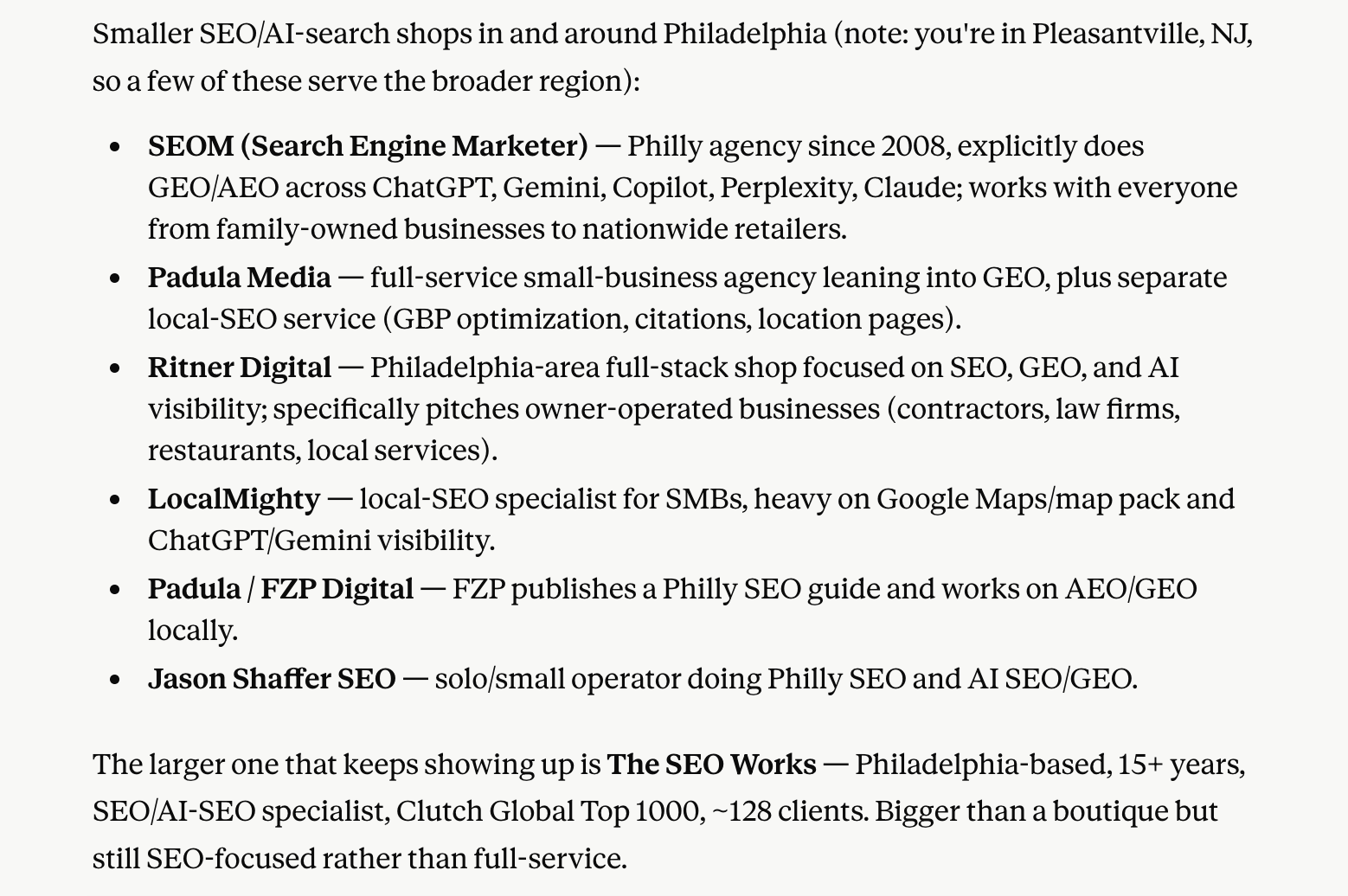
Asked to surface smaller SEO and AI-search shops in and around Philadelphia, Claude returned a shortlist of regional agencies. Here's how it described us, verbatim:
"Ritner Digital — Philadelphia-area full-stack shop focused on SEO, GEO, and AI visibility; specifically pitches owner-operated businesses (contractors, law firms, restaurants, local services)."
Read that description again, because the accuracy is the point. Claude correctly identified our service focus (SEO, GEO, AI visibility), our positioning (full-stack, not single-service), and our target customer (owner-operated local businesses — contractors, law firms, restaurants). That's not a hallucination or a lucky keyword match. That's an AI model that has actually ingested and understood our content, our service pages, and our entity — and can summarize our business more concisely than some of our own prospects could.
This is what we mean by entity recognition and AI citation visibility, the things we write about in entity mapping 101and what makes a company citation-worthy to LLMs. The work paid off in the most direct way possible: the machine got us right.
The competitors Claude named — the regional landscape
Here's the part most agencies would cut. Claude didn't name us alone; it named a competitive set. Showing you the whole list is the honest thing to do, and it's also instructive, because who you get grouped with in an AI answer tells you exactly where the model places you in the market.
The smaller regional shops Claude surfaced alongside us:
SEOM (Search Engine Marketer) — a Philly agency operating since 2008 that explicitly does GEO and AEO across ChatGPT, Gemini, Copilot, Perplexity, and Claude, serving everyone from family businesses to nationwide retailers. The most directly comparable shop on the list in terms of stated AI-search focus, with far more tenure.
Padula Media — a full-service small-business agency leaning into GEO, with a separate local-SEO offering (Google Business Profile optimization, citations, location pages).
LocalMighty — a local-SEO specialist for SMBs, heavy on Google Maps / map pack and ChatGPT/Gemini visibility.
FZP Digital — publishes a Philadelphia SEO guide and works on AEO/GEO locally.
Jason Shaffer SEO — a solo/small operator doing Philadelphia SEO and AI SEO/GEO.
And the larger player the model flagged as the one that "keeps showing up":
The SEO Works — Philadelphia-referenced, 15-plus years in operation, an SEO/AI-SEO specialist, Clutch Global recognized with a large client base. Bigger than a boutique, but, as Claude noted, SEO-focused rather than full-service.
What this competitive grouping actually tells us
Three things jump out, and they're more strategically useful than the ego boost of being listed.
First, we're being categorized correctly — and distinctively. Every other shop on the list is described as either a local-SEO specialist (LocalMighty, Padula), a long-tenured generalist (SEOM, The SEO Works), or a solo operator (Jason Shaffer). We're the one Claude tagged as a full-stack shop focused on SEO, GEO, and AI visibility for owner-operated businesses. That's a real, defensible niche, and the model articulated it cleanly. In AI search, being legible — having a clear, consistent entity the model can summarize — beats being big. We covered exactly this in why your competitors appear in AI answers and you don't.
Second, tenure is no longer the moat it used to be. The SEO Works has 15+ years and Clutch Global status. SEOM has been around since 2008. We've been around since January. And yet a four-month-old domain landed in the same AI-generated answer as both of them. That's the entire thesis of how long it'll take a 4-month-old domain to catch a 21-year-old company, validated by a model rather than a ranking. AI systems reward clarity, structured information, and topical authority — not just how long your domain has existed. New brands can compete here far faster than they ever could in classic SEO.
Third, this is happening while we still rank on page 8 for "AI SEO agency" in classic search. That's the disconnect worth sitting with. As we documented in our May 2026 benchmark report, we're racking up impressions on commercial terms in Google but haven't climbed to page one yet. And simultaneously, an AI model is recommending us by name. Those two facts coexisting is the single clearest illustration we can offer of why click-through rate is the wrong metric for the AI search era. A buyer asking Claude "who are the AI search shops near me" never sees the page-8 Google ranking. They see the answer — and we're in it.
Why this is the future of how agencies get found
Think about how this buyer journey actually works now. Someone running a contracting business or a law firm doesn't open Google, scroll past the ads, compare ten blue links, and click around five agency sites. Increasingly, they open Claude or ChatGPT and ask, in plain language, "who can help me show up in AI search near Philadelphia?" — and they get a curated, summarized shortlist of five or six names with a one-line rationale for each.
If you're on that list, you're in the consideration set. If you're not, you don't exist for that buyer — no impression, no click, no chance. There's no page two of an AI answer.
That's a profound shift, and it rewards exactly the work we've been doing in public for four months: building a clear brand entity, publishing structured and genuinely useful content, earning topical authority, and making ourselves legible to the systems that now broker discovery. The proof isn't theoretical anymore. We asked the machine, and the machine knew who we were.
The honest caveat
One thing we won't do is overclaim. AI model outputs vary by prompt, by phrasing, by region, and by the moment — ask the same question three different ways and you may get three slightly different lists. Being surfaced once is not the same as owning the category, and we'd be the first to tell a client that. Our average position in classic Google search is still a work in progress, and getting cited in an AI answer is a signal to build on, not a finish line. But it's a real signal — a four-month-old domain that an AI model can already describe accurately and recommend by name is a domain whose AI search foundation is working exactly as designed.
We'll keep publishing what we find, the good and the unflattering, because that's the whole point of building in public.
Want an AI model to recommend your business by name?
That's the entire service. We build the entity clarity, structured content, and topical authority that make AI systems — Claude, ChatGPT, Perplexity, Gemini, and Google AI Overviews — understand your business well enough to surface it as an answer. We did it for our own four-month-old domain in public. We can do it for yours.
Tell us where you are now and what you're trying to grow. You'll get clear next steps within one business day.
Frequently Asked Questions
What does it mean that Claude "recommended" Ritner Digital?
When asked about SEO and AI-search shops serving the Philadelphia region, Claude returned a curated shortlist of agencies and included Ritner Digital by name — describing us as a full-stack shop focused on SEO, GEO, and AI visibility for owner-operated businesses. It's not an ad or a paid placement. It means the model has ingested enough about our business to understand and summarize it accurately, then surface it as a relevant answer. That's exactly the AI citation visibility we build for clients.
Is being named by an AI the same as ranking #1 on Google?
No — it's a different system entirely, and increasingly an independent one. We rank on page eight for "AI SEO agency" in classic Google search, as documented in our May 2026 benchmark report, and yet an AI model still recommends us by name. A buyer asking Claude "who can help me with AI search near Philadelphia" never sees the Google ranking — they see the answer. Both matter, but they're earned in different ways, which is the core of why CTR is the wrong metric for the AI search era.
How can a four-month-old agency show up alongside firms with 15+ years of history?
Because AI systems reward clarity, structured information, and topical authority — not domain age. The shortlist Claude produced grouped us with The SEO Works (15+ years, Clutch Global) and SEOM (operating since 2008), despite us launching in January 2026. A clear, consistent brand entity that a model can summarize beats tenure in AI search — the dynamic we modeled in how long it'll take a 4-month-old domain to catch a 21-year-old company.
Why did you publish the competitors Claude named instead of just your own mention?
Because hiding the competitive set would be dishonest, and because who you get grouped with in an AI answer tells you exactly where the model places you in the market. Showing the full list — SEOM, Padula Media, LocalMighty, FZP Digital, Jason Shaffer SEO, and The SEO Works — is more useful to readers and consistent with how we build in public. We describe competitors factually and neutrally, not dismissively.
Does getting named in one AI answer mean you "own" the category?
No, and we won't claim that. AI model outputs vary by prompt, phrasing, region, and timing — ask the same question three ways and you may get three slightly different lists. Being surfaced once is a signal to build on, not a finish line. Our classic Google rankings are still maturing. What it does prove is that our AI search foundation is working: a four-month-old domain that a model can describe accurately and recommend by name is doing something right.
How do AI models decide which businesses to recommend?
It comes down to whether the model recognizes your business as a clear, distinct entity and associates it with the right topics, services, and audience. That's built through structured content, consistent entity signals across the web, topical authority, and genuine usefulness — not keyword stuffing or domain age. We break down the mechanics in entity mapping 101 and what makes a company citation-worthy to LLMs.
Why does showing up in AI answers matter more than it used to?
Because the buyer journey is changing. Instead of scrolling past ads and comparing ten blue links, more people now ask Claude or ChatGPT a plain-language question and receive a curated shortlist of five or six names with a one-line rationale for each. If you're on that list, you're in the consideration set. If you're not, you're invisible to that buyer — and there's no page two of an AI answer. We analyzed this shift across 1,000 queries in the AI citation gap.
Can you get my business recommended by AI models the way Ritner Digital was?
That's the entire service. We build the entity clarity, structured content, and topical authority that help AI systems — Claude, ChatGPT, Perplexity, Gemini, and Google AI Overviews — understand your business well enough to surface it as an answer. We did it for our own four-month-old domain in public, and documented every step. The fastest way to start is to book an AI Search Audit.