We Put 5 South Jersey Fire Departments Head-to-Head in Google and AI Search. The Ones That Need Recruits Most Are the Hardest to Find.
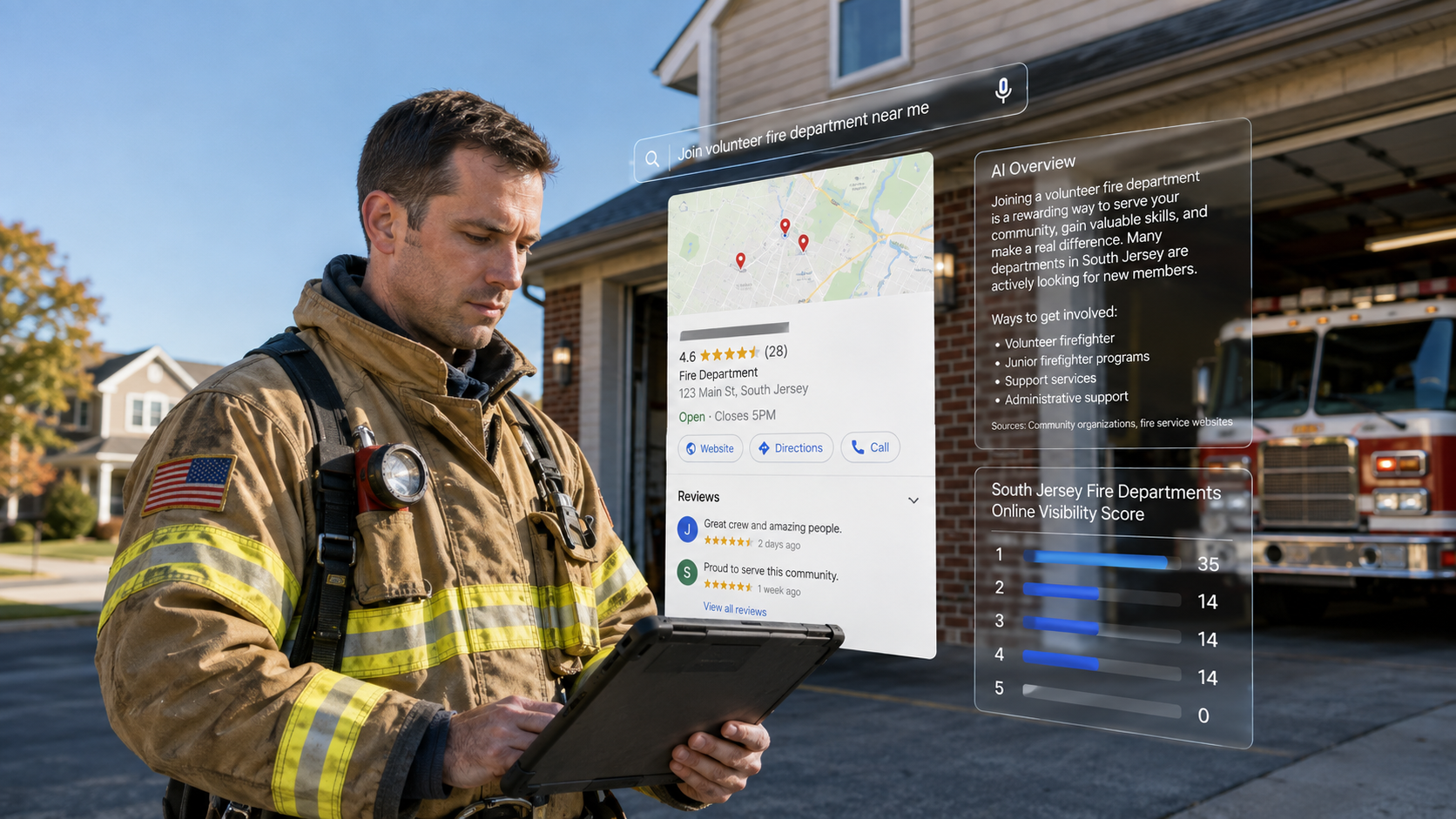
Every fire department in South Jersey is asking the same question right now: where are the next volunteers coming from? Recruitment tables at community events, stipend programs, Facebook posts that end with "interested in joining?" — the ask is everywhere.
Here's the question almost nobody is asking: when a 24-year-old in Gloucester or Burlington County types "how do I become a volunteer firefighter near me" into Google — or asks ChatGPT — which department comes up?
We keep saying search has split in two: the index Google ranks, and the answer engines people increasingly ask instead. We proved it with five Nissan dealerships, where the store that dominated Google finished dead last in AI visibility. This time we ran the same audit on organizations where the stakes aren't car sales — they're staffed engines. Five fire departments serving South Jersey, measured across classic search, the AI answer layer, and the entity signals underneath both: Evesham Fire-Rescue, the Mount Laurel Fire Department, the Washington Township Fire Department, the Blackwood Fire Company, and Williamstown Fire Company No. 1.
The result is the starkest version of the split we've published yet. In classic Google search, the three biggest departments are locked in a statistical tie. In the AI answer layer, one of them holds two and a half times the visibility of everyone else. And the field's only all-volunteer company — the kind of organization the recruitment crisis is actually about — scores a flat zero. Not last place. Absent.
How to read this, honestly. All search metrics are Semrush estimates pulled in August 2026 — modeled data, not any department's actual analytics — and Semrush's AI Visibility score is a new, evolving metric estimating presence in AI-generated answers. Google Business Profile names, ratings, and review counts were verified live in Google search and Maps in August 2026. This scoreboard measures one thing: visibility in search and AI. It says nothing about who fights fires well, trains hard, or serves their community — every organization on this page does all three, and several have been doing it for a century. Nobody here is a client. Nobody paid for placement or exclusion. And if you serve with one of these departments and believe any number is off: email us, we'll check it, and we'll correct the post in public. That's the deal with everything we publish. One more note for fairness: Google auto-generates listings for fire stations from map data whether departments want them or not. The findings below aren't about messes anyone made — they're about messes nobody's been told they can claim and clean up, for free.
The field
Five departments, three counties, one overlapping question. Evesham Fire-Rescue (Facebook, 15.6K followers) is the professionalized operation of the field — a combination department in Burlington County whose own strategic plan lists 47 career personnel, 12 per-diem EMTs, and 46 volunteers across three stations, backed by a volunteer stipend program paying $100–$875 a month with no residency requirement. Mount Laurel Fire Department (Facebook, 10.4K), established 1953, runs three stations staffed 24/7 next door in Burlington County. Washington Township Fire Department (Facebook, 17.8K) is Gloucester County's combination heavyweight — and the loudest recruiter in the field, with recruitment tables at community events as recently as this month. Blackwood Fire Company (Facebook, 6.2K) covers its slice of Gloucester Township in Camden County from two stations, one of them quartering career personnel. And Williamstown Fire Company No. 1 (Facebook, 1.6K) is the field's only all-volunteer company — protecting Monroe Township for over a century on nothing but people who show up.
Four combination departments with paid staff and budgets. One pure volunteer company running on recruits. Hold that framing — it's the whole story.
Now the races.
Race 1: Classic Google search — a three-way tie nobody can win
In the search race everyone knows how to measure, the surprise is how little separates the big three. Semrush estimates Washington Township at roughly 1,400 monthly organic visits, with Evesham and Mount Laurel each right around 1,000. Blackwood sits at 56 monthly visits and Williamstown at 104: small numbers that make sense for organizations whose "customers" mostly arrive by dialing 911, but numbers that matter enormously for the one thing these sites are actually competing for — the recruit who searches before they show up.
The composition under those numbers tells you who's playing what game. Evesham holds the field's biggest keyword footprint at 320 terms (and growing, +2.6%) — the fingerprint of a site with real content depth: facility pages, inspection forms, a published strategic plan. Washington Township pairs the traffic lead with healthy keyword growth (+4.6%). Mount Laurel is the anomaly: the field's largest backlink profile at 1.6K — and the only one in the field that's growing (+2.9%) — attached to a shrinking keyword footprint (−5.8%). Authority without expansion.
And Williamstown, the smallest operation, quietly posts the field's best percentage trends: keywords up 15.1%, backlinks up 10%. The base is tiny — 84 keywords, 254 links — but the direction is the right one, and in this report we grade direction honestly wherever we find it.
One more pattern before the scoreboard flips. Look at the trend columns together: three of five departments are losing traffic, backlink profiles are decaying at two of the three biggest departments — Washington Township's at a field-worst −14.5% — and the growth that exists is concentrated in keywords, not authority.
Race 2: The AI answer layer — one leader, a logjam, and a zero
Semrush's AI Visibility score estimates how present each organization is in AI-generated answers. Here's the field, re-ranked:
Evesham Fire-Rescue: 35. Mount Laurel, Washington Township, and Blackwood: 14 each. Williamstown Fire Company: 0.
Read that column again — 35, 14, 14, 14, 0 — because it's the cleanest visibility hierarchy we've ever pulled, and it correlates with almost nothing on the classic scoreboard. Mount Laurel's field-leading 1.6K backlinks buy it a 14. Washington Township's field-leading traffic buys it a 14. Blackwood matches them both with 56 monthly visits and the smallest website in the field. And Evesham more than doubles all three — with fewer backlinks than Mount Laurel and a third less traffic than Washington Township.
If backlinks don't explain it and traffic doesn't explain it, what does? We can't see inside Semrush's model, but the pattern matches everything we've measured across markets: AI answers are assembled from citable evidence — documents, programs, coverage, structured facts that an engine can quote. And Evesham is the only department in this field that publishes like it knows that. A full strategic plan as a public PDF. A stipend program with specific dollar figures that local outlets can write about. Facility pages with addresses and histories. It's the same lesson from the content formats AI search actually cites: engines don't reward whoever has a website — they reward whoever gives them something quotable.
Then there's the mentions column, and its brutal outlier. Semrush counts how often each organization gets named in AI conversations: Evesham leads at 10, Mount Laurel takes 4 — and Washington Township, the department with the field's biggest and most active audience, gets mentioned once.
Seventeen thousand eight hundred Facebook followers. One AI mention.
That gap is the most important finding in this report for any department pouring energy into social media. Washington Township's community engagement is genuinely the best in the field — the posts are constant, warm, and human, exactly what a fire company's page should be. But it's all happening inside a walled garden. AI engines can't retrieve it, can't cite it, can't turn it into an answer. The conversation is thriving where the machines can't hear it — and when a would-be recruit asks an answer engine instead of scrolling a feed, none of that 17.8K-strong goodwill comes with them.
And Williamstown. Zero visibility, zero mentions. The only all-volunteer company in the field — the organization that runs entirely on people finding it and joining it — does not exist in the answer layer at all. Ask an AI how to become a volunteer firefighter in Williamstown, and as far as the engines are concerned, there is nothing to recommend. A century of showing up for Monroe Township, invisible to the surface where a growing share of its future members will look first. If this report changes one thing in South Jersey, we hope it's that.
Race 3: The entity layer — thirteen Google profiles, one coherent identity
Rankings and answers both sit on the same foundation: does Google's entity graph understand who you are? So we pulled every Google Business Profile we could find for the five departments, verified live in August 2026. The field's five organizations resolve to thirteen separate Google profiles — and exactly one department's set adds up to a coherent identity.
Evesham Fire-Rescue exists on Google as three different organizations — and none of them is named Evesham Fire-Rescue. There's "Evesham Fire" (4.4★, 7 reviews) at the Main Street station, a lowercase "Evesham firestation" (5.0★, 1 review) at Kings Grant, and an "Evesham Township Fire Department" (5.0★, 1 review) at 984 Tuckerton Road — an address we couldn't match to any of the three stations on the department's own facilities pages. The brand on the trucks, the website, and the stipend program — the one an AI would try to resolve — has no Google entity at all. The remarkable part: Evesham leads the AI race anyway, on the strength of its content. Imagine the score with a clean identity under it.
Mount Laurel is the field's honest bright spot, and we want to say so plainly: three profiles, and all three are right. A main "Mount Laurel Fire Department" listing (4.5★, 15 reviews) plus properly-named station children — "Fellowship Station 362" and "Masonville Station 361" — every one categorized as a fire station, sharing one phone number, all pointing at mlfd.org. That's a hierarchy, not a fragmentation; it's roughly what Google wants from a multi-station operation, and it's the only one in the field. The puzzle it sharpens: the department with the cleanest entity and the most backlinks still posts an AI score of 14 — proof that tidy listings alone don't earn answers. Entity clarity is the floor. Citable content is the ceiling.
Washington Township carries four profiles, and they're the field's strangest set. The primary listing (4.8★, 20 reviews — the field's biggest review corpus) is categorized as a "Fire protection consultant." Not a fire station. Not a fire department. A consultant. Alongside it: an orphan "Station" listing (4.0★, 1 review), and two ghosts — "Whitman Square Fire Company Station 10-2" and "Grenloch Fire Company 10-1 Sub Station," zero reviews each, carrying the names of legacy companies from before consolidation. For an engine trying to decide whether Grenloch Fire Company and Washington Township Fire Department are the same organization, that's unresolvable noise — and a candidate explanation for how the field's most-followed department ends up with a single AI mention.
Blackwood has the simplest profile in the field — one listing, "Blackwood Fire Co Headquarters/Main Station," a perfect 5.0★ — and it's unclaimed. The "Own this business?" prompt is sitting right on it. Five stars, a live website link, a 4.8 rating across 38 Facebook reviews backing it up, and nobody holding the keys. Given that Blackwood matches Mount Laurel's and Washington Township's AI scores on a fraction of their footprint, they're the field's pound-for-pound overachiever — with their most important local surface running on autopilot.
Williamstown splits across two profiles: a claimed-looking "Williamstown Fire Department" (5.0★, 3 reviews) at the South Main Street station, and a second "Williamstown Fire Company" listing with zero reviews whose website link points to an old contact.htm address from a previous version of the site. Two names, two listings, a stale link — thin signals on top of a thin web presence, and a zero in the answer layer underneath it all.
Total the field: thirteen profiles, one coherent entity, one "consultant," two ghost companies, one unclaimed five-star listing, three names for one department, and a link to a page that likely no longer exists. Every single item on that list is fixable for zero dollars. Not cheap — zero. Claiming, consolidating, renaming, and recategorizing Google Business Profiles costs nothing but an afternoon and knowing it matters. That's the finding: the gap in this field isn't budget. It's housekeeping nobody knew was load-bearing.
Why this race decides the recruitment crisis
It's fair to ask whether AI visibility deserves this much weight for organizations that aren't selling anything. Here's the honest answer.
The recruitment shortage is real and the departments say so themselves. Pennsauken's fire department states it plainly on its own recruitment page: volunteer memberships are declining, companies are struggling to stay staffed, and undermanned companies put communities at risk. Evesham's strategic plan lists recruitment — career and volunteer — among its central challenges, with increased competition for talent. Every department in this field is actively recruiting. Which means every department in this field is competing for the same scarce resource: a local person, probably young, deciding whether and where to serve.
And that person's discovery behavior already moved. BrightLocal's 2026 Local Consumer Review Survey recorded AI tools leaping from 6% to 45% of local business discovery in a single year, with 64% of consumers aged 30–44 having already asked an AI for a recommendation. The 19-year-old thinking about the fire service and the 34-year-old who just moved to town are exactly the people asking "how do I volunteer as a firefighter near me" into a chat box — a question with no results page, just an answer that names somebody or doesn't.
That's the structural difference that makes this race worth real effort. A Google results page distributes clicks; an AI answer typically names one or two organizations and stops. There is no page two of a ChatGPT recommendation. Applied to this field: when the answer layer gets asked about volunteering in South Jersey, Evesham's 35 means it's plausibly inthe answer. The 14s mean sometimes. Williamstown's zero means never — and the department that needs every recruit most forfeits the question entirely, to better-resourced departments a town or two over that don't even need volunteers as badly.
The signals that move it — entity clarity, claimed and consolidated profiles, structured data, citable documents — are cheap, and nobody in this field is deliberately working on them yet. Every prescription below is free or nearly free, which for volunteer organizations isn't a nicety. It's the whole point.
What each department should do next (free, because that's the model)
Evesham Fire-Rescue: You're winning the answer layer on content alone — now put a foundation under it. Claim and consolidate the three Google profiles under your actual name, resolve what the Tuckerton Road listing is, and add entity schema and sameAs links tying eveshamfire.org, the Facebook page, and the profiles into one identity. You're the field's proof that citable documents earn AI visibility; you could be the region's proof of what a clean entity adds on top.
Mount Laurel Fire Department: Your Google identity is the best in South Jersey and your backlink profile is the only one growing — what's missing is something for engines to quote. One citable asset — an annual response-data report, a public recruitment page with real numbers, a published department history — would convert the authority you've already earned into answers. You have the field's best foundation and its emptiest bookshelf.
Washington Township Fire Department: Three fixes, one afternoon. Recategorize the main profile from "Fire protection consultant" to fire department. Claim and fold in the Whitman Square and Grenloch ghosts so Google knows they're you. Then get your Facebook energy onto surfaces machines can read — the recruitment pushes, the award nights, the incident summaries, mirrored as simple pages on wtfd10.com. You have the field's biggest audience and its best review corpus; the answer layer just can't see either one yet.
Blackwood Fire Company: Claim the listing. It's five stars, it's yours, and the "Own this business?" button is right there. Then add your second station properly and put a real join page on blackwoodfire.org. You're matching departments with ten times your footprint in AI visibility — that efficiency deserves an owner at the wheel.
Williamstown Fire Company: You're the most urgent case on this page and the cheapest to fix. Consolidate the two Google listings under one name, kill the dead contact.htm link, and publish one page that says plainly what an engine needs to recommend you: who you are, what you cover, how to join, and why a century of Monroe Township has trusted you. Your keywords and backlinks are already growing faster than anyone's in the field — the trajectory is right. Right now the answer to "how do I volunteer in Williamstown" is silence. It should be you.
All of it on the honest timeline — months, not days — and all of it measurable, the way we measure ourselves monthly, dips included.
The bottom line
Five departments, three counties, two scoreboards. In Google, the big three are locked in a tie no one can win. In the answer layer, Evesham leads on citable content despite a scattered identity, three departments logjam at 14 for three completely different reasons — clean entity without content, big audience behind a wall, small footprint punching up — and the field's only all-volunteer company scores zero on the exact surface its survival depends on. Thirteen Google profiles, one coherent entity, and every gap on the board fixable for free.
Nobody in South Jersey is winning both races. And in this field, unlike the dealership one, we're genuinely rooting for all five.
Frequently asked questions
Where does this data come from, and how reliable is it?
Search metrics are Semrush estimates pulled in August 2026 — traffic, keywords, and backlinks are modeled from Semrush's index, not from any department's actual analytics, and its AI Visibility score is a new metric estimating presence in AI-generated answers. Google Business Profile names, ratings, categories, and review counts were verified live in Google search and Maps in August 2026, and Facebook follower counts come from each department's public page, linked inline. Estimates are directionally strong and excellent for comparison, but no third-party tool is exact — which is why every number links to a source, and why any department that spots an error can email us for a public correction.
How can a department have 17,800 Facebook followers and one AI mention?
Because AI engines can't cite what they can't retrieve, and most of Facebook is a walled garden. A department whose entire digital life happens in social posts is rich in community and invisible to the answer layer at the same time. The fix isn't posting less — it's mirroring the substance of that presence (recruitment info, incident summaries, department news) onto the open web where engines can read and quote it.
What's the difference between AI visibility and AI mentions?
Visibility estimates whether an organization appears in the answers AI engines give; mentions count how often it comes up in AI conversations at all. Evesham leads both in this field (35 and 10). The gap matters most at the bottom: a department can be talked about without being recommended, or — like three departments here with one, one, and zero mentions — barely enter the conversation at all.
Why does AI visibility matter for a volunteer fire company?
Because recruitment is a discovery problem, and discovery moved. AI tools jumped from 6% to 45% of local discovery in a year per BrightLocal's 2026 survey, led by exactly the age groups volunteer companies need. When a potential recruit asks an AI how to get involved, the engine names a department or it doesn't — there's no second page. A company with zero answer-layer presence forfeits those recruits to whoever is visible, regardless of who needs them more.
Isn't it unfair to compare a small volunteer company to combination departments with paid staff?
It's the comparison that matters most, because the scoreboard doesn't reward budget — Blackwood matches two departments many times its size, and the biggest spender on staff doesn't lead. Williamstown's zero isn't a resources problem; every fix in its prescription is free. The point of including the field's only all-volunteer company isn't to grade it against giants — it's to show that the organizations most dependent on being found currently aren't, and that closing the gap costs almost nothing.
Can Google Business Profile problems really affect AI answers?
They're foundational. AI engines resolve organizations as entities before they recommend them, and Google's business listings are among the strongest entity signals on the open web. When one department exists as three differently-named profiles, or a "fire protection consultant," or an unclaimed listing, engines struggle to connect the organization's evidence into one confident answer. Mount Laurel proves clean listings alone aren't sufficient — but the rest of the field shows what broken ones cost. It's the floor of the entity SEO playbook, not the ceiling.
I serve with one of these departments. Can we get the full version — and does it cost anything?
It's free, full stop — for the departments on this page, no strings and no pitch. You'll get the layers we didn't publish: AI test results across ChatGPT, Gemini, and Claude prompt by prompt, your complete profile audit, and the first three things we'd fix, in plain English. And if you think any number above is wrong, same address — we check it and correct in public.
Five departments measured. Your organization is next — free.
Every business and organization sits somewhere on a scoreboard like this one, whether anyone's published it yet or not. The free visibility check shows you yours: your Google numbers, your AI visibility, your entity health, your competitors' versions of all three, and what we'd fix first — in plain English, with every claim checkable. No pitch deck, no pressure, and a real reply from the founder within one business day.
Get your free visibility check →
Sources: Semrush — organic traffic, keyword, backlink, AI Visibility, and AI Mentions estimates for all five domains, retrieved August 2026 · Google Business Profile listings for all five departments, verified live August 2026 · Evesham Fire-Rescue · Evesham volunteer stipend program · Evesham Township Fire District No. 1 Strategic Plan 2023–2026 · Evesham Fire-Rescue on Facebook · Mount Laurel Fire Department · Mount Laurel Fire Department on Facebook · Washington Township Fire Department · Washington Township Fire Department on Facebook · Blackwood Fire Company· Blackwood Fire Company on Facebook · Williamstown Fire Company No. 1 · Williamstown Fire Department on Facebook · Pennsauken Township — Volunteer Firefighters Needed · BrightLocal Local Consumer Review Survey 2026