Website Hygiene: How Often Should You Redesign, Refresh, and Update — And Does It Change by Industry?
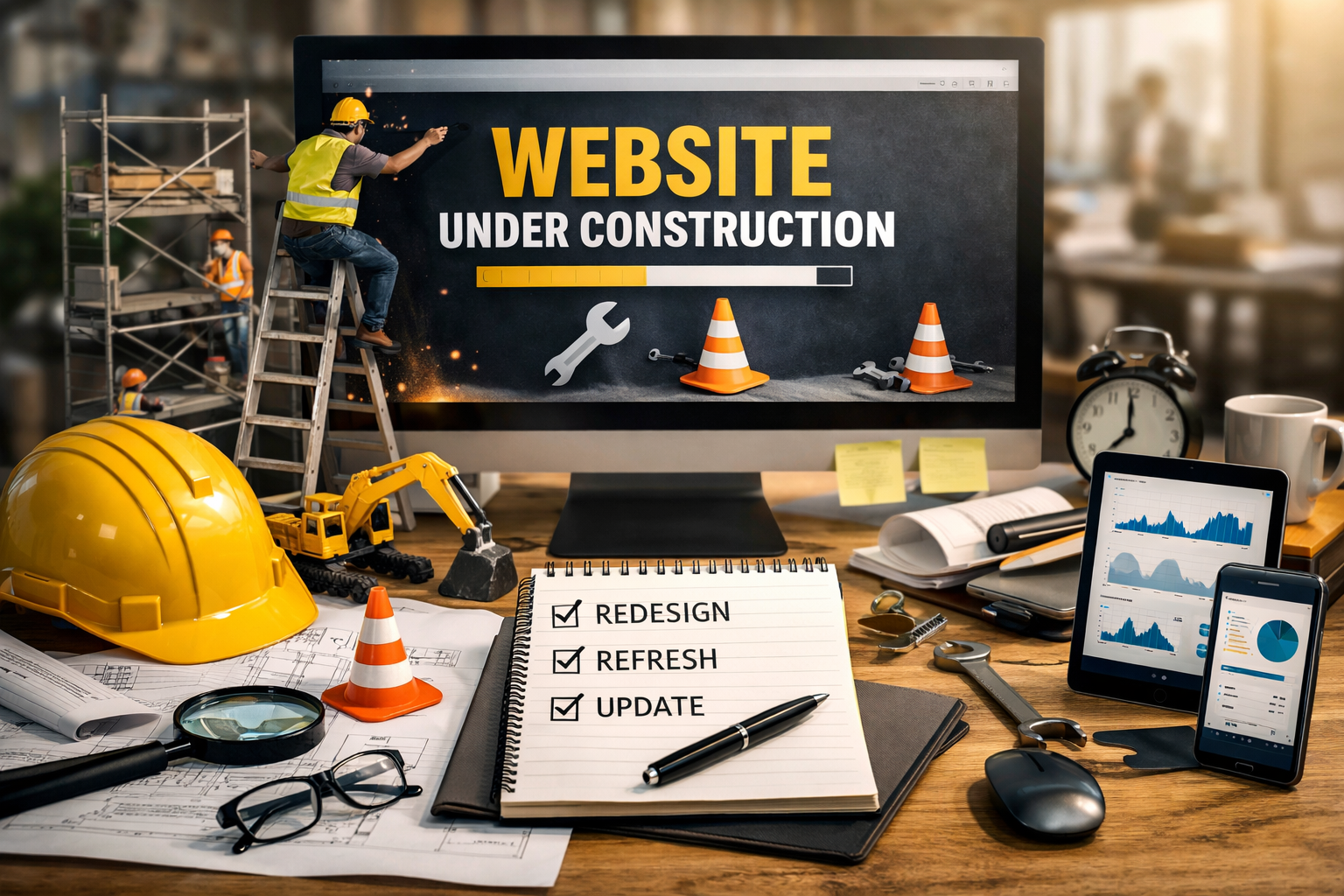
Most businesses treat their website like a construction project. You plan it, you build it, you launch it, and then you move on. The ribbon gets cut. The champagne gets poured. And then the site quietly begins aging while everyone's attention turns back to actually running the business.
This is how you end up with a 2019 website representing a 2026 company. The services have evolved, the team has changed, the market has shifted, the phones you're targeting don't display it correctly anymore — and the site sitting at your domain is still telling the story of who you were seven years ago.
Website hygiene isn't a dramatic concept. It's the discipline of treating your website the way you treat any other business asset that requires regular maintenance to keep performing — your equipment, your team, your physical space. Ignore it long enough and the decay becomes expensive to reverse. Stay ahead of it with the right cadence and it compounds in your favor rather than working against you.
This post covers the principles that govern how often a site needs attention, the difference between a redesign, a refresh, and routine maintenance, and how the right cadence changes depending on what industry you're in.
The Three Levels of Website Work — And Why the Distinction Matters
Before talking about frequency, it helps to be precise about what kind of work we're actually discussing. "Updating the website" means different things depending on context, and conflating them produces bad decisions in both directions — either over-investing in a full rebuild when a refresh would do, or patching a site that genuinely needs to be replaced.
Level One: Routine Maintenance
This is the ongoing, operational work that keeps a functioning site functional. It includes updating plugins and software, fixing broken links, refreshing outdated content, updating team bios and headshots when people join or leave, correcting pricing or service information, and monitoring for technical errors or security vulnerabilities.
Routine maintenance isn't optional. A site with broken links, outdated personnel, wrong pricing, and security gaps is actively damaging your credibility with every visitor it encounters. This is weekly and monthly work, not annual work. Most businesses either don't do it or do it inconsistently, which is how you end up with a testimonials page featuring a client who has been gone for three years and a team page with two people who left the company before the pandemic.
Level Two: Content and Conversion Refresh
A refresh is more substantive than maintenance but less disruptive than a redesign. It involves updating the messaging, improving page structure, adding new content, optimizing existing pages for current search intent, improving calls to action, and making targeted adjustments to user experience without rebuilding the site from scratch.
A refresh is appropriate when the underlying architecture and visual identity of the site still work, but the content is stale, the conversion rate has declined, or specific pages are underperforming relative to their traffic. It's the equivalent of renovating a room in a well-built house rather than tearing the house down and starting over.
Level Three: Full Redesign
A redesign is the complete replacement of a site's visual identity, architecture, content structure, and in many cases technical platform. It's appropriate when the site's foundations are no longer serving the business — when the design language is so dated it undermines credibility, when the information architecture has become too tangled to navigate effectively, when the platform can't support the performance or functionality the business needs, or when the company has undergone a significant strategic or brand evolution that the current site doesn't reflect.
A redesign is a significant investment of time and money. It is frequently undertaken when a refresh would have been sufficient, and it is frequently avoided when it's actually necessary. Getting the diagnosis right is the first step.
The Principles That Govern Timing
There is no universal answer to "how often should you redesign your website" — but there are clear principles that determine when it's time, regardless of industry.
The Credibility Test
The most important question to ask about any website is whether it makes prospects more likely to trust and contact you, or less. This is not primarily a question about aesthetics. A site can look slightly dated and still convert well if the content is strong, the proof is compelling, and the user experience is functional. A site can look slick and convert terribly if the messaging is wrong, the navigation is confusing, or the calls to action are absent.
Run the credibility test by having someone unfamiliar with your business spend three minutes on your site and then answer three questions: What do you do? Who do you serve? What should I do next? If they struggle to answer any of those questions, there's a content or structure problem that needs fixing regardless of when the site was last rebuilt.
The Competitive Context Test
Your site doesn't exist in isolation. It exists alongside every competitor your prospects will visit before making a decision. The relevant question isn't whether your site is better than it was three years ago. It's whether your site is better than the other sites your prospects will evaluate this week.
If your category has experienced a wave of well-executed new websites — as most industries do periodically — your site may have fallen behind the competitive standard without you doing anything wrong. A site that was genuinely impressive in 2020 can look mediocre in 2026 simply because the bar moved. Periodic competitive audits — reviewing three to five competitor sites annually — will tell you where you stand relative to the market, which is the only comparison that actually matters to prospects.
The Performance Test
A site that looks fine but isn't performing is a site that needs attention regardless of its age. The key metrics to watch: organic traffic trend over the past 12 months, conversion rate on key landing pages, bounce rate and engagement time on critical pages, page load speed especially on mobile, and the ratio of qualified leads generated per month to total traffic. If any of these metrics have been declining without a clear external cause, the site is the variable worth examining first.
The Technology and Standards Test
Web standards change. What was technically acceptable five years ago — page load times, mobile responsiveness standards, Core Web Vitals, accessibility compliance — may be actively hurting your SEO and user experience today. A site built in 2017 on a platform that no longer receives security updates, with a mobile experience that wasn't built for current phone screen sizes, is a technical liability regardless of how the content looks. Technology decay happens slowly and invisibly, which is why it gets missed until it becomes a crisis.
General Timing Guidelines
With the principles established, here are the general cadence guidelines that apply across most industries.
Routine maintenance should be ongoing — at minimum monthly for content accuracy and quarterly for deeper technical audits. Broken link checks, plugin updates, content accuracy reviews, and Google Search Console monitoring should be part of a standing operational process, not an annual scramble.
Content and conversion refresh should happen every 12 to 24 months for most businesses. Service offerings evolve, messaging sharpens, SEO best practices change, and the proof points that make your site persuasive — case studies, testimonials, results — need to be kept current. A site with testimonials from 2021 and case studies from 2020 is telling prospects that your most recent success was several years ago, which is almost never true.
Full redesign has traditionally been cited as a three-to-five year cycle, and that remains a reasonable benchmark for most established businesses in stable industries. The honest answer is that the trigger for a redesign should be the failure of any of the three tests above — credibility, competitive context, or performance — rather than a fixed calendar interval. Some sites function well at seven years with regular refreshes. Others need to be rebuilt at three because the platform, the brand, or the business has changed significantly.
How the Right Cadence Changes by Industry
The general guidelines above apply broadly, but the right maintenance and redesign cadence varies meaningfully by industry based on how often the competitive standard moves, how closely prospects scrutinize the site before deciding, and how rapidly the underlying business changes.
Professional Services: Law Firms, Accounting, Consulting, Financial Advisory
Professional services websites exist primarily to establish credibility and earn trust. The prospect evaluating a law firm or financial advisor is making a high-stakes, relationship-based decision. They will read your website carefully. They will judge your credibility by the quality of your content and the currency of your information. They will notice a team page with a lawyer who left two years ago.
Routine maintenance: Monthly — attorney and team bios, practice area updates, case results where appropriate, blog content freshness.
Content refresh: Every 12 to 18 months at minimum. Messaging in professional services evolves as case law, regulatory environments, and market conditions change. A financial advisory firm's messaging in 2026 should reflect the current interest rate environment, the state of AI-driven investment tools, and the concerns of clients in 2026 — not 2022.
Full redesign: Every four to five years is appropriate for firms that stay current with content, but the credibility test is especially important here. Professional services sites in particular tend to hold onto conservative, dated designs because the partners who approve changes are risk-averse. The problem is that a prospects comparing three law firms will form a strong impression about operational quality from the website before they've read a word of content. A site that looks neglected implies a firm that may be neglected.
Healthcare and Medical Practices
Healthcare websites carry specific regulatory obligations alongside the standard performance expectations. Content accuracy isn't just a conversion issue — outdated medical information, provider credentials that haven't been updated, or services that are no longer offered create both credibility gaps and potential liability.
Routine maintenance: Monthly at minimum. Provider listings, accepted insurance, service offerings, office hours, and contact information change frequently and every inaccuracy erodes trust with a prospect population that is particularly attentive to detail.
Content refresh: Every 12 months for medical content. Healthcare is one of the highest E-E-A-T sensitivity categories in Google's quality guidelines — meaning Google evaluates health content with particular scrutiny for expertise, authoritativeness, and trustworthiness. Outdated clinical content, stale blog posts, or pages that haven't been reviewed in years can actively suppress search rankings.
Full redesign: Three to four years is appropriate for medical practices, driven partly by the technology standards for patient-facing digital experiences — online scheduling, telehealth integration, patient portal access — which evolve faster than most categories. A healthcare site that doesn't support mobile scheduling in 2026 is a friction point that costs the practice patients who simply move on to a competitor who makes it easier.
Home Services: HVAC, Roofing, Plumbing, Electrical, Landscaping
Home services businesses often have websites that were built for a different era — keyword-stuffed, thin on content, heavy on phone numbers, light on trust signals. The competitive standard in this category has risen significantly as consumers have become more research-oriented and Google has become more sophisticated about what constitutes a quality local business website.
Routine maintenance: Quarterly for content, but with particular attention to Google Business Profile synchronization — making sure that NAP information (name, address, phone) is consistent across your website, Google Business Profile, and any directory listings. Inconsistencies here are a local SEO penalty that costs rankings.
Content refresh: Every 12 to 18 months, with particular attention to service area pages and seasonal content. An HVAC company's content should reflect current equipment brands, current efficiency standards, and current service offerings — not what was installed in 2019. Local SEO for home services is driven heavily by the specificity and currency of location and service content.
Full redesign: Every three to four years, with particular urgency if the site isn't generating leads at the rate the business needs. Home services is one of the most competitive local SEO categories, and a weak website — slow, thin, non-responsive, lacking trust signals — is often the primary reason a technically capable business isn't ranking or converting. In this category more than most, the website redesign pays for itself quickly when the underlying SEO foundation is strong.
Restaurants and Hospitality
Restaurant websites have a unique relationship with freshness because the product itself changes constantly. A website with a menu from two years ago isn't just outdated — it's actively misleading to a prospect who makes a reservation based on dishes that no longer exist. In a category where a single bad experience generated by a mismatch between digital promise and in-person reality can produce a damaging review, content currency is tied directly to reputation management.
Routine maintenance: Weekly for menus, hours, and reservation links. This is non-negotiable. A restaurant website with an outdated menu is the single most common and most preventable cause of a poor guest experience before the guest has even arrived.
Content refresh: Seasonally — or at minimum twice a year. Photography should be updated whenever the menu changes significantly. Restaurant websites live and die on imagery, and food photography from 2019 that no longer represents what's being served is a mismatch that costs covers.
Full redesign: Every three to four years, or sooner if the visual identity of the restaurant has evolved. A restaurant's website is its digital storefront. If the physical space has been renovated, the menu has been repositioned, or the brand has shifted in tone, the website needs to reflect the current experience — not the one that existed when it was last built.
E-Commerce and Retail
E-commerce sites have the most demanding maintenance requirements of any category because the product catalog is inherently dynamic and every inaccuracy — a product showing as in stock when it isn't, pricing that hasn't been updated, a discontinued item still appearing in search results — has a direct revenue cost.
Routine maintenance: Continuous for product data, weekly for site performance and technical health. E-commerce sites also require more aggressive monitoring for security vulnerabilities given that they handle payment information.
Content refresh: Quarterly for homepage and category page messaging, seasonally for promotional content. The conversion rate on an e-commerce site is acutely sensitive to how well the messaging matches current consumer priorities, competitive positioning, and seasonal context.
Full redesign: Every two to three years for the platform and checkout experience, which evolve faster than any other category. Consumer expectations for e-commerce UX are set by the largest platforms in the world — Amazon, Shopify storefronts, major DTC brands — and the gap between current best practices and a site built five years ago is more visible to the average shopper than in almost any other category.
B2B SaaS and Technology
B2B SaaS websites are in a category where the product, the competitive landscape, and the messaging vocabulary change rapidly. A positioning statement that accurately described a product in 2022 may be meaningfully wrong in 2026 — either because the product has evolved or because the category has evolved around it.
Routine maintenance: Monthly for product feature pages, pricing, and case studies. In SaaS, outdated pricing pages and feature lists that don't reflect the current product are among the most conversion-damaging forms of content decay.
Content refresh: Every six to 12 months. SaaS marketing is acutely sensitive to category language — the terminology that buyers use to search for and evaluate solutions changes as the market matures. A website still using 2021 category vocabulary to describe a 2026 product is invisible to a significant portion of its potential market.
Full redesign: Every two to three years. SaaS is one of the categories with the most aggressive competitive standards for website design and performance. The bar for what a credible SaaS product website looks like is set by well-funded companies that invest heavily in their digital presence, and the gap between current design standards and a three-year-old site is often significant enough to undermine conversion for prospects who are explicitly evaluating multiple solutions side-by-side.
Real Estate
Real estate websites have a dual maintenance challenge: the properties themselves are inherently dynamic, and the market context — rates, inventory, neighborhood values — changes continuously. A real estate website that doesn't reflect current market conditions looks out of touch to prospects who have been doing their own research.
Routine maintenance: Weekly for listings and market data, monthly for neighborhood content. Stale listings — properties that sold six months ago still appearing as available — are one of the fastest ways to lose a prospect's trust in any real estate context.
Content refresh: Every 12 months for market analysis content and every time a significant shift in market conditions makes existing content misleading. The interest rate environment that produced the right messaging for a buyers' agent in 2021 is very different from the right messaging in 2026.
Full redesign: Every three to four years, with particular attention to whether the site's search and listing functionality is keeping pace with the tools prospects expect. The technology expectations for real estate search — IDX integration, map-based search, neighborhood filters, saved searches — evolve as the category standard advances.
The Signs Your Site Needs Attention Now — Regardless of When It Was Built
Across all industries, certain signals indicate that a site needs immediate attention regardless of its age or last update date.
Leads have declined without a corresponding decline in traffic. If your organic traffic is stable but fewer people are converting, the site's conversion architecture — CTAs, forms, trust signals, messaging clarity — has a problem that needs diagnosing.
You're embarrassed to share your website. This is one of the most reliable signals in business. If you hesitate before including your URL in an email, if you avoid mentioning your website in pitches, or if you find yourself prefacing it with "it's a bit outdated but" — the site is costing you credibility with every prospect who visits it.
Your top competitor just launched a significantly better site. The competitive standard in your category just moved. Your site needs to respond.
Core Web Vitals scores are failing. Google's page experience signals directly affect search rankings. A site with poor load times, unstable layout, or poor interactivity scores is being penalized in search regardless of how good the content is.
Mobile experience is broken or degraded. More than half of web traffic arrives on mobile devices. A site that works acceptably on desktop but poorly on mobile is failing a majority of its visitors.
You've undergone a significant business change that the site doesn't reflect. New services, new leadership, new positioning, new target market — any of these represent a gap between what your site says and what your business is. That gap costs you with every prospect who visits.
The Bottom Line
Website hygiene is not a project. It's a practice. The businesses with the most effective websites aren't the ones that did the biggest redesign five years ago and left it alone. They're the ones that treat their site as a living document — maintained continuously, refreshed regularly, and rebuilt when the foundations no longer serve the business.
The cadence is different by industry, the triggers are different by situation, and the level of work required varies enormously depending on the gap between where the site is and where it needs to be. But the underlying principle is constant: your website is the first thing most new prospects will judge you by, and the judgment they form in those first few minutes determines whether they contact you or move on.
A website that reflects the quality of your actual work earns that judgment. One that doesn't will keep losing prospects you never knew you had.
Ritner Digital builds and maintains websites that earn the trust of the customers looking for you. If your site isn't performing the way it should, let's take a look.
Frequently Asked Questions
How do I know if my website needs a full redesign or just a refresh?
Start with the three tests from the post. First, the credibility test — have someone unfamiliar with your business spend three minutes on your site and ask them what you do, who you serve, and what they should do next. If they struggle, you have a content or structure problem. Second, the competitive context test — look at three to five competitor sites and honestly assess whether yours is in the same league. Third, the performance test — is your site generating leads at a rate that makes sense for your traffic volume? If the first two tests reveal problems but the underlying structure and platform are sound, a refresh is likely the right move. If all three are failing simultaneously, or if your platform is outdated or your brand has significantly evolved, a full redesign is probably warranted.
What's the most common mistake businesses make with their websites?
Treating the launch as the finish line. The businesses with the worst-performing websites aren't the ones who built bad sites — they're the ones who built reasonable sites and then stopped paying attention. Content goes stale. Team pages become inaccurate. CTAs that made sense at launch stop converting as the market evolves. Competitors rebuild and raise the bar. All of this happens slowly and invisibly, which is why it's so easy to miss until the site has fallen years behind. The fix isn't a frantic redesign — it's building a standing process for routine maintenance and quarterly content review so the site never falls far enough behind to require an emergency rebuild.
How much does website decay actually affect search rankings?
More than most people realize, and through several distinct mechanisms. Outdated content signals to Google that a page isn't being maintained, which affects freshness scoring for queries where recency matters. Technical decay — slow load times, failing Core Web Vitals, mobile experience problems — directly affects page experience signals that Google uses as ranking factors. Inaccurate NAP information across your site and directory listings creates consistency signals that hurt local SEO specifically. And content that was written for 2020 search intent often doesn't match 2026 search behavior — meaning pages that once ranked for relevant queries have drifted away from what people are actually searching for. Each of these individually is manageable. All of them together can produce a significant and puzzling decline in organic visibility that's hard to diagnose without a proper audit.
Our website is three years old but still gets compliments. Do we still need to update it?
Compliments from people who know you are not the same as performance with people who don't. Your existing clients and colleagues have context — they know who you are and what you do, so the website is confirming something they already believe. A first-time prospect has none of that context. They're evaluating you cold, against competitors they may have just visited, with no prior relationship to inform their judgment. The question isn't whether the people who already trust you like the site. It's whether the site is converting people who don't know you yet — and that answer lives in your analytics, not in compliments.
How often should we be adding new content to the website?
The right cadence depends on your goals and your industry, but a useful baseline for most businesses is at least one substantive piece of content per month — a blog post, a case study, a service page update, or a meaningful refresh of an existing page. More important than frequency is consistency and intent. A post published because it addresses a real question your prospects are searching for is worth ten posts published to fill a calendar. The businesses that see the best results from content aren't the ones producing the most — they're the ones producing content that is specifically built around what their best customers are searching for and clearly connected to a business outcome.
Does the industry really change the redesign timeline that much?
Yes — significantly. A B2B SaaS company competing in a category where the design standard is set by well-funded startups faces a different competitive reality than a local plumbing company whose prospects are comparing three regional websites. An e-commerce site where every product page is a conversion opportunity operates under different maintenance demands than a law firm's practice area pages. A restaurant whose menu changes seasonally has a different content freshness requirement than a financial advisory firm whose core services are stable year over year. The principles that determine when a site needs attention are consistent, but the cadence at which those principles trigger action varies enormously based on how fast the competitive standard moves and how dynamic the underlying business is.
What should we actually be checking on our website every month?
A monthly review should cover five things at minimum. First, content accuracy — are team bios, service offerings, pricing, and contact information still correct? Second, broken links — run a basic link checker and fix anything that returns a 404. Third, Google Search Console — check for any new crawl errors, manual actions, or significant drops in impressions or clicks that need investigation. Fourth, Google Business Profile sync — confirm that your name, address, phone number, and hours match what's on your website exactly. Fifth, form and CTA function — actually submit each lead form on your site to confirm it's working and routing correctly. These five checks take less than an hour and catch the most common and most damaging forms of site decay before they compound into larger problems.
We had a new website built two years ago and it already feels outdated. What happened?
A few possibilities. If the site was built to a specific design trend rather than a timeless visual direction, trends move fast and two years can be enough for something to feel dated. If the platform or theme hasn't been updated, the technical foundation may have aged faster than the design. More commonly, the content was written to reflect the business as it was at launch, and the business has evolved enough in two years that the site no longer tells an accurate story. The fix depends on the diagnosis — but in most cases a two-year-old site that feels outdated needs a content and messaging refresh rather than a full rebuild. Start there before committing to a full redesign budget.
Ritner Digital audits, refreshes, and rebuilds websites for businesses that are serious about what their digital presence produces. Start with a conversation about what yours needs.