What Gladwyne and South Philly Have in Common (And What They Absolutely Don't)
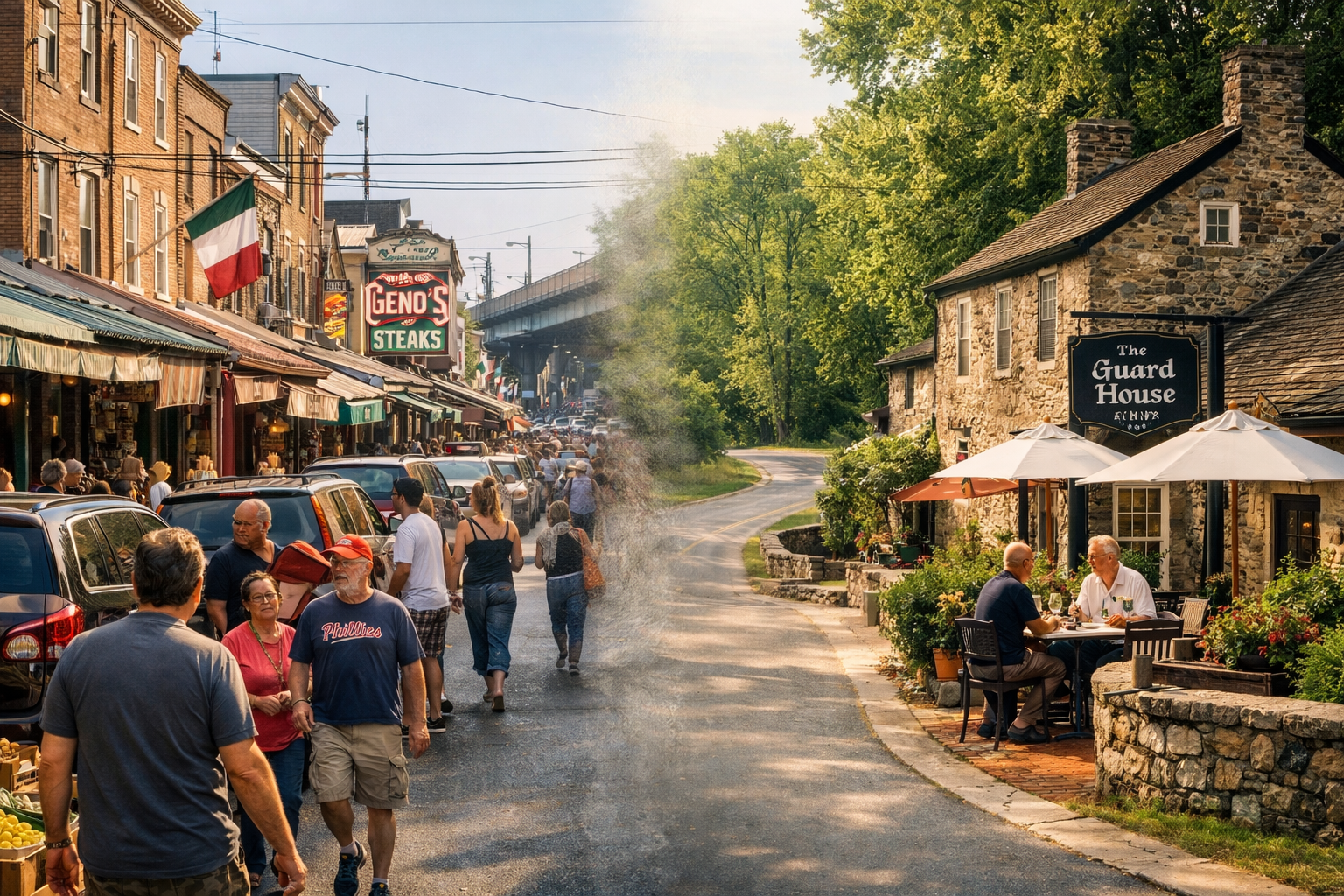
Twelve miles separate the Italian Market on South Ninth Street from the Guard House Inn on Youngsford Road in Gladwyne. Twelve miles and, depending on which direction you're traveling and what you're carrying, what feels like a complete change of civilization.
One is dense, loud, layered, block-specific, built on the principle that everyone within earshot knows everyone else's business and that reputation travels at the speed of a conversation through a screen door. The other is private, quiet, deed-restricted, built on three-acre lots behind stone walls and mature tree lines, where reputation travels at the speed of a whispered recommendation at the Philadelphia Country Club between people who already knew each other before they had anything to recommend.
They are as different as two communities in the same metropolitan area can reasonably be. And they operate on exactly the same principle.
The best businesses in both of them don't advertise. They get recommended. The recommendation is everything. And if you serve either market — or both — the most important thing you can understand is not the principle they share. It's the way the principle expresses itself differently in each, because getting that wrong is not just ineffective. In a market as relationship-dependent as either of these, it can be actively damaging.
What South Philly's recommendation culture actually looks like
South Philadelphia operates on proximity and volume. The blocks are dense, the houses are attached, the social lives of neighbors overlap in ways that residents of more spread-out communities would find either comforting or suffocating depending on their temperament. Trust here is built through repetition and visibility — the same face, the same quality, the same reliability, delivered enough times to enough people that the neighborhood absorbs the business the way a neighborhood absorbs a corner store. It doesn't choose it consciously. It just starts taking it for granted, the way you take for granted the place you've been going your whole life.
The channels through which recommendations move in South Philly are informal and fast. They live in the conversation at the deli counter, the exchange on the front step, the thread in the neighborhood Facebook group where someone asks for a plumber at 9pm and gets eleven replies before midnight. There is nothing discreet about it. When a South Philly neighborhood decides it trusts a business, it says so at full volume — to neighbors, to relatives, to the family members who moved to the suburbs and still come back to the same contractors because the relationship was built before the zip code changed.
The pace of trust-building here is faster than in almost any other market in the Philadelphia region. A new business that does excellent work and treats people right can enter the South Philly recommendation network in a matter of months, because the network is dense enough and vocal enough that a strong signal moves quickly. The flip side is equally true: a business that fails the community's expectations doesn't get a quiet fade. It gets mentioned, specifically, every time someone asks.
What this market rewards above all else is consistency and directness. The customer isn't expecting refinement. They are expecting reliability — the same experience, the same price, the same person, every time. Anything that signals pretension or distance reads as wrong here and travels through the network as a warning rather than a recommendation.
What Gladwyne's recommendation culture actually looks like
Gladwyne operates on privacy and selectivity. The properties are large, the gates are real, the social lives of residents overlap through structured channels — the Philadelphia Country Club, Merion Cricket Club, the Stony Lane Swim Club, the Gladwyne Civic Association, the Lower Merion school network — rather than through the organic proximity that creates South Philly's perpetual information flow. Trust here is built through demonstrated discretion as much as demonstrated quality. A business that serves this community well, that handles the details of a significant estate or a complex professional household without making any of it visible or discussable outside the relationship, earns something more durable than a good review. It earns inclusion.
The channels through which recommendations move in Gladwyne are slow, formal, and information-dense. They happen at club dinners and school fundraisers and over drinks at the Guard House — or what used to be the Guard House, before the Union League took it over. They happen between people who have been in the community long enough to carry weight with each other, which means they happen slowly for anyone new and extremely efficiently once the relationship is established. A recommendation in Gladwyne is not a casual mention. It is a considered endorsement from someone whose judgment is respected by the recipient, delivered in a context where both parties understand what is being transferred.
The pace of trust-building here is among the slowest in the region. A new business cannot accelerate it through marketing or volume or aggressive presence, because those signals read as inappropriate in a community that values the opposite of aggressive. What can accelerate it is getting in front of the segment of the market that isn't yet connected to the existing network — the physicians and attorneys and finance professionals who arrive in Gladwyne every year from outside Philadelphia, without a single local contact, and who make every service decision from a search bar until they've been in the community long enough to have built their own relationships. Those new arrivals are the opening. They move into the network eventually, and when they do, they carry with them the recommendations they've already formed.
What this market rewards above all else is quality and discretion. The customer isn't expecting warmth, exactly, though warmth is welcome. They are expecting a level of expertise and care that matches the property and the profile. Anything that signals generic, mass-market, or interchangeable reads as wrong here and never travels through the network at all — not as a warning, but simply as silence.
The mechanism is the same. The expression is completely different.
Both markets run on word of mouth. Neither responds well to conventional advertising. Both reward consistency and quality over time. Both have trust networks that, once penetrated, generate referrals with remarkable efficiency. Both have segments of the market that are unreachable through the existing network and accessible primarily through digital presence.
But the way you build credibility in each is so different that a strategy designed for one will fail in the other — not just underperform, but actively misread the room.
A contractor who markets to South Philly the way you'd market to Gladwyne — carefully curated, restrained, whispered — won't register. The signal is too quiet for a market that processes information at full volume. A contractor who markets to Gladwyne the way you'd market to South Philly — high volume, lots of reviews, aggressive visibility — won't be trusted. The signal is too loud for a market that treats restraint as evidence of quality.
The review strategy is different. In South Philly, volume and recency matter — a steady stream of reviews from neighbors in recognizable zip codes signals active, reliable presence. In Gladwyne, a handful of specific, substantive reviews from clients in zip code 19035 and Lower Merion Township carries more weight than a hundred generic five-stars from across the region. The content is different. The tone is different. The keywords that signal local knowledge are different. The platforms where each community verifies business decisions before they call are different.
None of this means the underlying work is different — good work is good work in both places, and both communities can identify it. What's different is the language in which that work needs to be communicated to reach the right person at the right moment in each market.
What this means if you serve one and want to serve the other
The businesses that successfully cross from one of these markets to the other are the ones that resist the temptation to apply what worked in the first one to the second. The South Philly contractor with a fifteen-year reputation and four hundred contact list entries doesn't translate that reputation to Gladwyne by putting it on a billboard. They translate it by building a quiet, specific, credential-forward digital presence that lets the arriving neurosurgeon on Youngsford Road find them through a search and conclude, based on what they find, that this business understands what their property requires.
The Gladwyne-based service provider who wants to expand their reach into South Philadelphia neighborhoods doesn't do it by becoming more restrained. They do it by becoming more visible — more reviews, more presence in the community recommendation channels, more of the directness and warmth that signals to a South Philly customer that this business is accessible and familiar rather than remote and exclusive.
The principle is the same. The translation is everything.
Both of these markets are underserved by digital presence — because the businesses embedded in each one built their positions before digital presence was necessary, and because the newcomers who need to be reached in each market are starting from a search bar that most of the embedded businesses have never bothered to optimize. The South Philly plumber booked through referrals doesn't need Google to fill his schedule. The Gladwyne contractor whose name circulates through the Country Club doesn't need a website to get calls. But the new family that just moved into a rowhouse on Ellsworth Street, and the new family that just bought a Tudor Revival estate on Crosby Brown Road, are both searching. They just need to find someone different when they do.
That's the whole story. Two markets, twelve miles apart, one principle, two completely different executions. Get the execution right and both markets are extraordinary. Get it wrong and neither one forgives you easily.
Ritner Digital builds digital presence calibrated to the specific market you're in — whether that's South Philly, Gladwyne, or anywhere in between. If you're ready to reach the clients in your market who haven't found you yet, let's talk.
Frequently Asked Questions
How does word of mouth work differently in South Philadelphia versus the Main Line?
The underlying mechanism is identical — trust travels through personal relationships, and businesses earn their place in the recommendation network through consistent quality over time. But the expression is completely different. In South Philadelphia, recommendations move fast, publicly, and at volume through dense neighborhood networks — conversations at the deli counter, threads in neighborhood Facebook groups, relatives who moved to the suburbs but still call the same contractors. In Gladwyne and the Main Line, recommendations move slowly, privately, and with considerable weight through structured social channels — the Philadelphia Country Club, the Merion Cricket Club, the school network, conversations between people whose endorsements carry institutional significance. Same principle, completely different pace and texture.
Why doesn't the same marketing strategy work in both South Philly and Gladwyne?
Because the signals that communicate credibility are opposite in each market. In South Philly, volume and visibility signal reliability — a steady stream of reviews from neighbors in recognizable zip codes, active presence in community recommendation channels, the kind of directness and warmth that tells a customer this business is accessible and familiar. In Gladwyne, restraint signals quality — a handful of specific, substantive reviews from clients in Lower Merion Township, a digital presence that demonstrates expertise without performing it, the kind of quiet credibility that tells a high-net-worth professional this business understands their property and their expectations. A high-volume approach that works in South Philly reads as inappropriate in Gladwyne. A restrained, curated approach that works in Gladwyne doesn't register in South Philly. Getting the translation wrong doesn't just underperform — in markets this relationship-dependent, it can actively damage credibility.
What do South Philadelphia and Gladwyne have in common as business markets?
More than most people would expect. Both communities have deep, well-established recommendation networks that have been operating without digital infrastructure for generations. Both reward consistency and quality over time above almost everything else. Both have trust networks that, once penetrated, generate referrals with unusual efficiency — because the network is strong enough that a genuine endorsement travels far. And crucially, both have a segment of the market that is completely unreachable through the existing recommendation network: new arrivals who haven't built local connections yet and are starting every service decision from a search bar. In both communities, that audience represents a real and active opportunity for businesses with the right digital presence.
How should a contractor or service business approach expanding from one of these markets to the other?
By resisting the instinct to apply what worked in the first market to the second. A South Philly contractor with fifteen years of embedded reputation doesn't translate that to Gladwyne through volume and visibility — they translate it through a quiet, credential-forward digital presence that lets the new Main Line resident find them through a search and conclude the business understands what their property requires. A Gladwyne-based provider expanding into South Philadelphia neighborhoods doesn't become more restrained — they become more visible, more present in community recommendation channels, more direct in the way that signals accessibility rather than exclusivity. The work and the quality are the same. The communication strategy that reaches each market is not.
How important is local SEO for businesses serving neighborhood-based markets like these?
Critical — but for a specific reason that most generic local SEO advice misses. The embedded businesses in both South Philly and Gladwyne don't need digital presence because they aren't being searched for. They're being called directly by people who already know their name. The search results in both markets are largely uncontested by the best local operators — which means the opportunity for a business that builds the right digital presence is unusually strong. You're not competing with the entrenched names for clients who already know those names. You're competing for the clients who don't know any names yet — the family that just moved into a South Philly rowhouse, the physician who just bought a Tudor Revival estate on the Main Line — and that audience is real, active, and making decisions right now.
How does Ritner Digital approach local SEO differently for different markets?
By building presence calibrated to how trust actually moves in the specific community being targeted — not a generic local SEO package applied everywhere the same way. For South Philadelphia and dense urban neighborhoods, that means review strategy focused on volume and recency from recognizable local addresses, content that signals neighborhood-level familiarity, and a presence that reads as accessible and community-embedded. For Gladwyne and the Main Line, that means review strategy focused on specificity and credential, content that demonstrates genuine understanding of historic properties and high-expectation clients, and a presence that reads as appropriate rather than aggressive. The underlying technical work is similar. The strategy that makes it effective in each market is specific to that market — which is what makes the difference between being found and being chosen.