Why Serious Businesses Invest $50,000+ Per Year in SEO and Paid Ads (And Why That Number Makes Sense)
We had a conversation recently with a guy who sells Amish sheds.
Custom-built. Handcrafted. The kind of thing you buy once and it outlasts your mortgage. He's got a great product, a loyal customer base, and a reputation that's been built door-to-door and word-of-mouth for over a decade.
He wanted to know why his competitors — other shed dealers, some of them newer to the market — were showing up on Google before him. He wanted to know why their ads were everywhere. He wanted to know what they were spending.
The answer surprised him.
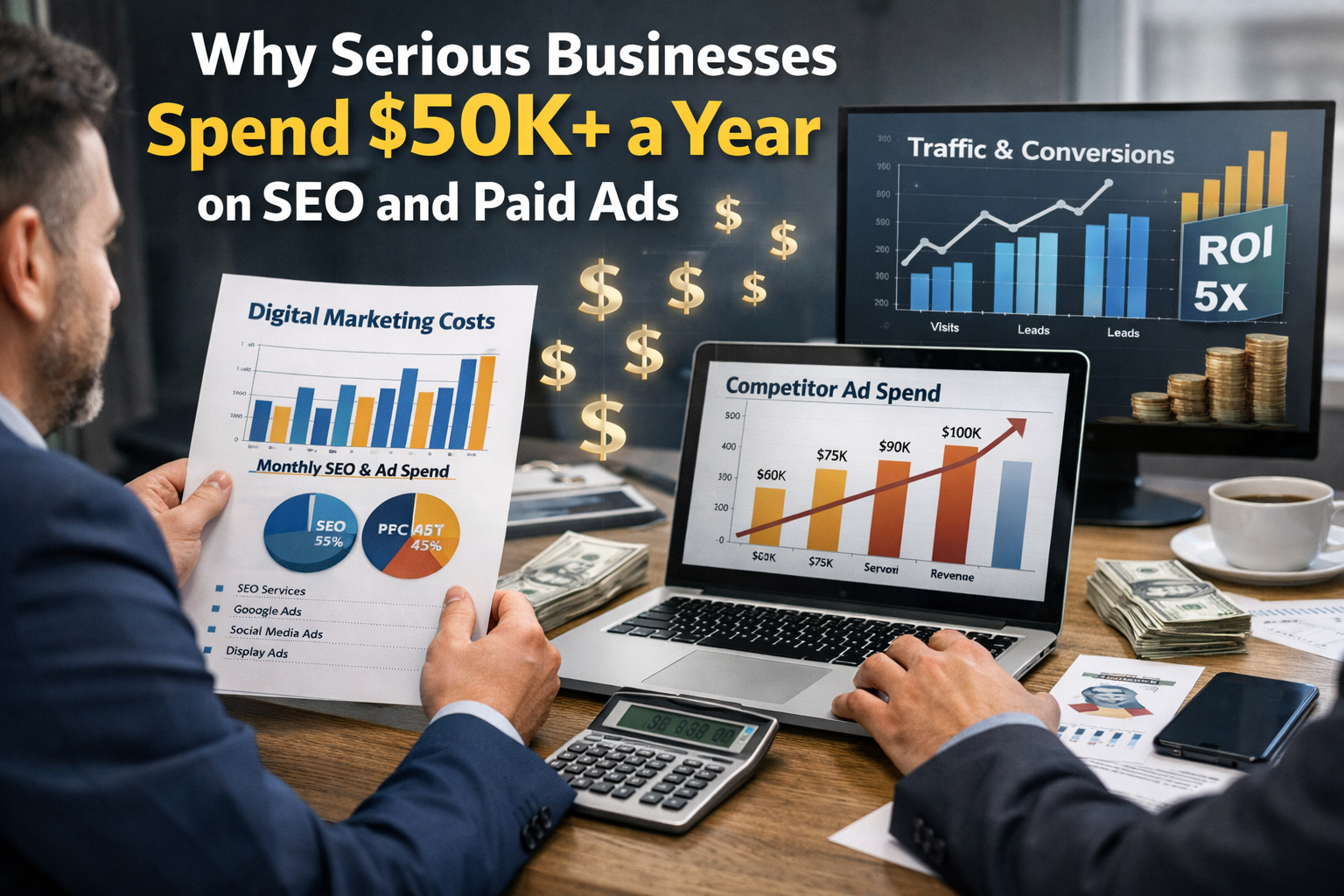
Most serious players in markets like his — sheds, playsets, carports, home improvement, home services — are putting $50,000 or more into digital marketing every year. Some of them are well north of that. And when you look at the math, it's not reckless. It's the cost of staying competitive.
The $50K Number Isn't Arbitrary
Let's start with what $50,000 a year actually looks like in practice. Broken down monthly, that's roughly $4,200 per month. For a business generating $500,000 to $2 million in annual revenue, that's somewhere between 2.5% and 10% of top-line revenue going into digital marketing.
That's not extreme. The U.S. Small Business Administration has historically suggested marketing budgets in the range of 7–8% of gross revenue for businesses in growth mode. In highly competitive categories — and categories like outdoor structures, playsets, and carports are more competitive than most people realize — the ceiling can be even higher.
The $50K number typically breaks down something like this:
SEO: $1,500–$3,500/month ($18,000–$42,000/year) Paid Ads (Google + Meta): $1,500–$3,000/month in management fees, plus ad spend ($18,000–$36,000/year in total spend)
Some clients put more weight on SEO. Some lean heavier on paid. Most successful ones do both — because SEO and paid ads serve fundamentally different purposes and work better together than they do independently.
Let's Talk About Amish Sheds for a Second
We use sheds as an example because it illustrates something important about markets that look simple on the surface but are actually brutally competitive online.
Do a Google search for "Amish sheds for sale" or "Amish sheds near me." What you'll find is a mix of large national dealers, regional distributors, manufacturer websites, and local mom-and-pop operations — all fighting for the same set of high-intent buyers. The people typing that query aren't browsing. They've already decided they want a shed. They have money. They're shopping.
That's a valuable audience. And like any valuable audience, multiple businesses are competing hard for their attention.
Here's what competitive SEO looks like for a shed dealer:
Optimized location pages targeting searches like "Amish sheds in [city]" and "storage sheds [county]"
Product-specific content targeting high-intent terms like "12x16 shed with loft" or "pressure-treated floor sheds"
Blog content answering buyer questions like "how long do Amish-built sheds last" or "permit requirements for sheds in Pennsylvania"
Google Business Profile optimization to dominate local map pack results
Link-building to establish authority in the "outdoor storage" category
None of that happens overnight. None of it is free. And none of it can be maintained by someone who's also taking orders, scheduling deliveries, and managing a sales floor.
The businesses showing up at the top of those results are investing in them. Consistently. Month over month.
The Same Is True for Playsets
Playsets are an even more interesting case study because the market has gotten more fragmented — you've got big-box retailers like Costco and Amazon competing with regional dealers and local custom builders.
A local playset dealer competing in that environment can't out-advertise Costco. But they can out-SEO them at the local level, and they can run more targeted, higher-converting paid campaigns than a national brand can.
Local SEO for a playset business looks like:
Optimized Google Business Profiles across all service areas
Location-specific landing pages ("wooden playsets in [city]")
Reviews strategy (dealers with 100+ high-rated reviews convert dramatically better from map results)
Content targeting buying-stage questions: "swing set vs. playset," "how much does installation cost," "best playsets for small yards"
On the paid side, Google Shopping and Performance Max campaigns can generate strong ROI for playset businesses because the purchase intent is high and the ticket size justifies the cost per click. A $2,000–$4,000 playset sold from a $30 ad click is exceptional math — but only if the campaign is built and managed correctly.
We've seen playset dealers running $2,000–$4,000 per month in ad spend alone, with another $1,500–$2,500 going to agency management fees. That's $3,500–$6,500 per month, or $42,000–$78,000 per year. For a business doing $750,000–$1.5M in revenue, that spend is justifiable on a pure return basis.
Carports: The Underrated SEO Opportunity
Carports are a slightly different animal because the purchase intent is so specific. Someone searching "metal carport 20x21 free delivery" has already done their research. They know what they want. They're looking for the right dealer.
That kind of high-intent search is exactly where paid ads shine — and exactly where organic rankings matter for long-term visibility.
The challenge for carport dealers is that many of them haven't invested heavily in digital infrastructure. Their websites are outdated. Their Google Business Profiles aren't optimized. Their product pages lack the specifications and information that search engines reward.
That creates a gap — and gaps are opportunities.
A carport dealer willing to put real investment into SEO and paid ads in their region can build a dominant position relatively quickly compared to more mature categories. We're talking about a business that could realistically go from page three to page one in a focused six-month SEO push, because the competition hasn't made the same investment.
The businesses doing this well are spending $3,000–$5,000 per month on combined SEO and paid, with ad spend on top of that. All in, they're at $50,000–$80,000 per year. And their lead flow justifies it.
Why the Combination Matters
One question we get constantly: "Can't I just do one or the other?"
You can. But here's what you're giving up.
If you only do SEO:
You're building for the long term, which is smart — but you're invisible in paid results during the months it takes to rank organically
You miss the high-intent buyers who click on ads specifically because they're ready to purchase now
You have no way to test messaging quickly or chase seasonal demand spikes
If you only do paid ads:
The moment you stop paying, the traffic stops
You're building no lasting equity — there's nothing left after the campaign ends
Every lead costs money, and as your competitors bid up keywords, your cost per lead rises
You're missing the 60–70% of searchers who skip paid results and click organic listings
The businesses that win long-term do both. SEO builds the foundation. Paid ads fill in the gaps, accelerate results, and defend your position when competition heats up.
A carport dealer who ranks #1 organically for "metal carports in [state]" AND runs ads for the same keywords is capturing a disproportionate share of that search result page. They're everywhere. They look like the market leader — because, digitally, they are.
What's Actually Included in a $50K/Year Marketing Budget
To make this more concrete, here's what a realistic annual allocation looks like for a business in a category like sheds, playsets, or carports:
SEO ($18,000–$24,000/year)
Monthly technical SEO and site health maintenance
On-page optimization across product and location pages
Monthly content production (2–4 pieces per month minimum)
Link building and authority development
Google Business Profile management and optimization
Monthly reporting tied to lead and revenue outcomes
Paid Ads ($20,000–$30,000/year total)
Google Search campaign management for high-intent keywords
Google Shopping or Performance Max (for product-based businesses)
Meta retargeting to stay in front of visitors who didn't convert
Seasonal campaign builds for peak demand periods
Conversion tracking and CRO on landing pages
Monthly ad spend (this is the money going to Google/Meta, not the agency)
Supporting Infrastructure ($5,000–$10,000/year)
Landing page builds and CRO work
Reputation management and review strategy
Email nurture sequences for leads that didn't close immediately
Analytics setup and monthly performance dashboards
Not every business needs all of this on day one. But the businesses spending $50K+ a year are typically running all of it — because every piece supports the others.
The ROI Math (And Why It Pencils Out)
Let's run the numbers for a shed dealer doing $800,000 in annual revenue.
Average sale: $3,500 Marketing budget: $50,000/year Required sales from marketing to break even: ~14 sales/year
Most businesses running SEO and paid ads effectively are generating far more than 14 attributed sales per year from that investment. A shed dealer with a well-optimized Google Business Profile, competitive organic rankings, and active paid campaigns in their region could realistically generate 100–200 inbound leads per year from digital channels — with a close rate of 20–40% on quality inbound leads.
At 100 leads with a 25% close rate, that's 25 new customers. 25 customers × $3,500 average = $87,500 in revenue from a $50,000 marketing investment.
That's a 1.75x return — before accounting for repeat purchases, referrals, and the compounding value of organic rankings built over time.
At 150 leads with a 30% close rate: 45 customers × $3,500 = $157,500 from a $50,000 investment.
The math works. It works for sheds, for playsets, for carports, and for almost every business category where the average transaction size is in the thousands of dollars and customers are actively searching for what you sell.
What Happens When You Don't Invest
This is the part no one wants to hear, but it's the most important part of the conversation.
If you're not investing in SEO and paid ads, your competitors are. And every dollar they put in is building an advantage over you — rankings you don't have, brand awareness you haven't built, leads you're not getting.
In a category like Amish sheds or carports, where the purchase decision often starts with a Google search, being invisible is being irrelevant. It doesn't matter how good your product is. It doesn't matter how long you've been in business. If someone searches "sheds for sale near me" and you don't show up in the top results, you don't exist for that buyer.
The businesses that have been investing in digital for the last three to five years have a head start. Their domains have authority. Their Google Business Profiles have hundreds of reviews. Their paid campaigns have months of conversion data optimized into them.
You can close that gap. But it takes time and sustained investment. The best time to start was three years ago. The second best time is right now.
A Note on Trusting Who You Work With
One thing worth saying plainly: the $50,000/year number assumes you're working with a partner who's actually spending it effectively.
There are agencies that will take $3,000 a month and produce reports full of impressions and sessions while your phone doesn't ring. There are contractors who "do SEO" as a side project who've never built a technical audit, never done competitive keyword research, never tied their work to your actual revenue.
The right agency — and we'd say this regardless of whether it's us or someone else — should be able to tell you what your competitors are doing, what keywords you should own and why, what your cost per acquired customer is from paid campaigns, and how your rankings are trending relative to those competitors. If they can't answer those questions, they're not the right partner.
What we do at Ritner Digital isn't complicated to describe: we tie every dollar you spend to a business outcome. Whether it's SEO, paid ads, or both, you know what it's producing. That's the standard. It shouldn't be rare, but it is.
The Bottom Line
If you're in a business where customers search before they buy — sheds, playsets, carports, home services, professional services, nearly anything — $50,000 a year in combined SEO and paid ads isn't an extravagance. It's the cost of playing at a serious level.
The businesses at the top of your category know this. They're already spending it. The question is whether you're building the kind of digital presence that competes with them — or ceding that ground and hoping word of mouth holds.
We'll be honest with you about where you stand. We'll pull your Google Search Console data, look at your paid performance if you're running campaigns, and tell you exactly what it would take to compete in your market. No commitment. Just the information you need to make a smart decision.
Ritner Digital is a Philadelphia-based digital marketing agency specializing in SEO, paid advertising, web design, and CRM. We work with businesses across the country — from regional shed dealers to national brands — who are serious about building digital presence that drives real growth.
Frequently Asked Questions
Is $50,000 a year really necessary, or can a smaller business get by with less?
It depends on your market and your ambitions. A business in a low-competition area with a modest growth target can see meaningful results from $1,500–$2,500 per month. But if you're in a competitive category — and most shed, playset, and carport dealers are — the $50K range is where you have enough budget to run SEO and paid ads simultaneously, produce consistent content, and build real authority over time. Under-investing doesn't save you money if it means your competitors keep taking market share you'll have to buy back later at a premium.
How long until we see a return on a $50K/year marketing investment?
Paid ads can generate leads within days of launch. SEO takes longer — expect meaningful organic traction in three to six months, with compounding returns building from there. A combined strategy typically breaks even on investment within the first six to twelve months for businesses with strong close rates and average transaction sizes above $1,500. The businesses that don't see ROI are usually ones who quit too early, who hired the wrong partner, or who didn't have the sales infrastructure to close the leads they were generating.
Should I spend more on SEO or paid ads?
That depends on where you are in your digital lifecycle. If your website is new or your domain has low authority, paid ads deliver immediate visibility while SEO builds in the background. If you've been investing in SEO for a year or more and have solid organic rankings, you can reduce paid reliance — or use paid to dominate keywords you haven't ranked for yet. Most businesses doing $50K/year split roughly 40–60% on SEO (including content) and 40–60% on paid ads plus ad spend. The right ratio shifts with your business cycle and competitive landscape.
What if I've tried paid ads before and they didn't work?
This is one of the most common things we hear. In almost every case where paid ads "didn't work," the issue wasn't the channel — it was the execution. Either the campaigns were built incorrectly, the landing pages weren't converting, the targeting was too broad, or there was no conversion tracking in place to tell you what was actually working. Google and Meta ads are not plug-and-play. When they're built and managed properly, with real conversion data driving optimization, the math changes completely. If you've had a bad experience, it's worth having an honest audit of what went wrong before writing off the channel entirely.
Do you work with businesses that aren't in Philadelphia?
Yes. We're based in South Philly and proud of it, but we work with clients across the country — including regional shed dealers, playset distributors, and carport companies in markets from the Mid-Atlantic to the Midwest and Southeast. Local SEO work is geographically targeted regardless of where our office is. The work is the same; the only difference is we bring extra local insight when you're competing in the Philadelphia market specifically.
How do I know if my current agency is actually doing a good job?
Ask them three questions: What keywords am I currently ranking for, and how have those rankings moved in the last 90 days? What is my cost per acquired customer from paid campaigns? What content have you published in the last 30 days, and what traffic has it driven? If your agency can't answer those three questions clearly and quickly, something is wrong. Good marketing partners tie everything back to business outcomes — not impressions, not sessions, not "brand awareness." If the phone isn't ringing more than it was before you hired them, that's data.
What does the onboarding process look like with Ritner Digital?
We start with a full audit — your Google Search Console data, your current rankings, your paid campaign structure if you're running one, and a competitive analysis of who's winning in your category and why. That audit tells us where the real opportunities are and what a realistic 90-day and 12-month plan looks like. We don't sell you a package and start the clock. We build a strategy specific to your business first. From there, onboarding typically takes two to three weeks before active campaign execution begins.
What's a realistic lead volume expectation from a $50K/year investment?
It varies significantly by category, geography, and how competitive your market is. For a shed or carport dealer in a mid-size metro area, a well-run combined SEO and paid strategy generating 80–150 qualified inbound leads per year is a realistic target in the first 12 months — with growth from there as organic rankings compound. "Qualified" is the key word. We'd rather send you 80 people ready to buy than 500 people who were casually browsing. Quality of lead matters more than volume, and that's something we optimize for explicitly.
Can you work with my existing website, or do I need a new one?
Both happen. We'll give you a straight answer after reviewing your current site. If the foundation is solid — reasonable load speed, mobile-friendly, navigable — we can often get strong results with optimization rather than a full rebuild. If the site is technically broken, built on an outdated platform, or just fundamentally doesn't convert visitors into leads, a rebuild is worth the investment before pouring money into driving traffic to it. Sending paid traffic to a bad website is one of the fastest ways to burn your budget.