What Wegmans Coming to Route 73 Taught Every Small Business Owner in South Jersey About Competing on Experience
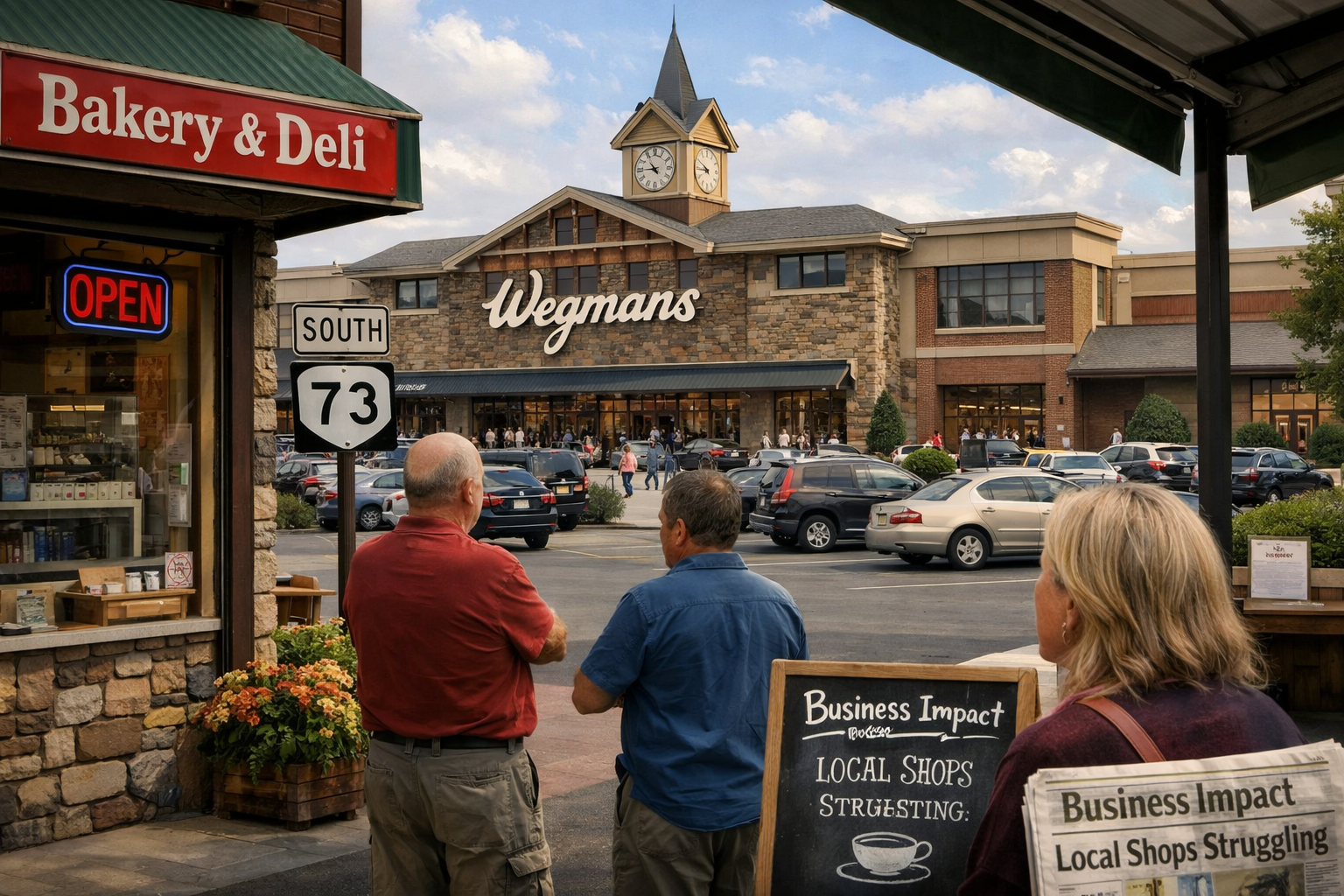
When Wegmans opened on Route 73 in Marlton, the conversation in South Jersey grocery circles went predictably. Smaller operators worried. Regional chains ran the numbers. People who had been shopping at the same ShopRite for twenty years suddenly had somewhere new to be on a Sunday afternoon, and it wasn't just a grocery run — it was an event. There were lines. There were people driving in from three towns over just to walk the produce section. There were reviews that read less like grocery store assessments and more like restaurant write-ups.
And somewhere in all of that, a lesson was available to every small business owner in the region — not just the ones selling food, not just the ones worried about competition from bigger players, but every business in every category that has ever looked at a well-funded competitor moving into their market and wondered what to do next.
Most of them missed it. The ones who caught it are still here.
What Wegmans actually is
To understand the lesson, you have to understand what Wegmans actually built — because it was not a grocery store that outcompeted other grocery stores on price or selection or convenience. Those are the wrong categories entirely.
Foodservice, which comprises roughly 10% of Wegmans' annual sales, is what makes many shoppers drive past all of those competitors to a Wegmans location. Progressive Grocer Think about that for a moment. One in ten dollars spent at Wegmans is spent on food that gets eaten in or near the store — prepared meals, the café, the ready-to-cook sections, the cheese counter staffed by people who can actually tell you what to do with an aged Manchego. The store is not primarily a place to buy groceries. It is primarily a place to spend time around food, with grocery purchasing as the most common activity that happens during that time.
Wegmans designed their stores to resemble European open-air markets, providing a higher-quality experience than their competitor set — food prepared in front of customers, produce arranged in beautiful displays. Robertson InnovationThe stores run between 80,000 and 120,000 square feet, with wider aisles and meal stations where you can grab every component of a dinner without navigating to three separate sections. The physical environment was engineered, from the beginning, to make the act of buying groceries feel like something other than a chore.
What Wegmans competes on is not product. It is not price. It is experience — the totality of how it feels to be in that building, to interact with the staff, to leave with something you didn't plan to buy because the display made it irresistible. Customers have been known to present petitions requesting a Wegmans store in their area. Progressive Grocer People petition for grocery stores. That is what competing on experience produces at scale.
What happened to the businesses that panicked
When a competitor that size lands in your market, the panic response is understandable and almost always wrong. The panic response looks like this: match their prices where you can, expand your selection to cover what they carry, run promotions to hold onto customers who are being pulled away, and hope that loyalty to the familiar wins out over the appeal of the new.
None of that works against Wegmans — not because the prices are wrong or the promotions are badly timed, but because the premise is wrong. You cannot out-Wegmans Wegmans on Wegmans' terms. They have a 100-year head start on the experience model, a supply chain that took decades to build, and a training culture that has earned recognition as the best large retail workplace in the country for ten consecutive years. Progressive Grocer If you try to compete with them by becoming a smaller, worse version of what they already are, you will lose. You will lose slowly, which is the worst way to lose, because it gives you just enough time to exhaust your resources before the outcome becomes undeniable.
The businesses along Route 73 that tried to meet Wegmans in its own lane — competing on variety, on prepared foods, on the in-store experience they simply didn't have the footprint or capital to replicate — are not the ones still thriving today. Some of them are gone. Some of them are diminished versions of what they were. The competition didn't beat them. The strategy beat them.
What happened to the businesses that paid attention
The smarter response to Wegmans' arrival wasn't to compete with it. It was to let it do the work it was going to do anyway — drawing foot traffic to the Route 73 corridor, establishing Marlton as a destination rather than just a pass-through — and position alongside it rather than against it.
Wegmans does not do the things that small businesses do well. It does not know your name. It does not remember that you're lactose intolerant or that your daughter just started swim lessons or that you always want the fennel sausage from the case on the left. It does not have a three-year relationship with you built on thirty interactions that have all gone the same reliable way. It cannot pivot its entire operation based on one conversation with a longtime customer. Its scale — the very thing that makes it formidable — is also the thing that makes it permanently incapable of being local in the way a genuinely local business can be.
The businesses that thrived after Wegmans arrived on Route 73 are the ones that understood this and doubled down on it. The specialty butcher that became more specialized, more knowledgeable, more personal — not less. The local restaurant that stopped trying to offer everything and committed harder to the three things it did better than anyone else in South Jersey. The service business that used the Wegmans moment as a forcing function to get sharper about what it actually was and who it actually served. They didn't compete on experience by trying to replicate Wegmans' experience. They competed on experience by deepening their own — the experience that no 100,000-square-foot operation could ever replicate because it requires knowing the customer, not just serving the customer.
The lesson that applies to every business on every corridor in South Jersey
You do not have to be in the grocery business for this to matter to you. The Wegmans story is the story of every market where a well-funded, well-operated competitor arrives and does some things genuinely better than you can do them. It happens in home services when a national franchise moves into Marlton and spends six figures on digital advertising. It happens in retail when a category killer opens on the same stretch of Route 73 you've been operating on for fifteen years. It happens in professional services when a larger firm with more resources starts targeting your clients.
The answer is never to panic and try to match them. The answer is to identify the dimension of competition where you have a structural advantage they cannot acquire — and in almost every case, for a genuinely local South Jersey business, that dimension is relationship. It is the depth of embeddedness in this specific community, the accumulated trust of years of showing up the same way, the knowledge of the customer that no scale can replicate.
That advantage is real. But it has a digital component now that it didn't used to have. The Wegmans of your industry — whatever that looks like in your specific market — has a marketing budget, a review profile, and an online presence that newcomers to the area will find before they find you. If your relationship-based reputation doesn't have a digital surface that new residents can discover, the new competitor wins by default — not because they earned it, but because they were findable and you weren't.
The businesses that survived and thrived after Wegmans came to Route 73 understood what they were. They knew what they could offer that Wegmans couldn't. And they made sure the right people could find them. That is still the whole playbook — for any business, in any category, in any South Jersey market where a bigger competitor has more resources than you do.
Know what you are. Deepen it. Be findable.
Ritner Digital helps South Jersey small businesses build the digital presence that makes their real advantages visible. If you're ready to stop competing on the wrong terms, let's talk.
Writing them now. This piece has a stronger business strategy angle than the others, so the FAQs can go a bit deeper on the competitive positioning argument while still pulling search traffic and warming up the Ritner ask.
Frequently Asked Questions
How do small businesses compete with large national competitors in South Jersey?
The mistake most small businesses make when a well-funded competitor enters their market is trying to match them on the competitor's terms — broader selection, lower prices, more aggressive advertising. That almost never works because it requires resources the smaller business doesn't have. The businesses that compete successfully do the opposite: they identify what the larger competitor structurally cannot do — personal relationships, community embeddedness, deep knowledge of the specific customer — and invest harder in those things. National scale is a real advantage. It is also a real limitation. No 100,000-square-foot operation knows your customer the way a genuinely local business can.
What can a local South Jersey business offer that Wegmans or a national chain can't?
Relationship, specificity, and genuine local knowledge. A national chain can offer a remarkable product at a competitive price in a well-designed environment. What it cannot offer is the accumulated trust of years of showing up for the same community, the ability to pivot based on a single conversation with a longtime customer, or the kind of embedded reputation that travels through the Marlton Nextdoor thread and the Cherokee High School parking lot and the Kings Grant HOA email. That's not sentiment — it's a structural competitive advantage that no amount of marketing spend can replicate. The only question is whether enough new people can find you to benefit from it.
Why do some local businesses fail after a major competitor opens nearby?
Usually not because the competitor was better at everything — because no competitor is better at everything. Local businesses most commonly fail after a major arrival when they try to compete on the competitor's terms instead of their own, when they panic-spend on marketing that doesn't reflect what actually makes them worth choosing, or when their digital presence is so thin that new residents who haven't yet found the local recommendation network simply never discover them. The competitor didn't beat them. The strategy and the invisibility beat them.
How does digital presence help a local business compete against larger competitors in Marlton or Evesham Township?
A larger competitor has a marketing budget that most local businesses can't match. But local SEO is not a spending contest — it's a relevance contest. A business with a complete, well-maintained Google Business Profile, consistent reviews from real customers in Evesham Township and the surrounding communities, and content that signals genuine local knowledge will outperform a generic national brand in local searches even if that brand has far more resources. The people moving into Marlton who haven't yet found the local recommendation network are searching right now. Digital presence is how you get in front of them before they find someone else.
What does "competing on experience" actually mean for a small business?
It means identifying the dimension of your customer relationship that larger competitors cannot replicate at scale and building everything around that dimension. For Wegmans it means the store environment, the prepared food, the staffing culture. For a local South Jersey business it almost always means the relationship — the fact that you know the customer, remember the context, can respond to the specific situation rather than the general category. Competing on experience doesn't require a large budget. It requires clarity about what you do that no one else can do, and the discipline to keep doing it consistently enough that it becomes the thing you're known for.
Should a local South Jersey business worry about SEO if their reputation is already strong?
Yes — specifically because of the customers who don't yet know their reputation exists. A strong local reputation is built on the people who already know you. Every new family moving into a Kings Grant development or a new Sagemore neighborhood build is starting from scratch, without a connection to the recommendation network that would naturally point them your way. SEO doesn't replace the reputation you've earned. It builds a front door that gives new residents a way to find it before they've had time to develop the local connections that would have led them to you eventually anyway.