100 Clicks a Day: The Organic Search Sweet Spot Where Leads Become a Daily Habit
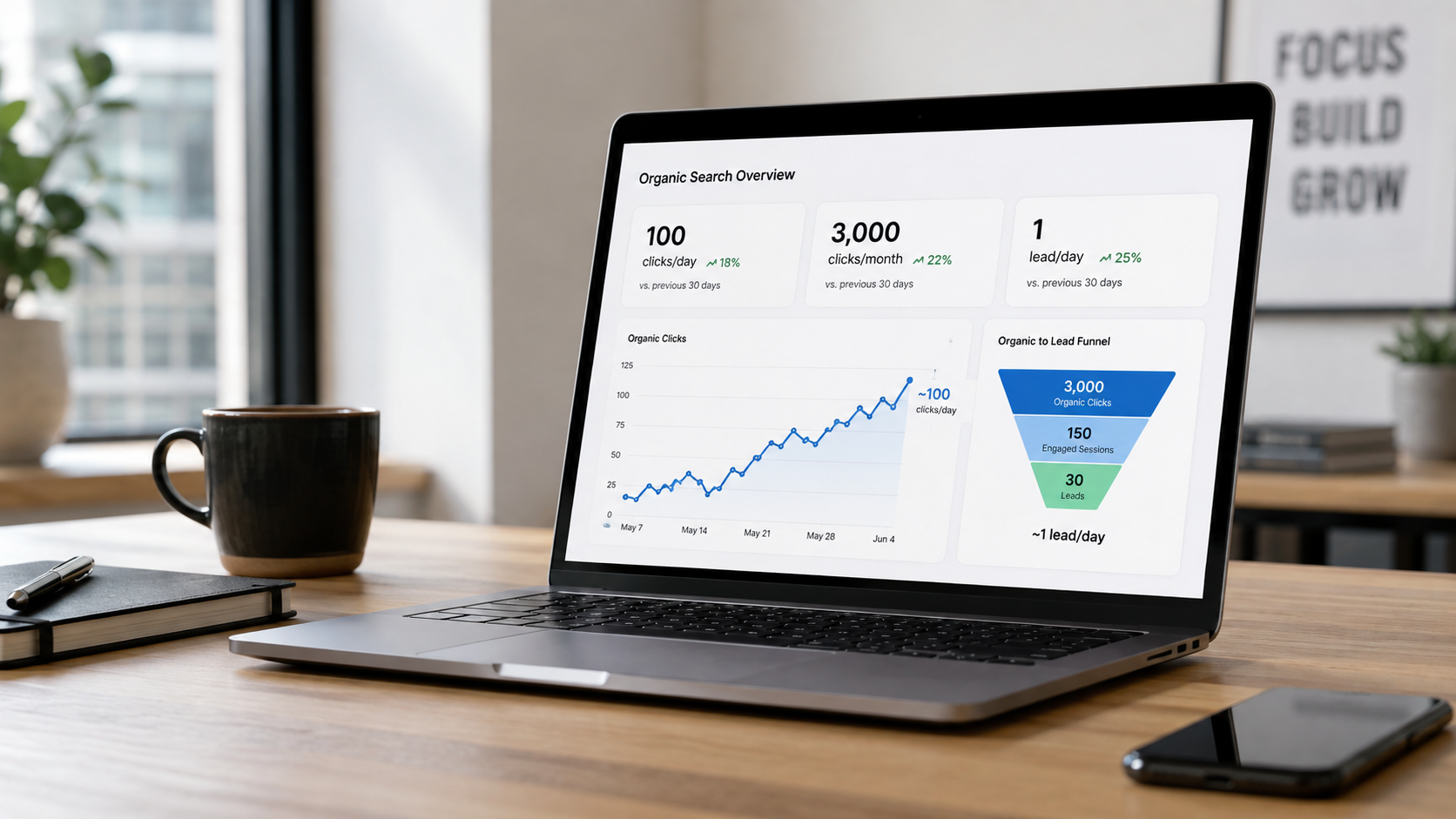
There's a number we keep coming back to when a business owner asks what organic search is actually supposed to do for them. Not a vanity number, not a ranking, not a domain score. A number with a lead attached to it:
100 clicks a day.
That's the sweet spot — the point where organic search stops being an abstract marketing line-item and starts behaving like a salesperson who shows up every morning. Because 100 clicks a day, at even a deliberately conservative 1% conversion rate, is one lead a day. Every day. From people who searched for what you sell, found you, and raised their hand — without you paying for a single one of those visits at the meter.
This post is the full math: what 100 a day compounds into, what it's worth against paid-ad prices, why the overwhelming majority of business websites are nowhere near it, and what the honest road there looks like — including where we are on that road ourselves, because we publish our own numbers monthly, dips included.
The math, start to finish
Start with the calendar, because the daily number hides how big it really is:
100 clicks a day is roughly 3,000 clicks a month, and about 36,500 a year. Three thousand monthly visits from search intent — not social scrollers, not people who mistyped a URL, but people who asked a question your business answers.
Now run it through a conversion rate. We use 1% — one lead per hundred visitors — and it's worth being clear that 1% is the floor, not the target. Across every 2026 benchmark study we can find, average website conversion runs meaningfully higher: the global median sits around 2.35%, with the general cross-industry average at 2–3%, Ruler Analytics' analysis of five-million-plus tracked conversions puts the B2B median at 2.9%, and service businesses — contractors, dentists, lawyers, dealerships — are told to aim for 3–5% on contact forms and calls. We use 1% anyway, for two reasons: it keeps the promise honest for a site that isn't optimized yet, and it makes the arithmetic impossible to argue with.
So, conservatively:
3,000 clicks/month × 1% = 30 leads a month. One a day.
Keep going, because leads aren't the finish line. Say you close a modest 20–25% of the leads you actually pursue — that's 6 to 8 new customers a month, from organic search alone, before you've spent a dollar on ads that month. Now attach your customer value. For a service business averaging $2,000 a job, that's $12,000–16,000 in monthly revenue riding on the channel. For a dealership, where a single unit's gross plus the service relationship behind it runs into the thousands, the same funnel does considerably more. And if your site converts at the average 2–3% instead of our floor, double or triple everything above.
That's the entire pitch for the number. Below 100 a day, organic produces leads occasionally — often literally fractions of a lead per day, which is exactly why it feels like it isn't working. At 100 a day, the law of averages takes over and the channel becomes a rhythm: something arrives most days, and the days something doesn't, tomorrow covers it.
What 3,000 clicks would cost you at the meter
Here's the comparison that makes the sweet spot concrete: what would those same 3,000 monthly visits cost if you bought them?
The 2026 all-industry average cost per click on Google Ads is $5.42. At that rate, 3,000 clicks is about $16,300 a month in equivalent media value — roughly $195,000 a year. Even in a comparatively cheap vertical like automotive, where the average CPC is $3.13, you're looking at $9,400 a month to buy what the sweet spot delivers organically. In expensive verticals — attorneys average $9.87 a click — the equivalent value clears $29,000 a month.
Run it on leads instead of clicks and the story holds. The 2026 average cost per lead in search advertising is $66.69; thirty leads a month at that rate is about $2,000 a month, every month, forever — because paid search is a faucet, and the moment you stop paying, it stops flowing. Organic behaves like the opposite instrument: it costs real money and real patience up front, and then the asset keeps producing whether or not you fed it that particular month. A page that ranks doesn't invoice you per click.
None of this is an argument against paid ads — they're the right tool for speed and for testing, and we say so in our full breakdown of dealership advertising costs. It's an argument about what the organic asset is worth once built, so you can weigh the build cost honestly.
The uncomfortable part: almost nobody is at 100
Now the reason this post exists. When we run first audits, the most common reaction to the traffic report isn't disappointment at the trend — it's surprise at the level. Owners routinely guess they get hundreds of clicks a day. The data usually says single digits.
They're not unusual. They're the norm. Ahrefs studied roughly 14 billion webpages and found that 96.55% of them get zero traffic from Google — none. Only 1.94% of pages get even one to ten search visits a month. The distribution of organic traffic isn't a bell curve with most sites near the middle; it's a cliff, with nearly everything at zero and a thin sliver collecting nearly all the clicks.
Translate that to the local-business website that hasn't invested in organic: a homepage that ranks for the business's own name, a handful of thin pages ranking for nothing, maybe 5–20 clicks a day total, most of them people who already knew the business existed. Run that through the same math and you see why "SEO doesn't work" feels true to so many owners: 300 clicks a month at 1% is three leads a month. One lead every ten days is statistically indistinguishable from luck. The owner can't feel it, can't staff around it, and can't attribute it — so the channel gets written off, the investment never happens, and the site stays exactly where 96.55% of the web lives. The problem was never that organic doesn't produce. It's that below a certain volume, production is invisible.
That's what makes 100 a day the right target rather than just a nice round number: it's the threshold where the channel's output becomes perceptible enough to trust — and therefore fund.
Where we are on our own curve — because we publish it
We hold ourselves to the same scoreboard, so here's ours. In our July 2026 benchmark report, Ritner Digital logged 694 organic clicks for the month — about 22 a day — with our best single week at 202. That's roughly a fifth of the sweet spot. We're not writing this from the summit; we're writing it from the trail, with our GPS coordinates published monthly.
And the trajectory is the point. At 22 clicks a day and our own conversion math, organic hands us a lead roughly every week or so — real, but not yet a rhythm. The plan to 100 isn't a secret and isn't magic: it's the same plan we sell, run on ourselves — publish the content formats engines actually cite, build the entity so machines know exactly who we are, earn links by publishing data other people want to reference, and compound for the months the honest timeline actually takes. When we cross 100, you'll see it in a monthly report. If a month goes backward, you'll see that too — you always do.
How 100 a day actually gets built
A hundred clicks a day is not one ranking. That's the mental model that trips people up — imagining a single #1 position delivering the whole number. In practice it's a portfolio: dozens of pages each earning a trickle, a few earning streams, stacked. The engineering looks like this:
It's an impressions × CTR problem. Clicks are downstream of how often you appear and where. The #1 organic position earns roughly 27% of clicks, and the top three together take about two-thirds — while page two takes approximately nothing. So the path to 3,000 monthly clicks is some blend of: a few head terms in the top three, a long tail of dozens of specific queries at #1–5 (the questions, comparisons, and local variants big competitors don't bother writing for), and steady growth in total queries you appear for at all. This is why our client work reports keywords and impressions alongside clicks — they're the leading indicators the click number follows.
Local businesses have a shortcut national sites don't. You don't need to outrank the internet; you need to own a geography's worth of questions. A dealership doesn't need "best SUV" — it needs the county-level, category-level queries that our audits keep finding completely unclaimed. Fifty local queries averaging two clicks a day each is the sweet spot.
And the 2026 wrinkle: each click is getting harder — and more valuable. Zero-click search is real: AI Overviews are associated with a 58% lower click-through rate for the top organic result, which means the same rankings now yield fewer clicks than they did three years ago. But the clicks that survive are worth more, because the low-intent lookers get satisfied on the results page and the buyers click through. And the new channel forming alongside pays a startling premium: visitors referred by ChatGPT convert at 15.9% against a 1.76% organic baseline — call it nine times our whole-post assumption. Which means the modern version of the sweet spot is blended: if a slice of your hundred daily clicks arrives from AI answers, the channel where defaults are still forming, you can hit one-lead-a-day at lower total volume. Traffic quality is becoming the lever that bends the math in your favor — one more reason we optimize for search everywhere, not just the ten blue links.
The benchmark, restated plainly
If you remember one panel of numbers from this post:
100 clicks a day ≈ 3,000 a month ≈ 36,500 a year. At a floor-level 1% conversion, that's ~30 leads a month — one a day — and at typical close rates, 6–8 customers a month from a channel you own. Bought at the meter, those clicks would run ~$16,000 a month at 2026's average CPC (about $9,400 even at automotive's cheap rates), and those leads about $2,000 a month at average cost-per-lead — permanently. Meanwhile 96.55% of all pages on the web get zero search traffic, most non-investing business sites idle at a level where organic's output is statistically invisible, and the gap between those two states is not a mystery — it's a portfolio of rankings built page by page, on a timeline measured in months, with compounding doing the late-stage work.
One lead a day changes how a small business feels to run. The number that buys it is knowable, the road there is boring and public, and we're walking it ourselves in full view.
Frequently Asked Questions
Why 1%? Isn't that low?
Deliberately. Median website conversion runs around 2.35% globally, B2B medians near 2.9%, and service businesses are commonly benchmarked at 3–5% on forms and calls. We use 1% because it holds even for a site that hasn't been conversion-optimized yet, and because a promise built on floor-level assumptions survives contact with reality. If your site converts at the actual average, the sweet spot delivers two to three leads a day, not one — treat everything in this post as the conservative case.
Is 100 clicks a day realistic for a small local business?
Yes — with the right expectation of shape. It's rarely one keyword; it's a portfolio of dozens of local and category queries each contributing a trickle. Local businesses actually have the advantage here: the queries that matter are geographically bounded, the incumbent content is usually thin, and in the markets we audit, whole categories of high-intent questions have no strong answer at all. The honest caveat is time: this is a months-not-weeks build, which is exactly why most competitors never do it — and why it works for the ones who do.
How do I know how far below the sweet spot I am right now?
Google Search Console, free, ten minutes: Performance report, last three months, look at total clicks and divide by ~90. That's your daily number. While you're there, note total impressions and your average position — those are the leading indicators. Most business owners we meet guess high by 5–10x, which is useful to know before setting a plan; our own current number is 22 a day, published, so you'll always know what comparing against us means.
Does the rise of AI search break this math?
It bends it in two directions at once. Zero-click results mean rankings yield fewer clicks than they used to — AI Overviews correlate with dramatically lower CTR on the top result — so the bar for impressions is higher. But AI-referred visitors convert at roughly nine times the organic baseline, so each click from that channel does the work of many. The net: the sweet spot is becoming a quality-adjusted 100 — a business strong in AI answers can hit one-lead-a-day on fewer total clicks, which is why we treat AI visibility as part of the same build, not a separate product.
What does it cost to get there compared to buying the clicks?
Buying 3,000 clicks a month runs about $16,300 at 2026's average CPC, and it's rent — stop paying, stop receiving. Our flat rate is $1,000 a month, and what it buys is equity: content and rankings that keep producing after any given month's work is done. The fair comparison isn't month one, when paid wins on speed — it's month twelve and every month after, when the organic asset delivers its 3,000 clicks at a marginal cost approaching zero. We'd tell you to run both if budget allows; we'd never tell you to rent forever.
Find out your daily number — and the shortest road to 100
Ten minutes in your Search Console with us and you'll know exactly where you sit, what's producing, and which unclaimed queries in your market would move you fastest toward one lead a day. Free, specific, and benchmarked against numbers we publish about ourselves every month.
Get your free organic search check →
Sources: Ahrefs — search traffic study (96.55% of pages get zero Google traffic) · Ahrefs — SEO statistics 2026 (traffic distribution, CTR by position, AI Overviews CTR impact) · LocaliQ/WordStream — 2026 search advertising benchmarks ($5.42 avg CPC, $66.69 avg CPL) · LocaliQ — 2026 automotive search benchmarks ($3.13 CPC) · WordStream — 2026 Google Ads benchmarks by industry · Logos Web Designs — small business conversion benchmarks 2026 (2.35% median)· Martal — conversion rate statistics 2026 (Ruler Analytics B2B median 2.9%) · First Page Sage via Colorlib — CTR by position · Omnibound — GEO statistics (Seer Interactive ChatGPT conversion data) · Ritner Digital — July 2026 benchmark report