A Country Club Membership and an Association Membership Aren't the Same Thing. One Is Much Easier to Market.
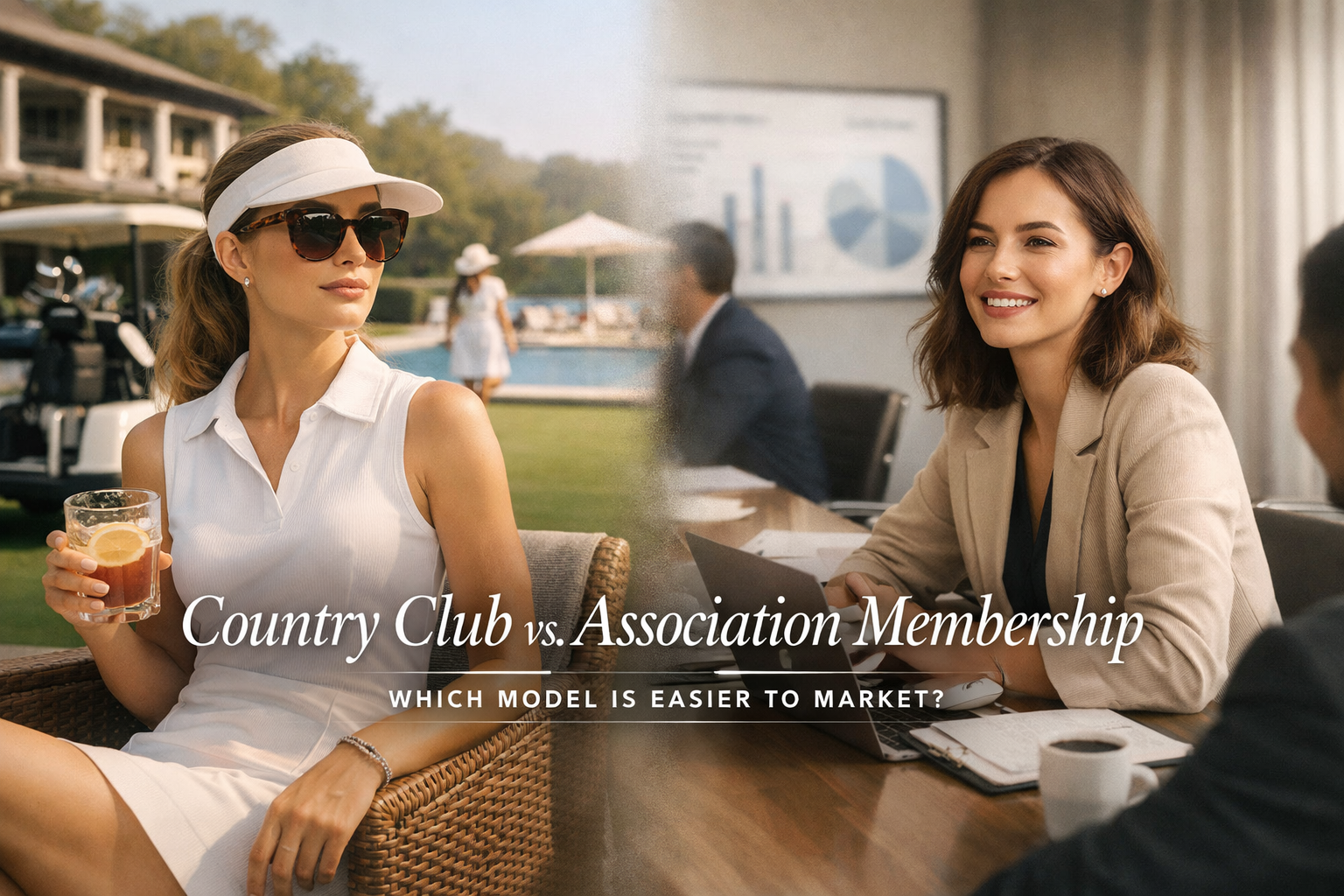
Both cost money. Both promise community. Both ask you to invest in belonging to something larger than yourself with the expectation that the connection, the access, and the relationships that come with membership will be worth more than the dues you paid to get in.
But there is a fundamental difference between the two models that almost nobody talks about directly — and it has enormous implications for how easy or difficult each one is to market, how visible the value of membership actually is to prospective members, and why one model consistently outperforms the other at attracting and retaining members in 2026.
The difference is visibility.
A country club membership is physically, socially, and visually present in your life in a way that is almost impossible to ignore. An association membership, for many members, exists primarily as a line item in the annual budget and an email newsletter they may or may not open. That gap — between a membership experience that is tangible and one that is largely digital and intermittent — is the central marketing challenge facing membership organizations today. And understanding it clearly is the first step toward closing it.
What a Country Club Gets Right Without Trying
A country club doesn't have a particularly sophisticated marketing strategy. It doesn't need one. The product markets itself because the product is inherently visible.
When you join a country club, the membership is present in your life in concrete, recurring, unmistakable ways. You drive through the gate. You walk the course. You sit in the dining room. You see the same faces at the same tables. Your children take lessons from the same pro your neighbor's children take lessons from. The physical space is always there — a standing invitation to show up, to use it, to get your money's worth, to be seen by other members and to see them.
The value of the membership is demonstrated continuously and passively. You don't have to be reminded that you belong to a country club because the country club is physically in your life. The social proof is ambient — when you mention your membership to someone who isn't a member, the status signal is immediate and legible. When you're on the course with a client or a prospective partner, the setting is doing marketing work that no email campaign could replicate.
Recruiting new members is also structurally easier because the product is showable. You can bring a guest. You can host a dinner. You can let the experience sell itself through direct contact rather than through a description of benefits that the prospective member has to imagine. The conversion path from awareness to membership runs directly through the product — which is the most powerful sales tool that exists.
This is not to say that country clubs don't face marketing challenges — they do, particularly around demographic relevance and evolving definitions of what makes a social membership worth the investment. But the visibility problem is not one of them. The product is visible. The value is demonstrable. The community is tangible.
What Association Memberships Are Working Against
An association membership is, by its nature, a different kind of product. It is primarily a promise — access to a network, a credential, a body of resources, a seat at the table of a community organized around a shared professional or personal identity. The value is real. But it is largely intangible, intermittent, and invisible in ways that make it structurally harder to demonstrate, harder to sell, and harder to retain.
Think about what a typical association membership actually looks like from the member's perspective over the course of a year. There's an annual dues renewal notice — which is the single most vivid reminder that the membership exists and costs money. There are email newsletters, probably weekly or monthly, that may or may not contain information relevant enough to read. There might be a member directory that gets referenced occasionally. There might be webinars or educational content that gets promoted but infrequently attended. And there is, in many cases, one significant anchor event — an annual conference or gala — that concentrates the community in one place for one or two days before dispersing again for another eleven months.
In between those touchpoints, for many members, the membership is invisible. It doesn't show up in their daily life. It doesn't generate tangible ongoing value that they can feel and point to. When renewal time comes, they're being asked to justify a line item that hasn't demonstrated its worth in months — and the conversation they're having internally is some version of "did I actually use this enough to pay for it again?"
That's a hard marketing problem. And it's one that country clubs, by the nature of their physical product, simply don't have.
The Visibility Gap and Why It Matters for Marketing
The country club has a physical space that creates natural, recurring touchpoints with members. The association has digital channels — email, social media, a website, an app — and periodic events. Neither model is inherently superior for building community. But one model is inherently easier to market because the value is continuously visible and the touchpoints are continuous rather than scheduled.
Here's what this means practically for association marketing.
When a country club wants to recruit a new member, the most powerful tool it has is an invitation to experience the product directly. When an association wants to recruit a new member, the most powerful tool it has is a description of benefits that the prospective member has to evaluate abstractly. The country club converts through experience. The association converts through persuasion. Persuasion is harder than experience, which means association marketing has to work harder to achieve the same conversion outcome.
When a country club wants to retain an existing member, the product is doing passive retention work every time the member uses the facility — which is frequently, because the facility is physically present and convenient. When an association wants to retain an existing member, the retention work has to be done actively through deliberate communication, visible value delivery, and regular demonstration that the membership is worth what it costs. The country club retains through presence. The association retains through proof.
And when it comes to social proof — the ambient signal that membership is desirable that drives organic word-of-mouth — the country club generates it passively through visibility. The association has to generate it intentionally through the content, the events, and the community moments it creates and amplifies deliberately.
None of this means associations can't win the marketing battle. Many do. But it means they have to fight a battle that country clubs don't — and the weapons available to them are almost entirely digital.
The Association Marketing Stack: What Actually Works
If the country club's marketing advantage is physical presence, the association's competitive response has to be digital presence — building visibility, demonstrating value, and creating community touchpoints through channels that can replicate, as closely as possible, the ambient presence that a physical facility provides for free.
Here's what that actually looks like when done well.
Social media as a community visibility engine. The single most underutilized asset most associations have is their member community — the collective expertise, achievement, and activity of their membership base. A well-run association social media program isn't posting generic industry news. It's featuring member accomplishments, amplifying member content, documenting community moments, and creating the kind of visible social proof that tells prospective members "this is a community of people I want to be associated with." Every member feature, every milestone acknowledgment, every behind-the-scenes look at what the community is doing is a piece of content that demonstrates membership value to current members while marketing it to prospective ones simultaneously.
Email that delivers genuine value rather than just information. Most association email newsletters are information delivery vehicles — here are the events, here are the resources, here is the renewal notice. The associations that retain members at higher rates treat email as a value delivery vehicle — here is something genuinely useful for your professional life that you wouldn't have without this membership. The distinction sounds subtle but produces dramatically different open rates, engagement rates, and renewal rates.
The annual event as a marketing cornerstone. The annual conference, gala, or signature event is the association's closest equivalent to the country club's physical facility — the moment when the community is most visibly, tangibly present. Associations that treat this event purely as a member benefit are leaving significant marketing value on the table. The event is also the most powerful recruitment tool the organization has. Prospective members who experience the community in person convert at dramatically higher rates than those who only evaluate it through a benefits page. Every element of event marketing — the pre-event content, the live documentation, the post-event recap — should be built around creating the kind of visibility that sells the experience to people who weren't there.
Digital content that demonstrates expertise. One of the most credible membership value propositions an association can build is positioning itself as the authoritative source of knowledge in its domain. A member who regularly consults the association's research, attends its educational programming, and credits the community with advancing their professional development is a member who renews without hesitation and recruits peers without being asked. Building that content authority requires consistent investment in genuinely useful, genuinely expert content — not press releases and event announcements.
Member recognition as marketing. Every time an association visibly recognizes a member's achievement — on social media, in the newsletter, at the annual event — it is doing two things simultaneously. It is delivering a tangible membership benefit to the member being recognized, and it is demonstrating to every other member and every prospective member watching that this is a community that celebrates its people. Recognition content consistently produces the highest engagement of any association content type because it is personal, specific, and emotionally resonant in a way that informational content never is.
Which Model Is Actually Easier to Market?
The honest answer is the country club — but for reasons that are structural, not strategic. The physical product creates visibility and value demonstration that no digital program can fully replicate. The conversion path runs through direct experience rather than abstract persuasion. The retention mechanism is ambient rather than active.
But here's the more useful framing: the association that understands its visibility challenge and builds a deliberate digital marketing program to address it can absolutely compete — and in some ways has advantages the country club doesn't.
An association's community is not geographically constrained. A country club can only draw members who can drive to it. An association can draw members from anywhere, which means its potential membership base is orders of magnitude larger. An association's value proposition — professional development, industry credibility, peer community — speaks to motivations that are often more durable than the social status signals that drive country club membership. And an association's digital presence, built well, creates visibility that extends far beyond the membership base into the broader community the organization serves.
The associations winning the membership marketing battle in 2026 are the ones that have stopped trying to sell a list of benefits and started building a visible, active, compelling community — one where the value of membership is demonstrated continuously through the content they produce, the members they feature, the events they document, and the expertise they share. They're using digital channels to create the ambient visibility that the country club gets from its parking lot and its dining room.
It's harder to build than a fairway. But the ceiling is much higher.
Ready to Build a Membership Marketing Program That Actually Works?
Whether you're leading an association, running a membership organization, or building a community around a brand, the marketing challenge is the same: make the value visible, make it continuous, and make it compelling enough that belonging feels like a decision people are proud of rather than a line item they're questioning at renewal time.
At Ritner Digital, we build integrated marketing programs for organizations that want to grow their community, retain their members, and demonstrate their value in a way that converts. If you want an honest conversation about what that looks like for your specific organization, reach out and we'll put time on the calendar.
Frequently Asked Questions
Why is a country club membership easier to market than an association membership?
The core reason is visibility. A country club membership is physically present in a member's life every time they drive through the gate, walk the course, or sit in the dining room. The value is demonstrated continuously and passively — the product is always there, always usable, always generating tangible proof that the membership is worth what it costs. An association membership, by contrast, exists primarily through digital touchpoints — emails, social posts, a website, periodic events — that are intermittent and easy to ignore. The country club retains members through presence. The association has to retain members through deliberate, active proof of value delivered through channels that compete with everything else in the member's inbox and feed. That's a structurally harder marketing challenge, and understanding it clearly is the starting point for addressing it.
What is the biggest marketing mistake association membership organizations make?
Selling benefits instead of demonstrating community. Most association membership marketing reads like a features list — access to a member directory, discounted event tickets, a monthly newsletter, professional development resources. These are descriptions of what membership includes, not evidence of what membership feels like or what it produces for real members. The associations that convert and retain at the highest rates aren't leading with a benefits page — they're leading with visible, active proof of community. Member spotlights. Event documentation. Recognition of member achievements. Expert content that demonstrates what the collective knowledge of the membership produces. The shift from describing benefits to demonstrating community is the single highest-leverage change most associations can make in their marketing program.
How should associations use social media differently from other organizations?
As a community visibility engine rather than an announcement channel. Most association social media programs are a mix of industry news shares, event promotions, and generic motivational content — none of which demonstrates the specific value of this membership to this community. The associations using social media most effectively are using it to make their membership visible. They're featuring individual members, documenting what the community is doing, amplifying member content and achievements, and creating the kind of ongoing social proof that tells both current and prospective members that this is a community worth belonging to. Every member feature is simultaneously a retention touchpoint for the member being featured and a recruitment tool for every prospective member who sees it. That dual function — value delivery and marketing in the same piece of content — is what makes community-focused social content so efficient for membership organizations.
How important is the annual event for association membership marketing?
It's the single most powerful marketing asset most associations have and the most consistently underutilized one. The annual conference, gala, or signature event is the closest thing an association has to the country club's physical facility — the moment when the community is most visibly, tangibly present in one place. Members who attend the annual event renew at dramatically higher rates than those who don't, because the event makes the community real in a way that twelve months of email newsletters cannot. And prospective members who experience the event in person convert at rates that no digital campaign can match, because they're evaluating the community through direct experience rather than abstract description. The associations getting the most marketing value from their annual event are treating it as a year-round content asset — building anticipation before it, documenting it live during it, and distributing the highlights and outcomes after it in a way that markets the experience to everyone who wasn't there.
What does good association email marketing actually look like?
It looks fundamentally different from what most associations are sending. The default association email program is an information delivery vehicle — here are the upcoming events, here are the resources available, here is your renewal reminder. Members receive it, skim it, and delete it because it doesn't deliver anything they couldn't have found on the website. Good association email marketing treats the inbox as a value delivery channel rather than an announcement channel. It gives members something genuinely useful — a piece of industry insight they wouldn't have without the membership, a curated resource that saves them time, a connection to a peer dealing with the same challenge they're facing — that makes opening the next email feel worthwhile. The test for every email an association sends should be "would a member feel like they got something from this, or did they just receive information?" The organizations asking that question consistently produce email programs that members actually read.
How do associations compete with the geographic advantage country clubs have?
By turning the liability into an asset. A country club's membership is geographically constrained — you can only draw members who can physically access the facility. An association has no geographic ceiling, which means its potential membership base is fundamentally larger. The challenge is that a geographically distributed membership requires a different kind of community infrastructure — one built through digital channels rather than a shared physical space. The associations that compete most effectively on this dimension are the ones that use digital community thoughtfully: online forums and groups where members actually engage rather than lurk, virtual programming that delivers real value rather than replicated in-person formats that don't translate, and regional or sector-specific subgroups that create the smaller, more intimate community feel that drives genuine connection within a large distributed membership. The geography isn't the constraint — the failure to build digital community with the same intentionality that a country club builds physical community is.
When is the right time for an association to invest in a serious marketing program?
Earlier than most do. The most common pattern is that associations invest minimally in marketing during growth phases — relying on word of mouth, founding member networks, and the natural momentum of a new organization — and then turn to marketing when membership growth stalls or renewal rates start declining. By that point, the marketing program is playing catch-up against a retention problem that has already compounded. The associations that grow most consistently treat marketing as a foundational investment from the beginning — building the content library, the social presence, and the email program before they need them rather than after. The compounding nature of content authority and community visibility means that the organization that starts building two years before its competitor has an advantage that is genuinely difficult to close. Membership marketing, like most marketing, rewards patience and consistency more than it rewards urgency and spend.