The Philadelphia Flower Show Is Nearly 200 Years Old. Here's What It Can Teach Every Brand About Marketing.
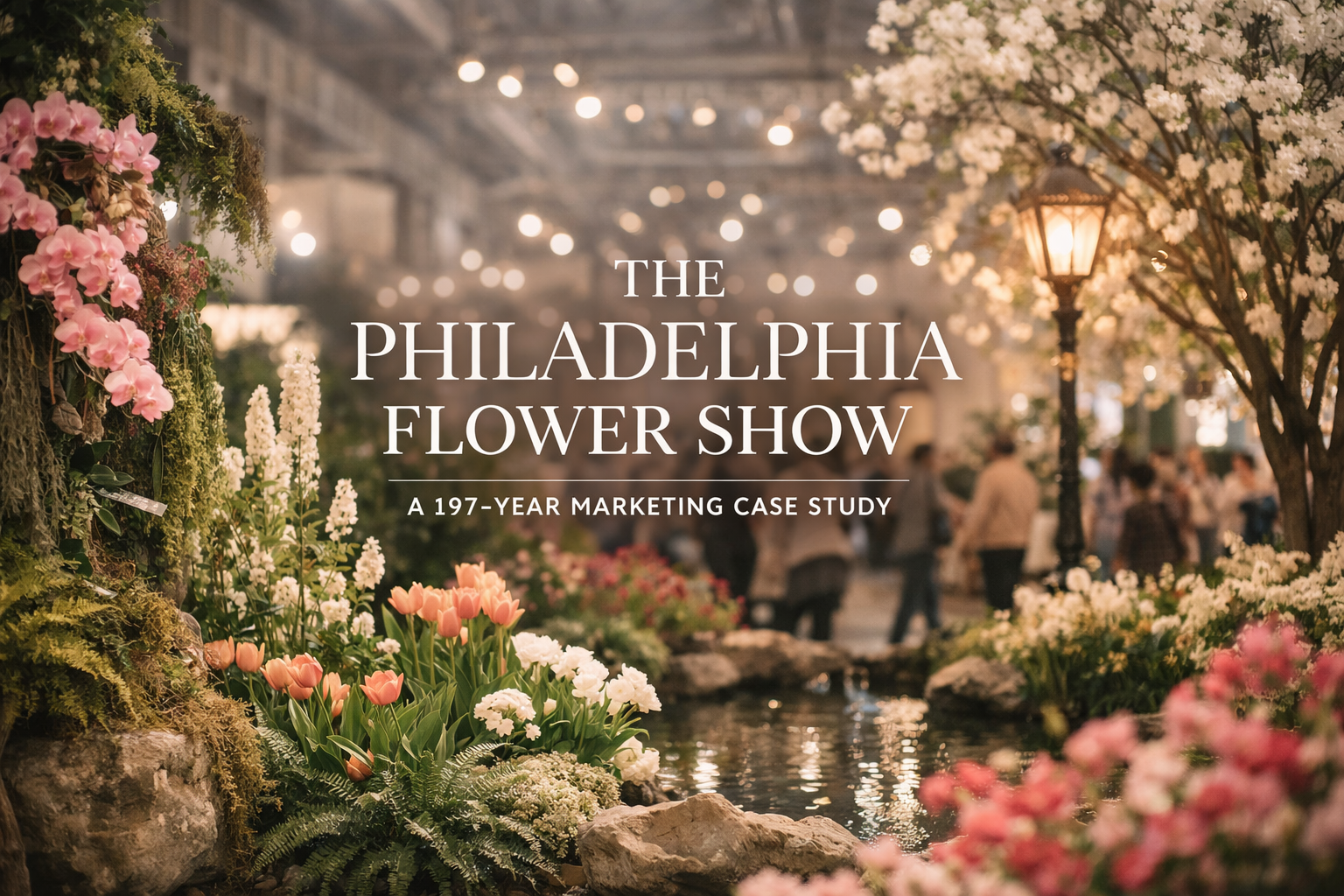
Most events don't survive a decade. Most brands don't survive two generations. Most cultural institutions — even beloved ones — eventually lose relevance, struggle to attract new audiences, and quietly fade into something that older people remember fondly and younger people have never heard of.
The Philadelphia Flower Show has been running since 1829. Wikipedia It survived the Civil War. It survived the Great Depression — drawing tens of thousands of visitors even during those years. Kremp Florist It survived two World Wars. It survived the internet, the attention economy, the death of countless competing entertainment formats, and a global pandemic that forced it outdoors for the first time in its history. Today it attracts more than 250,000 people annually Wikipedia and holds the title of the oldest and largest indoor horticultural event in the world. DiscoverPHL
That is not an accident. That is not luck. That is one of the most sustained, disciplined, and instructive cases of brand building in American cultural history — and almost nobody talks about it in those terms.
This is a case study in what it actually looks like to build something that lasts. And if you run a brand, market a business, or are responsible for making people care about something year after year, there is more practical marketing intelligence in the Philadelphia Flower Show's nearly two-century run than in most MBA programs.
First, the History — Because Context Is Everything
The Pennsylvania Horticultural Society was founded in 1827, and two years later, in 1829, held the first Philadelphia Flower Show in a Freemason building — a one-day exhibition showcasing fruit, flowers, and plants. Wikipedia
That very first show introduced the poinsettia to American audiences Metro Philadelphia — a plant then newly imported from Mexico that attendees had never seen before. The Encyclopedia of American Folklife credits the flower show with introducing poinsettias as an American Christmas tradition. Wikipedia The show wasn't just displaying beauty. From its very first edition, it was shaping American culture.
The modern show spans nine to ten days, features 54 major exhibitors and about 6,600 competitors, and is considered one of the top three flower shows in the world alongside London and Singapore. Yahoo! It draws about 250,000 attendees from around the world each year DiscoverPHL and occupies a ten-acre exhibition space inside the Pennsylvania Convention Center in the heart of Philadelphia.
Each year the show declares a new theme — in 2026 it was "Rooted: Origins of American Gardening," timed to coincide with America's 250th anniversary. Visit Philadelphia The year before that, the theme looked to the future. The year before that, it celebrated the present. The theme rotates. The audience returns. That tension — between consistency and reinvention — is one of the most important things the show gets right, and we'll come back to it.
The Marketing Phenomenon Nobody Calls a Marketing Phenomenon
Here's the thing about the Philadelphia Flower Show that makes it genuinely unusual as a case study: it doesn't market like a brand. It doesn't need to. It has built something more durable and more valuable than any campaign — it has built a ritual.
For hundreds of thousands of people across the Philadelphia region and beyond, attending the flower show isn't a decision they make each year by weighing options. It's something they do. It's on the calendar before the tickets go on sale. It's the thing they bring their mother to every March. It's the event they took their kids to as children and now bring their grandchildren to. It has moved from the category of "event I might attend" to "annual tradition I participate in" — and that transition is the holy grail of brand building that most organizations spend decades chasing and never achieve.
How did it get there? A few things worth examining closely.
Lesson One: Consistency Creates Ritual
The Philadelphia Flower Show has run almost every year since 1829, with the exception of a few years during World War II. Kremp Florist Nearly two centuries of showing up, in roughly the same window of the calendar year, delivering roughly the same promise — a spectacular immersive experience of flowers and horticulture in the dead of late winter — has done something that no single campaign or viral moment could have accomplished.
It has made itself expected.
When something shows up reliably enough, for long enough, it stops being something you discover and becomes something you anticipate. The anticipation is the marketing. The show doesn't need to convince people it's worth attending — people have been telling each other it's worth attending for generations. The consistent presence in the calendar created the word-of-mouth infrastructure that sustains it.
The lesson for brands isn't "run your event for 200 years." It's that consistency compounds in a way that intermittent effort never can. The brand that shows up reliably — same season, same quality, same core promise — builds anticipatory loyalty that the brand chasing novelty is always trying to manufacture from scratch.
Lesson Two: Reinvention Within a Stable Identity
Here is the tension that most brands get wrong in one direction or the other. Some brands are so consistent they become stale — same product, same messaging, same everything until their audience ages out and nobody new finds them relevant. Other brands reinvent so aggressively in pursuit of new audiences that they lose the loyalty of the people who built them.
The Philadelphia Flower Show has navigated this tension with remarkable discipline for nearly two centuries. The core identity — an immersive celebration of horticulture and floral design, held in late winter, produced by the Pennsylvania Horticultural Society — has never changed. The specific expression of that identity changes every single year through the annual theme.
The 2025 theme looked at the future. The 2024 theme celebrated the present. The 2026 show looked back at horticultural legacies and cultural practices that shaped American gardening. Visit Philadelphia Each theme gives returning visitors something genuinely new to experience while delivering the same foundational promise that brought them the first time.
This is the model. Stable identity, dynamic expression. The brand promise never changes. The way you bring it to life does. It gives loyal audiences a reason to return and gives new audiences a fresh entry point without requiring the organization to abandon what made it worth attending in the first place.
Lesson Three: Seasonal Demand Is a Superpower If You Own It
Every March, something quietly miraculous happens beneath the vast roof of the Pennsylvania Convention Center. The gray monotony of late winter — that particular exhaustion that sets in around February when cold has lost its novelty and spring feels like a rumor — gets interrupted. Jegtheme
The timing of the Philadelphia Flower Show is not incidental. It is strategic at a level so fundamental that it has become invisible. The show arrives at the precise moment when its audience is most psychologically primed for exactly what it offers — color, warmth, growth, and the promise that winter is ending. The emotional resonance of the show isn't just about flowers. It's about the timing of flowers arriving in a month when people desperately want them.
Every brand has a version of this opportunity — a moment in the calendar, in the buyer's journey, or in the cultural context where what you offer lands with amplified emotional resonance. The brands that identify that moment and build their marketing presence around it consistently outperform the ones distributing their presence evenly across the year as though every moment is equivalent.
The Philadelphia Flower Show owns March in Philadelphia's cultural calendar in a way that no competitor could displace because it got there first and stayed there without interruption. Owning a moment — a season, a life stage, a decision point — is one of the most durable competitive advantages a brand can build.
Lesson Four: Community Is the Moat
The Pennsylvania Horticultural Society is not merely an events organization that happens to produce a famous flower show. It is an urban greening organization with deep programmatic commitments in Philadelphia's neighborhoods, and the flower show is its most visible fundraising and awareness mechanism. Jegtheme
This is the part of the Philadelphia Flower Show's story that most purely commercial brands miss entirely. The show isn't just an event people attend — it's a vehicle for something larger that people want to be part of. The event serves as a platform for emerging talent and reflects Philadelphia's commitment to creativity and inclusion. Yahoo! The revenue it generates funds neighborhood greening projects, youth education programs, and community gardens across the city.
When you attend the flower show, you're not just buying a ticket to see floral displays. You're participating in an institution that is visibly, demonstrably invested in the city around it. That connection — between the event's commercial success and the community's wellbeing — creates a loyalty that pure entertainment cannot manufacture.
Robertson's Flowers has participated in the show for nearly a century, with five generations of the same family involved. CBS News That's not a vendor relationship. That's a community. The businesses, families, designers, and horticulturalists who have built their professional and personal identities around participation in the show are the show's most powerful marketing asset — and they were built through genuine community investment, not through sponsorship packages.
The brands that build communities around their mission rather than just customers around their product create a kind of loyalty that is qualitatively different from transactional satisfaction. People don't just like the Philadelphia Flower Show. They belong to it.
Lesson Five: Earned Prestige Compounds Forever
In 2019, the International Festivals and Events Association granted the Philadelphia Flower Show its Grand Pinnacle Award, marking it as an outstanding event throughout the world. Kremp Florist The show is consistently ranked among the top horticultural events globally. Publications cover it. Travel guides list it. It generates its own media ecosystem of anticipation, coverage, and retrospective that most brands would spend millions trying to manufacture.
None of that prestige was bought. It was earned through nearly two centuries of showing up and delivering. The compounding nature of earned reputation — where each year's quality builds on the credibility of every previous year — is something that paid media genuinely cannot replicate. You can buy attention. You cannot buy the kind of institutional credibility that comes from being the oldest and largest of anything for 197 years.
This is the long game that most brands are too impatient to play. The flower show's marketing advantage in 2026 is not the result of its 2026 marketing budget. It is the result of every decision made since 1829. The audience it attracts this year was built by the audience it cultivated last year, and the year before, and the decade before that.
What Mid-Market Brands Can Actually Take From This
You don't have 197 years. You probably don't have a convention center or a horticulture society. The scale of the Philadelphia Flower Show is not a realistic model for most brands — but the principles underneath it are.
Show up consistently. Own a moment in the calendar or in the buyer's journey. Build a stable identity that can be expressed dynamically year over year. Invest in community rather than just customers. Play the long game on earned reputation rather than the short game on paid attention. Make your audience anticipate you rather than discover you.
These are not complicated ideas. They are hard to execute because they require patience, discipline, and the willingness to measure marketing success on a timeline longer than the next quarter. The Philadelphia Flower Show is evidence that the payoff for that patience is an institution that markets itself — because the community around it does the marketing for free.
That's the goal. And it's achievable at any scale, for any brand, in any category. It just requires starting now and not stopping.
Ready to Build Something That Lasts?
The brands that grow over years and decades aren't the ones who found the right campaign — they're the ones who built the right foundation and committed to it consistently.
Frequently Asked Questions
How long has the Philadelphia Flower Show been running?
The Philadelphia Flower Show has been running since 1829, when the Pennsylvania Horticultural Society held its first exhibition in a Freemason building as a one-day showcase of fruit, flowers, and plants. Wikipedia It has run almost every year since, with the exception of a few years during World War II, Kremp Florist making it one of the most enduring public events in American history. Now in its 197th year, it holds the title of the oldest and largest indoor horticultural event globally. Art Threat
How many people attend the Philadelphia Flower Show each year?
The Philadelphia Flower Show attracts more than 250,000 people annually. Wikipedia The modern show spans nine to ten days and features 54 major exhibitors and about 6,600 competitors. Yahoo! To put that attendance figure in context, the 1925 show alone attracted 84,000 people Wikipedia — at a time when there was no social media, no digital marketing, and no online ticketing. The show has built its audience through nearly two centuries of consistent delivery, not through any single campaign or promotional push.
What makes the Philadelphia Flower Show a marketing phenomenon?
Several things operating simultaneously. First, it has converted attendance from a decision into a ritual — hundreds of thousands of people don't evaluate whether to go each year, they simply go, because it has become an annual tradition embedded in their personal and family calendars. Second, it owns a specific moment in the calendar — late winter — when its emotional offer of color, warmth, and the promise of spring lands with maximum psychological resonance. Third, it is not merely an events organization but an urban greening institution with deep programmatic commitments in Philadelphia's neighborhoods, Jegtheme which means its audience isn't just buying a ticket — they're participating in something larger than entertainment. The combination of ritual, timing, and community investment has produced a marketing advantage that no campaign budget could replicate.
How does the Philadelphia Flower Show stay relevant after nearly 200 years?
By doing something most brands struggle to execute: maintaining a completely stable core identity while reinventing its specific expression every year. The show declares a new theme annually — in 2024 it celebrated the present with "United by Flowers," in 2025 it looked to the future with "Gardens of Tomorrow," and in 2026 it looked back at horticultural history with "Rooted: Origins of American Gardening." Visit Philadelphia The foundational promise — an immersive world-class celebration of horticulture in late winter — never changes. The way that promise is expressed does. This gives loyal returning visitors something genuinely new to experience every year while giving new audiences a fresh entry point without requiring the institution to abandon what built its reputation in the first place.
What can brands learn from the Philadelphia Flower Show's community model?
That community built around a mission is a fundamentally different — and more durable — asset than customers built around a transaction. Robertson's Flowers has participated in the show for nearly a century, with five generations of the same family involved. CBS News That kind of multi-generational participation isn't a vendor relationship — it's a community membership. The revenue the show generates funds neighborhood greening projects, urban gardens, and community programs across Philadelphia, Jegtheme which means attendees aren't just buying an experience — they're investing in their city. Brands that create genuine community around their mission rather than just customers around their product build loyalty that competitors cannot undercut on price, outspend on ads, or replicate with a better product alone.
Does the Philadelphia Flower Show do traditional advertising?
It does some — but its most powerful marketing has never been paid. What the show has built over nearly two centuries is an earned media and word-of-mouth infrastructure that most brands would spend millions trying to manufacture. Publications cover it annually as a cultural event. Travel guides list it as a Philadelphia essential. Families talk about it across generations. In 2019, the International Festivals and Events Association granted it the Grand Pinnacle Award as an outstanding event throughout the world. Kremp Florist That kind of institutional prestige compounds over time in a way that paid advertising cannot replicate — each year's quality and reputation builds on every previous year's, creating a credibility flywheel that has been spinning since 1829. The marketing lesson isn't to stop advertising. It's that the long game of earned reputation produces returns that paid attention never can.
How does the Philadelphia Flower Show's timing make it a better marketing case study than most?
Because it demonstrates something most brands never figure out: owning a moment is more valuable than having a presence everywhere. The show arrives at the precise moment when its audience is most psychologically primed for what it offers — the gray exhaustion of late winter, when cold has lost its novelty and spring feels like a distant rumor. Jegtheme The emotional resonance of the show isn't just about flowers — it's about the timing of those flowers arriving exactly when people need them most. Every brand has a version of this opportunity: a moment in the calendar, a stage in the buyer's journey, or a cultural window where what they offer lands with amplified impact. The brands that find that moment and own it consistently — rather than distributing their presence evenly across the year as though every moment is equal — build the kind of anticipatory loyalty that the Philadelphia Flower Show has sustained for nearly two centuries.