Anatomy of Our Biggest Day: 18 Clicks on May 19, Spread Across 14 Pages — Here's Exactly What Happened
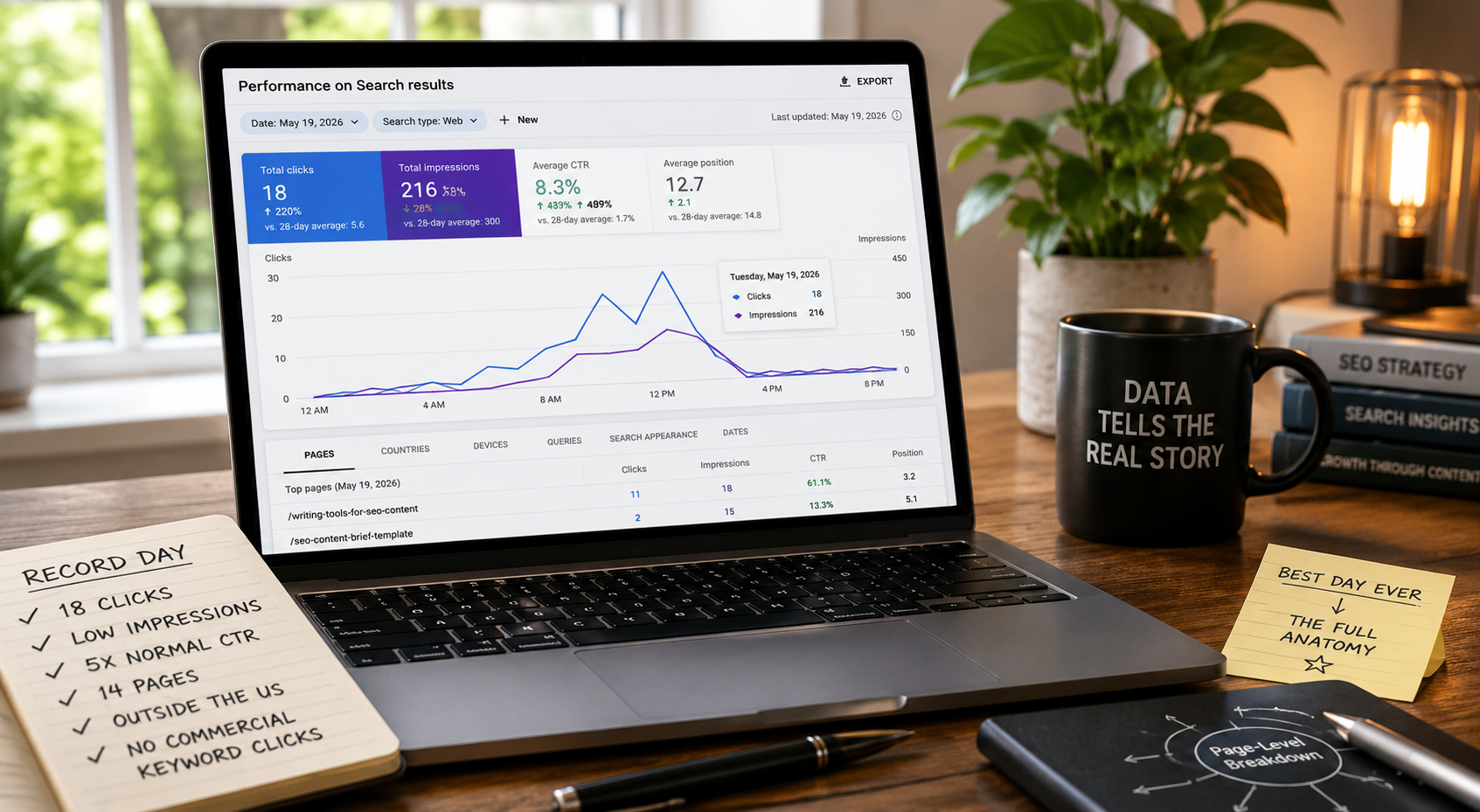
We publish our search data every month — the full May benchmark, the 90-day report card, the wins and the warts. But a single day occasionally earns its own deep-dive, because a daily snapshot reveals things a monthly average smooths flat.
May 19 was that day. Our domain logged 18 clicks — by a wide margin the best single day in our history. Our prior bests were 12 (May 6) and 11 (May 11); our May daily average was just 5.6 clicks. So 18 is roughly 3.2x a normal day.
For most agencies, that's where the post ends: a number, a victory lap. We did the opposite — we pulled the query, page, device, and country breakdown for that one day and took it apart. What we found reframes the whole event. Let's go layer by layer.
Layer 1: It was a Tuesday — and the timing isn't incidental
May 19, 2026 was a Tuesday. That matters more than it sounds, because our audience is B2B — owner-operated businesses, agencies, marketers — and B2B search behavior clusters hard in the Tuesday-to-Thursday midweek window when people are at their desks doing work, not browsing on a weekend.
Look at the surrounding days and the pattern holds: the back half of May, our strongest click days were Tuesday (18), Wednesday (9), Thursday (8) — and our weakends sagged. This is consistent with the well-documented reality that B2B engagement peaks midweek and craters on weekends, which we've written about before. The biggest day landing on a Tuesday isn't a coincidence; it's the calendar working in our favor.
Layer 2: The number that explains everything — it was a low-impression day
Here's the single most important fact in this entire post, and it's the one nobody expects.
The 18 clicks came on just 1,489 impressions — one of the lowest-impression days of the whole month. Compare that to the days right before it:
Read that highlighted row against the one two days above it. On Sunday May 17, we had 3,189 impressions and earned 2 clicks. On Tuesday May 19, we had less than half the impressions — and earned nine times the clicks.
This was not a traffic flood. Nobody fire-hosed new visibility at us. We didn't suddenly rank for a thousand new queries. We converted the visibility we already had at a dramatically higher rate.
Layer 3: The CTR is the real headline — 1.2%, about 5x normal
The metric that actually explains May 19 isn't the 18 clicks. It's the 1.2% click-through rate.
Our typical daily CTR in May ran around 0.2–0.3%, and our blended monthly CTR was 0.26%. So May 19's 1.2% is roughly five times our normal click-through rate, achieved on a below-average impression day. The clicks didn't come from more eyeballs; they came from a far higher share of eyeballs choosing to click.
This is the distinction most people miss reading their own Search Console, and it's worth stating plainly. There are two completely different kinds of "good day":
An impression-driven day, where Google shows you to far more people and clicks rise even at a flat click rate. That's a visibility event.
A CTR-driven day, where the same or fewer people see you but far more of them click. That's a relevance and intent event.
May 19 was emphatically the second kind — and the second kind is the more valuable signal, because it means the searches we appeared in were well-matched to what we offer and our titles and snippets were compelling enough to win the click. Google's own guidance frames this exactly: when impressions hold and clicks move, the lever is the relevance and appeal of your result, not raw visibility (Google Search Central: debugging Search traffic drops).
Layer 4: The clicks came from 14 different pages — not one viral hit
This is where the page-level data overturns the most common assumption. A huge day usually means one page caught fire. That's not what happened.
Those 18 clicks were spread across 14 different pages. No single piece of content carried the day. Here's the full breakdown of every page that earned a click on May 19:
The single biggest winner of the day was The agency model is breaking — here's what comes next: 3 clicks on just 5 impressions — a 60% CTR at position 3. That's a tiny number of impressions converting at an extraordinary rate, because the page ranked near the top for a tightly-matched, high-intent query. It's the cleanest possible illustration of the whole day's lesson: position plus relevance beats raw volume every time.
The rest of the clicks came from a genuine spread of our library — explainers like why GSC shows zero clicks on a query(15.4% CTR), why your website isn't showing up in Perplexity, the AI visibility audit scam, and even do people still fill out website contact forms (1 click on 1 impression — a literal 100% CTR).
This "broad, distributed" profile is actually the healthier version of a big day. A single viral post is fragile — it spikes and dies. Fourteen pages each pulling their weight means the result rests on a maturing content library, not one lucky hit. It's the topical-authority compounding we've been building toward showing up in a single day's data.
Layer 5: Desktop did the work — 89% of the clicks
The device split was lopsided, and consistent with everything we know about our B2B audience:
Desktop delivered 16 of the 18 clicks (89%) at a 1.3% CTR. A B2B audience researching agencies and SEO concepts on a Tuesday is, overwhelmingly, doing it on a work computer — and the data reflects exactly that. (It's also a quiet reminder of the mobile-snippet gap we flagged in the May benchmark: mobile keeps under-converting relative to its impressions.)
Layer 6: The clicks were more international than you'd guess
The country split held a genuine surprise. The US drove 7 clicks, but 11 of the 18 — about 61% — came from outside the US:
United States — 7 clicks (926 impressions, 0.8% CTR)
United Kingdom — 2
Germany — 2 (at a remarkable 8.7% CTR on 23 impressions)
Australia, Netherlands, Pakistan, Portugal, Iran, Malaysia, Isle of Man — 1 each
Note that the US supplied 62% of the day's impressions but only 39% of the clicks — while a scatter of international visitors converted at far higher rates (Germany at 8.7%, the Isle of Man at a literal 100% on its single impression). This is the same organic international spillover we documented at the monthly level in the May benchmark — topic authority reaching markets we don't actively target — showing up inside a single day.
What we won't claim
Honesty discipline applies hardest to the days that flatter us. So here's what May 19 is not.
It's not a trend. The next day we dropped to 9, then 8, then back into the low single digits. One great day is a data point, not a trajectory, and Google's own guidance explicitly warns against over-reading short-term daily fluctuations — wait days to a week before treating a single-day move as signal (Search Console Help). At 18 clicks, this is also a small-numbers event; a handful of well-matched searches swung the whole day, and we can't forensically prove every one.
And notably, our biggest, most commercially important keywords contributed nothing on our best day. "ai seo agency" pulled 48 impressions at position 78 — and zero clicks. Our Best SEO and AI Search Agencies page pulled 160 impressions at position 79 — and zero clicks. The page that won the day did so from position 3. That contrast is the lesson: even on a record day, page-8 visibility converts nothing, while page-1 relevance converts at 60%. The gap between those two is the entire job ahead of us.
The honest, useful takeaway
If we'd written this as "our biggest day ever, 18 clicks, hockey-stick growth," it would've been true and misleading. The honest version is richer:
We had our best click day ever, on a Tuesday, on a below-average impression day, at a CTR five times normal, spread across 14 different pages, led by one page converting at 60% from position 3, with the majority of clicks coming from outside the US — and not a single click from our most valuable commercial keywords, which are still stuck on page 8.
That's not a viral fluke. It's a maturing site proving it can convert at a high rate when well-matched, high-intent searches reach pages that rank — and a crisp map of exactly where the remaining work is. The capability is proven; the consistency, and the commercial-keyword rankings, are the job. We'll keep publishing the days that matter — the records and the flat ones — because that's the whole point of building in public.
Want to know whether your good days are visibility wins or conversion wins?
Most reporting can't tell the difference — and that difference decides what you should actually fix. We read Search Console the way we just read our own: separating visibility events from relevance events, finding which pages convert and why, and turning one-off record days into a consistent baseline. We're doing it for our own four-month-old domain in public. We can do it for yours.
Tell us where you are now and what you're trying to grow. You'll get clear next steps within one business day.
Data sourced from Ritner Digital's Google Search Console, May 19, 2026 (single-day view): 18 clicks, 1,489 impressions, 1.2% CTR, average position 34.4. Day-of-week and comparative figures cross-checked against the full March–May daily export. External guidance via Google Search Central and Search Console Help.
Frequently Asked Questions
What actually caused the 18-click day on May 19?
Not a traffic flood — a conversion surge. The 18 clicks came on just 1,489 impressions, one of the lowest-impression days of the month, at a 1.2% click-through rate roughly five times our normal. The clicks didn't come from more eyeballs; they came from a far higher share of eyeballs choosing to click, because well-matched, high-intent searches reached pages that actually rank. It was a relevance event, not a visibility event.
Why does a low-impression day matter so much here?
Because it flips the usual assumption. Two days earlier, on Sunday May 17, we had 3,189 impressions and earned 2 clicks. On Tuesday May 19, we had less than half the impressions and earned nine times the clicks. That proves the day wasn't about being seen by more people — it was about being seen by the right people on pages positioned to convert them. Google's own guidance confirms that when impressions hold or fall but clicks rise, the lever is relevance, not raw visibility.
Did one viral post drive the day?
No — and that's the healthier outcome. The 18 clicks were spread across 14 different pages, with no single piece of content carrying the day. The biggest winner earned 3 clicks on just 5 impressions (a 60% CTR at position 3). A distributed result like this rests on a maturing content library rather than one fragile viral hit, which is more durable and harder to lose.
What day of the week was it, and does that matter?
It was a Tuesday — and yes, it matters. Our audience is B2B (owner-operated businesses, marketers, agencies), and B2B search behavior clusters in the Tuesday-to-Thursday midweek window when people are at their desks. Our strongest click days in late May were all midweek. The biggest day landing on a Tuesday is the calendar working in our favor, a pattern we explore in the best day of the week to get B2B clicks.
Why did desktop drive almost all the clicks?
Desktop delivered 16 of the 18 clicks — 89% — at a 1.3% CTR. A B2B audience researching agencies and SEO topics on a Tuesday is overwhelmingly doing it on a work computer. It's also a reminder of the mobile-snippet gap we flagged in our May benchmark: mobile keeps under-converting relative to the impressions it earns.
Why were most of the clicks from outside the US?
The country split was a genuine surprise: 11 of the 18 clicks (about 61%) came from outside the US. The US supplied 62% of the day's impressions but only 39% of the clicks, while international visitors converted at much higher rates — Germany at 8.7% on 23 impressions, for instance. It's the same organic international spillover from topic authority we documented at the monthly level, showing up inside a single day.
Does an 18-click day mean your traffic is taking off?
No, and we won't claim it. The very next day we dropped to 9, then 8, then back into the low single digits — which is normal. One great day is a data point, not a trend, and Google explicitly warns against over-reading short-term daily fluctuations. At 18 clicks it's also a small-numbers event, where a handful of well-matched searches can swing the whole day. We're filing it as a high-water mark and a proof of ceiling, not evidence of a trajectory.
Why did your most important keywords earn zero clicks on your best day?
This is the most instructive contrast in the data. "ai seo agency" pulled 48 impressions at position 78 — and zero clicks. Our Best SEO and AI Search Agencies page pulled 160 impressions at position 79 — also zero clicks. Meanwhile the page that won the day did so from position 3. Even on a record day, page-8 visibility converts nothing while page-1 relevance converts at 60%. Closing that gap is the entire job ahead of us.
What's the difference between a "visibility win" and a "conversion win," and why should I care?
A visibility win is when Google shows you to far more people and clicks rise even at a flat click rate. A conversion win is when the same or fewer people see you but far more of them click. They look similar on a dashboard but require completely different fixes — a visibility problem needs more or better rankings, while a conversion problem needs better-matched queries and more compelling titles and snippets. Confusing the two means fixing the wrong thing, which is most of why reading Search Console correctly matters.