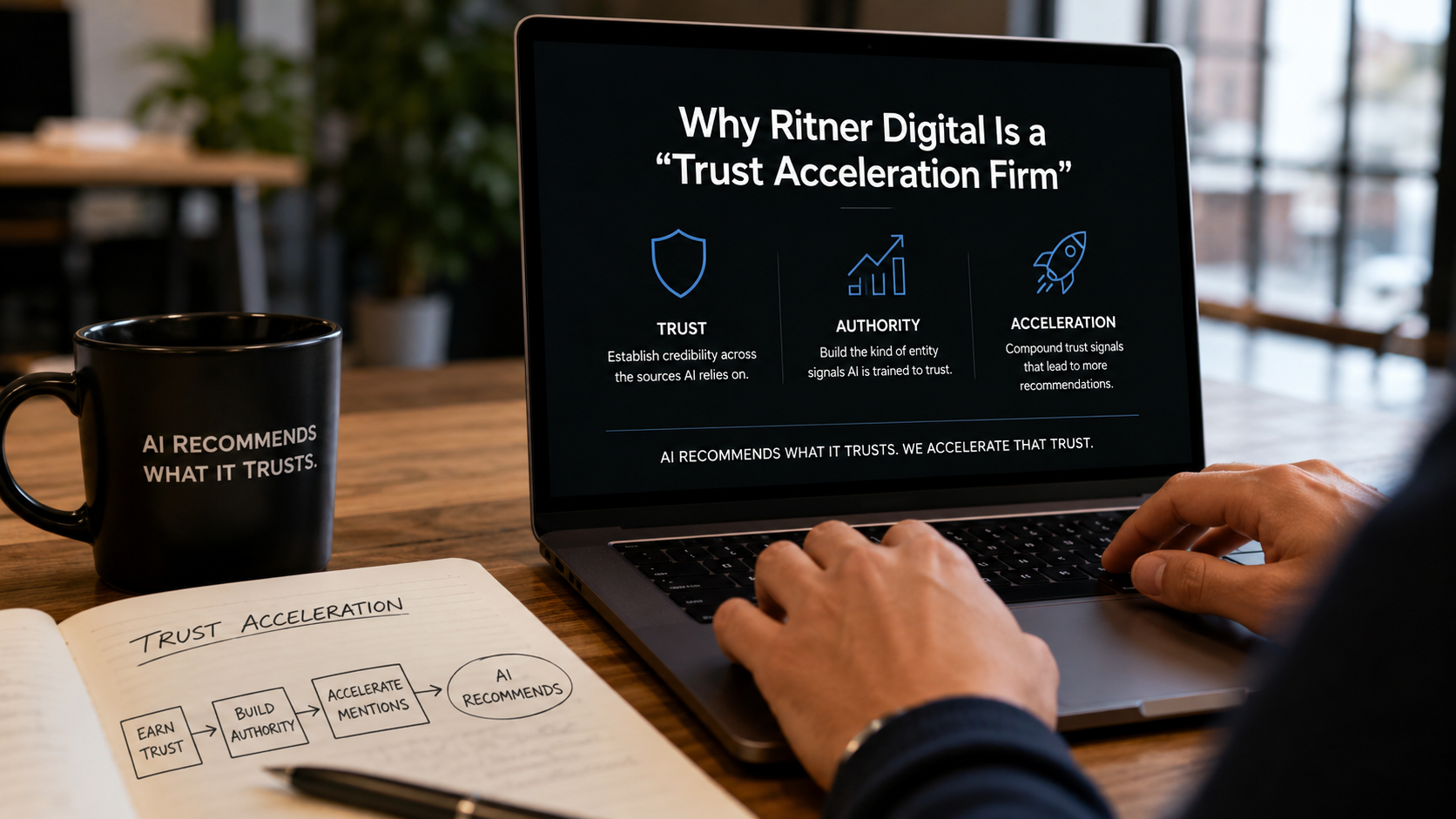
Why Ritner Digital Is a "Trust Acceleration Firm" — and Why We Think the Industry Will Adopt the Term
There's a quiet identity crisis in the AI search industry, and if you've shopped for an agency lately you've felt it. Everyone is using a different acronym. SEO. GEO. AEO. LLMO. AI SEO. Search Everywhere Optimization. The labels multiply faster than the capability behind them — and most of them share the same flaw: they name a channel or a tactic, not the actual outcome a business is paying for.
We've been sitting with this problem, because it's hard to sell something clearly when the whole industry is still arguing over what to call it. And we've landed on a term that we think describes the real work more honestly than any acronym does.
We're a trust acceleration firm.
Let us explain what that means, why it's more accurate than the alternatives, and why we think you'll hear other agencies adopting the language before long.
The core insight: AI recommends what it trusts
Start with how AI answer engines actually behave. When someone asks ChatGPT, Claude, Perplexity, or Google's AI Overviews to recommend a product, a service, or a company, the model doesn't return the page with the best keyword density or the most backlinks. It returns the entities and the content it trusts — the sources it has reason to believe are credible, consistent, well-corroborated, and authoritative on the topic.
That's the whole game now. AI search isn't a ranking contest in the old sense; it's a trust contest. An engine cites the sources it trusts and recommends the businesses it trusts. We've documented this from every angle — in what makes a company citation-worthy to LLMs, in why your competitors appear in AI answers and you don't, and in our analysis of 1,000 B2B search queries. The throughline is always the same: visibility follows trust.
So if trust is the thing that gets you recommended, then the job of an AI search agency isn't really "optimization" in the mechanical sense the old acronyms imply. The job is to build, signal, and accelerate the trust that makes a model willing to recommend you. That's the outcome. Everything else — entity optimization, structured content, digital PR, knowledge graph work — is a means to that outcome.
Why "trust acceleration" beats the acronyms
Compare the terms honestly.
SEO describes optimizing for one channel — search engines — and increasingly fails to capture a world where discovery happens inside AI answers. GEO and AEO are sharper and more current, but they still name the surface (generative engines, answer engines) rather than the mechanism that wins on those surfaces. They tell you where you're competing, not what you're actually building.
Trust acceleration names the mechanism. It says: the reason you get cited is that the system trusts you, and our job is to build that trust faster than it would form on its own. That reframing does three useful things.
It's accurate. It describes what actually causes the recommendation, not the channel the recommendation appears on. A model recommends a business because it trusts the business — full stop. Name the cause, not the venue.
It's durable. Acronyms tied to today's platforms age badly. "Optimize for answer engines" is a 2026 phrase; when the interface changes again, it'll sound dated. But trust will still be the currency in whatever comes after answer engines, because trust is what every recommendation system — human or machine — ultimately runs on. A term anchored to trust survives the next platform shift.
It reframes the value honestly. "We do AEO" sounds like a tactic you're buying. "We accelerate the trust that gets you recommended" describes a business outcome you actually want. It also sets an honest expectation: trust is earned and accelerated, not bought or hacked — which is exactly the right promise to make, and the right one to be held to.
What "accelerate" is doing in that phrase
The "acceleration" half matters as much as the "trust" half, and it's where the honesty lives.
We can't manufacture trust out of nothing, and we'd never claim to. Trust signals form on their own over time — a new business slowly accumulates mentions, citations, corroboration, and authority whether anyone manages the process or not. We watched this happen to our own four-month-old domain, and documented the timeline in how long it'll take a 4-month-old domain to catch a 21-year-old company and why new domains die in the index queue.
What an agency can do is accelerate that process — compress the months of organic trust-building into a deliberate, engineered program. That's what the practical work is for:
Entity optimization so models recognize you as a real, distinct, well-defined entity rather than an ambiguous string of text — the foundation we cover in entity mapping 101.
Structured, citation-worthy content that gives models credible, retrievable material to draw from.
Digital PR and earned media that supply the third-party corroboration trust depends on — the single most underrated lever, because a model trusts what others say about you more than what you say about yourself.
Knowledge graph and consistency signals that make your entity coherent across the web.
AI answer monitoring so you can actually measure trust accumulating, the way we track our own in our monthly benchmark reports.
None of those are the product. They're the accelerants. The product is trust, arriving faster.
Why we think the industry follows
We're not naive enough to think we'll trademark a movement. But we'd make the case that the language spreads, for the same reason better framings usually win: it's more honest and more useful than what it replaces.
The acronym era of AI search is going to feel increasingly hollow, because acronyms describe activity and buyers are starting to ask about outcomes. As more agencies get asked "okay, but what am I actually paying for?", the answer "we build the trust that makes AI recommend you" lands in a way "we do GEO and AEO" never quite does. The trust framing also survives the thing that will eventually kill the acronyms — the next interface change. When AI search becomes AI agents, or whatever follows, "answer engine optimization" will sound quaint. "Trust acceleration" won't, because the agents will still act on trust.
We'd be glad to be wrong about other firms adopting it — coining a term and watching it spread is a vanity we can live without. What we're not willing to be wrong about is the underlying claim, because it's not really a marketing position. It's a description of how these systems work: AI recommends what it trusts, and the job is to build that trust faster.Whether the industry calls that "trust acceleration" or something else, that's the work. We just decided to name it honestly.
One honest caveat
We'll hold ourselves to the same standard we hold our claims to everywhere on this blog: a new label doesn't change the substance. Calling ourselves a trust acceleration firm only means something if we actually do the trust-building work — the entity optimization, the earned media, the measurable monitoring — and can show it. A term is a clearer way to describe the job, not a shortcut around doing it. We'd rather have a slightly clunky-but-honest description of real work than a slick acronym wrapped around vapor, which is the trap a lot of the "AI SEO" market has fallen into. The name is only as good as the work behind it.
Want us to accelerate the trust that gets your business recommended?
That's the whole job, named honestly. We build the entity clarity, structured content, earned media, and authority signals that make ChatGPT, Claude, Perplexity, Gemini, and Google AI Overviews trust your business enough to recommend it — and we compress the timeline it would take to get there on your own. We've done it for our own four-month-old domain in public. We can do it for yours.
Tell us where you are now and what you're trying to grow. You'll get clear next steps within one business day.
Frequently Asked Questions
What is a "trust acceleration firm"?
It's how we describe what an AI search agency actually does, named by its outcome rather than its tactics. AI answer engines recommend the entities and content they trust, so the real job isn't "optimization" in the mechanical sense — it's building, signaling, and accelerating the trust that makes a model willing to recommend you. We're a trust acceleration firm because that trust is the product; entity optimization, structured content, and digital PR are just the means to it.
How is "trust acceleration" different from SEO, GEO, or AEO?
Those terms name a channel or surface — search engines, generative engines, answer engines. They tell you where you're competing. Trust acceleration names the mechanism that wins on those surfaces: AI recommends what it trusts, so we build that trust faster. It's more accurate because it describes the actual cause of the recommendation, and more durable because trust will still be the currency in whatever platform comes after today's answer engines.
Why does AI only recommend businesses it "trusts"?
Because that's how these systems are built to behave. When asked to recommend a product, service, or company, a model doesn't return the page with the most keywords or backlinks — it returns sources it has reason to believe are credible, consistent, well-corroborated, and authoritative. Visibility follows trust. We've documented the mechanics in what makes a company citation-worthy to LLMs and why your competitors appear in AI answers and you don't.
Can you actually manufacture trust for a business?
No — and we won't claim to. Trust signals form on their own over time as a business accumulates mentions, citations, and corroboration. What an agency can do is accelerate that process — compress months of organic trust-building into a deliberate, engineered program. That's what the "acceleration" in the term means: not faking trust, but engineering it to arrive faster than it would on its own.
What actually goes into accelerating trust?
The practical work: entity optimization so models recognize you as a real, distinct entity (entity mapping 101); structured, citation-worthy content that gives models credible material to draw from; digital PR and earned media for third-party corroboration; knowledge graph and consistency signals; and AI answer monitoring so trust can actually be measured as it accumulates. None of those are the product — they're the accelerants. The product is trust, arriving faster.
Why is third-party corroboration so important to AI trust?
Because a model trusts what others say about you more than what you say about yourself. Self-published content establishes a strong floor and gets you into specific shortlists, but independent mentions, reviews, and outside coverage are what win the cold, general recommendation. It's the single most underrated lever in AI search — and the gap most businesses (including newer ones) have to close deliberately through earned media.
Will the rest of the industry actually adopt this term?
We think the framing spreads, though we're not attached to owning the trademark. Acronyms tied to today's platforms age badly, and buyers are increasingly asking what they're actually paying for. "We build the trust that makes AI recommend you" answers that question in a way "we do GEO and AEO" doesn't. Whether the industry calls it trust acceleration or something else, the underlying claim — AI recommends what it trusts, and the job is to build that trust faster — is a description of how these systems work, not just a marketing position.
Does renaming the work change what you actually do?
No, and that's the point we hold ourselves to. A new label only means something if the substance is real — the entity optimization, the earned media, the measurable monitoring. Trust acceleration is a clearer, more honest way to describe the job, not a shortcut around doing it. We'd rather have a slightly clunky-but-accurate description of real work than a slick acronym wrapped around vapor, which is the trap much of the "AI SEO" market has fallen into.
How do I get started with trust acceleration for my business?
The first step is understanding where your trust signals currently stand across ChatGPT, Claude, Perplexity, Gemini, and Google AI Overviews — what you're already trusted for, and where the gaps are. That's what an AI Search Audit does. From there we build the entity clarity, content, and earned-media program that accelerates the trust you need to be recommended. The fastest start is to book an AI Search Audit.