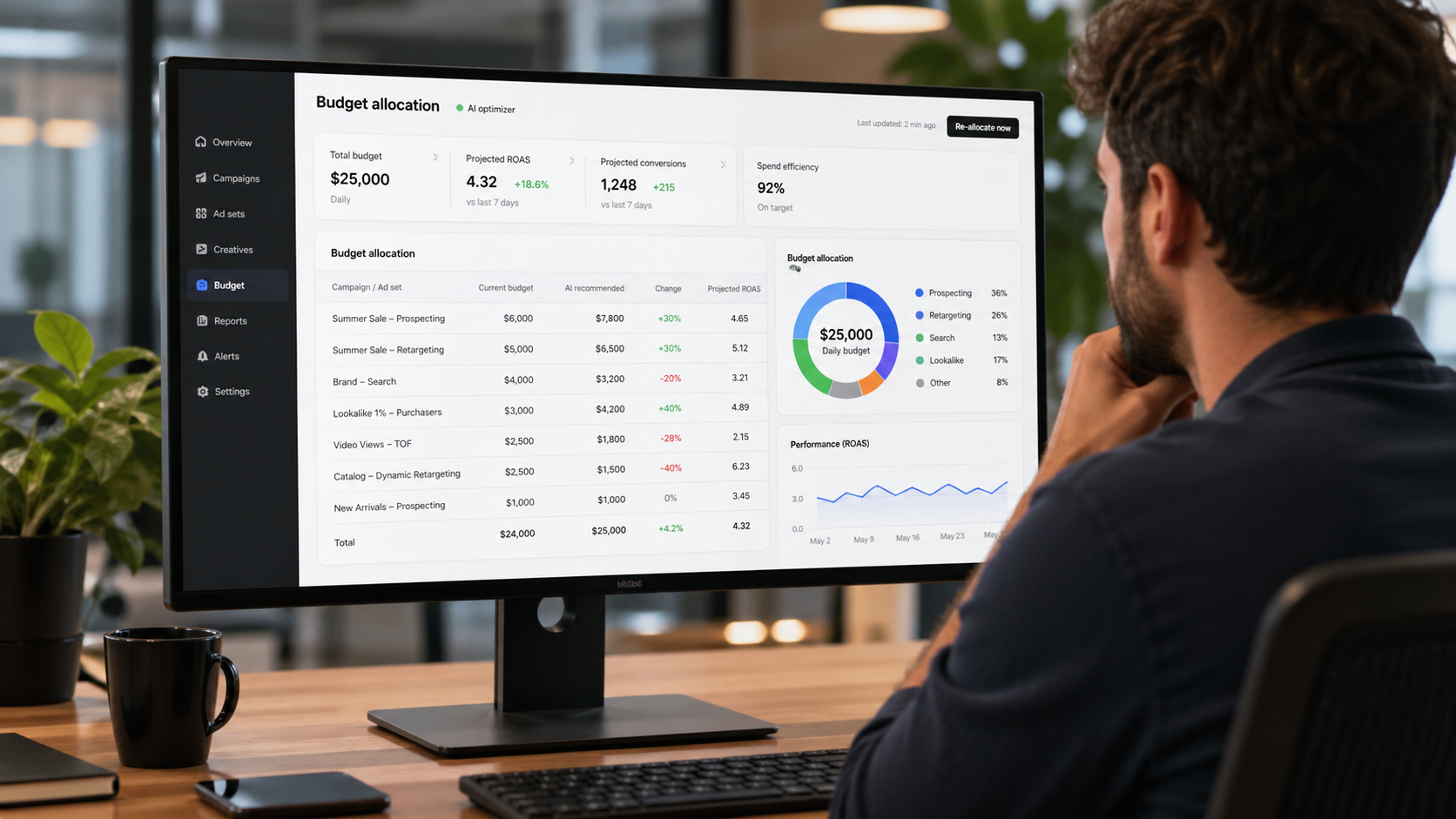
Manual Budget Management Is Losing the Race
Every week, businesses running paid advertising face the same problem. A campaign that was performing well last Tuesday is underperforming today. Another campaign that looked sluggish for two weeks just found its audience and is converting efficiently. One ad set is burning through budget on clicks that never convert. Another is running out of budget at noon and missing the evening traffic window where half the day's conversions happen.
The traditional response to this is human intervention — a media buyer reviews performance, shifts budget manually, adjusts bids, and hopes the changes hold until the next review. In practice, that review happens daily at best, weekly in most organizations.
Facebook's auction system operates in real time, adjusting delivery and costs by the minute. A manual weekly review is trying to optimize a system that changes thousands of times between each check-in. AdStellar
This is the gap that AI budget allocation closes. Instead of periodic human reviews making periodic adjustments to a system that operates continuously, AI systems monitor performance across every campaign, ad set, and creative in real time — and reallocate spend automatically to wherever it will produce the best returns right now, not wherever it was producing the best returns last Tuesday.
This guide explains how AI budget allocation actually works, how to set it up correctly on Google and Meta, what it takes for the AI to perform well, and where human judgment still has to stay in the picture.
Part I: What AI Budget Allocation Actually Does
The term "AI budget allocation" covers a spectrum of capabilities, from narrow automation that adjusts bids within a single campaign to fully autonomous systems that redistribute spend across campaigns, channels, and even creative variations without human intervention. Understanding what is happening under the hood helps you configure these systems correctly and evaluate whether they are working.
At the most fundamental level, AI budget allocation systems do four things that human buyers cannot match at scale:
Continuous monitoring. AI systems continuously monitor performance across every campaign, ad set, and creative. Real-time analysis processes data points every few minutes, not once a day. The system starts by establishing performance baselines for each element of your campaign. AdStellar When performance deviates from those baselines — in either direction — the system responds immediately rather than waiting for the next human review.
Predictive reallocation. Campaign AI forecasts spend efficiency hourly, automatically reallocating budgets to top-performing campaigns, ad groups, and even individual keywords. The system prevents both overspend and underspend scenarios. Campaign-ai Rather than reacting to yesterday's data, predictive systems model where budget will produce the best returns in the next 24 hours based on historical patterns, time-of-day signals, competitive dynamics, and audience behavior.
Auction-level optimization. Smart Bidding optimizes bids for every auction, helping set more precise bids tailored to each user's search context. In addition to evaluating key signals like device, location, and time of day, Smart Bidding accounts for other signals like browser, operating system, language, and many more. It also considers signal combinations that have a statistically significant impact on conversion rate, which individual bid adjustments could not capture. Google Support
Scale beyond human capacity. The human brain cannot process the 3,847 auction-time signals that Google's Smart Bidding evaluates in real time. ALM Corp This is not a criticism of human judgment — it is a statement about the scale of the problem. No human team, regardless of skill or effort, can optimize at the granularity that AI systems operate at.
Part II: The Foundation You Need Before AI Can Work
Here is the single most important thing to understand about AI budget allocation: the AI is only as good as the data you feed it. A sophisticated algorithm optimizing toward the wrong signal, or toward a noisy and inaccurate signal, produces sophisticated waste rather than efficient performance.
Before enabling AI budget allocation in any meaningful way, three foundations need to be in place.
Accurate Conversion Tracking
Conversion tracking underpins the success of any Smart Bidding strategy. Making sure your conversion tracking is accurate is the non-negotiable prerequisite. Google
This sounds obvious — of course you should be tracking conversions. But in practice, many accounts have conversion tracking that is misconfigured, double-counting events, tracking proxy metrics instead of actual business outcomes, or relying on cookie-based tracking that privacy restrictions have made unreliable. The AI will optimize toward whatever signal you give it. If that signal does not accurately reflect the business outcomes you care about, the AI optimizes efficiently in the wrong direction.
The average Google Ads account wastes 20 to 30 percent of its budget on irrelevant or low-intent searches. That is not a targeting problem. It is a systems problem. Accounts without clean conversion data train the algorithm on bad signals and pay for clicks that will never convert. Launchcodex
Server-side tracking has become increasingly important as browser-level tracking becomes less reliable. Third-party attribution tools like Cometly, Triple Whale, and Northbeam are worth evaluating if you are running multi-channel campaigns where understanding the true path to conversion matters.
Optimize Toward Your Actual Business Goal
One of the most common mistakes in AI budget allocation is optimizing toward a convenient proxy metric rather than the actual business outcome you care about. Businesses have naturally gravitated towards conversion events that are readily available and easy to set up — for instance, tracking form fills. But ultimately, the business probably cares about the sign-up to a course or the completed purchase, not just the interest form. Businesses should challenge themselves to understand whether there is something closer to their ultimate business goal that they want to optimize toward. Google
If you optimize for lead form submissions when what you actually want is qualified appointments, the AI will find the cheapest lead form submissions — which may be the least qualified leads. If you optimize for purchases when you actually want profitable purchases, the AI may find high-volume low-margin transactions that look good in the dashboard and destroy your profit margin.
Sufficient Conversion Volume
AI bidding strategies require data to learn from. Without enough conversion events, the algorithm cannot identify meaningful patterns and defaults to behavior that looks random from the outside.
The key is ensuring your budget is large enough to generate at least 30 conversions per month for Smart Bidding strategies to work effectively. For new campaigns with limited conversion data, start with Maximize Conversions to gather data, then transition to Target CPA or Target ROAS once you have at least 30 conversions in 30 days. Brain Buzz Marketing
Underfunding campaigns is one of the most common mistakes — setting budgets too low prevents campaigns from generating sufficient conversion data for optimization and forces the system to ration impressions rather than compete effectively. If you have limited budget, it is better to have fewer, well-funded campaigns than many underfunded campaigns that never generate enough data to optimize. Adventureppc
Part III: AI Budget Allocation on Google Ads
Google's AI budget allocation operates through two complementary systems: Smart Bidding at the individual auction level, and Campaign Budget Optimization and portfolio bid strategies at the campaign and account level.
Smart Bidding: Auction-Level Intelligence
Smart Bidding is Google's suite of automated bidding strategies that use machine learning to optimize for conversions or conversion value at every individual auction. The current active strategies are:
Maximize Conversions gets you the most conversions possible within your daily budget. Use this when volume is the goal and each conversion has roughly equal value — lead generation campaigns where every lead is a similar opportunity, for instance.
Maximize Conversion Value prioritizes conversions that are worth more to your business rather than just volume. Use this for e-commerce campaigns where you are tracking actual purchase revenue or for service businesses where different products or service tiers have different values.
Target CPA tells Google's AI you want to hit a specific cost per acquisition and lets the system adjust bids to achieve that target at the highest possible volume. Use this when you have a clear profitability threshold — you know a lead is worth acquiring at $80 but not at $120, so you set a $90 Target CPA and let the system optimize around it.
Target ROAS tells Google's AI you want to achieve a specific return on ad spend and lets the system prioritize high-value conversions. Use this for e-commerce where you are tracking revenue and want to maintain a minimum return ratio on your ad investment.
According to Google's own product managers, you can generally start with the bidding strategy you want to optimize toward — the system will learn as new conversions come in and adjust quickly. This contradicts the conventional wisdom of starting with manual bidding until data accumulates. PPC Land
Portfolio Bid Strategies: Optimizing Across Campaigns
Portfolio bid strategies allow you to apply a single Smart Bidding strategy across multiple campaigns, letting Google's AI redistribute budget dynamically based on where it sees the best opportunity at any given moment.
Individual campaign bid strategies create silos. Portfolio strategies orchestrate resources across your entire account. Setting a portfolio budget allows Google's algorithm to have flexibility to dynamically reallocate spend to capture opportunities and prevent waste that static campaign budgets guarantee. Typical performance lift: 19 to 27 percent improvement in overall account ROAS. ALM Corp
To set up a portfolio bid strategy in Google Ads: go to Tools → Budgets and Bidding → Bid Strategies → click the plus button → choose your strategy type → name the portfolio → select the campaigns to include → set your targets → save. Once live, Google's AI manages bid adjustments across all included campaigns simultaneously, shifting resources toward whichever campaigns are finding the most efficient conversion opportunities at any given moment.
AI Max and Performance Max
For advertisers who want to extend AI budget allocation beyond bidding into targeting and placement, AI Max for Search and Performance Max represent the current frontier of Google's automation.
AI Max for Search launched in May 2025 as a suite of AI-powered targeting and creative features applied on top of existing Search campaigns. It includes intent-based query matching that goes beyond traditional keyword lists, text customization that generates ad copy variations within defined brand guidelines, URL expansion to the most relevant landing pages based on query context, and brand controls. Early testing showed 20 to 30 percent improvements in reach and relevance. Launchcodex
Part IV: AI Budget Allocation on Meta
Meta's AI budget allocation operates through Campaign Budget Optimization and the Advantage+ suite, which together give the algorithm increasing control over where spend goes and how creative is served.
Campaign Budget Optimization vs. Ad Set Budgets
The first structural decision on Meta is whether to let the campaign-level budget flow across ad sets dynamically or lock budget to individual ad sets.
Campaign Budget Optimization sets one budget at the campaign level and lets Meta distribute it across all ad sets based on performance. AdStellar This is the AI-native approach — you set the total campaign budget and define the ad sets, and Meta's algorithm shifts spend toward whichever ad sets are finding the most efficient results in real time.
Ad Set Budget Optimization locks a specific budget to each individual ad set, giving you manual control over allocation but sacrificing the AI's ability to shift resources dynamically. This approach makes sense when you have specific audience segments you want to protect, when you are running a controlled test where equal spend matters more than efficiency, or when one ad set consistently gets neglected by the algorithm despite strategic importance.
For most standard performance campaigns, Campaign Budget Optimization is the right starting point. For brand awareness campaigns with specific reach requirements across particular audiences, manual ad set budgets give you the control the algorithm does not naturally apply.
Advantage+ and Full Automation
Meta has made Advantage+ the default for Sales, Leads, and App campaigns. The automation framework handles targeting, placements, creative optimization, and budget allocation with minimal human input. Fraud Blocker™
Within Advantage+, Meta's AI manages bid strategy and budget pacing automatically. You can layer on cost controls to protect your margins:
Cost cap bidding sets a maximum average cost per conversion event. If you set a $30 cost cap for purchases, Meta aims to keep your average cost per purchase at or below $30 while maximizing volume. This protects your margins but may limit delivery if your cap is too aggressive. Cost caps work best when you have clear profitability thresholds and want to prevent unprofitable spending. AdStellar
Automated Rules for Custom Budget Guardrails
Beyond Meta's native CBO, automated rules let you build custom conditions that trigger specific budget actions based on your performance thresholds — creating a layer of controls that sit on top of the AI's native optimization.
Examples of useful automated rules: pause an ad set when cost per result exceeds your threshold, increase budget by 20% when ROAS exceeds your target for three consecutive days, send an alert when any ad set's daily spend falls below a minimum threshold. These rules do not replace AI optimization — they establish guardrails that prevent the AI from making allocation decisions your business cannot absorb.
Part V: Cross-Channel Budget Allocation
The most sophisticated application of AI budget allocation is not within a single platform but across platforms — shifting spend between Google, Meta, and other channels based on where the AI sees the most efficient path to your business goals.
AI recommendations adapt to your business constraints. You might have minimum spend requirements for certain channels due to agency relationships, or maximum shift percentages to maintain brand presence across platforms. The AI factors these guardrails into its suggestions, ensuring recommendations are both optimal and practical. Cometly
Third-party tools including Cometly, Skai, and Triple Whale provide cross-channel attribution and budget recommendations that sit above the walled gardens of individual platforms. Because Google's reporting lives inside Google and Meta's reporting lives inside Meta, and the two systems attribute the same conversions differently, a neutral third-party attribution layer is often the only way to make genuinely informed cross-channel budget decisions.
Organizations using AI for dynamic budget reallocation capture opportunities faster and reduce wasted spend on underperforming channels. Continuous, real-time budget optimization outperforms annual planning cycles. Aprimo
Part VI: What to Watch — and What to Keep Human
Handing budget allocation to an AI system does not eliminate the need for human oversight. It changes the nature of that oversight from manual execution to strategic governance.
Monitor learning periods carefully. When you enable a new Smart Bidding strategy or switch from manual to automated bidding, campaigns enter a learning period during which performance may fluctuate while the algorithm calibrates. The typical timeline: Week 1 to 2 — data gathering, high volatility. Week 3 to 4 — performance stabilizes. Week 5 to 8 — optimization kicks in. Month 3 and beyond — mature performance. ALM Corp Do not make major structural changes during a learning period. Do not judge performance in the first two weeks.
Verify results independently. Platform-reported ROAS and CPA numbers should always be cross-referenced against actual business outcomes — revenue in your CRM, orders in your e-commerce platform, qualified appointments in your pipeline. Traditional approaches wait for statistical significance before suggesting changes, often taking weeks to gather enough data. AI identifies directional trends earlier, but this speed advantage requires you to verify that the trends are real and not artifacts of the platform's measurement methodology. Cometly
Keep humans in control of strategic decisions. New product launches lack historical data for AI to learn from. During launch phases, manual budget allocation allows you to give new products adequate testing time before AI makes efficiency-driven cuts. Brand awareness campaigns often require human judgment because the goals are not purely conversion-driven. AdStellar The AI optimizes for the signal you give it. Strategic decisions about what signal to optimize for, what channels to prioritize, and what trade-offs between volume and margin to accept — those remain human responsibilities.
Do not starve the AI of budget. One of the most common mistakes is under-funding campaigns and then blaming the AI when performance is poor. Make sure campaigns are not limited by budget if you want to get the most performance from AI-powered strategies. Budget constraints prevent the AI from exploring the full range of opportunities it could otherwise find. Google
Part VII: A Practical Implementation Sequence
For businesses that want to move toward AI-managed budget allocation without doing it all at once, a phased approach reduces risk while building the data foundation the AI needs to perform well.
Phase 1 — Fix the data foundation. Audit your conversion tracking. Ensure you are tracking the outcomes closest to your actual business goals, not just the events easiest to measure. Implement server-side tracking if cookie reliability is a concern. This phase is not optional — everything that follows depends on it.
Phase 2 — Enable Smart Bidding on your best-performing campaigns. Start with campaigns that already have 30 or more conversions per month. These have the data history the algorithm needs to learn quickly. Choose Maximize Conversions to start if you want volume, or set a Target CPA if you have a clear cost threshold. Give the learning period its full run — at least three to four weeks — before evaluating.
Phase 3 — Implement Campaign Budget Optimization. Once individual campaigns are running on Smart Bidding, consolidate related campaigns into CBO structures or portfolio bid strategies. This gives the AI cross-campaign flexibility to shift budget toward wherever performance is strongest.
Phase 4 — Add automated rules as guardrails. Set up rules that protect against the AI making decisions your business cannot sustain: cost cap floors, spend floor alerts, automatic pauses when CPA exceeds your threshold by a defined percentage.
Phase 5 — Run parallel measurement. Connect a third-party attribution tool to verify that platform-reported performance matches actual business outcomes. Run this parallel measurement for at least a full quarter before making major strategic decisions based on it.
Conclusion: The AI Manages the Execution. You Set the Strategy.
AI budget allocation is not a set-it-and-forget-it solution. It is a force multiplier that amplifies whatever strategy you give it — which means the quality of your strategy, the accuracy of your data, and the clarity of your optimization goals determine whether that force multiplier produces results or scales waste.
The competitive advantage compounds over time. While competitors are still reviewing weekly reports and making monthly budget adjustments, you are optimizing continuously based on current performance. Small efficiency gains accumulate into significant advantages in customer acquisition costs, conversion rates, and overall marketing ROI. Cometly
The businesses that win with AI budget allocation are not the ones that hand everything to the algorithm. They are the ones that build the right data foundation, configure the right objectives, give the AI the budget it needs to learn and operate, and stay engaged with strategy and measurement while the AI handles the execution.
That division of labor — AI managing the mechanics, humans managing the direction — is what makes the whole system produce results that neither could achieve alone.
Sources
Campaign AI — 7 AI Campaign Optimization Strategies Boosting ROI in 2026 (campaign-ai.com)
AdStellar — AI Budget Allocation Facebook Ads: Complete Guide 2026 (adstellar.ai)
AdStellar — 9 Best AI Ad Budget Optimization Tools 2026 (adstellar.ai)
AdStellar — Automated Ad Budget Allocation Facebook: Guide 2026 (adstellar.ai)
Cometly — AI-Powered Marketing Budget Allocation Guide 2026 (cometly.com)
Aprimo — How AI in Marketing Planning Transforms Budget Optimization for Maximum ROI (aprimo.com)
Google — Your Guide to Smart Bidding (support.google.com)
Google — Budgets, Bidding & AI-Powered Campaigns: Best Practices for 2026 (business.google.com)
PPC Land — Google's Smart Bidding Secrets: What Advertisers Get Wrong in 2026 (ppc.land)
ALM Corp — Google Ads Advanced Tactics to Maximize ROAS for 2026 (almcorp.com)
Launch Codex — Google Ads Management: How to Run, Optimize, and Scale Your Campaigns (launchcodex.com)
Fraud Blocker — Should You Turn Off Meta Advantage+? (fraudblocker.com)
Want help setting up AI budget allocation correctly — with the right data foundation, the right objectives, and the right guardrails? Let's talk → ritnerdigital.com/#contact
Ritner Digital helps businesses across South Jersey and the greater Philadelphia region run smarter paid media campaigns — with the right balance of AI efficiency and human strategic oversight.
Frequently Asked Questions
What does it mean to let AI automatically allocate your ad budget?
AI budget allocation means handing the real-time decisions about where your ad spend goes to machine learning systems rather than making those adjustments manually. Instead of a human reviewing performance once a day and shifting budget between campaigns, AI systems monitor every campaign, ad set, and creative continuously — processing performance signals every few minutes — and reallocate spend automatically toward wherever it is producing the best results right now. This happens at a speed and granularity that no human team can match. On Google, this looks like Smart Bidding adjusting bids at every individual auction. On Meta, this looks like Campaign Budget Optimization shifting spend between ad sets in real time. Both systems operate on the same principle: money should flow toward performance, and the algorithm can track performance faster and at greater scale than a manual review process can.
What do I need to have in place before AI budget allocation will actually work?
Three things, in order of importance. First, accurate conversion tracking — the AI optimizes toward whatever signal you give it, so if your tracking is misconfigured, double-counting, or measuring a proxy metric instead of your actual business outcome, the AI will optimize efficiently toward the wrong thing. Second, enough conversion volume — most Smart Bidding strategies need at least 30 conversions per month to learn effectively. Below that threshold the algorithm cannot identify meaningful patterns and performance becomes unpredictable. Third, adequate budget — underfunding campaigns is one of the most common mistakes. If a campaign runs out of budget by noon, the AI has no room to find afternoon or evening conversions, and the learning data it collects is incomplete. Fix the data foundation first, then enable the automation.
What is the difference between Smart Bidding and Campaign Budget Optimization?
Smart Bidding operates at the bid level — it adjusts how much Google bids for each individual auction based on the predicted likelihood of a conversion from that specific user at that specific moment. Campaign Budget Optimization operates at the budget level — it decides how to distribute a fixed total budget across multiple ad sets or campaigns based on where it sees the best performance opportunity. They solve different problems and work best in combination. Smart Bidding ensures you are bidding the right amount in every auction. CBO ensures your total budget flows toward the campaigns or ad sets where those optimized bids are finding the best results.
Which Google Smart Bidding strategy should I use?
It depends on your campaign goal and the nature of your conversions. Use Maximize Conversions if your primary goal is volume and each conversion has roughly equal value — lead generation where every lead is a similar opportunity, for instance. Use Maximize Conversion Value if you are tracking actual revenue and want the AI to prioritize high-value conversions over cheap ones. Use Target CPA if you have a clear cost threshold — you know what you can profitably pay per acquisition — and want the AI to optimize for volume within that constraint. Use Target ROAS if you are running e-commerce and want to maintain a minimum return ratio on your ad spend. For brand new campaigns without conversion history, Google's own product team now recommends starting with the strategy you ultimately want rather than defaulting to manual bidding first — the system learns as conversions come in.
How does Meta's Campaign Budget Optimization differ from setting individual ad set budgets?
Campaign Budget Optimization gives Meta's algorithm one total budget at the campaign level and lets it distribute that budget across all your ad sets based on real-time performance. If one ad set is finding efficient conversions and another is struggling, CBO shifts more spend toward the winner automatically. Individual ad set budgets lock a specific amount to each ad set regardless of relative performance — giving you manual control over allocation but preventing the AI from moving resources toward your best opportunities. CBO is generally the right choice for standard performance campaigns where efficiency is the priority. Manual ad set budgets make sense when you have specific audience segments you need to protect, when you are running a controlled test where equal spend matters, or when one ad set consistently gets neglected by the algorithm despite strategic importance to your business.
What is a learning period and why should I not make changes during it?
When you enable a new Smart Bidding strategy or switch from manual to automated bidding, the algorithm enters a calibration phase where it is gathering data and adjusting to your campaign's conversion patterns. During this period — typically two to four weeks — performance can look erratic. CPAs may be higher than expected. ROAS may be lower. Conversion volume may fluctuate. This is normal. The mistake most advertisers make is interpreting early learning-period volatility as failure and making structural changes — pausing campaigns, drastically changing budgets, switching bid strategies — which restarts the learning period and prevents the algorithm from ever reaching stable performance. Give any new automated strategy at least three to four weeks before drawing conclusions, and do not make major changes unless something is clearly broken like a tracking error or a budget misconfiguration.
What is a Target CPA and how do I set it realistically?
Target CPA is the average cost per acquisition you want Google's AI to aim for. The algorithm adjusts bids across auctions to hit that target at the highest possible volume. Setting it correctly is critical — if your Target CPA is too aggressive relative to what the market will support, the algorithm will restrict delivery significantly to avoid auctions it thinks will exceed your target, and your campaign will barely spend. If it is too generous, you will get volume but at unprofitable costs. The right starting point is your actual historical cost per acquisition over the last 30 to 90 days. Set your initial Target CPA at or slightly above that baseline and give the algorithm room to work. Once performance stabilizes, you can tighten the target gradually — reducing it by 10 to 15 percent at a time rather than making dramatic adjustments that force another learning period.
Can I use AI budget allocation across Google and Meta simultaneously?
You can, but it requires a neutral third-party attribution layer to do it meaningfully. Google attributes conversions within Google's ecosystem and Meta attributes conversions within Meta's ecosystem — and both platforms will frequently claim credit for the same conversion. If you try to make cross-channel budget decisions based on each platform's native reporting, you are comparing numbers measured by different rules with different incentives. Tools like Cometly, Triple Whale, and Northbeam provide cross-channel attribution that connects ad spend on both platforms to actual business outcomes — revenue, orders, qualified leads — giving you a platform-agnostic view of where your budget is actually producing results. With that foundation in place, cross-channel AI budget allocation becomes a meaningful optimization rather than an exercise in comparing incompatible numbers.
What should I still control manually even with AI budget allocation enabled?
Several things. Strategic decisions about which campaigns to run, which audiences to target, and what your optimization goals are — the AI executes the strategy you set, it does not set the strategy. New product launches, where the AI has no historical data to learn from and may cut spend before a new product has had adequate testing time. Brand awareness campaigns with specific audience reach requirements that the algorithm will sacrifice for conversion efficiency. Any campaign where compliance matters, since the AI cannot evaluate whether its targeting decisions create legal or regulatory exposure. And your budget guardrails — cost caps, minimum spend thresholds, automated rules that prevent the AI from making allocation decisions your business cannot absorb. Think of your role as the architect who designs the system and sets its boundaries, with the AI handling execution within those boundaries.
How do I know if AI budget allocation is actually improving my results?
Verify results outside the platform's own reporting. Platform dashboards have incentives to report favorably on the performance of their own AI systems, and their attribution models measure in ways that tend to credit platform activity broadly. Connect your ad spend to actual business outcomes — revenue in your CRM, orders in your e-commerce system, qualified appointments in your pipeline — and compare those numbers against what the platform is claiming. Run a parallel test where possible: allocate a portion of your budget to AI-managed campaigns and a comparable portion to manually managed campaigns targeting the same audience with similar creative, and measure the difference over four to eight weeks. The results will not always favor the AI — some campaign types and business models perform better with manual control — but the test will tell you which approach actually works for your specific situation.
Is AI budget allocation worth it for a small business with a limited ad budget?
Yes, with appropriate expectations. Small businesses with limited budgets face a specific challenge: lower spend means fewer conversions, which means the AI has less data to learn from and takes longer to reach efficient performance. The practical threshold is roughly $1,500 to $2,000 per month in ad spend generating at least 30 conversions monthly — below that, manual management may actually outperform AI automation because the algorithm simply does not have enough signal to optimize reliably. If you are at or above that threshold, AI budget allocation frees up the time you would otherwise spend on manual bid adjustments and reallocation decisions, letting you focus on strategy and creative — the areas where human judgment adds the most value. Start with Smart Bidding on your single best-performing campaign, give it a full learning period, verify the results independently, and expand from there once you have confidence in how the system performs for your specific business.
Want help setting up AI budget allocation correctly for your ad accounts — with the right foundation, the right objectives, and the right guardrails in place? Reach out to Ritner Digital.