The Expensive Habit of Finding Out After You Launch
Every advertiser knows the feeling. You have spent time developing a campaign. The creative looks sharp. The copy feels right. The targeting is dialed in. You hit launch — and then you wait. Forty-eight hours of refreshing the dashboard, watching the numbers crawl in, hoping the instinct that guided the creative decisions turns out to be correct.
Sometimes it is. More often, you discover that the headline you thought was clever is not converting, the image you were confident about is generating clicks but not purchases, and the variation you almost did not include is quietly outperforming everything else. By the time you know this, you have spent real budget finding it out.
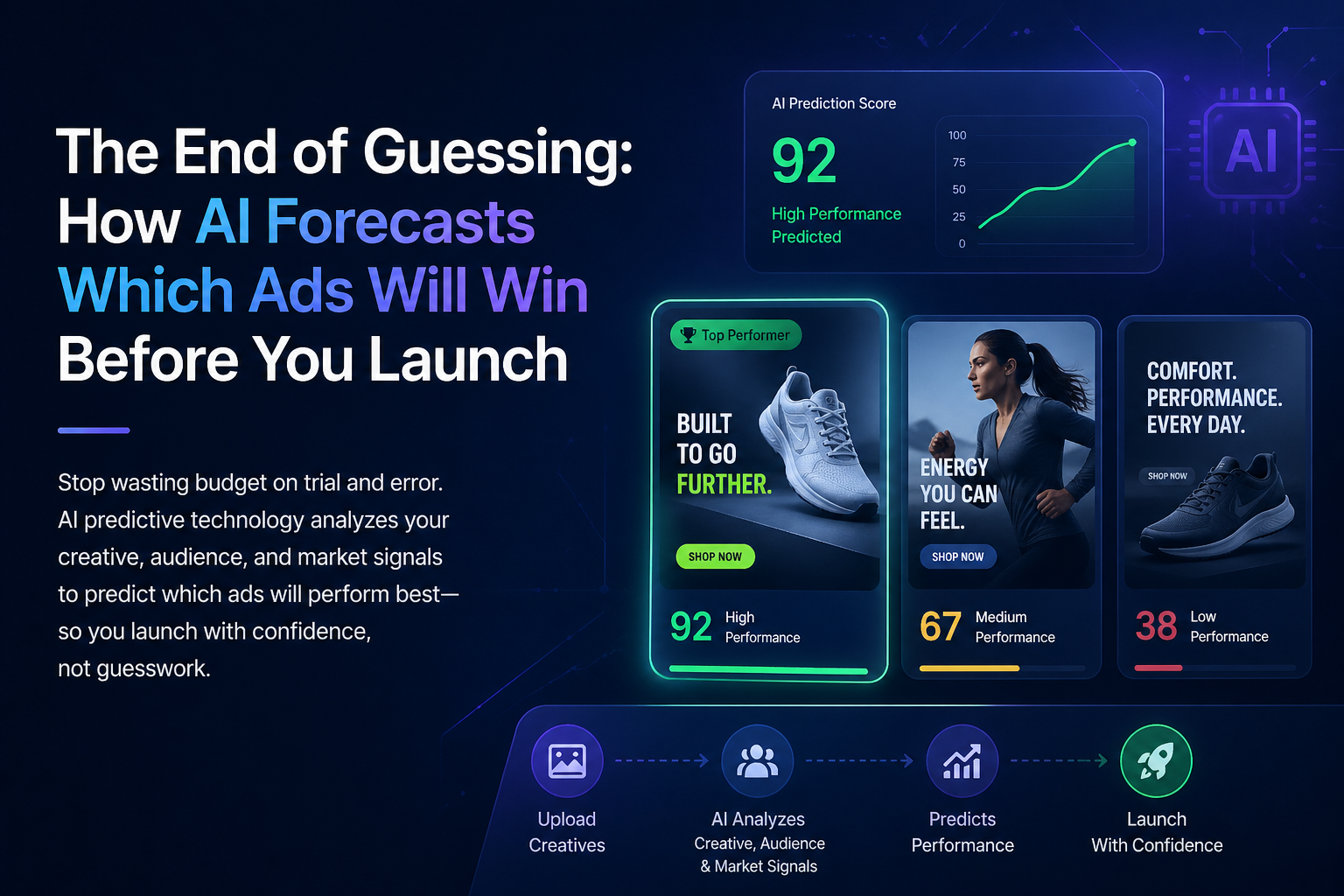
This is the core inefficiency that AI creative forecasting is designed to eliminate. Instead of launching blindly and optimizing reactively, predictive intelligence analyzes patterns from historical data to forecast which ads will perform before you spend a dollar. This shift from guesswork to data-driven foresight represents the most significant evolution in digital advertising since programmatic buying. AdStellar
The technology is not coming. It is here. Understanding how it works, what it can reliably predict, and how to structure your creative process to take advantage of it is increasingly the difference between advertisers who waste budget discovering winners and advertisers who launch with statistical confidence about which creative is most likely to succeed.
Part I: How AI Ad Prediction Actually Works
The intuitive question is: how can a system predict whether an ad will work before anyone has seen it? The answer lies in pattern recognition at a scale that human analysis cannot approach.
Machine learning models powering ad performance prediction analyze thousands of data points from historical campaigns to identify patterns invisible to human analysis. Every creative element, audience characteristic, and performance metric becomes a variable in complex algorithms that map relationships between inputs and outcomes. Think of it like weather forecasting. Meteorologists do not guess if it will rain by looking at the sky. They feed atmospheric data into models that recognize patterns from millions of historical weather events. Similarly, predictive ad AI examines past campaigns to understand which combinations of creative elements, targeting parameters, and messaging strategies correlate with high performance. AdStellar
The pattern recognition happens across multiple dimensions simultaneously. The AI might identify that video ads featuring product demonstrations convert better with cold audiences aged 25 to 34, while carousel ads with customer testimonials perform stronger with warm retargeting audiences. It recognizes that headlines under eight words generate higher click-through rates for a specific product category, or that certain color palettes correlate with lower cost-per-acquisition. AdStellar
Crucially, this analysis evaluates interactions between elements — not just individual components in isolation. Ads do not exist in isolation — they are complex systems where creative elements, audience characteristics, and messaging work together. A headline that wins with one audience might fail with another. An image that converts well in one format might underperform in a different placement. Predictive models analyze these interactions holistically. AdStellar
The result is not a vague directional signal. Sophisticated prediction tools can tell you that a specific video style, with a particular hook in the first three seconds, targeting a defined audience segment, with a specific headline variation, has a measurable probability of outperforming your current benchmark. That level of specificity was not achievable with manual testing because manual testing can only examine one variable at a time and requires live campaign spend to generate data.
Part II: What AI Can — and Cannot — Reliably Predict
Pre-launch prediction is not equally accurate across all campaign metrics. Understanding what the technology is good at and where uncertainty remains helps you use these tools effectively rather than over-relying on them.
What Predicts Well: Click-Through Rate
Click-through rate predictions tend to be highly accurate because they are driven by factors the model can analyze directly: creative appeal, headline strength, audience relevance. When a prediction tool says an ad has an 80% probability of achieving 2.5% CTR or higher, that forecast typically holds up because it is based on clear creative and targeting signals. AdStellar
CTR prediction accuracy is high because the model is evaluating the same factors that determine whether someone stops scrolling — visual attention capture, headline relevance, offer clarity — all of which have well-established patterns in historical data.
What Predicts Moderately Well: Cost Per Acquisition
CPA predictions introduce more complexity. The model needs to account for not just initial engagement but the entire conversion path. These forecasts are generally reliable when targeting audiences similar to those previously converted and using creative styles that have historically driven conversions. The prediction accuracy drops when testing entirely new audience segments or dramatically different creative approaches. AdStellar
CPA prediction requires the model to chain together multiple probabilities — the probability of a click, the probability of a landing page conversion, the probability of completing a purchase flow — each of which carries its own uncertainty.
What Predicts With Ranges: ROAS
ROAS forecasting is where things get truly interesting and challenging. ROAS depends on conversion rate, average order value, and cost per click — multiple variables that each carry their own uncertainty. The most sophisticated tools provide ROAS predictions with confidence intervals: "70% probability of achieving 3.5x to 4.2x ROAS" rather than a single fixed number. AdStellar
A prediction with a range is more honest and more useful than a single point estimate. When a tool gives you a confidence interval rather than a single number, that is a sign the model understands the limits of its own certainty.
What Predicts Uniquely Well: Creative Fatigue
Creative fatigue is one of the most valuable predictions these tools offer. By analyzing how audience engagement patterns decay over time, the system can forecast when a currently winning ad will start losing effectiveness. This lets you prepare replacement creative before performance drops, rather than scrambling after CPA has already spiked. AdStellar
Most advertisers discover creative fatigue reactively — they notice performance degrading and trace it back to overexposure. Predictive fatigue modeling lets you see it coming and have replacement creative ready before the damage is done.
Part III: Dynamic Creative Optimization — AI Prediction at Scale
Standalone prediction tools score creative before launch. Dynamic Creative Optimization — DCO — extends AI prediction into an ongoing system that tests, learns, and optimizes continuously throughout the campaign lifecycle.
DCO's main job is to stop you from wasting money on ads that do not work. Instead of manually A/B testing five variations, an automated system can test thousands. It quickly learns which blend of images, headlines, and CTAs drives conversions for different audiences. The result is a direct improvement in your most important KPIs. One case study showed a 58% ROAS increase and a 30% CPA drop just by testing over 2,000 ad variations automatically. Needle
The mechanics of DCO involve breaking ads into modular components — headlines, images, body copy, calls to action — and feeding those components to an AI system that assembles every possible combination, serves them to different audience segments, and continuously reallocates impressions toward the highest-performing combinations.
Dynamic Creative Optimization works by breaking ads into modular components such as headlines, images, CTAs, and product feeds, then reassembling them dynamically based on user signals like location, device, browsing history, and weather. Machine learning algorithms analyze real-time data to predict optimal combinations, ensuring every impression delivers maximum relevance. Starti
Every major ad platform now has a native DCO capability:
On Google, Performance Max and App campaigns are inherently DCO-based — you supply headlines, descriptions, images, and videos, and Google assembles combinations across Search, YouTube, Display, and Discover based on what its AI predicts will perform best for each impression opportunity.
On Meta, Advantage+ Creative and Dynamic Creative allow you to upload multiple creative components and let Meta's algorithm assemble and test combinations automatically, shifting budget toward the combinations it predicts will perform best.
On TikTok, Smart Creative launched in 2025 and allows multiple video and text variations per ad group, with the algorithm handling combination testing and delivery optimization.
Part IV: The Creative Fatigue Problem — and How AI Solves It
Creative fatigue is the silent killer of advertising performance. Even a genuinely excellent ad degrades in effectiveness as the target audience sees it repeatedly. Engagement drops, costs rise, conversion rates decline — and by the time the data makes the problem obvious, the campaign has already wasted budget it did not need to waste.
Creative fatigue is not just a minor inconvenience — it is the silent killer of Meta campaigns. When an audience sees the same ad repeatedly, engagement drops, costs rise, and conversion rates plummet. The solution is not creating one perfect ad. It is maintaining a constant flow of fresh variations that keep the message from going stale. Successful Meta advertisers in 2026 are testing 50 to 100 or more variations per campaign. AdStellar
This is where AI creative prediction creates a proactive rather than reactive discipline. DCO ad sets experience measurable fatigue — a 10% or higher CPA increase — within three to four weeks if no components are refreshed, compared to five to six weeks for standard single-creative ads. The algorithm concentrates spend on winning combinations, burning them out more quickly. RocketShip HQ AI systems that monitor engagement decay can predict when a creative is approaching the end of its effective lifespan and signal that replacement creative needs to be ready — before performance has degraded enough to affect your results.
The practical implication for creative teams: your job is no longer to find the one winning ad. It is to maintain a library of creative components that gives the AI system enough raw material to keep producing fresh, high-performing combinations continuously. Even strong creatives lose effectiveness over time. You need updated visuals, new offers, and different messaging angles — and the question is knowing which creatives are starting to fatigue before performance drops significantly. Segwise
Part V: Pre-Launch Scoring — Choosing Winners Before You Spend
The most direct application of AI prediction is pre-launch scoring: evaluating creative variants before any budget is committed and using those scores to decide which ads actually launch and which get revised or discarded.
The average digital advertising campaign wastes 26% of its budget on underperforming creatives, according to Proxima's 2024 Ad Waste Report. Forecasting identifies these creatives before they run, redirecting budget to higher-performing variants. Instead of launching 10 variants and waiting for data, generate 50 variants, review their predicted performance, and launch only the top 5. This compresses weeks of testing into minutes. Lapis
Several platforms now offer this capability with meaningfully different approaches:
Pattern89 examines colors, image composition, text placement, and copy tone to forecast how specific creative decisions will impact results. Unlike tools that provide simple pass/fail scores, Pattern89 delivers actionable recommendations about which creative elements to adjust. If an ad is predicted to underperform, you know exactly which components need refinement and why. AdStellar
Neurons takes a neuroscience-based approach. Neurons uses AI eye-tracking and attention analysis to forecast creative performance without needing real test subjects. The platform predicts where viewers will look, how long they will pay attention, and which elements will capture focus — all before showing the ad to a single real person. The cognitive load and clarity scoring helps identify ads that might confuse viewers or fail to communicate key messages effectively. AdStellar
AdCreative.ai offers creative scoring that predicts ad performance with claimed 90% or higher accuracy, allowing you to select the best-performing creatives before launching a campaign. AdCreative
These tools do not eliminate the need for creative judgment. They inform it. A prediction score is not a guarantee — it is a probability estimate based on historical patterns. The value is in raising the floor: ensuring that creatives with obvious structural problems get identified and revised before they consume budget.
Part VI: What This Means for Your Creative Process
Integrating AI prediction into your creative workflow requires rethinking how the creative development process is structured — not just adding a scoring step at the end.
Build Modular Creative Assets, Not Single Ads
DCO and predictive systems work best when they have a rich library of components to combine and evaluate. Automating creative production allows performance teams to scale testing volume by 85% without increasing design headcount. Hunch The creative team's job shifts from producing individual finished ads to producing modular components — multiple headline options, multiple visual concepts, multiple CTA variations — that the AI can assemble and test in combination.
This requires discipline. Components need to be designed to work interchangeably — a headline that works with Video A needs to work equally well with Video B. Non-interchangeable components create awkward or contradictory combinations. If your Headline 1 says "Start your free 7-day trial" but Video 3 makes no mention of a trial, the combination will confuse users and tank conversion rates. RocketShip HQ
Use Prediction Data to Brief Creative, Not Just Evaluate It
The most sophisticated teams are using AI prediction insights to inform creative briefs — not just to score finished work. If historical data shows that hooks focusing on outcome rather than process consistently outperform in your category, that insight should shape the brief before anyone opens a design tool. If certain color palettes consistently correlate with lower CPA for your specific audience, that is a creative direction worth specifying at the brief stage.
Forecasting replaces subjective creative debates — "I think this headline is better" — with objective performance predictions. Teams can align around data rather than opinions. Lapis
Plan for Refresh Cadence as Part of the Launch Strategy
A creative launch plan in 2026 should include a refresh schedule alongside the initial creative. Given that DCO ad sets experience measurable fatigue within three to four weeks if no components are refreshed, RocketShip HQ treating the initial creative as the only creative is a recipe for predictable performance decline. Plan what new components will enter the rotation at week three, week six, and week ten — before the campaign launches, not as a reactive response to declining numbers.
Part VII: The Limits of Prediction — Where Human Judgment Stays Essential
AI prediction is powerful. It is not omniscient. Understanding where the technology has genuine limits prevents over-reliance that leads to poor decisions.
New creative territory is harder to predict. Prediction models learn from historical patterns. When you are testing a genuinely new creative direction — a format your brand has never used, a messaging angle with no historical precedent in your account — the model has less to work from. Prediction accuracy drops when testing entirely new audience segments or dramatically different creative approaches. AdStellar For category-defining creative, human judgment about what will resonate with a new audience often outperforms algorithmic prediction trained on old behavior.
Brand and cultural context is invisible to algorithms. An AI system analyzing image composition and headline length has no awareness of whether an ad is culturally appropriate, whether it aligns with a current news moment, or whether it reinforces or undermines your brand's strategic positioning. AI excels at data-driven tasks, automation, and predictive analytics, but it lacks human intuition, creativity, and ethical judgment. StackAdapt
The prediction is only as good as the data behind it. If creative assets are mislabeled, or if user data is incomplete, the neural network will make flawed predictions. Bigabid A prediction model trained on a small dataset, or on data from a very different campaign period or audience, may not transfer accurately to your current situation. The volume and quality of historical campaign data available to the model determines the reliability of its predictions.
Truly original ideas cannot be scored before they have precedent. The most important creative breakthrough of any campaign — the unexpected angle that no one saw coming — is precisely the kind of thing prediction models are least equipped to evaluate. AI can tell you which permutation of known elements is most likely to work. It cannot tell you whether an entirely new idea is worth pursuing. That remains a human call.
Conclusion: Prediction Does Not Replace Creativity — It Focuses It
The advertisers who will benefit most from AI creative prediction are not the ones who hand everything to the algorithm. They are the ones who use prediction as a filter — surfacing which of their creative instincts have the strongest data support, identifying structural problems before they cost budget, and building the kind of modular creative library that gives AI systems meaningful material to optimize.
Companies using AI-driven analytics are seeing decision-making speed improve by 78% and forecasting accuracy jump nearly 50%. Magnet That is not because the AI replaced the creative team. It is because the creative team now has a faster feedback loop, better data to brief against, and a system that identifies winners faster than the traditional launch-and-learn cycle.
The end of guessing does not mean the end of creative judgment. It means creative judgment gets better data, faster feedback, and a more efficient path from good idea to proven winner.
Sources
AdStellar — AI Ad Performance Prediction: 2026 Complete Guide (adstellar.ai)
AdStellar — Best Ad Performance Prediction Software: 2026 Guide (adstellar.ai)
AdStellar — Meta Ad Performance Prediction Tool: AI Guide 2026 (adstellar.ai)
AdStellar — Dynamic Creative Optimization Platform: Meta Guide (adstellar.ai)
Lapis — AI Ad Performance Forecasting: Predict Results Before You Spend (2026) (trylapis.com)
AI Tech Insights — Using AI to Predict Ad Campaign Performance Before Launch (aitechinsights.com)
StackAdapt — AI in Advertising: How It's Transforming Marketing in 2026 (stackadapt.com)
Starti — Dynamic Creative Optimization: Ultimate Guide to DCO in 2026 (starti.ai)
Ask Needle — What Is Dynamic Creative Optimization and How Does It Drive Growth? (askneedle.com)
Hunch Ads — Dynamic Creative Optimization Guide for Meta 2026 (hunchads.com)
RocketShip HQ — How to Use Dynamic Creative Optimization for Mobile App Ads 2026 (rocketshiphq.com)
Segwise — A Complete Guide to Dynamic Creative Optimization for 2026 (segwise.ai)
Magnet — 2026 AI Marketing Predictions (magnet.co)
Want to build a creative testing system that identifies winners faster and wastes less budget finding them? Let's talk → ritnerdigital.com/#contact
Ritner Digital helps businesses across South Jersey and the greater Philadelphia region build smarter paid media campaigns — with creative strategy informed by data, not just instinct.
Frequently Asked Questions
What does it mean for AI to predict ad performance before launch?
Pre-launch ad prediction means using machine learning models trained on historical campaign data to estimate how a creative will perform before it is shown to a live audience. Instead of spending budget to discover which ads work, predictive systems analyze the elements of a creative — headlines, visuals, video hooks, calls to action, audience targeting — and compare those elements against patterns from thousands of previous campaigns to forecast likely outcomes. The output might be a predicted click-through rate, a probability of achieving a target CPA, or a comparative score showing which variant is most likely to outperform the others. The goal is to enter every campaign with a higher-confidence starting point rather than treating launch as the beginning of the discovery process.
How accurate are AI ad predictions?
Accuracy varies significantly depending on what is being predicted and how much relevant historical data the model has to work from. Click-through rate predictions tend to be the most reliable because they depend on creative elements the model can directly evaluate — visual appeal, headline strength, audience relevance — and these signals have clear precedents in historical data. Cost per acquisition predictions are moderately reliable when you are targeting familiar audiences with proven creative approaches, but less reliable when you are testing new audience segments or significantly different creative directions. ROAS predictions are the most complex because they chain together multiple uncertain variables. The most honest prediction tools express results as probability ranges with confidence intervals rather than single point estimates, which is a good sign that the model understands its own limits.
What is Dynamic Creative Optimization and how is it different from A/B testing?
Traditional A/B testing compares two or three creative variants against each other, requires a statistically significant sample to reach a conclusion, and produces a winner that then runs exclusively. Dynamic Creative Optimization breaks ads into modular components — multiple headlines, images, video hooks, calls to action — and uses AI to assemble and test every possible combination simultaneously, continuously reallocating impressions toward whichever combinations are performing best in real time. Instead of testing sequentially and waiting for a winner, DCO runs thousands of parallel tests and keeps optimizing as data accumulates. The practical difference is scale and speed — a manual A/B test might compare five variants over two weeks. DCO can evaluate hundreds of combinations continuously and surface winning patterns without a fixed testing window.
What is creative fatigue and how does AI help prevent it?
Creative fatigue is the degradation in ad performance that occurs when an audience has seen the same creative too many times. As frequency increases, engagement drops, costs rise, and conversion rates decline — often before the advertiser has noticed the pattern. AI helps in two ways. First, predictive fatigue modeling analyzes engagement decay patterns to forecast when a currently performing ad is approaching the end of its effective lifespan, allowing you to prepare replacement creative before performance drops rather than reacting after it has. Second, Dynamic Creative Optimization continuously rotates creative combinations, which slows fatigue by preventing any single combination from being overserved to the same audience. DCO ad sets typically experience measurable fatigue within three to four weeks without component refreshes, which is why building a refresh cadence into your creative plan from the start matters.
How many creative variations do I need for AI prediction and DCO to work effectively?
More than most advertisers initially expect. For DCO specifically, you need enough variation in each component category for the algorithm to have meaningful combinations to test. The recommendation is at least five variations for each major element type — five headline options, five image or video options, three to four CTA variations at minimum. Providing too few variations limits what the AI can optimize, and the combinations become repetitive quickly. For pre-launch scoring tools, the value comes from generating a larger pool of variants than you intend to launch — perhaps twenty to thirty options — scoring them, and launching only the highest-scoring five to ten. This compresses what would be weeks of live testing into a pre-launch filter that concentrates your budget behind the creative most likely to succeed.
Can AI predict the performance of a completely new creative concept my brand has never tried before?
Not reliably. This is one of the genuine limits of AI prediction. These models learn from historical patterns, which means they can confidently forecast the performance of creative approaches that have precedent in your account history or in the broader platform data they were trained on. When you are testing something genuinely new — a format your brand has never used, a messaging angle with no historical analog, a creative style outside the training data — the model has less to work from and the predictions carry more uncertainty. For category-defining creative ideas, human judgment about what will resonate with an audience often outperforms algorithmic prediction trained on different behavior. AI prediction is most valuable as a filter for known creative territory and as a way to prioritize among variations of proven approaches. It is less valuable as an evaluator of genuinely novel ideas.
Which platforms have built-in DCO capabilities I can use right now?
All three major digital advertising platforms have native DCO capabilities available today. On Google, Performance Max is inherently DCO-based — you supply multiple headlines, descriptions, images, and videos, and Google's AI assembles and tests combinations across Search, YouTube, Display, and Discover. On Meta, Advantage+ Creative and Dynamic Creative allow you to upload multiple creative components and let Meta's algorithm handle combination testing and delivery optimization, shifting budget toward what it predicts will perform best. On TikTok, Smart Creative launched in 2025 and supports multiple video and text variations per ad group with algorithmic combination testing. All three are accessible without third-party tools, though dedicated DCO platforms offer more granular control, better prediction capabilities, and more detailed insights into which specific elements are driving performance.
What data does an AI prediction model actually need to produce reliable forecasts?
The model needs sufficient historical campaign data from campaigns similar enough to the one being predicted that the patterns transfer reliably. At the account level, this generally means a meaningful volume of conversion events — the more the better, with diminishing returns on accuracy improvement above a certain threshold. The data needs to be clean and accurately attributed, since a model trained on misconfigured conversion tracking will produce predictions that reflect the measurement error rather than actual performance. The creative assets being scored need to be properly tagged and labeled so the model can identify which elements correlate with which outcomes. And the audience being targeted needs to be similar enough to historical audiences that the model's learned patterns apply. When any of these conditions are not met — too little data, bad tracking, unfamiliar audience — the predictions will be less reliable, and the tool should be treated as directional guidance rather than definitive forecasting.
Should I trust AI prediction scores over my own creative instincts?
Neither exclusively. The most productive relationship between human creative judgment and AI prediction treats them as complementary rather than competing. AI prediction is most valuable for filtering out structural problems — creatives with elements that consistently underperform across the category — and for prioritizing among multiple variants when the creative team has developed options that all seem plausible. It is less valuable for evaluating ideas that have no historical precedent or for making judgment calls about brand appropriateness, cultural sensitivity, and strategic positioning. The practical approach is to use prediction scores to inform creative decisions rather than override them. If the prediction model consistently flags a creative element as underperforming but your team has a strong strategic reason for it, investigate whether the prediction is accurately reflecting your specific audience and context before discarding the instinct.
How do I start using AI ad prediction if I am relatively new to it?
The lowest-friction starting point is the native DCO capabilities already available on whatever platforms you are advertising on. If you are running Google Ads, structure your Performance Max campaigns to include multiple headline, description, image, and video variations — this activates Google's AI to test combinations and surface what works. If you are running Meta ads, experiment with Dynamic Creative on campaigns where you have a meaningful creative library to draw from. Once you are comfortable with native DCO and have built a habit of developing modular creative assets rather than single finished ads, explore third-party prediction and creative scoring tools for more granular pre-launch evaluation. The priority before any of this is ensuring your conversion tracking is accurate — prediction models optimizing toward incorrect signals will produce reliably wrong forecasts, no matter how sophisticated the underlying technology.
Ready to build a creative testing system that finds winners faster and wastes less budget discovering them? Reach out to Ritner Digital.