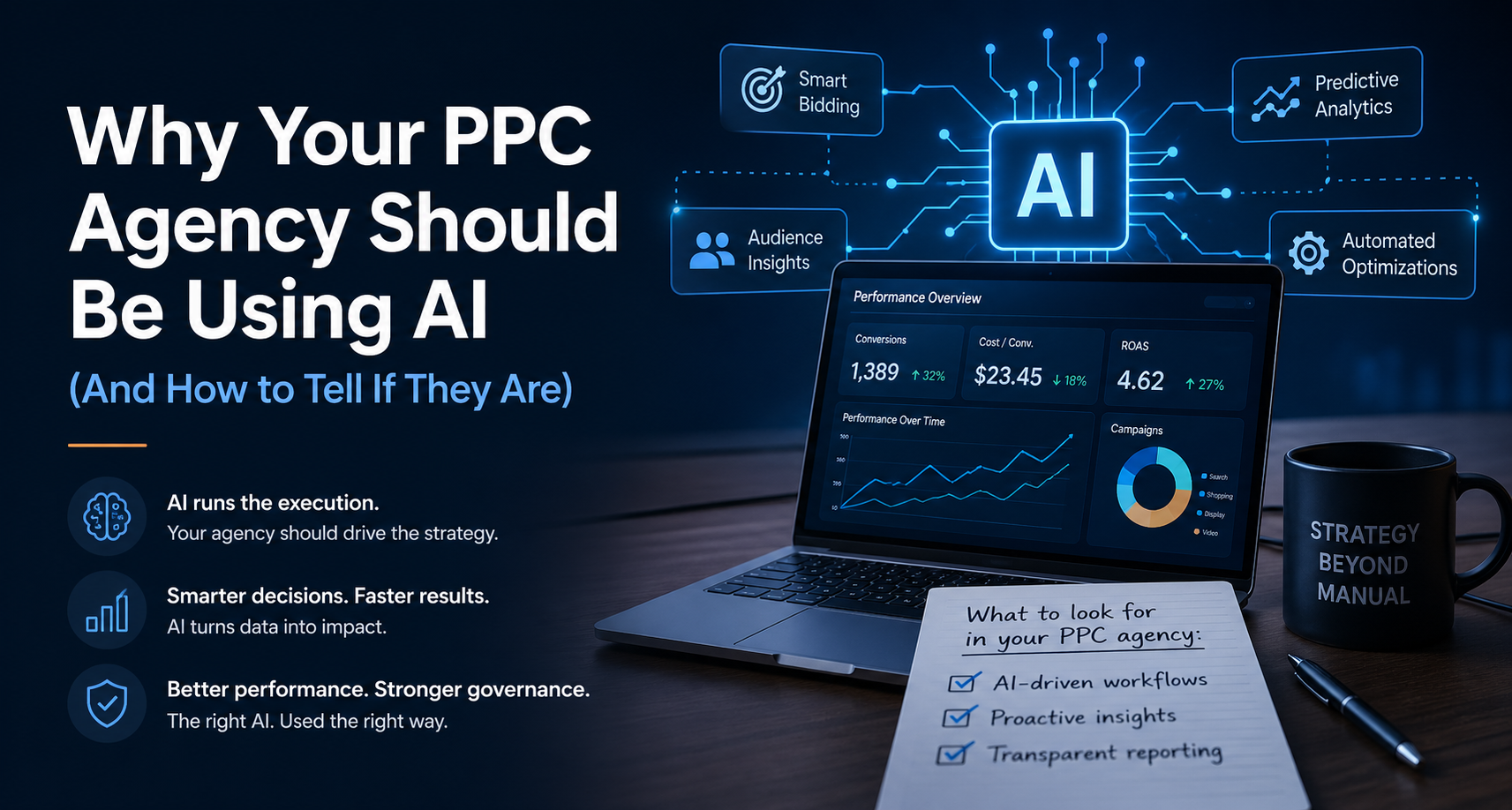
The Agency You Hired in 2022 Is Not the Agency You Need in 2026
When most businesses hire a PPC agency, they are buying three things: expertise, time, and access. The agency knows the platforms better than you do. They have the hours to manage the campaigns. And they have tools and data you cannot easily access on your own.
For most of the past decade, that value proposition held up. An experienced buyer with a well-structured Google Ads account and a disciplined testing process could reliably outperform an amateur running the same budget. The knowledge gap was real and meaningful.
That gap has not disappeared. But it has fundamentally shifted in character. 53% of PPC professionals say their work is harder today than it was two years ago. The primary drivers of increased difficulty are black-box platform automation, less accurate measurement due to privacy changes, and increased competition. ALM Corp The agencies that are navigating this environment well are not the ones with the most manual bidding expertise — it is the ones that understand how to configure, govern, and extract strategic value from AI systems that now control most of the execution layer.
AI is now used at over 99% of agencies surveyed. Daily use has reached 59.2% of agency professionals in 2026, up sharply from 15.9% in 2024. An additional 27.2% use AI tools three to four times per week, meaning 86.4% of agency professionals use AI at least several times weekly. PPC Land
But here is the problem: nearly universal AI adoption does not mean uniform AI capability. There is a profound difference between an agency using AI to generate first drafts of ad copy and an agency using machine learning to forecast performance, optimize bids at the auction level, predict creative fatigue, and govern automated campaign systems with genuine strategic rigor.
This guide explains what meaningful AI adoption looks like in a PPC agency, why it matters for your results, and the specific questions you can ask to tell the difference between an agency that is genuinely leveraging AI and one that is using the word as a marketing claim.
Part I: What the Industry Data Actually Shows
Before diving into what good AI adoption looks like, it is worth understanding the honest picture of where the industry stands — because the headline numbers conceal a more complicated reality.
The tasks where AI has taken hold are concentrated in the earlier, less consequential stages of workflow. Ideation and brainstorming lead at 86.9%, followed by research at 84.0%, drafting content or creative at 72.3%, and producing images or videos at 56.3%. But at the stages where AI could deliver the most operational leverage — media planning at 29.1% and media buying strategy at 22.1% — adoption remains comparatively low. PPC Land
This reveals the gap. Most agencies use AI for content generation and research — tasks where it accelerates work that humans were already doing. Far fewer have integrated AI into the strategic and operational core of their media buying: the bid optimization logic, the budget allocation architecture, the predictive measurement frameworks, and the systematic governance of automated platform tools.
In 2024, "AI and automation" was the number one priority for PPC professionals. In 2026, it has dropped to number three at 43%, behind improving campaign efficiency at 68% and generating conversions at 59%. This does not mean AI adoption is declining — quite the opposite. It means AI has moved from shiny new thing to tool I use daily. The novelty has worn off. PPC Chief
The agencies that moved from novelty to genuine capability are the ones worth hiring. The ones still treating AI as a feature to mention in a pitch are the ones to be cautious about.
Part II: Why AI Capability Matters for Your Campaign Results
The reason this matters is not abstract. AI capability in a PPC agency directly affects what your campaigns can accomplish and how efficiently your budget is spent.
Bid Optimization at a Scale Humans Cannot Match
85% of modern campaigns now rely on machine learning algorithms to determine real-time auction bids. While these systems are powerful tools, they require human oversight to prevent the "set and forget" mentality that drains budgets. Agencies must demonstrate technical expertise in controlling automated bidding strategies through precise value-based rules. Headred
An agency that understands how to configure Smart Bidding correctly — setting the right optimization goals, providing the right conversion signals, establishing the right target constraints, and monitoring the learning period without premature intervention — will consistently outperform one that applies automated bidding without that configuration expertise. The tool is the same. The results are not.
Performance Forecasting and Proactive Strategy
The best agencies use predictive algorithms, not reactive rules. Ask potential agencies whether their system can predict campaign performance 7 to 14 days ahead, whether they optimize for lifetime value or just immediate conversions, and whether they use rule-based automation or machine learning models that consider 50 or more variables simultaneously. Ryze AI
The difference between reactive and predictive management is the difference between adjusting campaign settings after performance has degraded and anticipating performance changes before they affect your results. An agency with genuine predictive capability catches creative fatigue before it spikes CPA. It identifies budget pacing gaps before they create underspend. It models what next quarter's campaign performance will look like before you commit the budget.
Creative Testing at Scale
Most professionals now use AI daily for tasks like keyword research and ad copy variations. The tools are good enough to integrate into workflows. Several contributors report that AI-generated creative assets can perform competitively with human-created versions when they are prompted effectively. But "when prompted effectively" is doing substantial work in that sentence. Search Engine Journal
An agency that uses AI to generate ad copy variations and then selects among them with no testing discipline is different from one that uses Dynamic Creative Optimization to systematically test hundreds of combinations and surface genuine winners. Both are "using AI for creative." Only one is generating meaningful performance intelligence.
Time Reallocation Toward Strategy
AI saves 5.2 hours per week on average for PPC professionals. PPC Chief What agencies do with those recovered hours is the real question. The best agencies reinvest that time into strategy — analyzing what the AI is actually doing, identifying performance gaps the automation cannot see, developing creative direction, and thinking through the attribution and measurement architecture that makes all the AI tools work correctly. Agencies that do not use AI meaningfully never get those hours back, which means your account gets less strategic attention.
Part III: Red Flags — Signs Your Agency Is Not Really Using AI
Before getting to the diagnostic questions, it helps to know the warning signs that an agency's AI claims are superficial.
They use AI for copy generation but cannot describe their bid strategy. If an agency talks enthusiastically about using AI to write headlines but cannot clearly articulate how their Smart Bidding configuration is set up, what conversion events they are optimizing toward, and why, the AI is being applied to the least impactful part of the workflow.
Their reporting shows only platform-reported metrics. An agency that presents you with Google's ROAS or Meta's reported CPA as the definitive measure of performance, without independent verification against your actual business outcomes, is either not using sophisticated measurement tools or is not challenging the numbers it receives. Revenue remains the most reliable source of truth when platform-reported metrics conflict. Revv Growth
They describe automation as the strategy. When an agency says "we use Performance Max" as if that explains their approach, that is a red flag. Performance Max is a campaign type, not a strategy. The strategy is how you configure it, what signals you feed it, how you monitor it, and how you govern the decisions it makes with your budget. An agency that cannot describe those specifics in detail is likely running the campaign with default settings and calling it AI.
They cannot explain what the AI is actually doing. A good agency will explain how they use automation strategically. They will talk about when they use automated bidding versus manual control, how they set up conversion tracking to guide the algorithms correctly, and when they intervene manually versus letting the system learn. Revv Growth If an agency gives you vague answers about proprietary strategies when you ask about their AI tools and how they work, that vagueness is the answer.
They have not updated their approach recently. Anyone who is not actively evaluating new AI tools to improve or streamline their PPC work is doing their brand or clients a disservice. The challenge is that keeping up with these tools has become almost a full-time job. Search Engine Land AI capabilities in paid media are evolving monthly. An agency that describes the same workflow they were using eighteen months ago has fallen behind in a way that costs clients performance.
Part IV: The Diagnostic Questions — What to Actually Ask
These are the specific questions to ask a current or prospective PPC agency to evaluate their genuine AI capabilities. The quality of the answers will tell you more than any pitch deck.
"How do you configure your Smart Bidding strategies, and how do you decide when to use automated versus manual bidding?"
A strong answer will cover how they set Target CPA or Target ROAS targets relative to historical performance baselines, how they manage learning periods, what their policy is on making changes during learning periods, and when they use manual bidding or modified automated strategies for specific campaign types. A weak answer will say "we use Google's automated bidding" without explaining the configuration logic.
"What conversion events are you optimizing toward, and are those events the closest available proxy to our actual business goal?"
AI and automation have transformed PPC, but automation without strategy is a disaster. Google's algorithms optimize for what you tell them to optimize for, and if you set it up wrong, they will efficiently drive terrible results. Revv GrowthAn agency that is optimizing toward form fills when you care about qualified appointments, or toward purchases when you care about profitable purchases, is giving the algorithm the wrong signal regardless of how sophisticated the AI system is.
"How do you verify that platform-reported performance matches our actual business outcomes?"
Look for an answer that mentions independent tracking — GA4 with proper cross-channel attribution, CRM integration, or a third-party measurement tool. With 20% of clients looking to replace agency work with AI, the agencies worth keeping are those providing strategic insight you cannot get from a chatbot. Do not accept reported performance at face value — cross-reference with your own analytics and look for signs of wasted spend. ALM Corp
"Can you show me your change log from the past 30 days and explain the decisions behind major changes?"
A genuine AI-informed workflow produces a documented trail of decisions — what changed, why it changed, what the AI signaled that prompted the change, and what the outcome was. An agency that cannot produce this, or that describes changes without connecting them to a strategic rationale, is likely managing the account reactively rather than proactively.
"How do you approach Performance Max campaigns — specifically, how do you monitor where budget is going and what guardrails do you put in place?"
Nearly half of all advertisers are dissatisfied with Performance Max control and transparency. PPC Chief A knowledgeable agency will discuss how they use asset groups to provide meaningful creative variation, how they monitor channel performance reporting to understand budget distribution, how they implement negative keyword lists and audience exclusions to prevent clearly irrelevant spend, and how they verify Performance Max results against other campaign types. An agency that says Performance Max is working great and points to the in-platform ROAS without this supporting detail is not adequately governing the campaign.
"What creative testing methodology do you use, and how does AI factor into it?"
The answer should describe a systematic process: how creative variants are developed with the modular structure that DCO requires, how the algorithm is given meaningful variation to test, how fatigue is monitored and addressed, and at what point the agency intervenes to refresh creative versus letting the system continue optimizing. Vague references to "A/B testing" without this specificity suggest the creative process is not genuinely AI-informed.
"How are you staying current with AI developments on the major platforms?"
Be cautious about agencies that cannot describe what has changed on their tools in the past quarter. At the pace things are moving, the tool that catches your eye in December could be an afterthought by April. Search Engine Land Google and Meta release meaningful AI feature updates every few months. An agency that is not actively tracking and testing these updates is falling behind in ways that affect your results.
Part V: What Good AI Adoption Actually Looks Like
For contrast, here is what genuine AI integration in a PPC agency looks like in practice in 2026.
Campaign architecture that enables AI. Rather than launching campaigns and then trying to optimize reactively, a sophisticated agency designs campaign structure to give AI systems the right inputs from the start — clean conversion tracking, meaningful audience signals, adequate budget to enable learning, and creative assets modular enough for systematic testing.
Governance frameworks over automation. Establishing a human sign-off process for AI-generated creatives, conducting weekly reviews of change logs and search term insights, and building a governance rhythm that keeps campaigns aligned and accountable. Roar AI runs the execution. Humans maintain oversight of whether the execution is producing the right outcomes.
Independent measurement. The best agencies do not rely on platform-reported metrics as the sole source of truth. They maintain independent attribution that connects ad spend to actual business results and use that data to evaluate platform claims rather than accepting them at face value.
Predictive rather than reactive management. Rather than waiting for performance to decline and then diagnosing the cause, AI-informed agencies use forecasting tools and trend monitoring to anticipate performance shifts and prepare responses before the damage occurs.
Strategic clarity about when not to automate. Good agencies explain how they use automation strategically — when they use automated bidding, when they use manual control, and when they intervene manually rather than letting the system learn. Ryze AI Automation applied without discrimination produces worse results than thoughtful hybrid management.
Part VI: The Bigger Question — What You Are Actually Paying For
87.3% of agency professionals believe the traditional agency model is either broken today or will be within three to five years. Among senior leaders at the VP level or above, that figure climbs to 91.5%. PPC Land
This is not a prediction about the irrelevance of agencies. It is a prediction about the irrelevance of the old agency value proposition — the one where you paid primarily for execution. When AI handles most of the execution, the value of an agency relationship shifts entirely toward strategy, governance, and expertise in making the AI work correctly.
The agencies most likely to retain clients and revenue are those transitioning toward strategic advisory roles — managing first-party data strategy, automation architecture, and attribution modeling — rather than competing on execution volume. ALM Corp
As a client, that means the question you should be asking about your current agency is not "are they using AI?" Almost every agency is using AI in some form. The question is whether they are using AI in ways that are actually improving your campaign performance and generating strategic insight you could not get elsewhere — or whether they are using it to accelerate work that was already happening without fundamentally changing what you are getting for your investment.
The agencies worth the relationship are the ones that can answer the diagnostic questions in Part IV with specificity and confidence, that present independent measurement alongside platform-reported results, and that bring strategic thinking about how to make the AI work for your specific business rather than just applying default configurations to your budget.
Conclusion: The Standard Has Changed
The bar for what constitutes competent PPC management has risen significantly in the past two years and will continue to rise. AI tools that were experimental in 2024 are table stakes in 2026. Platform automation that was optional is now nearly mandatory. The measurement complexity that was manageable with basic GA4 configuration now requires a more sophisticated attribution approach.
A PPC agency that has not kept pace with this evolution is not just behind on tools — it is behind on the fundamental capability to manage your campaigns effectively in the current environment. And the clients most at risk are the ones who do not know which questions to ask to find out.
Ask the questions. Evaluate the answers with specificity rather than confidence. And apply the same evidence standard to your agency's performance claims that any responsible business applies to any significant investment.
Sources
Basis Technologies / PPC Land — 87% of Agency Pros Say the Traditional Agency Model Is Broken (ppc.land)
Search Engine Journal — PPC Trends 2026: AI, Automation, and the Fight for Visibility (searchenginejournal.com)
ALM Corp — The State of PPC in 2026: Data from 1,306 Professionals (almcorp.com)
PPC Chief — State of PPC Report 2026: Key Findings From 1,306 Professionals (ppcchief.com)
RevvGrowth — The 20 Questions You Should Be Asking Your PPC Agency in 2026 (revvgrowth.com)
RevvGrowth — AI PPC Management: Best Tools, Strategies & Examples for 2026 (revvgrowth.com)
Ryze AI — Best AI-Powered PPC Agencies 2026 (get-ryze.ai)
HeadRed — Questions to Ask a PPC Agency to Maximise ROI in 2026 (headred.net)
Roar Digital — 10 Questions to Ask Before Using AI for PPC Campaigns (roardigital.co.uk)
Repeat Digital — AI in PPC 2026: Navigating ChatGPT Ads, AI Max & Copilot (repeatdigital.com)
Search Engine Land — AI Tools for PPC, AI Search, and Social Campaigns: What's Worth Using Now(searchengineland.com)
Adventure PPC — The 20 Questions You Should Be Asking Your PPC Agency in 2025 (adventureppc.com)
Wondering whether your current paid media setup is keeping pace with where AI-powered PPC actually is in 2026? Let's take a look → ritnerdigital.com/#contact
Ritner Digital helps businesses across South Jersey and the greater Philadelphia region run paid media campaigns that use AI where it genuinely improves results — with the strategic oversight that keeps it working in your direction.
Frequently Asked Questions
Why does it matter whether my PPC agency uses AI?
Because the platforms your campaigns run on are already using AI — whether your agency knows how to work with it or not. Google's Smart Bidding, Performance Max, and AI Max are all machine learning systems that make thousands of real-time decisions about your budget. Meta's Advantage+ does the same. These systems are not optional layers you can turn off. They are the default operating environment for paid advertising in 2026. An agency that does not understand how to configure, monitor, and govern these AI systems is not managing your campaigns effectively regardless of how experienced they are with older methods. The question is not whether AI is involved in your campaigns — it almost certainly is. The question is whether anyone is steering it competently.
What is the difference between an agency that uses AI well versus one that just claims to?
The difference shows up in specificity. An agency using AI well can tell you exactly which conversion events their Smart Bidding strategies are optimizing toward and why those events were chosen. They can show you a change log documenting the decisions made on your account and the reasoning behind each one. They can describe how they verify platform-reported performance against your actual business outcomes. They can explain their approach to governing Performance Max — what guardrails they put in place, how they monitor channel-level budget distribution, and what signals they use to determine when manual intervention is needed. An agency making AI claims without this underlying specificity is using the word as marketing, not as an operational description.
How should a PPC agency be using AI that genuinely improves performance?
At the execution layer — bid optimization, budget pacing, audience expansion, and creative combination testing — AI systems already outperform human management in speed and scale. A good agency configures these systems correctly, gives them the right inputs, and governs them with strategic oversight rather than just activating defaults. At the strategic layer, AI should be informing decisions about campaign architecture, conversion tracking setup, measurement methodology, and creative direction — not replacing those decisions, but accelerating the analysis that feeds into them. And across both layers, a strong agency maintains independent measurement that verifies whether the AI's reported performance aligns with your actual business results.
What should I ask my current PPC agency about their AI capabilities?
Ask them how they configure their Smart Bidding strategies and what their approach is to learning periods. Ask what conversion events they are optimizing toward and whether those events accurately represent your actual business goals. Ask how they verify that platform-reported ROAS or CPA reflects actual business outcomes rather than platform attribution. Ask them to walk you through the change log on your account from the past 30 days and explain the decisions behind major adjustments. Ask specifically how they govern Performance Max — what guardrails they put in place, how they monitor where budget is going, and how they validate results. The quality of the answers to these questions will tell you more about their actual capability than any presentation or proposal.
Is it a red flag if my agency says they use Performance Max without explaining much more?
Yes. Performance Max is a campaign type, not a strategy. Saying "we use Performance Max" tells you approximately as much as saying "we use spreadsheets" — it describes a tool, not a methodology. The strategy is everything that surrounds it: how the campaign is structured with asset groups that give the algorithm meaningful creative variation, what audience signals and customer lists are provided to guide the machine learning, what negative keyword lists and audience exclusions are in place to prevent clearly inappropriate spend, how channel performance is monitored to understand where budget is flowing, and how results are verified against your actual business performance rather than just accepted from the platform dashboard. If your agency cannot describe these specifics, the campaign is likely running on default settings with your budget.
How do I know if my agency is measuring performance accurately or just showing me what the platform reports?
Ask them directly how they verify platform-reported results. A sophisticated agency will reference independent tracking — properly configured GA4 with cross-channel attribution, CRM integration that connects ad spend to actual revenue or qualified leads, or a third-party attribution tool that provides a platform-agnostic view of performance. They should also be able to explain discrepancies between what Google or Meta reports and what your own analytics show — those discrepancies are normal and expected, and an agency that cannot explain them has not looked at both datasets carefully. If your monthly reporting consists exclusively of numbers pulled from the Google Ads or Meta Business Manager dashboard with no independent corroboration, you are seeing what the platform wants you to see, not necessarily what is actually happening.
Should I be worried that AI might replace my PPC agency entirely?
Not in the near term, but the nature of what makes an agency valuable is genuinely changing. According to the State of PPC 2026 report, 20% of clients are already considering replacing some agency work with AI tools — which is a real pressure on the industry. What AI cannot replace is the strategic judgment about what to optimize toward, the governance of automated systems that will otherwise spend inefficiently, the independent measurement that verifies whether reported results are real, the creative direction that feeds the algorithm meaningful material to test, and the business context that determines whether a campaign outcome is actually good for your specific situation. The agencies that are building their value proposition around those capabilities are the ones worth working with. The ones competing primarily on execution volume — managing bids and trafficking campaigns — are the ones most at risk of being replaced.
What does a good monthly report from an AI-informed PPC agency look like?
It should show performance against the business outcomes you care about — actual revenue, qualified leads, cost per acquisition relative to your profitability threshold — not just platform metrics like impressions, clicks, and platform-reported ROAS. It should include a clear explanation of what changed during the month and why, with specific reference to the decisions made and their outcomes. It should surface any discrepancies between platform-reported performance and your independent analytics, with an explanation of what is driving them. It should describe what the AI systems are doing — where Smart Bidding is finding performance, how DCO is distributing creative, what audience segments are converting — not just show you aggregate numbers. And it should make a forward-looking recommendation about what changes or tests are planned for the next period, not just a backward-looking summary of what happened.
My agency says their AI is proprietary and they cannot share details about how it works. Is that a reasonable answer?
It depends on what they mean. There is a legitimate distinction between proprietary tools and trade secrets on one hand, and basic transparency about your own account on the other. An agency can reasonably decline to share the internal workings of a custom algorithm. They cannot reasonably decline to tell you which conversion events they are optimizing toward, how they structure campaigns, what their approach is to governing automated features on your account, or how they measure results. If "proprietary" is the answer to any of those questions, that is a red flag. Your campaigns are running on your budget in your account. You are entitled to understand the strategic and operational decisions being made on your behalf, regardless of which tools the agency uses internally to make those decisions.
How often should my PPC agency be making changes to my campaigns, and how should they communicate those changes?
In an AI-managed campaign environment, the frequency of changes has two layers. The AI systems themselves — Smart Bidding, budget pacing, DCO creative rotation — make continuous micro-adjustments that you do not need to be briefed on individually. The strategic decisions made by the human team — campaign structure changes, budget reallocation between campaigns, bidding strategy adjustments, creative refreshes, audience strategy changes — should be documented in a change log and communicated with enough frequency and clarity that you understand what is being done and why. Monthly reporting is a minimum. Weekly or bi-weekly check-ins are appropriate for accounts with significant spend or fast-moving campaigns. What you should never experience is discovering that a major change was made to your account — a budget increase, a campaign structure overhaul, a switch to a new bidding strategy — without being informed and without an explanation of the rationale.
Want an honest assessment of whether your current paid media setup is getting the most out of AI — or leaving performance on the table? Reach out to Ritner Digital.