The Testing Bottleneck That Has Always Existed
There is a math problem at the center of advertising creative that most businesses have never fully solved.
You know that different headlines, images, hooks, and calls to action perform differently with different audiences. You know that the best way to find what works is to test. But testing takes time. It requires statistical significance — enough data to distinguish a genuine winner from a random fluctuation. And while you are waiting for that data to accumulate, the creative is running, the budget is spending, and the market is moving.
The traditional answer to this problem was A/B testing: run version A against version B, wait two to four weeks, pick the winner, and repeat. It worked. But it was slow, sequential, limited in scope, and — perhaps most importantly — it could only test one variable at a time. If you wanted to know whether a specific headline worked better with a specific image in a specific format for a specific audience segment, the manual testing process to answer that question could take months.
The traditional agency creative testing process follows a predictable pattern: produce three to five ad variants, set up an A/B test, run the test for seven to fourteen days, review results, pick a winner, and repeat. This process has three fundamental limitations. XPath Labs It is slow. It is sequential rather than parallel. And it evaluates ads as finished products rather than as combinations of elements that can be assembled and tested independently.
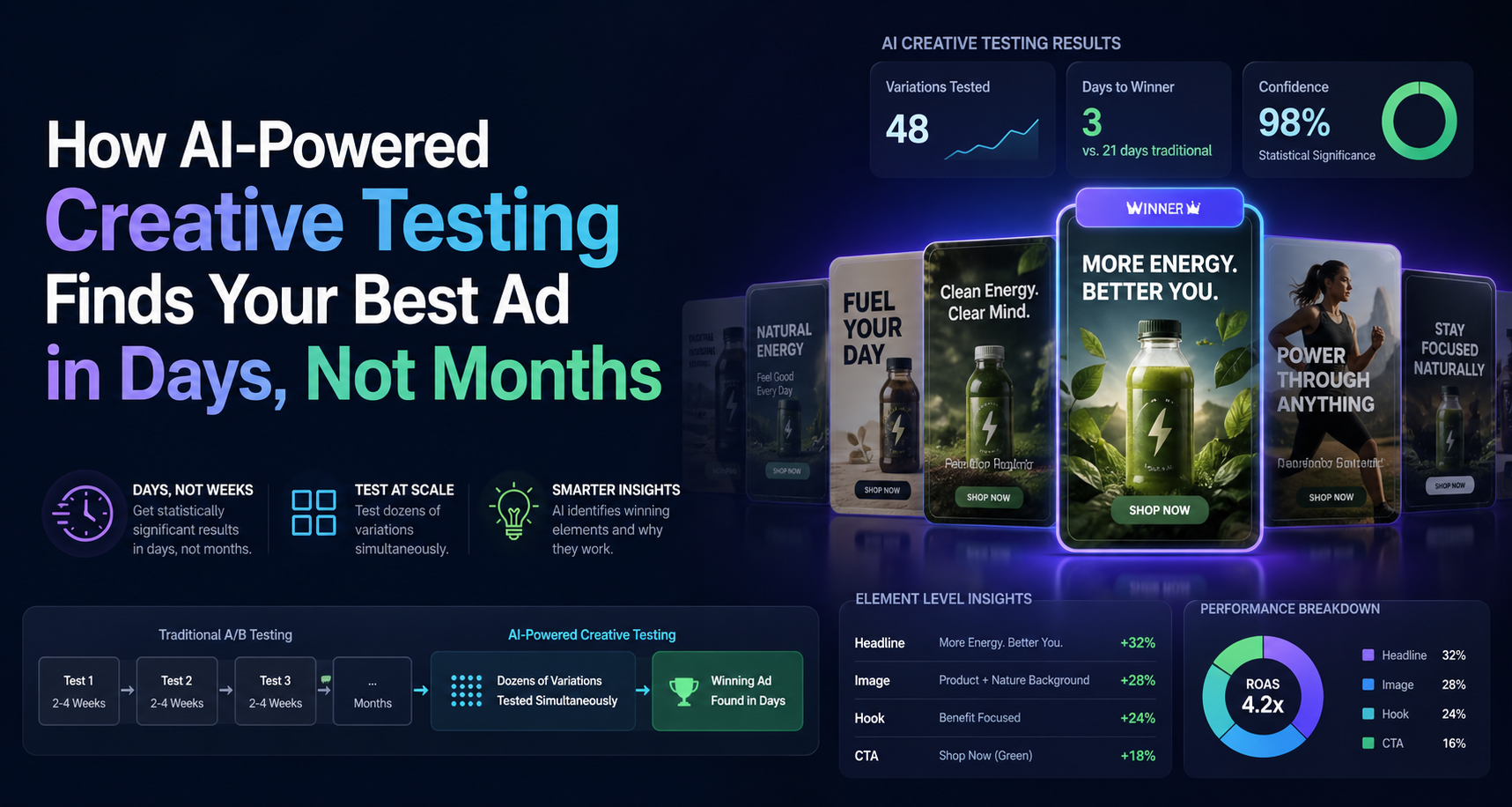
AI-powered creative testing changes all three of those constraints at once. AI agents can identify statistically significant creative winners in two to five days, compared to the seven to fourteen day testing cycles typical of manual A/B testing. XPath Labs They do it by running dozens or hundreds of variations simultaneously, analyzing performance in real time, and reallocating budget toward winners before a human reviewer would even have enough data to draw a conclusion.
This guide explains how that works, why it is faster, what it can tell you that traditional testing cannot, and how to structure your creative process to take advantage of it.
Part I: Why Traditional Creative Testing Was Always Slow
To appreciate what AI testing changes, it helps to understand precisely why the old approach was so slow — not because it was poorly designed, but because of fundamental constraints in how statistical confidence is built.
Traditional A/B testing works by splitting your audience into two groups, showing each group one version of an ad, and measuring which version produces more of the outcome you care about. The insight it generates is reliable, but it comes with a time requirement that scales with the number of variables you want to test.
Manual variation creation requires marketers to brainstorm and create each test variation — time-intensive and limited by human creativity and bandwidth. Binary comparisons typically test two variations at a time, meaning you need multiple sequential tests to evaluate several options. Extended timelines require large sample sizes and extended run times, often two to four weeks, to reach statistical significance. Limited scope means resource constraints mean teams can only run a few tests at once, leaving many optimization opportunities unexplored. Nutshell
The sequential nature is the core problem. If you want to test five different images, three different headlines, and two different calls to action, you have thirty possible combinations. Testing those sequentially through traditional A/B testing — running each pair for two weeks before moving to the next — could take over a year to complete. By the time you finish, the audience has changed, the platform algorithm has changed, and the competitive landscape has changed. The results may no longer apply.
There is also the interaction problem. Traditional A/B testing tells you that Headline A outperforms Headline B. It does not tell you whether Headline A outperforms Headline B specifically when combined with Image 3 and CTA 2. Creative elements do not perform independently — they interact with each other. A headline that works brilliantly with one visual might fall flat with another. Traditional testing misses those interactions entirely.
Part II: What AI Testing Does Differently
AI-powered creative testing addresses both problems — speed and scope — through a fundamentally different approach to how variations are tested and how performance data is processed.
Parallel Testing at Scale
The speed difference is transformative. Manual testing might take four to six weeks to identify a winning combination through sequential A/B tests. AI optimization can surface top performers within days by testing everything simultaneously and continuously analyzing results as data accumulates. AdStellar
Instead of testing two ads against each other, AI systems can test twenty, fifty, or a hundred variations simultaneously — each getting a portion of the budget, each generating performance data, and the system continuously reallocating impressions toward the variants showing the strongest early signals.
AI-powered creative testing enables digital marketing agencies to test twenty or more ad creative variants simultaneously versus the traditional three to five, identify statistically significant winners in days instead of weeks, and generate granular insights about which creative elements drive performance across different audiences and platforms. XPath Labs
Real-Time Statistical Analysis
The speed advantage is not just from running more tests simultaneously. It comes from how AI systems process the data those tests generate.
A creative that has a great Tuesday is not necessarily a winner. A creative that consistently outperforms across three days with sufficient impression volume probably is. The balance is between reacting quickly to genuine signals and avoiding knee-jerk responses to statistical noise. AI helps by requiring minimum data thresholds before flagging performance changes. You get fast insights, but only when they are backed by enough data to be actionable. AdStellar
Traditional creative testing requiring four to six weeks to reach statistical significance means results arrive after creative has already begun fatiguing. Admetrics' Bayesian approach identifies winners with 85% or higher confidence in days, enabling budget reallocation while creative remains fresh and effective. This speed advantage compounds across testing cycles. Where traditional testing might evaluate eight to ten creative variations per quarter, AI-powered testing can evaluate thirty to forty variations in the same timeframe, dramatically accelerating learning velocity and creative iteration. Admetrics
Element-Level Intelligence
Perhaps the most significant advantage of AI creative testing over traditional A/B testing is not just speed — it is the type of insight generated.
Unlike traditional A/B testing, AI-driven creative testing leverages machine learning algorithms to analyze multiple variables simultaneously, uncover patterns, and optimize ads in real time. Multivariate analysis tests dozens of creative elements — headlines, images, CTAs — at once instead of comparing just two versions. Prose
The result is not just "Ad A beats Ad B." It is "this headline consistently outperforms with cold audiences aged 25 to 34, while this image drives higher conversion specifically on mobile placements, and this combination of hook plus CTA produces 40% lower CPA in this product category." Instead of broad insights like "Creative A wins," you get actionable granularity: "Creative A resonates with value-driven millennials on mobile, but not with Gen X professionals on desktop." Datadynamix
That granularity is what transforms a testing result into a creative brief for the next round.
Part III: The Numbers Behind the Speed Advantage
The performance data on AI creative testing is compelling enough to make the case quantitatively.
After implementing AI testing frameworks across $40 million in ad spend, ATTN Agency reduced time-to-winner from 21 days to 7 days while improving winning creative identification accuracy by 73%. Attnagency
Average brands now test 47 creative variations per month, up from 12 in 2025. Top-performing brands test 200 or more variations monthly with AI acceleration. Attnagency The gap between average testing volume and top-performer testing volume is the gap between finding occasional winners and building a systematic machine for continuous creative improvement.
AI creative wins on click-through rate — 12% higher on Meta platforms compared to human-created ads targeting the same audiences with the same budgets — production speed, saving 20 hours per week, and variant volume, producing five to ten times more variations per testing cycle. Digital Applied
One case study showed a 58% ROAS increase and a 30% CPA drop just by testing over 2,000 ad variations automatically. Needle
These are not marginal improvements. They represent the compounding advantage of a system that finds winners faster, wastes less budget on losers, and generates more learning per dollar of ad spend.
Part IV: How AI Creative Testing Actually Works in Practice
Understanding the mechanics of how AI creative testing operates helps you structure your creative production process to take full advantage of it.
Step 1: Build a Modular Creative Library
AI creative testing works by combining elements — it is not evaluating finished ads, it is evaluating the components that make up ads and finding which combinations perform best. This requires a different approach to creative production.
Instead of starting from intuition, the brief starts with AI-generated insights. Example output: "Based on 90-day performance data, creatives featuring product-in-use imagery, a question-based hook under three seconds, and a specific price point in the CTA have outperformed other formats by 40% in this vertical." With a data-informed brief, the creative team produces fifteen to twenty-five variants per testing cycle. The AI's analysis provides enough specificity that even junior creatives can produce on-brief variants. XPath Labs
The creative team's output shifts from finished ads to modular components: five headline options, four image concepts, three video hook approaches, three CTA variations. These components feed the testing engine rather than arriving as complete units.
Step 2: Deploy Tests Automatically
The AI agent structures and launches tests across platforms, allocating budget optimally and configuring audience segments. XPath Labs Rather than manually setting up each test in each platform's ad manager, AI systems handle the combination logic, the launch sequencing, and the initial budget allocation. A testing cycle that would take several hours of manual setup runs in minutes.
Step 3: Monitor and Reallocate in Real Time
Performance shifts happen fast. An audience saturates. A creative fatigues. A competitor launches a similar offer. By the time you notice the pattern in your weekly report, you have already wasted budget. AI catches these shifts in real time, flagging underperformers and surfacing opportunities while you can still act on them. AdStellar
This real-time reallocation is where much of the budget efficiency advantage lives. In a traditional testing setup, an underperforming creative continues running until the next manual review. In an AI system, the budget starts shifting away from underperformers the moment the performance data justifies it — which might be hours into the campaign, not days.
Step 4: Graduate Winners and Build Institutional Knowledge
The beauty of this process is that it compounds over time. Each campaign teaches the AI more about what works for your specific products and audiences. Your winners hub fills with proven performers you can remix and reuse. What once took weeks now takes hours, and your creative testing velocity increases dramatically. AdStellar
Every testing cycle adds to a growing body of evidence about what resonates with your specific audience. Over time, the creative briefs get sharper, the winners emerge faster, and the gap between your testing velocity and that of a competitor running traditional testing becomes a durable competitive advantage.
Part V: Creative Fatigue — The Problem AI Catches Before You Do
One of the most underrated benefits of AI-powered creative testing is not how it finds winners. It is how it catches losers before they do significant damage.
Ad creative that generated strong ROAS three months ago now barely breaks even. Customers see hundreds of ads daily, developing banner blindness and creative fatigue faster than ever. Research shows that winning creatives on platforms like Facebook and TikTok now decline in performance 40 to 60 percent faster than they did two years ago. Admetrics
In a traditional management approach, creative fatigue is discovered reactively. You notice CPA rising or CTR declining, trace the cause back to overexposure of a single creative, and scramble to produce replacements. By the time you have the replacement ready, you have often spent weeks — and significant budget — on a creative that was already deteriorating.
Admetrics monitors creative performance trajectories in real time, detecting early fatigue signals like declining click-through rates, increasing cost per acquisition, or dropping conversion rates before they become significant problems. The platform automatically flags when additional data is needed versus when early signals reliably predict long-term performance. Admetrics
The practical workflow change this enables: rather than creating replacements in response to fatigue, you build creative refresh into your production calendar proactively. You know — based on your specific audience's engagement decay patterns — roughly when each creative will need to be rotated out, and you have replacements ready before performance drops.
Part VI: What AI Creative Testing Cannot Do
An honest treatment of this topic requires acknowledging what AI creative testing is not good at — because over-reliance on any automated system produces its own problems.
AI cannot generate the creative insight that informs the brief. The algorithms identify which elements perform. They do not understand why those elements resonate at a human level, what cultural context makes a message land, or what your brand stands for. The human creative director's job of understanding the audience deeply enough to brief creative work that connects emotionally — that remains irreducibly human.
AI performs better on known territory than unknown. Testing systems learn from your historical performance data. When you test a radically new creative direction — a format your brand has never used, a messaging approach with no precedent in your account — the AI has less to guide its analysis and the results take longer to be meaningful.
Automation without strategy scales poor results efficiently. If your conversion tracking is misconfigured, your audience targeting is too broad, or your landing page creates friction that kills conversions the ad generates, AI creative testing will efficiently eliminate creative after creative trying to overcome problems that live elsewhere in the funnel. The creative cannot fix a broken conversion path.
Human oversight remains non-negotiable. Successful AI creative testing requires balancing automation with human oversight. Clear hypotheses form the foundation — define what you are learning and what success looks like before launching tests. Statistical significance remains crucial even with AI processing. Brand consistency guardrails prevent AI from generating assets that conflict with your identity. Attnagency
Part VII: How to Start
For businesses that have been running traditional creative testing and want to move toward AI-powered testing, the transition does not require rebuilding everything at once.
Start with your best-performing campaign. AI testing systems learn from your data. Starting with a campaign that already has meaningful conversion volume gives the system better signal to work from. Start AI ad testing with your current best-performing campaigns rather than struggling campaigns. AI needs good baseline data to identify winning patterns effectively. Madgicx
Shift your creative production model before you shift your testing model. The biggest barrier to AI creative testing is not the testing technology — it is the production pipeline. Most creative teams produce finished ads. AI testing needs modular components. Shifting how your creative team thinks about output — from finished ads to building blocks — is the prerequisite for testing at meaningful scale.
Set realistic expectations for the learning period. Allow four to eight weeks for proper AI learning and optimization. Attnagency The speed advantage of AI testing is real. But the system is learning your specific audience and product category, and it takes time to build the performance baseline that makes its recommendations reliable.
Build a refresh cadence into your launch plan. Given that DCO ad sets experience measurable fatigue within three to four weeks if no components are refreshed, RocketShip HQ treat the launch creative as the first phase of a rolling production process, not the final output. Plan what new components enter the testing rotation at week three and week six from the beginning.
Conclusion: Velocity Is Now the Competitive Advantage
The brands that win at paid advertising in 2026 are not necessarily the ones with the best creative instincts. They are the ones with the fastest feedback loops — the ones that get from creative hypothesis to validated winner in days rather than months, and who turn those validated wins into the next creative brief before competitors have finished analyzing their last A/B test.
Your competitive advantage in 2026 is not having better creative ideas — it is having the systems to test and optimize those ideas faster and more effectively than anyone else in your space. Attnagency
AI-powered creative testing is not a replacement for strong creative judgment. It is the infrastructure that makes strong creative judgment more valuable — by finding out faster which creative judgments were right, concentrating budget behind the ones that were, and generating the data that makes the next round of creative judgment even more informed.
The testing bottleneck that has always existed in advertising is, for the first time, actually solvable. The question is whether your current creative process is structured to take advantage of that.
Sources
AdStellar — Best AI Creative Testing Platforms: Complete 2026 Guide (adstellar.ai)
AdStellar — AI Ad Creative Optimization: Complete Guide 2026 (adstellar.ai)
AdStellar — AI Insights for Ad Performance: Complete Guide 2026 (adstellar.ai)
AdStellar — Facebook Ads Creative Automation: Complete Guide 2026 (adstellar.ai)
ATTN Agency — AI Creative Testing Performance Analysis: What's Actually Working in 2026 (attnagency.com)
ATTN Agency — AI-Powered Creative Testing: How to Find Winning Ads 3x Faster (attnagency.com)
XPath Labs — AI-Powered Creative Testing at Scale: Agency Guide 2026 (xpathlabs.ai)
Admetrics — Best Automated Creative Testing Platforms 2026 Guide (admetrics.io)
Digital Applied — AI Ad Creative Benchmarks 2026: CTR and ROAS Data (digitalapplied.com)
Prose Media — How AI-Driven Ad Creative Testing Uncovers Winning Campaigns Faster (prosemedia.com)
Fetch and Funnel — AI Creative Testing: 10 Powerful Wins for Smarter Ads (fetchfunnel.com)
Data Dynamix — Performance-Based Creative Testing: Beyond A/B Ads (data-dynamix.com)
Madgicx — AI Ad Testing: Scale E-commerce Ads Significantly Faster (madgicx.com)
AdSkate — Why Creative Analysis Thrives on Multivariate Testing (adskate.com)
Want to build a creative testing system that finds winners faster and compounds those learnings into every campaign you run? Let's talk → ritnerdigital.com/#contact
Ritner Digital helps businesses across South Jersey and the greater Philadelphia region build paid media systems that test smarter, scale winners faster, and waste less budget on creative that was never going to work.
Frequently Asked Questions
What is AI-powered creative testing and how is it different from traditional A/B testing?
Traditional A/B testing compares two versions of an ad sequentially — you run version A against version B, wait two to four weeks for enough data to reach statistical significance, pick the winner, and start the next test. AI-powered creative testing runs twenty, fifty, or even a hundred variations simultaneously, analyzes performance data in real time, and reallocates budget toward winning combinations before a human reviewer would have enough information to draw any conclusions. The result is not just faster results — it is a fundamentally different type of insight. Traditional testing tells you which finished ad won. AI testing tells you which specific elements, in which combinations, perform best with which audience segments, giving you the intelligence to brief better creative on the next cycle.
How much faster is AI creative testing compared to traditional methods?
The speed difference is significant and well-documented. Traditional A/B testing typically requires seven to fourteen days to reach statistical significance for a single test. AI-powered systems identify statistically significant winners in two to five days by processing more data points simultaneously and applying statistical models that detect meaningful signals earlier in the data stream. At the campaign level, what used to take a quarter to learn — evaluating eight to ten creative variations — can now be accomplished in the same timeframe with thirty to forty variations evaluated. One agency documented reducing their time-to-winner from 21 days to 7 days across $40 million in managed ad spend. The compounding effect over a year of testing cycles is where the real advantage accumulates.
Why does testing more creative variations matter so much?
The math is straightforward. The more meaningful variations you test, the higher the probability that you find a truly high-performing combination rather than just the best of a limited field. A team testing five variations per month might find a solid performer. A team testing fifty variations per month in the same budget will find that solid performer plus discover the outlier — the unexpected combination that outperforms everything else by a significant margin. Top-performing brands in 2026 test more than two hundred creative variations per month. Average brands test around forty-seven. That gap in testing velocity translates directly into a gap in the quality of creative running in their accounts and the speed at which they find and scale winners.
What does a modular creative library mean and why does AI testing require one?
A modular creative library is a production approach where your creative team produces components — multiple headline options, multiple visual concepts, multiple video hooks, multiple calls to action — rather than finished ads. AI creative testing combines these components and evaluates every permutation, identifying which combinations perform best. If you produce finished ads instead of modular components, the AI can only test as many variations as you have completed ads. If you produce five headlines, four images, and three CTAs as separate components, the AI can test sixty combinations from those same assets. The shift from producing finished ads to producing building blocks is the production model change that unlocks testing at meaningful scale.
How does AI creative testing handle creative fatigue?
Creative fatigue — the performance degradation that occurs when an audience has seen the same ad too many times — is one of the most expensive problems in paid advertising. Traditional management discovers fatigue reactively: you notice CPA rising, trace it back to overexposure of a specific creative, and scramble to produce replacements while continuing to spend on a deteriorating asset. AI creative testing handles this proactively by monitoring engagement decay patterns in real time and flagging early fatigue signals — declining click-through rates, rising cost per acquisition, dropping conversion rates — before they become significant budget problems. The practical implication is that you can build a creative refresh cadence into your production calendar based on predicted fatigue timelines rather than reacting to performance drops after they have already cost you money.
Does AI creative testing work for small budgets or only for large advertisers?
It works across budget levels, but there are practical constraints. AI testing systems learn from conversion data — the more conversions they have to analyze, the faster and more accurately they identify winners. At very low spend levels where conversion events are rare, the learning period takes longer and early results carry more uncertainty. The practical threshold where AI creative testing delivers its full speed advantage is roughly $3,000 to $5,000 per month in ad spend generating at least thirty conversions per month. Below that threshold, the system is working with limited data and results should be treated as directional rather than definitive. Above that threshold, the speed and scale advantages become increasingly pronounced as the AI has more signal to work from.
What kind of creative elements can AI test simultaneously?
The scope of what AI systems can test simultaneously is far broader than what traditional sequential testing could address. On any given campaign, AI can test multiple headline variations, multiple image or video concepts, multiple video hook lengths and styles, multiple calls to action, multiple ad copy lengths and tones, multiple offer framings, multiple visual formats for the same content, and multiple combinations of all of those elements across different audience segments. The AI evaluates not just which individual elements perform best in isolation but which combinations of elements produce the best outcomes together — capturing the interaction effects that single-variable A/B testing misses entirely. This is particularly valuable because creative elements rarely perform independently in practice. A headline that works brilliantly with one visual may fall flat with another.
What happens to my budget while AI is testing variations?
AI creative testing systems allocate budget dynamically across the variations being tested, with more budget flowing toward variations showing stronger early signals. The system is not spending equally across all variants indefinitely — it is continuously shifting resources based on performance data in real time. Underperforming variations get less budget automatically. Strong performers get more. This means the budget spent during the testing phase is itself being optimized rather than being spent equally on a mix of winners and losers. The inefficiency of traditional testing — where you continue spending on a clearly underperforming variation until the test period ends — is substantially reduced because the AI can begin reallocating much earlier than a human review cycle would catch the issue.
How do I make sure AI-generated or AI-selected creative stays on-brand?
This requires intentional governance rather than trusting the AI to self-police. Before running any AI creative testing, establish explicit brand guardrails: approved color palettes, typography and visual style guidelines, approved messaging frameworks, prohibited language and imagery, and tone of voice parameters. These guardrails should be built into the brief that generates creative components and should be enforced through human review before any AI-generated or AI-selected creative goes live. AI creative testing is most reliable when it is testing variations within a defined brand framework, not when it is generating entirely unconstrained creative. Think of the guardrails as the fence that keeps the AI operating in your brand's territory while still giving it significant room to optimize within that space.
How long does it take to see meaningful results from AI creative testing?
The speed advantage kicks in immediately for individual test cycles — winners surface in days rather than weeks. But the larger benefit of AI creative testing — the accumulation of creative intelligence about what works for your specific audience and product category — builds over time. Most teams see meaningful improvements in creative performance within the first four to eight weeks of implementing a structured AI testing approach, as the system accumulates enough performance history to generate reliable pattern recognition. The compounding effect becomes most apparent at the three to six month mark, when the creative library has grown based on validated learnings and the briefs for new creative are substantially more informed than they were at launch. Teams that treat AI creative testing as a long-term capability rather than a one-campaign experiment extract significantly more value from it than those who run a single test cycle and evaluate from there.
Ready to build a creative testing system that finds winners in days instead of months and compounds those learnings into every campaign you run? Reach out to Ritner Digital.