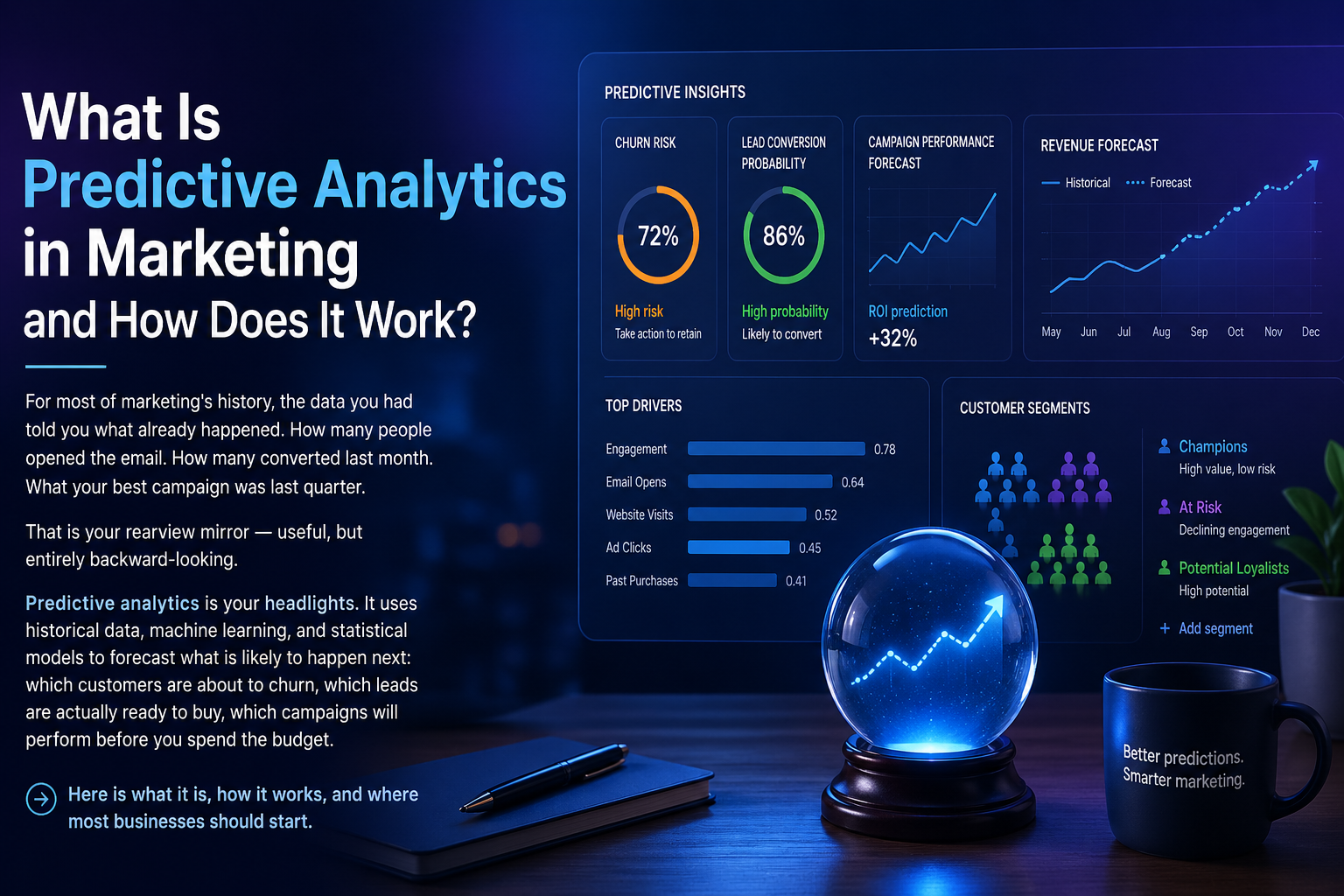
From Rearview Mirror to Headlights
For most of marketing's history, the data you had access to told you what already happened. How many people opened the email. How many clicked the ad. How many converted last month. What your best-performing campaign was last quarter. This is descriptive analytics — useful, necessary, and entirely backward-looking.
Descriptive analytics is your rearview mirror. It shows you where you have been with clarity, but it offers no visibility into what is coming.
Predictive analytics is your headlights. This shift from descriptive reporting to prescriptive action mirrors broader trends in digital marketing strategy. The marketing environment is more crowded, more expensive, and more complex, making it harder to generate results with traditional tactics. Thatagency
Predictive analytics is the use of historical data, machine learning, and statistical models to forecast future outcomes and behaviors before they occur. Businesses use it to reduce uncertainty and make faster, more confident decisions. Unlike descriptive and diagnostic analytics, which look backward, predictive analytics moves businesses from hindsight to foresight. It does not just report on the past — it actively anticipates what comes next. Ansi ByteCode LLP
The adoption numbers reflect how rapidly this has moved from an enterprise-only capability to a mainstream marketing tool. The global predictive analytics market grew from $18.02 billion in 2024 to $22.22 billion in 2025, projected to reach $91.92 billion by 2032. Google Analytics 4 includes predictive metrics for free. Mailchimp offers predictive demographics in standard plans. HubSpot provides predictive lead scoring in its Professional tier. Dataslayer
This guide explains what predictive analytics actually is, how it works mechanically, where it delivers the most value in a marketing context, and what you need to put in place before the technology can work effectively.
Part I: The Four Levels of Analytics
Predictive analytics makes the most sense when you understand where it sits in the broader analytics landscape. There are four levels of analytical capability, and most businesses are operating at level one or two when they need to be building toward three and four.
Descriptive analytics answers: what happened? This is standard reporting — campaign performance summaries, website traffic data, email open rates, conversion reports. Essential for understanding past performance, but it offers no strategic guidance because it only looks backward.
Diagnostic analytics answers: why did it happen? This is the deeper investigation layer — analyzing which audience segments performed differently, why a particular campaign underperformed, what changed between last quarter and this quarter. Still backward-looking, but more useful for improving future decisions.
Predictive analytics answers: what will happen next? Instead of waiting to see results, you are forecasting them before campaigns launch. Predictive models tell you which customers are likely to churn next month, which leads have the highest conversion probability, what products customers will purchase next, and which marketing channels will deliver the best ROI. You have moved from reactive to proactive marketing. ALM Corp
Prescriptive analytics answers: what should we do about it? The most advanced stage uses predictive insights to recommend specific actions. Prescriptive analytics does not just predict that certain customers will churn — it tells you exactly which retention offer to send each customer, when to send it, and through which channel. Dataslayer
Most organizations use descriptive analytics extensively and diagnostic analytics occasionally. The competitive gap opens up at the predictive level — where you are acting on what is about to happen rather than reacting to what already did.
Part II: How Predictive Analytics Actually Works
The mechanics of predictive analytics follow a consistent process regardless of the specific use case. Understanding this process helps you evaluate whether a tool is genuinely predictive or just descriptive analytics with better visualization.
Step 1: Data Collection and Unification
Predictive analytics starts with gathering data from the places where your marketing lives. This might include website analytics, ad platforms, email tools, CRM systems, or sales databases. Each source adds another piece to the story. The aim is to capture a fuller picture of how people interact with your brand over time. Nexa Lab
The challenge most organizations face is that this data lives in separate systems — your CRM holds customer purchase history, your email platform holds engagement data, your ad platforms hold campaign performance, your website analytics holds behavioral data. When these systems do not talk to each other, the model can only see part of the picture.
While many brands have the necessary data to do this, it is often scattered around disconnected systems — like analytics software, email marketing platforms, loyalty tools, customer service solutions, eCommerce platforms, social media tools, and more. This creates data silos that prevent marketers from getting a clear understanding of their customers and hinders accurate predictions. That is why a good customer data platform is so crucial for making accurate predictions. CDPs unify customer data from different sources into one convenient database. Insider
Step 2: Data Cleaning and Preparation
Raw data is almost never clean enough for a predictive model to work with reliably. Predictive models are only as reliable as the data they are trained on. Missing values, duplicates, and outdated records distort outputs and produce inaccurate forecasts. Gartner predicts that through 2026, organizations will abandon 60% of AI projects unsupported by AI-ready data. Skipping proper data hygiene does not just slow the process — it invalidates everything downstream. Ansi ByteCode LLP
This step is unglamorous and time-consuming, but it is not optional. A predictive model trained on poor data will generate confident-sounding predictions that are systematically wrong.
Step 3: Model Selection and Training
A predictive model is a tool's algorithmic approach to interpreting data and generating predictions. Many predictive marketing tools include several pre-built models designed to yield different types of insights. Businesses select and apply predictive models based on their goals and applications. Shopify
The main model types relevant to marketing:
Classification models answer yes or no questions. Will this lead convert? Will this customer churn? Is this subscriber likely to engage with this email? Classification models sort customers into categories, such as "most likely to convert" and "least likely to convert," based on behavioral patterns. Monday.com
Regression models predict specific numbers. What will this customer's next purchase value be? What revenue will this campaign generate? How many units will sell next month?
Time series models analyze patterns across time. When will demand peak? When is this customer likely to make their next purchase? When will a subscriber disengage?
Clustering models group customers by behavior. A fitness app clusters users into "morning exercisers," "weekend warriors," and "inconsistent users," then sends targeted messages to each group. Dataslayer These groupings emerge from the data rather than being defined in advance.
Step 4: Validation
Before any model goes live, it needs to be tested against historical data you held back specifically for this purpose. Split your historical data: training set at 70 to 80% — the model learns patterns from this data — and testing set at 20 to 30% — you check if predictions match actual outcomes. If your model predicts last quarter's conversions with 80% or higher accuracy, you can trust it for future forecasts. Dataslayer
Step 5: Activation — Turning Predictions Into Actions
This is where predictions become action. Validated insights are pushed directly into live marketing workflows — not reviewed in a report, but used to trigger real decisions in real time. Ansi ByteCode LLP
A churn prediction score that sits in a dashboard and requires someone to manually review it every week will produce some value. A churn prediction score that automatically triggers a retention email sequence when a customer crosses a risk threshold will produce significantly more. The activation layer — connecting the model output to an actual marketing action — is where most of the ROI lives and where many implementations fall short.
Part III: The High-Value Use Cases
Predictive analytics can theoretically be applied to almost any marketing question. In practice, the use cases that deliver the clearest return are well-established.
Lead Scoring
Traditional lead scoring assigns points based on fixed criteria — industry, company size, job title, whether someone downloaded a white paper. Predictive lead scoring replaces that static framework with a machine learning model that continuously updates a conversion probability score based on the full picture of behavioral signals.
Lead scoring improvements average a 20 to 30% increase in conversion rates and 25% reduction in sales cycle length. ALM Corp
A Texas-based B2B software firm uses predictive lead scoring inside Salesforce. Instead of contacting all leads, sales reps focus only on leads with a conversion probability above 70%. Result: shorter sales cycles and higher deal sizes. SaGeminieTech
The business logic is simple: the same sales team, contacting fewer but better-qualified leads, converts more of them because they are spending time on prospects that are actually ready to buy rather than working through a list that mixes high-intent buyers with people who downloaded a resource and never came back.
Churn Prediction
Predictive systems can identify engagement shifts up to six weeks before churn actually occurs. It gives teams a meaningful window to intervene with personalized offers or outreach before a customer is lost. Ansi ByteCode LLP
The economic case for churn prediction is compelling because retention is dramatically cheaper than acquisition. Churn prediction can reduce customer attrition by 15 to 25% when coupled with proactive retention campaigns. ALM Corp
Verizon built churn prediction models that flag subscribers showing early signs of disengagement — fewer logins, no purchases in 30 days, support ticket patterns. Instead of trying to win back customers after they cancel, which is expensive, they intervene early with targeted retention offers. Dataslayer
The key insight is timing. A retention offer sent to a customer who is actively considering leaving is worth far more than the same offer sent after they have already cancelled. Predictive churn models create the window for that intervention.
Customer Lifetime Value Prediction
Customer lifetime value forecasting sharpens marketing strategies by measuring the potential long-term value of each customer. Treating all customers the same often results in wasted budgets and missed opportunities. Predictive CLV forecasting replaces this guesswork with data-driven precision, pinpointing which relationships are worth the investment. Data-Mania, LLC
When you know which customers are likely to generate significantly more lifetime value than others, you can make smarter decisions at every stage: how much to spend acquiring similar customers, how aggressively to invest in retention for existing high-CLV customers, which segments deserve premium service treatment, and which acquisition channels are producing your most valuable customers rather than just your cheapest ones.
Businesses can calculate the maximum acceptable customer acquisition cost for different customer segments, optimizing their marketing spend. High-value customers can be given priority in customer service, improving their overall experience and increasing loyalty. LatentView Analytics
Campaign and Budget Optimization
Campaign optimization forecasts how your creative, channels, and messaging will perform before you launch, so you can put your budget in the right place. Monday.com
Rather than allocating budget based on last quarter's performance — which may not reflect current market conditions — predictive models incorporate historical data, seasonal patterns, competitive signals, and real-time performance data to recommend where budget should flow before the campaign launches and how it should shift as results come in.
Marketing mix optimization often improves marketing ROI by 15 to 30% through better budget allocation. ALM Corp
Personalization at Scale
Predictive marketing flips the script. Instead of waiting for signals and then responding, predictive intelligence uses data and analytics to forecast what customers will want or need in the future. In this way, you are always one step ahead. For example, if predictive analytics show that a certain type of product is becoming popular, you can ramp up your marketing before the trend hits its peak. Or, if the data suggests a customer might be losing interest in your brand, you can re-engage them with a personalized offer before they start looking elsewhere. Insider
Twilio's 2025 State of Customer Engagement Report found that 75% of businesses report increased customer spend as a direct result of personalization efforts. Predictive analytics is what makes personalization possible at scale. Ansi ByteCode LLP
Netflix deciding which thumbnail to show each user. Amazon recommending the next product before you have searched for it. Email marketing platforms sending each subscriber the email at the time they are most likely to open it. These are all predictive analytics at work — not magic, but pattern recognition applied at scale.
Part IV: What You Need Before Predictive Analytics Can Work
Understanding the use cases is straightforward. Getting the prerequisites in place is where most organizations struggle.
Sufficient historical data. Predictions are only as good as the patterns they are trained on. At minimum, you need 12 to 24 months of historical data showing customer behaviors and outcomes you want to predict. You typically need several hundred examples of the outcome you are predicting — if only 20 customers churned last year, you do not have enough data for a reliable churn model. ALM Corp
Data quality. The technical term is GIGO — garbage in, garbage out. A well-trained model on poor data will produce poor predictions with high confidence, which is worse than no prediction at all. Data quality requires ongoing maintenance: deduplication, standardization, and keeping records current as customer situations change.
Unified data infrastructure. Predictions that draw from only one data source miss the interactions between channels that often contain the most predictive signal. A customer's email engagement, combined with their website behavior and their purchase history, predicts churn far better than any single signal in isolation. Most U.S. and UK companies now unify these data sources through customer data platforms rather than storing data in silos. Data-Mania, LLC
Clear business objective before choosing a model. Focus on specific business problems, not technology. Define clear objectives like "reduce enterprise churn by 15%" before selecting platforms to avoid analysis paralysis and deliver measurable results. Monday.com Vague goals produce vague predictions. Specific goals — a particular churn rate, a target lead conversion improvement, a revenue forecast accuracy threshold — produce models that can be evaluated against real outcomes.
Activation infrastructure. A prediction that sits in a report and requires human review before action is taken at every instance will produce far less value than a prediction that automatically triggers the appropriate marketing response. Building the connection between model output and operational marketing action is as important as building the model itself.
Part V: Where Predictive Analytics Falls Short
Predictive analytics is not a crystal ball. Understanding its limitations is as important as understanding its capabilities.
Predictions are probabilities, not certainties. A model that predicts an 85% churn probability for a customer is telling you that customers with that behavioral profile churned 85% of the time historically. That specific customer may not churn. Acting on predictions means accepting that you will occasionally intervene for customers who did not need intervention and miss some who did. The goal is to be right more often than wrong at scale, not to be right every time.
Models drift as behavior changes. 91% of machine learning models suffer from model drift over time, and 85% of businesses report declines in AI performance without proper monitoring. Models must be regularly retrained as customer behavior shifts. Ansi ByteCode LLP A churn model trained on pre-pandemic customer behavior may produce very different predictions than an updated model trained on current data. Predictive systems require ongoing maintenance — they are not set-and-forget infrastructure.
Privacy regulations constrain the data available. As third-party cookies deprecate and privacy regulations tighten, the behavioral data available for model training is changing. As privacy rules change, these models rely more on first-party data, machine learning, and activity signals collected directly from your own channels. Nexa Lab Organizations that have invested in building strong first-party data assets are better positioned for predictive analytics in a privacy-constrained world than those who relied on third-party data.
Predictions can reinforce existing biases. A model trained on historical marketing data will inherit whatever biases existed in that marketing. If your historical campaigns concentrated spend on certain audience segments, the model will predict better performance in those segments — partly because they actually perform better and partly because they received more attention and investment. Predictive models can amplify existing patterns rather than help you discover new ones.
Part VI: Getting Started Without Overcomplicating It
For businesses that want to begin extracting value from predictive analytics without building a data science team from scratch, the entry points are more accessible than they might appear.
Five years ago, predictive models required PhDs and six-figure budgets. Today, Google Analytics 4, HubSpot, and Salesforce Einstein include built-in predictive features. Dataslayer
Start with one specific question. Pick one specific question: "Which email subscribers are most likely to make a first purchase in 30 days?" Use platform predictive features to segment that audience, send a targeted campaign, measure results. Dataslayer A focused first use case builds organizational confidence in predictive approaches and demonstrates measurable ROI before scaling to more complex applications.
Lead scoring and churn prediction are the best starting points. Start with lead scoring and churn prediction for quick wins. These two use cases deliver measurable revenue impact within months and require minimal technical complexity to implement. Monday.com Both have clear metrics, clear action triggers, and clear ROI pathways.
Build your data foundation in parallel. Whatever predictive tools you implement today will work better as your data quality and unification improve. Investing in a customer data platform or improving your CRM hygiene is not separate from your predictive analytics strategy — it is the prerequisite that makes everything else work better over time.
Conclusion: The Shift From Reactive to Proactive
Traditional analytics tells you 500 customers abandoned carts last month. Predictive analytics tells you which 200 customers will abandon carts this week, and why, so you can intervene before they bounce. Dataslayer
That is the fundamental value proposition. Not a better post-mortem. Not a clearer view of what already happened. A meaningful window to act on what is about to happen — before the budget is wasted, before the customer churns, before the campaign underperforms, before the lead goes cold.
Predictive marketing enables proactive, rather than reactive, strategies, allowing you to stay ahead of the curve. It also better ensures that every dollar spent is an investment toward reaching the right audience, with the right message, on the right channel. Insider
The technology to do this is no longer experimental or enterprise-exclusive. The data to power it exists in most businesses already — dispersed across systems, waiting to be unified and put to work. The organizational willingness to act on model outputs rather than intuition is the remaining variable that determines whether predictive analytics produces real results or remains a reporting capability that nobody acts on.
The rearview mirror will always be there. The question is whether you are ready to turn on the headlights.
Sources
Monday.com — Predictive Analytics in Marketing: 7 Use Cases That Drive ROI (2026) (monday.com)
Insider One — Predictive Marketing Strategies and Tools for 2026 (insiderone.com)
Ansibyte Code — Predictive Analytics in Marketing: A Complete Guide (ansibytecode.com)
Shopify — How Predictive Marketing Works for Small Businesses (2026) (shopify.com)
Keen — Predictive Analytics in Marketing: The Complete Guide (keends.com)
Nexalab — What Is Predictive Analytics in Marketing and How It Works (nexalab.io)
That Agency — Leveraging Predictive Analytics Marketing for Smarter Decisions (thatagency.com)
ALM Corp — Predictive Analytics in Marketing: AI Guide to Forecast Customer Behavior 2025 (almcorp.com)
OnSpot Data — Predictive Analytics in Marketing: Trends, Strategy & ROI (onspotdata.com)
Dataslayer — Complete Guide to Predictive Analytics for Marketers 2025 (dataslayer.com)
Dataslayer — Predictive Analytics Marketing: 57% Growth in 2025 (dataslayer.com)
Data-Mania — Predictive Analytics in Marketing: 10 Real-World Use Cases Driving Results (data-mania.com)
Analytics Magazine — Churn Prediction and Prevention: Using Data Analytics to Retain Customers(pubsonline.informs.org)
SAP Engagement Cloud — Predictive Analytics in Marketing: How Leading Brands Anticipate Customer Needs(emarsys.com)
Want to understand how predictive analytics could work for your specific business — and where to start? Let's talk → ritnerdigital.com/#contact
Ritner Digital helps businesses across South Jersey and the greater Philadelphia region build data-informed marketing strategies that move from reactive to proactive — using the right tools for the right stage of the journey.
Frequently Asked Questions
What is predictive analytics in marketing in simple terms?
Predictive analytics in marketing is the practice of using historical data and machine learning to forecast what is likely to happen next — before you have to find out the expensive way. Instead of analyzing what your customers did last month, predictive analytics tells you which customers are likely to buy in the next thirty days, which are likely to stop buying, and which leads are worth your sales team's time. The core shift is from backward-looking reporting to forward-looking forecasting. Traditional analytics is a rearview mirror. Predictive analytics is a set of headlights.
How is predictive analytics different from regular marketing analytics?
Regular marketing analytics — sometimes called descriptive analytics — tells you what already happened. Campaign performance, email open rates, conversion numbers, website traffic. It is entirely backward-looking. Predictive analytics uses those historical patterns to estimate what will happen next. Diagnostic analytics falls in between, helping you understand why something happened. The practical difference is that descriptive analytics informs your next decision with hindsight. Predictive analytics informs your next decision with foresight — which audience segment to target before the campaign launches, which customers to retain before they cancel, which leads to prioritize before your sales team calls.
What data does predictive analytics require?
Predictive analytics works by identifying patterns in historical data, so the data you need depends on what you want to predict. For lead scoring, you need records of past leads — their characteristics, their behaviors, and whether they ultimately converted. For churn prediction, you need behavioral data showing how customers who left behaved in the weeks and months before they left, compared to customers who stayed. For lifetime value prediction, you need purchase history, engagement data, and enough time to see how different customer segments develop over their relationship with your business. At minimum, most use cases require twelve to twenty-four months of historical data and several hundred examples of the outcome you are trying to predict. If you only had ten customers churn last year, you do not have enough data for a reliable churn model.
Is predictive analytics only for large enterprises with data science teams?
No longer. The tools have democratized significantly. Google Analytics 4 includes predictive metrics — purchase probability and churn probability — for free. HubSpot offers predictive lead scoring in its Professional tier. Salesforce Einstein provides predictive features built into its CRM. Mailchimp includes predictive demographics in standard plans. Most modern customer data platforms include built-in predictive capabilities that do not require custom model development. The honest caveat is that the more complex your use case and the more customization you need, the more technical expertise you require. But for standard applications like lead scoring and churn flagging, a business with clean CRM data and a willingness to configure existing tools can get meaningful predictive functionality without a data science team.
What is lead scoring and how does predictive analytics improve it?
Traditional lead scoring assigns point values to specific actions or attributes — downloading a white paper might be worth ten points, a job title match might be worth fifteen, attending a webinar twenty. The total score determines how hot a lead is. The problem is that the scoring criteria are set by human judgment and are static — they do not update as you learn more about which combinations of behaviors actually correlate with conversion. Predictive lead scoring replaces the static point system with a machine learning model that continuously analyzes which behavioral patterns, in which combinations, have historically produced conversions. It assigns a conversion probability to each lead that improves over time as it processes more data. The practical result is that your sales team spends time on prospects who are actually ready to buy, rather than working through a list that mixes high-intent buyers with people who downloaded a resource and went quiet.
What is churn prediction and how early can it identify at-risk customers?
Churn prediction is a predictive model that identifies customers likely to stop buying or cancel before they actually do. The model looks for early behavioral signals — declining engagement frequency, fewer logins, more support tickets, reduced purchase volume, changes in usage patterns — that historically preceded other customers leaving. Sophisticated predictive systems can identify engagement shifts up to six weeks before churn actually occurs, which creates a meaningful intervention window. The economic case is straightforward: retaining an existing customer costs significantly less than acquiring a new one. A retention offer sent to a customer who is actively considering leaving is far more valuable than a win-back campaign sent after they have already cancelled.
What is customer lifetime value prediction and why does it matter for marketing?
Customer lifetime value prediction uses historical purchase patterns, engagement data, and behavioral signals to estimate the total revenue a customer is likely to generate over their relationship with your business. It matters for marketing because it fundamentally changes how you allocate resources. When you know which newly acquired customers are likely to generate significantly more lifetime value than others, you can make smarter decisions about how much to spend acquiring similar customers, how aggressively to invest in retention for high-value accounts, which segments deserve personalized attention versus automated nurturing, and which acquisition channels are producing your most valuable customers rather than just your cheapest ones. Treating all customers the same when their predicted lifetime values differ dramatically is one of the most common sources of marketing budget waste.
How accurate are predictive analytics models?
Accuracy varies significantly depending on the use case, the quality and volume of the training data, and how recently the model was trained. Well-configured models for lead scoring achieve meaningful lifts in conversion rates — commonly reported improvements range from 20 to 30%. Churn prediction models, when coupled with proactive retention programs, typically reduce attrition by 15 to 25%. Marketing mix optimization frequently improves marketing ROI by 15 to 30%. That said, predictions are probabilities, not certainties. A model predicting 85% churn risk is saying that customers with that behavioral profile churned 85% of the time historically — the specific customer in front of you may not churn. The goal of predictive analytics is to be right more often than wrong at scale, not to be right every single time.
What causes predictive models to stop working accurately over time?
Model drift — the gradual degradation of a model's accuracy as real-world conditions change away from the patterns the model was trained on. Customer behavior shifts. Market conditions change. New channels and touchpoints emerge that were not part of the training data. A model trained on customer behavior before a major economic shift or before a new platform became dominant may produce systematically incorrect predictions based on patterns that no longer apply. This is why predictive models require ongoing monitoring and periodic retraining. The recommended cadence depends on how quickly your customer behavior evolves — businesses in fast-moving categories may need monthly retraining, while more stable industries might maintain accuracy with quarterly updates.
Where should a business start with predictive analytics if they have never done it before?
Start with one specific, measurable question tied to a clear business outcome. "Which of our current customers are most likely to churn in the next sixty days?" is a good starting question. "Which leads in our current pipeline have the highest conversion probability?" is another. Both have clear metrics, clear action triggers, and clear ROI pathways that make it easy to evaluate whether the predictive approach is working. Use the predictive features already built into tools you are likely already paying for — Google Analytics 4, HubSpot, Salesforce, or your email platform — before investing in dedicated predictive analytics infrastructure. Run the prediction, act on it, measure whether the intervention worked, and use that result to build organizational confidence before expanding to more complex use cases.
Want to understand how predictive analytics could apply to your specific marketing challenges — and where the highest-impact starting point is for your business? Reach out to Ritner Digital.
Frequently Asked Questions
What is predictive analytics in marketing in simple terms?
Predictive analytics in marketing is the practice of using historical data and machine learning to forecast what is likely to happen next — before you have to find out the expensive way. Instead of analyzing what your customers did last month, predictive analytics tells you which customers are likely to buy in the next thirty days, which are likely to stop buying, and which leads are worth your sales team's time. The core shift is from backward-looking reporting to forward-looking forecasting. Traditional analytics is a rearview mirror. Predictive analytics is a set of headlights.
How is predictive analytics different from regular marketing analytics?
Regular marketing analytics — sometimes called descriptive analytics — tells you what already happened. Campaign performance, email open rates, conversion numbers, website traffic. It is entirely backward-looking. Predictive analytics uses those historical patterns to estimate what will happen next. Diagnostic analytics falls in between, helping you understand why something happened. The practical difference is that descriptive analytics informs your next decision with hindsight. Predictive analytics informs your next decision with foresight — which audience segment to target before the campaign launches, which customers to retain before they cancel, which leads to prioritize before your sales team calls.
What data does predictive analytics require?
Predictive analytics works by identifying patterns in historical data, so the data you need depends on what you want to predict. For lead scoring, you need records of past leads — their characteristics, their behaviors, and whether they ultimately converted. For churn prediction, you need behavioral data showing how customers who left behaved in the weeks and months before they left, compared to customers who stayed. For lifetime value prediction, you need purchase history, engagement data, and enough time to see how different customer segments develop over their relationship with your business. At minimum, most use cases require twelve to twenty-four months of historical data and several hundred examples of the outcome you are trying to predict. If you only had ten customers churn last year, you do not have enough data for a reliable churn model.
Is predictive analytics only for large enterprises with data science teams?
No longer. The tools have democratized significantly. Google Analytics 4 includes predictive metrics — purchase probability and churn probability — for free. HubSpot offers predictive lead scoring in its Professional tier. Salesforce Einstein provides predictive features built into its CRM. Mailchimp includes predictive demographics in standard plans. Most modern customer data platforms include built-in predictive capabilities that do not require custom model development. The honest caveat is that the more complex your use case and the more customization you need, the more technical expertise you require. But for standard applications like lead scoring and churn flagging, a business with clean CRM data and a willingness to configure existing tools can get meaningful predictive functionality without a data science team.
What is lead scoring and how does predictive analytics improve it?
Traditional lead scoring assigns point values to specific actions or attributes — downloading a white paper might be worth ten points, a job title match might be worth fifteen, attending a webinar twenty. The total score determines how hot a lead is. The problem is that the scoring criteria are set by human judgment and are static — they do not update as you learn more about which combinations of behaviors actually correlate with conversion. Predictive lead scoring replaces the static point system with a machine learning model that continuously analyzes which behavioral patterns, in which combinations, have historically produced conversions. It assigns a conversion probability to each lead that improves over time as it processes more data. The practical result is that your sales team spends time on prospects who are actually ready to buy, rather than working through a list that mixes high-intent buyers with people who downloaded a resource and went quiet.
What is churn prediction and how early can it identify at-risk customers?
Churn prediction is a predictive model that identifies customers likely to stop buying or cancel before they actually do. The model looks for early behavioral signals — declining engagement frequency, fewer logins, more support tickets, reduced purchase volume, changes in usage patterns — that historically preceded other customers leaving. Sophisticated predictive systems can identify engagement shifts up to six weeks before churn actually occurs, which creates a meaningful intervention window. The economic case is straightforward: retaining an existing customer costs significantly less than acquiring a new one. A retention offer sent to a customer who is actively considering leaving is far more valuable than a win-back campaign sent after they have already cancelled.
What is customer lifetime value prediction and why does it matter for marketing?
Customer lifetime value prediction uses historical purchase patterns, engagement data, and behavioral signals to estimate the total revenue a customer is likely to generate over their relationship with your business. It matters for marketing because it fundamentally changes how you allocate resources. When you know which newly acquired customers are likely to generate significantly more lifetime value than others, you can make smarter decisions about how much to spend acquiring similar customers, how aggressively to invest in retention for high-value accounts, which segments deserve personalized attention versus automated nurturing, and which acquisition channels are producing your most valuable customers rather than just your cheapest ones. Treating all customers the same when their predicted lifetime values differ dramatically is one of the most common sources of marketing budget waste.
How accurate are predictive analytics models?
Accuracy varies significantly depending on the use case, the quality and volume of the training data, and how recently the model was trained. Well-configured models for lead scoring achieve meaningful lifts in conversion rates — commonly reported improvements range from 20 to 30%. Churn prediction models, when coupled with proactive retention programs, typically reduce attrition by 15 to 25%. Marketing mix optimization frequently improves marketing ROI by 15 to 30%. That said, predictions are probabilities, not certainties. A model predicting 85% churn risk is saying that customers with that behavioral profile churned 85% of the time historically — the specific customer in front of you may not churn. The goal of predictive analytics is to be right more often than wrong at scale, not to be right every single time.
What causes predictive models to stop working accurately over time?
Model drift — the gradual degradation of a model's accuracy as real-world conditions change away from the patterns the model was trained on. Customer behavior shifts. Market conditions change. New channels and touchpoints emerge that were not part of the training data. A model trained on customer behavior before a major economic shift or before a new platform became dominant may produce systematically incorrect predictions based on patterns that no longer apply. This is why predictive models require ongoing monitoring and periodic retraining. The recommended cadence depends on how quickly your customer behavior evolves — businesses in fast-moving categories may need monthly retraining, while more stable industries might maintain accuracy with quarterly updates.
Where should a business start with predictive analytics if they have never done it before?
Start with one specific, measurable question tied to a clear business outcome. "Which of our current customers are most likely to churn in the next sixty days?" is a good starting question. "Which leads in our current pipeline have the highest conversion probability?" is another. Both have clear metrics, clear action triggers, and clear ROI pathways that make it easy to evaluate whether the predictive approach is working. Use the predictive features already built into tools you are likely already paying for — Google Analytics 4, HubSpot, Salesforce, or your email platform — before investing in dedicated predictive analytics infrastructure. Run the prediction, act on it, measure whether the intervention worked, and use that result to build organizational confidence before expanding to more complex use cases.
Want to understand how predictive analytics could apply to your specific marketing challenges — and where the highest-impact starting point is for your business? Reach out to Ritner Digital.