Old Bay on Everything: The Biggest Brands Born in Maryland and What the Old Line State Is Actually Buying
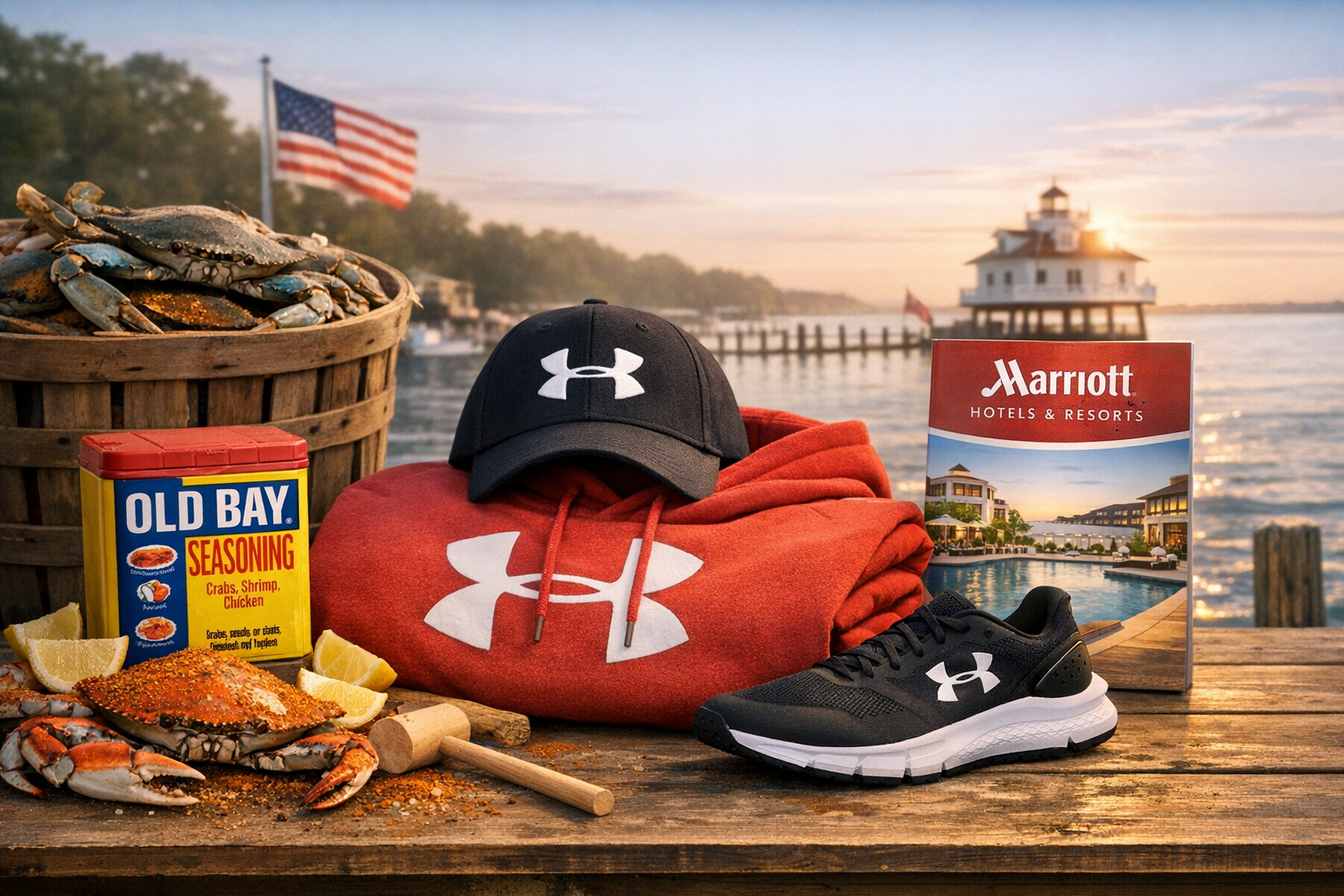
People hear "Maryland" and think crab cakes, the Chesapeake Bay, and maybe Ravens football. What they don't think about is that this small state on the mid-Atlantic coast is home to one of the most consequential collections of brands in America — from a spice tin that's become a cultural identity to a performance apparel company that rewrote the rules of athletic wear. And then there's the consumer side: a highly educated, high-income population that spends strategically, eats adventurously, and takes its local pride very seriously.
This is the second entry in Ritner Digital's State by State Brand Series. Welcome to the Old Line State.
The Brands That Made Maryland
Old Bay Seasoning — Baltimore, MD (Est. 1939)
There is no brand more synonymous with Maryland identity than Old Bay. It is not just a seasoning. It is a flag, a philosophy, and a personality trait. When thinking of uniquely Maryland brands, a few that always come to mind are Under Armour, Natty Boh, and of course, Old Bay. Marylanders are known for their brand loyalty — search Instagram and Twitter for #oldbay and you'll find hundreds of photos of people showing their Maryland pride with their favorite seasoning blend. Insight180
The founder of Old Bay, Gustav Brunn, was not a Baltimore native. Brunn and his family were German Jews who came to Baltimore in 1938 as escapees of Nazi Germany. Insight180 He created his signature blend — a mix of 18 herbs and spices — and named it after the Old Bay Line, a historic steamship company that ran between Baltimore and Norfolk. The brand was eventually acquired by McCormick & Company in 1990, which created a delicious irony: Old Bay was bought by McCormick, which is ironic because Brunn worked for them when he first came to Baltimore — for less than a week. Insight180
What makes Old Bay remarkable as a marketing story isn't the product — it's the loyalty infrastructure that's grown around it. Old Bay isn't just on crabs and shrimp anymore. It's on chips, popcorn, hot sauce, Bloody Marys, French fries, and increasingly, everything. Old Bay, created in Baltimore in 1939, is synonymous with crab feasts, but locals know it's good on everything from fries and popcorn to deviled eggs and Bloody Marys. It's Maryland pride in a can. The Roaming Nelsons The brand has extended into a full lifestyle licensing operation — apparel, towels, Apple Watch bands, windshield sun shades — all built on the equity of a 22-spice blend in a yellow tin.
For marketers, this is a masterclass: Old Bay never had to reinvent itself. It just had to let Marylanders be Marylanders.
Under Armour — Baltimore, MD (Est. 1996)
The origin story of Under Armour is the kind of thing business school professors put on PowerPoints: Under Armour was founded in 1996 by Kevin Plank, a former University of Maryland football player and special teams captain, who changed the way athletes dress forever with the introduction of UA HeatGear, a revolutionary baselayer that redefined performance apparel. Harbor East
Working from his grandmother's basement in Washington DC's Georgetown neighborhood, Plank traveled up and down the East Coast selling his revolutionary new product out of the trunk of his car. By the end of 1996, he made his first team sale, and Under Armour generated $17,000 in sales. Umterps Within a decade, it was a publicly traded company challenging Nike and Adidas for dominance of the global athletic apparel market.
The Maryland connection runs deep. In 2005, Under Armour signed an all-school deal with Plank's alma mater, the University of Maryland — and in 2003, the legendary "Protect This House" TV commercial, featuring former University of Maryland football standout Eric "Big E" Ogbogu, officially made Under Armour a household name. Umterps
Under Armour's story is also a lesson in the power of authenticity in brand building. It didn't start with a PR campaign or a Super Bowl spot. It started with a real athlete solving a real problem — sweaty cotton T-shirts during double sessions — and the credibility of that origin story still echoes in how the brand carries itself today.
Marriott International — Bethesda, MD (Est. 1927)
Marriott International holds the top position as Maryland's largest company by employee count. Zippia Founded by J. Willard Marriott — who started with a root beer stand in Washington, D.C. — the company grew into the world's largest hotel chain, with more than 30 brands and 9,000+ properties worldwide. Its headquarters in Bethesda makes Maryland the operational home of one of the most recognized hospitality brands on the planet.
Lockheed Martin — Bethesda, MD
The most valuable company in Maryland is Lockheed Martin with a market cap of nearly $150 billion. FinanceChartsWhile not a consumer brand in the traditional sense, Lockheed Martin's presence in Maryland — particularly in the defense corridor that runs from Bethesda through Montgomery County — shapes the economic character of the state's most affluent suburban markets. The density of defense contractors, federal agencies, and government-adjacent businesses in the DC suburbs directly influences the income levels and consumer behavior of a significant portion of Maryland's population.
McCormick & Company — Hunt Valley, MD (Est. 1889)
Speaking of Old Bay — its parent company is also a Maryland native. McCormick & Company has been headquartered in Maryland since 1889, making it one of the oldest consumer brands in the state's history. As the world's largest spice and flavor company, McCormick touches virtually every American kitchen, and the fact that it's a Maryland institution rarely gets the recognition it deserves. The company's Hunt Valley campus is a major employer in Baltimore County and a quiet pillar of the state's brand identity.
T. Rowe Price — Baltimore, MD (Est. 1937)
T. Rowe Price manages nearly $800 billion in assets and was founded in 1937. Fox Hill Residences For a state known for blue crabs and Old Bay, it's easy to overlook that Maryland is also a serious financial services hub. T. Rowe Price is one of the most respected investment management firms in the country, and its Baltimore headquarters represents the kind of long-standing institutional credibility that defines the state's professional culture.
National Bohemian Beer (Natty Boh) — Baltimore, MD (Est. 1885)
National Bohemian, known locally as Natty Boh, rounds out the trio of most iconic uniquely Maryland brands alongside Under Armour and Old Bay. Insight180 The one-eyed, mustachioed Mr. Boh is one of the most recognizable mascots in regional American brand history. Although production has long since moved out of state, the brand remains deeply embedded in Baltimore identity — a fixture at Orioles games, crab feasts, and anywhere Baltimoreans gather. It's a reminder that a brand's geographic and cultural equity can outlast its physical production roots by decades.
Fisher's Popcorn & Thrasher's French Fries — Ocean City, MD
Not every iconic Maryland brand is a Fortune 500 company. There's nothing quite like a day spent on the Boardwalk in Ocean City, enjoying Fisher's Popcorn and Thrasher's French Fries. Visit Maryland These two Ocean City institutions have built cult followings that Marylanders defend with the same ferocity they bring to any crab cake debate. Thrasher's fries — served in a bucket with vinegar and no ketchup, under threat of social death — and Fisher's caramel popcorn are beloved Maryland summer experiences masquerading as food products. They're what regional brand love looks like when it has nowhere to go but deeper.
What Maryland Consumers Are Actually Buying
A High-Income State That Shops Smart
Maryland is one of the wealthiest states in the country by median household income, and that shapes everything about how its residents shop. Maryland ranks third among states where residents spend the least percentage of their income on groceries. Residents on average devote just 1.55% of their monthly income to groceries. Patch This isn't because Marylanders are frugal — it's because they earn enough that even a fully stocked cart represents a small slice of the household budget.
People in Maryland spend $56,052 each year on goods and services on average, and residents spend $266.11 weekly on food at home. ConsumerAffairs The Baltimore-area inflation rate, meanwhile, sits at just 1.7% as of early 2026 — meaningfully lower than the national rate of 2.4% USAFacts — suggesting a consumer base that's navigating rising costs better than most of the country.
The Baltimore-DC Split
Understanding Maryland consumers means understanding that the state is functionally two different markets sharing a border. Baltimore and its surrounding counties form a dense, working-class-to-middle-class urban market with its own cultural identity, food traditions, and brand loyalties — Natty Boh, Old Bay, crab shacks, and Ravens gear. The DC suburbs — Montgomery County, Prince George's County, Howard County — are a different world: highly educated, higher income, more internationally diverse, and deeply influenced by the federal government ecosystem that defines the region.
Within the Baltimore metro area, medical care costs rose 4.2% year-over-year and apparel spending is up 6.2% Bureau of Labor Statistics — signals of a population that's still spending on health, wellness, and personal image even in an inflationary environment. For brands targeting the Baltimore consumer specifically, value and authenticity matter. For the DC suburb consumer, quality, credentials, and brand story carry more weight.
Grocery Loyalties Reflect the State's Two Personalities
Maryland's grocery landscape mirrors this split cleanly. Giant Food and Safeway dominate in the DC suburbs with strong brand recognition and loyalty program infrastructure. In Baltimore and its surrounding counties, Wegmans has developed a devoted following — particularly among higher-income shoppers in areas like Hunt Valley and Towson. Aldi and Lidl have made real inroads statewide, reflecting the same value-consciousness trend playing out nationally, even among a relatively affluent consumer base.
The Whole Foods and Trader Joe's footprints in Maryland are concentrated almost entirely in the DC suburbs and inner-ring Baltimore neighborhoods — which tells you exactly who is shopping there and what they prioritize. Maryland-roasted coffee brands like Chesapeake Bay Roasting Company, Zeke's, and Rise Up are popular with locals Visit Maryland, reflecting a consumer base that's happy to pay for quality when the local story is compelling.
The Crab Economy Is Real
Maryland's relationship with blue crabs goes well beyond tourism talking points — it's an active consumer economy. Crab season drives purchasing behavior across the entire state in ways that brands from outside the region consistently underestimate. Old Bay sales spike. Paper-covered picnic tables get booked out weeks in advance. The ritualistic nature of a Maryland crab feast — steamed hard shells, wooden mallets, cold Natty Boh, newspaper on the table — creates one of the most durable seasonal consumer habits in the American Mid-Atlantic. Brands that want to reach Maryland consumers in Q3 need to understand that the crab feast is not a niche event. It's a statewide institution.
McCormick's Influence on Maryland Food Culture
It's hard to overstate how much McCormick & Company shapes what Maryland consumers actually put in their carts. As the world's largest spice company with deep Maryland roots, McCormick's portfolio — which includes Old Bay, French's, Frank's RedHot, Lawry's, and dozens of other brands — lines the shelves of every grocery store in the state. Maryland consumers interact with McCormick products multiple times a week without necessarily thinking of it as a Maryland company. That invisible brand omnipresence is one of the most valuable forms of market dominance there is.
What Makes Maryland's Brand Ecosystem Unique
The government shadow effect. A significant portion of Maryland's consumer base works for the federal government, defense contractors, or the vast ecosystem of consultants, lobbyists, and agencies that orbit Washington D.C. This creates a consumer population that is unusually stable in its income — and unusually attuned to credibility, precision, and long-term value. Brands that come across as overhyped or under-delivered get filtered out quickly.
The Chesapeake identity. The Bay is not just geography — it's a value system for Maryland consumers. Environmental consciousness, local sourcing, and a deep connection to water-based food culture all shape purchasing decisions in ways that don't show up cleanly in national consumer data. Brands that align with Chesapeake culture — whether through genuine local sourcing, environmental commitments, or simply respecting the region's identity — earn a credibility bonus that money can't buy.
Small state, outsized brand legacy. Maryland punches well above its weight in terms of brand output. Under Armour, Natty Boh, and Old Bay represent three distinct categories of Maryland brand identity Insight180 — innovation-driven performance wear, nostalgic community pride, and cultural culinary identity. That range tells you something important about the state's brand DNA: Maryland doesn't have a single type of company it produces. It has range.
Local pride with an edge. Maryland consumers are proud, but they're not loud about it the way some states are. It's a quieter, more knowing kind of regional pride — the person who'll season their entire meal with Old Bay while explaining to you why the crab houses in Annapolis are superior to anything you'll find in Virginia. Brands that tap into this sensibility — with confidence rather than gimmickry — build deep roots fast.
The Marketing Takeaway for Brands in Maryland
Maryland is a state of contrasts that rewards brands willing to do the homework. Baltimore and the DC suburbs require different strategies, different tones, and in some cases different product positioning. The consumer base is smart, skeptical of hype, and extremely loyal to what it loves — which is both a challenge to break into and a massive reward once you do.
Old Bay didn't get on Apple Watch bands by accident. It got there because it understood that Maryland identity isn't just a feeling — it's a market. Brands that take that seriously, invest in local authenticity, and respect the cultural codes of the Chesapeake region will find consumers who don't just buy. They advocate.
Ritner Digital helps brands build sharper, more targeted marketing strategies at the local, regional, and national level. Want to talk about what your brand could look like in the Old Line State? Let's connect.
Sources: BLS Consumer Expenditure Surveys, WalletHub, USAFacts, ConsumerAffairs, Zippia, VisitMaryland.org, NJBIZ, Under Armour, Insight180, Maryland Matters, Finance Charts
Frequently Asked Questions
Is Old Bay actually still a Maryland company?
Technically, no — but culturally, absolutely yes. Old Bay was acquired by McCormick & Company in 1990, and McCormick itself is headquartered in Hunt Valley, Maryland, so the brand never fully left the state. The production and corporate ownership shifted, but the identity stayed rooted in Baltimore. This is actually a fascinating brand case study: Old Bay's Maryland equity is so strong that even after three decades under a corporate parent, most Marylanders still think of it as theirs. Few brands anywhere in the country can claim that kind of cultural staying power after an acquisition.
How did Under Armour grow so fast from a basement startup to a global brand?
The foundation was authenticity. Kevin Plank wasn't a marketer who dreamed up a product — he was an athlete who had a genuine problem with sweat-soaked cotton T-shirts during double sessions and built a solution. That credibility resonated immediately with other athletes. From there, early team sales to college football programs created grassroots visibility, and the "Protect This House" campaign in 2003 gave the brand a voice that felt earned rather than manufactured. The University of Maryland partnership also gave Under Armour a constant, high-visibility testing ground and a built-in regional fan base that grew with the brand nationally.
Why does Maryland rank so low in grocery spending as a percentage of income?
It comes down to high median household income rather than low food prices. Maryland consistently ranks among the top states for household earnings, driven by the concentration of federal government workers, defense contractors, tech professionals, and healthcare workers in the Baltimore-DC corridor. When your household income is high, even a well-stocked grocery run represents a smaller slice of your monthly budget. It doesn't mean Maryland consumers are getting better grocery prices — it means they're earning enough that the math works in their favor.
What's the biggest marketing mistake brands make when entering the Maryland market?
Treating it as a Washington DC suburb. A huge portion of Maryland's population — and its brand identity — is Baltimore-centric, and Baltimore has a fierce, distinct culture that doesn't take kindly to being overlooked or lumped in with the greater DC metro area. Brands that focus exclusively on Montgomery County and the DC suburbs miss an enormous and loyal consumer base in Baltimore City, Baltimore County, Anne Arundel County, and the Eastern Shore. Maryland is not one market. It's at least three, each with its own brand loyalties, spending habits, and cultural reference points.
How important is local sourcing and environmental identity to Maryland consumers?
Very — particularly in certain demographic pockets. The Chesapeake Bay is not just scenery for Maryland residents; it's a source of food, recreation, livelihood, and identity. Brands that align genuinely with Bay-area environmental values, support local watermen, or source seafood and produce responsibly within the region earn a level of trust that traditional advertising simply can't replicate. This is especially pronounced among higher-income consumers in the DC suburbs and Annapolis area, who are willing to pay premiums for products that reflect their environmental values. Performative sustainability messaging gets called out quickly. Substantive local commitment gets rewarded with loyalty.
Is National Bohemian Beer still actually brewed in Maryland?
No, and Marylanders are very aware of this — and have mostly made peace with it. Natty Boh production moved out of Baltimore decades ago and is now brewed by Pabst Brewing Company in various locations. But the mascot, the branding, and the cultural identity remain Baltimore institutions. You'll still see Mr. Boh's iconic one-eyed face at Orioles Park, on Baltimore bar walls, and at crab feasts across the state. It's a compelling reminder that a brand's geographic soul can outlive its physical production — and that community identity is sometimes more powerful than operational reality.
How does the defense and government contractor economy affect Maryland's consumer market?
Significantly. The concentration of federal agencies, defense contractors, and government-adjacent employers along the Maryland side of the DC corridor creates an unusually stable consumer base. These are workers with predictable salaries, strong benefits, and relatively low job volatility compared to private sector equivalents. For brands, this means a market that's slightly less reactive to economic downturns, more likely to prioritize quality and reliability over novelty, and deeply skeptical of overpromising. Marketing to this consumer requires credibility first, personality second. Trust is earned slowly and lost quickly.
Why are regional Maryland food brands like Fisher's Popcorn and Thrasher's French Fries so beloved despite being tiny operations?
Because they represent something no marketing budget can manufacture: a genuine, unrepeatable local experience. Thrasher's fries and Fisher's popcorn aren't just food — they're the Ocean City Boardwalk, summer, childhood, and Maryland identity baked into a paper bucket or a bag. The fact that you can only truly get them in Ocean City adds scarcity to the emotional equation. For brand strategists, these two operations are a reminder that experience-based brand loyalty — built over generations through repeated seasonal ritual — is the deepest kind there is. No national chain has ever successfully replicated it, and none ever will.
What categories are Maryland consumers spending more on in 2026?
Based on Baltimore metro consumer price data, medical care and apparel are two of the fastest-growing spending categories in the state. Medical care costs rose 4.2% year-over-year in the Baltimore area, reflecting both broader healthcare inflation and an aging population in certain suburban markets. Apparel spending is up 6.2%, suggesting Maryland consumers are still willing to invest in how they present themselves even in an uncertain economic environment. Housing costs continue to rise moderately, particularly in the suburbs, while energy costs have actually declined — giving consumers a bit more discretionary room than they had a year ago.