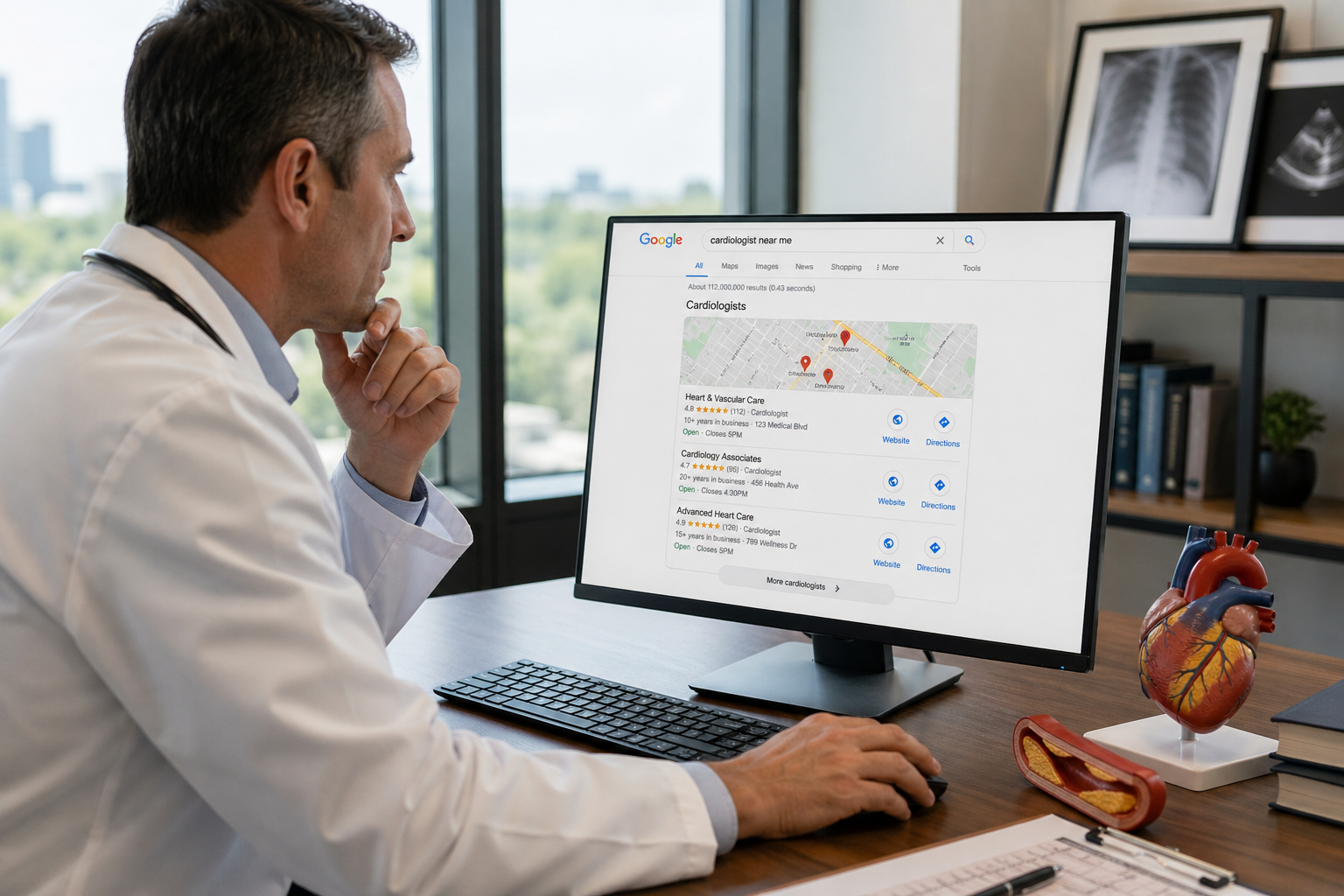
Your Next Patient Is Searching Right Now
Not long ago, a cardiologist's referral pipeline was relatively predictable. A primary care physician referred a patient, the patient called your office, and the relationship began. The internet was background noise — something you needed a website for, but not something that drove meaningful new patient volume on its own.
That model has fundamentally changed.
The referral-only era for cardiologists is fading. Patients referred by their primary care physician now routinely Google the recommended cardiologist before confirming the appointment — and they often switch to a different provider based on what they find. Meanwhile, a growing share of cardiac patients search directly for specialists without any referral, driven by consumer-driven healthcare trends and high-deductible insurance plans that motivate patients to shop for care. Hireseopro
Over 77% of patients initiate their healthcare journey through a search engine. Practicebeat For a cardiologist in a competitive market, that statistic has a direct translation: if you are not visible in local search results, you are invisible to the majority of patients who are actively looking for cardiac care — including patients who already have your name on a referral slip.
This guide covers everything a cardiology practice needs to know about SEO in 2026 — from Google Business Profile fundamentals to E-E-A-T content strategy, AI search visibility, and the specific tactics that separate practices that dominate their local market from those that get buried beneath hospital networks and aggregator sites.
Part I: Why Cardiology SEO Is Different From General Medical SEO
Not all medical SEO works the same way. Cardiology sits in a category that demands a higher standard of digital credibility than most other specialties — and understanding why shapes everything else about your strategy.
YMYL: The Standard That Governs Your Rankings
Google classifies medical content under a framework called YMYL — Your Money or Your Life. YMYL medical content must demonstrate E-E-A-T: Experience, Expertise, Authoritativeness, and Trustworthiness. Google applies heightened quality standards when evaluating it, which means content that would rank acceptably for a retail business can fail completely for a cardiology practice if it does not meet the elevated credibility bar Google holds for healthcare. Search Scale AI
In practical terms, this means Google is not simply evaluating whether your website contains relevant keywords about cardiac care. It is evaluating whether your practice can be trusted as an authoritative source on matters that directly affect a patient's health and life. That is a much higher bar — and it has significant implications for how you build your website, your content, and your online presence.
Competition From Institutions You Cannot Out-Rank Directly
National health systems and government sites like MedlinePlus and Mayo Clinic occupy the top spots for broad medical terms. Independent practices cannot compete on head terms, so you must own hyperlocal and specialty-specific queries where patient intent is strongest and competition is thinner. RankPill
This is the defining strategic reality of cardiology SEO. You will not outrank the Cleveland Clinic for "heart disease treatment." You do not need to. You need to rank for "cardiologist South Jersey accepting Medicare" or "echocardiogram near me" or "interventional cardiologist Cherry Hill NJ" — the queries where a real patient in your geographic area, with real intent to book an appointment, is searching. That is where independent cardiology practices win.
Part II: Google Business Profile — Your Most Important SEO Asset
For local cardiology practices, no single optimization delivers more immediate impact than a fully built-out, actively managed Google Business Profile. It is what populates the Map Pack — the three local listings that appear at the top of search results for location-based queries — and it is often the first thing a prospective patient sees about your practice.
Choose the most specific primary category for your specialty. A cardiologist should select "Cardiologist," not just "Doctor." Complete every section: add your services, insurance accepted, appointment links, and a thorough description of your practice. The more complete your profile, the better. Add quality photos — show your office, waiting room, exam rooms, and staff. Real photos of your actual practice build trust. Optuno
Beyond the initial setup, your Google Business Profile needs ongoing attention:
Post consistently. Post to your GBP twice weekly — health tip posts, seasonal wellness reminders, new provider introductions, or service announcements. Enable and monitor the Q&A section and proactively post and answer the ten most common patient questions, including hours, insurance accepted, the new patient process, and parking. Search Scale AI
Build your photo library. Upload at least 50 photos including practice exterior, waiting room, exam rooms, staff headshots, and any specialized equipment. Practices with more photos rank higher. Search Scale AI
Claim individual physician profiles. For multi-provider practices, each physician can have their own GBP listing alongside the practice's main listing. A practice with five physicians can have six GBP listings — one for the practice and one for each named physician. Each physician profile appears in relevant searches for their specialties, dramatically expanding your practice's total Google Maps visibility. Search Scale AI
Part III: E-E-A-T — The Foundation of Cardiology Content Authority
E-E-A-T — Experience, Expertise, Authoritativeness, and Trustworthiness — is not a checklist item. For a cardiology practice, it is the entire basis on which Google evaluates whether your content deserves to rank. Getting it right requires specifics, not gestures.
All medical content on your website should be authored or reviewed by a board-certified cardiologist. Include an author bio with credentials, board certifications, and hospital affiliations on every article. Prominently display ABIM board certification, fellowship training, hospital privileges, and any subspecialty certifications — interventional, electrophysiology, heart failure — on your website and Google Business Profile. Accumulate reviews on Google, Healthgrades, Vitals, and Zocdoc. High review volume and quality directly signal trustworthiness to both Google and prospective patients researching cardiac care. Hireseopro
Each of those elements serves a dual purpose. They signal authority to Google's algorithm, and they convert skeptical patients into booked appointments. A prospective patient who finds your website and immediately sees your board certifications, your hospital affiliations, a physician-authored article about the condition they are researching, and 150 four-star reviews on Google has all the validation they need to call your office. The SEO work and the patient conversion work are the same work.
What to Publish and How Often
The content gap in cardiology is significant and exploitable. Medical practices hesitate to publish patient stories, case studies, or condition-specific content due to compliance fears and review anxiety. This creates a content gap that competitors fill, and Google rewards the practices that educate patients while staying compliant. RankPill
The topics that drive the most valuable traffic to a cardiology practice are the ones patients are already asking:
What is the difference between a cardiologist and an interventional cardiologist? What does an echocardiogram involve? What are the warning signs of atrial fibrillation? When should I see a cardiologist versus going to the emergency room? What does a first appointment with a cardiologist look like? These are real searches, with real patient intent behind them, and most cardiology practice websites do not answer them.
Answer common patient questions. What conditions do you treat? What should someone expect during their first visit? What symptoms warrant seeing a specialist? These are searches patients actually make. Keep content updated — medical information changes, and outdated content hurts both your credibility and your rankings. Optuno
Part IV: Local SEO — Owning Your Geographic Market
Local SEO for cardiologists is about dominating search visibility within the specific area where your patients live and where your practice operates. The fundamentals are non-negotiable.
Citation Consistency Across Every Directory
Claim the major platforms: Google Business Profile, Healthgrades, Zocdoc, WebMD, Vitals, RateMDs, Yelp, and your state medical board directory. Ensure consistency everywhere. Your practice information must be identical across all platforms. One wrong phone number or address variation creates confusion for both patients and search engines. Monitor and update regularly — staff changes, new locations, updated hours all need to be reflected everywhere simultaneously. Optuno
This is not glamorous work. It is also the kind of work that most practices neglect after their initial setup, allowing inconsistencies to creep in over time that quietly suppress local rankings. Conduct a citation audit at least twice a year.
Reviews Are a Direct Ranking Factor
84% of patients check online reviews before choosing a new healthcare provider. Optuno That is not a preference — it is near-universal behavior. And Google reads it the same way patients do.
Google uses review volume, recency, and rating as local ranking factors. A practice with 200 or more reviews and a 4.5-plus rating will outrank competitors with fewer reviews, even if their website is technically stronger. Actively request reviews on Google, Healthgrades, and Vitals after appointments. RankPill
The most effective review generation approach is systematic and frictionless: send a review request via text or email within 24 to 48 hours of a positive appointment, with a direct link to your Google review page. Remove every unnecessary step between the patient's intent to leave a review and the review actually being written.
Location-Specific Service Pages
If your practice serves multiple communities or operates across multiple locations, each geographic area deserves its own dedicated page on your website — not a duplicate page with the city name swapped in, but a genuinely useful page that addresses the specific community, references local hospital affiliations, and speaks to the patients in that area. Search engines reward geographic specificity. A page titled and structured around "Cardiologist in [City], NJ" that includes locally relevant content will outperform a generic services page for location-based queries in that area every time.
Part V: Schema Markup — The Technical Edge Most Practices Miss
MedicalOrganization schema and Physician schema types from Schema.org allow medical practices to communicate structured information directly to Google and AI search engines: practice type, medical specialties offered, physician credentials, accepted insurance, service area, and booking options. This structured data is the technical foundation of effective answer engine optimization for healthcare — it is how AI answer engines know to include your practice in responses to patient queries like "find a cardiologist near me who accepts Medicare." Search Scale AI
To boost your chances of showing up in featured snippets and voice search results, implement FAQ schema using Google's structured data guidelines for healthcare. Practicebeat For a cardiology practice, FAQ schema on pages that answer common patient questions — symptoms of heart disease, what to expect from a stress test, how to prepare for a cardiac catheterization — dramatically increases the probability of appearing in AI Overviews and voice search responses.
Most cardiology practice websites do not have schema markup implemented at all. Among those that do, most use only the most basic variety. Implementing MedicalOrganization schema, Physician schema for each provider, FAQPage schema on content pages, and LocalBusiness schema with complete service and insurance information puts your practice in a technical category most competitors are not in.
Part VI: AI Search and the New Patient Discovery Landscape
The search landscape your patients use in 2026 extends beyond Google's traditional results page. A growing share of patients are turning directly to AI platforms like ChatGPT and Perplexity for healthcare advice. Google AI Overviews now generate summaries in their own words, pulled from existing websites, and sometimes credit the source with a link, sometimes not. Intrepy
Google AI often embeds YouTube videos directly into AI Overviews, and assistants like ChatGPT and Perplexity prefer citing content that exists in multiple formats. A short, clear video makes your content more visible and helps patients understand your services faster. Record FAQ videos answering common patient questions in 30 to 60 seconds. Add transcripts and tag the video with VideoObject schema so AI can parse it. Embed the video on the matching service page and upload it to YouTube for maximum reach. Intrepy
For cardiology practices, this creates a specific opportunity. Short, physician-authored videos answering the questions patients are actually typing into AI platforms — "what causes atrial fibrillation," "when should I worry about chest pain," "what does a cardiologist check on a first visit" — build authority across Google search, AI Overviews, YouTube search, and voice simultaneously. One piece of content, executed well, earns visibility across every surface where your next patient might be looking.
Backlinks remain essential for medical SEO. AI engines use citations from trusted medical and local sources as credibility signals. Doctors or their staff can pitch the office to local news as expert sources. Contribute guest blogs to associations and patient advocacy groups. Secure incoming website links from hospital partners or other trusted affiliates. Think of backlinks like referrals — just as patients trust a doctor more when another physician refers them, search engines and AI trust your practice more when credible websites point back to you. Intrepy
Part VII: Website Fundamentals That Cannot Be Ignored
All of the content and citation work above rests on a website foundation that either supports or undermines everything else. For cardiology practices, three technical factors are non-negotiable.
Speed and mobile performance. Your website is more than a digital brochure — it is a patient acquisition engine. Digital Marketing A site that loads slowly on mobile does not just frustrate patients; it is actively penalized by Google's ranking algorithm. A cardiac patient searching "cardiologist near me" on their phone while experiencing symptoms does not wait for a slow website. Neither does Google.
HIPAA compliance in your digital infrastructure. Contact forms, appointment request systems, and any intake tools on your website must be HIPAA-compliant. This is a legal requirement, not an SEO factor — but practices that handle it poorly face risks that dwarf any ranking consideration.
Clear conversion paths. A prospective patient who lands on your website needs to be able to book an appointment, call your office, or request a consultation within one or two clicks from any page. If the path from "found your website" to "scheduled an appointment" has friction, you are losing patients who had intent when they arrived.
Part VIII: Realistic Timelines and What to Expect
Local SEO for doctors typically costs between $1,000 and $2,500 per month depending on specialty, market competitiveness, and scope of services. The ROI calculation usually favors investment. If your average patient generates $2,000 in annual revenue and stays with your practice for five years, that is $10,000 in lifetime value. Even one or two new patients per month makes SEO worthwhile. Optuno
Medical SEO is a 90 to 180 day play due to YMYL scrutiny and competitive local markets. Practices that publish condition content consistently, optimize for insurance and location modifiers, and earn citations from health directories see first-page rankings within 90 days. Speed depends on specialty competitiveness and domain age. Established practices in underserved neighborhoods rank faster than new clinics in saturated metros. RankPill
For most cardiology practices, the timeline looks like this: Google Business Profile improvements and review generation produce visible results within 30 to 60 days. Content and on-page optimization begins driving traffic at the 60 to 90 day mark. Competitive keyword rankings for terms like "cardiologist [city]" or "interventional cardiologist [region]" typically require four to eight months of sustained effort. The investment compounds over time — unlike paid advertising, which stops producing results the moment you stop paying, SEO authority builds continuously and generates returns long after the work is done.
Conclusion: Your Patients Are Searching. The Question Is Whether They Find You.
Cardiac care is one of the most consequential decisions a patient makes. They research carefully, they check credentials, they read reviews, they verify referrals. The practice that shows up at every stage of that research process — in local search, in AI Overviews, in review platforms, in condition-specific content — earns the appointment. The practice that does not show up loses it to a competitor who did the work.
The fundamentals of cardiology SEO are not complicated. They require consistent execution, genuine medical expertise expressed in accessible language, and the patience to build authority that compounds over months rather than days. What they do not require is a massive budget or a marketing department. They require the right strategy, implemented correctly, and maintained over time.
Your next patient is searching right now. The only question is whether they find you.
Sources
Hire SEO Pro — SEO for Cardiologists (2026): Rank Higher & Get More Cardiac Patients (hireseopro.com)
Practice Beat — SEO for Doctors: The Ultimate Guide to SEO for Medical Practices (practicebeat.com)
Optuno — Local SEO for Doctors: How to Attract More Patients in 2026 (optuno.com)
Search Scale AI — SEO for Orlando Medical Practices: Attract More Patients Online in 2026 (searchscaleai.com)
Intrepy — AI SEO for Doctors in 2025: Advanced SEO for Medical Practices (intrepy.com)
Zeqons — SEO for Cardiologists in 2026: How to Rank Higher in an AI-Driven Search World (zeqons.us)
RankPill — SEO for Medical: The Complete 2026 Guide (rankpill.com)
First Page Sage — The Top Cardiologist SEO Agencies of 2026 (firstpagesage.com)
Is your cardiology practice showing up where patients are searching? Let's find out → ritnerdigital.com/#contact
Ritner Digital helps medical practices across South Jersey and the greater Philadelphia region build digital marketing strategies that drive real patient growth — not just clicks.
Frequently Asked Questions
How long does it take for SEO to work for a cardiology practice?
Most cardiology practices start seeing meaningful results in 90 to 180 days, though some improvements come faster than others. Google Business Profile optimizations and active review generation can produce noticeable increases in local visibility within 30 to 60 days. Content improvements and on-page optimization typically begin driving additional traffic by the 60 to 90 day mark. Ranking competitively for high-value terms like "cardiologist near me" or "interventional cardiologist [city]" generally takes four to eight months of sustained effort. The timeline depends heavily on how competitive your local market is, how much authority your website currently has, and how consistently the work gets done. Unlike paid advertising, the authority SEO builds does not disappear when you stop writing a check — it compounds over time and continues generating returns.
Can a private cardiology practice realistically compete with large hospital systems in search results?
Yes — but not on the same terms. You will not outrank the Cleveland Clinic or Penn Medicine for broad terms like "heart disease treatment" or "cardiology." You do not need to. Hospital systems rarely invest in the neighborhood-level, insurance-specific, condition-specific content that drives local patient acquisition. A page targeting "cardiologist accepting Horizon Blue Cross in Cherry Hill NJ" or "echocardiogram near Haddonfield" competes in a space where large institutions are not optimizing at all. The strategy for independent cardiology practices is to dominate the hyperlocal and specialty-specific queries where real patients with real appointment intent are searching — and where your competition is other local practices, not academic medical centers.
What is E-E-A-T and why does it matter so much for cardiologists specifically?
E-E-A-T stands for Experience, Expertise, Authoritativeness, and Trustworthiness — Google's framework for evaluating the credibility of content. It matters more for cardiologists than for most other businesses because cardiology falls under Google's YMYL classification — Your Money or Your Life — meaning Google holds medical content to a significantly higher quality standard than it holds content about, say, restaurants or software. Practically, this means your website content needs to be authored or reviewed by a board-certified cardiologist, your credentials need to be prominently displayed, your content needs to cite credible sources, and your online reviews need to reflect the quality of care you deliver. Every one of those signals tells Google that your practice is a trustworthy source of cardiac health information — and that directly affects where you rank.
How important are online reviews for a cardiology practice's SEO?
Extremely important, in two distinct ways. First, Google uses review volume, recency, and rating as direct local ranking factors — a practice with 200 or more Google reviews and a strong average rating will outrank a competitor with a better website but fewer reviews. Second, 84% of patients check online reviews before choosing a new healthcare provider, meaning reviews are not just an SEO signal but the primary conversion factor between a patient finding your practice and actually booking an appointment. The platforms that matter most are Google, Healthgrades, Vitals, and Zocdoc. A systematic approach to requesting reviews — a direct text or email within 24 to 48 hours of a positive appointment, with a link directly to your review page — is the most effective way to build review volume consistently without it feeling like a manual burden.
What keywords should a cardiology practice focus on?
The most valuable keywords for a cardiology practice fall into three categories. Local intent keywords — "cardiologist near me," "cardiologist in [city]," "heart doctor [neighborhood]" — capture patients who are ready to book and searching by location. Condition and symptom keywords — "atrial fibrillation treatment," "chest pain specialist," "heart failure cardiologist" — capture patients researching a specific diagnosis or symptom who are in the process of selecting a specialist. Procedure keywords — "echocardiogram near me," "stress test cardiologist," "cardiac catheterization [city]" — capture high-intent patients who already know what they need and are looking for a provider. Insurance and subspecialty modifiers add significant value to all three categories: "cardiologist accepting Medicare," "interventional cardiologist South Jersey," "electrophysiologist near [city]" narrow the field considerably and often face far less competition than the broader terms.
What is schema markup and does my cardiology website really need it?
Schema markup is structured code added to your website that directly communicates information to Google and AI search engines in a format they can read precisely — your specialty, physician credentials, accepted insurance, services offered, location, and booking options. For a cardiology practice, implementing MedicalOrganization schema, Physician schema for each provider, FAQPage schema on content pages, and LocalBusiness schema with complete practice information is one of the highest-leverage technical investments available. It increases the probability of appearing in Google AI Overviews, voice search responses, and rich search result features. Most cardiology practice websites either have no schema markup or only the most basic implementation — which means getting it right puts your practice in a technical category most local competitors have not reached.
Should my cardiology practice be on Healthgrades, Zocdoc, and WebMD?
Yes, and not just for SEO. These platforms serve a dual function: they are citation sources that contribute to your local search authority when your information is accurate and consistent across all of them, and they are patient acquisition channels in their own right, since many patients use Healthgrades and Zocdoc specifically to find and book specialists. Claim and fully complete your profile on Google Business Profile, Healthgrades, Zocdoc, WebMD, Vitals, RateMDs, and your state medical board directory at minimum. Ensure your practice name, address, phone number, and hours are absolutely identical across every listing — even minor variations confuse search engines and suppress your local rankings. Set a reminder to audit these listings twice a year, since information drifts over time as staff changes, hours update, and new providers join the practice.
What kind of content should a cardiology practice publish on its website?
The most valuable content for a cardiology practice answers the questions real patients are already asking. That includes condition explainers — what is atrial fibrillation, what causes heart failure, what is the difference between a heart attack and cardiac arrest — written at a level that is accessible to patients while maintaining medical accuracy. It includes procedure guides — what to expect during an echocardiogram, how to prepare for a stress test, what happens during a cardiac catheterization. It includes symptom guidance — when chest pain warrants a same-day call versus an emergency room visit, what palpitations might indicate, what risk factors make someone a candidate for a cardiology referral. All of this content should be authored or reviewed by a physician at your practice, should include the author's credentials, and should be updated regularly as medical guidance evolves. The goal is to become the most useful, trustworthy cardiac health resource in your geographic area — which is exactly what Google rewards.
How does voice search affect SEO for cardiologists?
Voice search has converged with AI search at the technical level, which means optimizing for voice no longer requires a separate strategy. Patients using voice assistants to find cardiac care tend to phrase queries conversationally and with local intent — "Who is the best cardiologist near me accepting new patients?" or "Where can I get an echocardiogram in [city]?" Content that answers these conversational queries directly, FAQ schema that structures those answers for machine extraction, a fully optimized and consistently updated Google Business Profile, and accurate local directory listings all feed into voice search performance simultaneously. The practices that win voice search are the ones with the strongest local SEO foundation overall — there is no shortcut unique to voice.
What does cardiology SEO typically cost, and is it worth it?
Local SEO for a cardiology practice typically runs between $1,000 and $2,500 per month depending on market competitiveness, the scope of services, and whether content creation is included. In a major metro area or highly competitive specialty market, a comprehensive program can run higher. The ROI calculation is unusually favorable for cardiology compared to most industries because the lifetime value of a cardiology patient is significant — a patient who comes to your practice for ongoing cardiac management, periodic imaging, and procedure-based care over several years represents substantial revenue. If SEO generates even two or three new long-term patients per month, the return far exceeds the investment. The more useful way to think about it is not cost per month but cost per acquired patient — and for most cardiology practices operating in competitive markets, SEO delivers a lower cost per acquisition than paid advertising over any sustained time horizon.
Want to know exactly where your cardiology practice stands in local search — and what it would take to get to the top? Let's talk → ritnerdigital.com/#contact