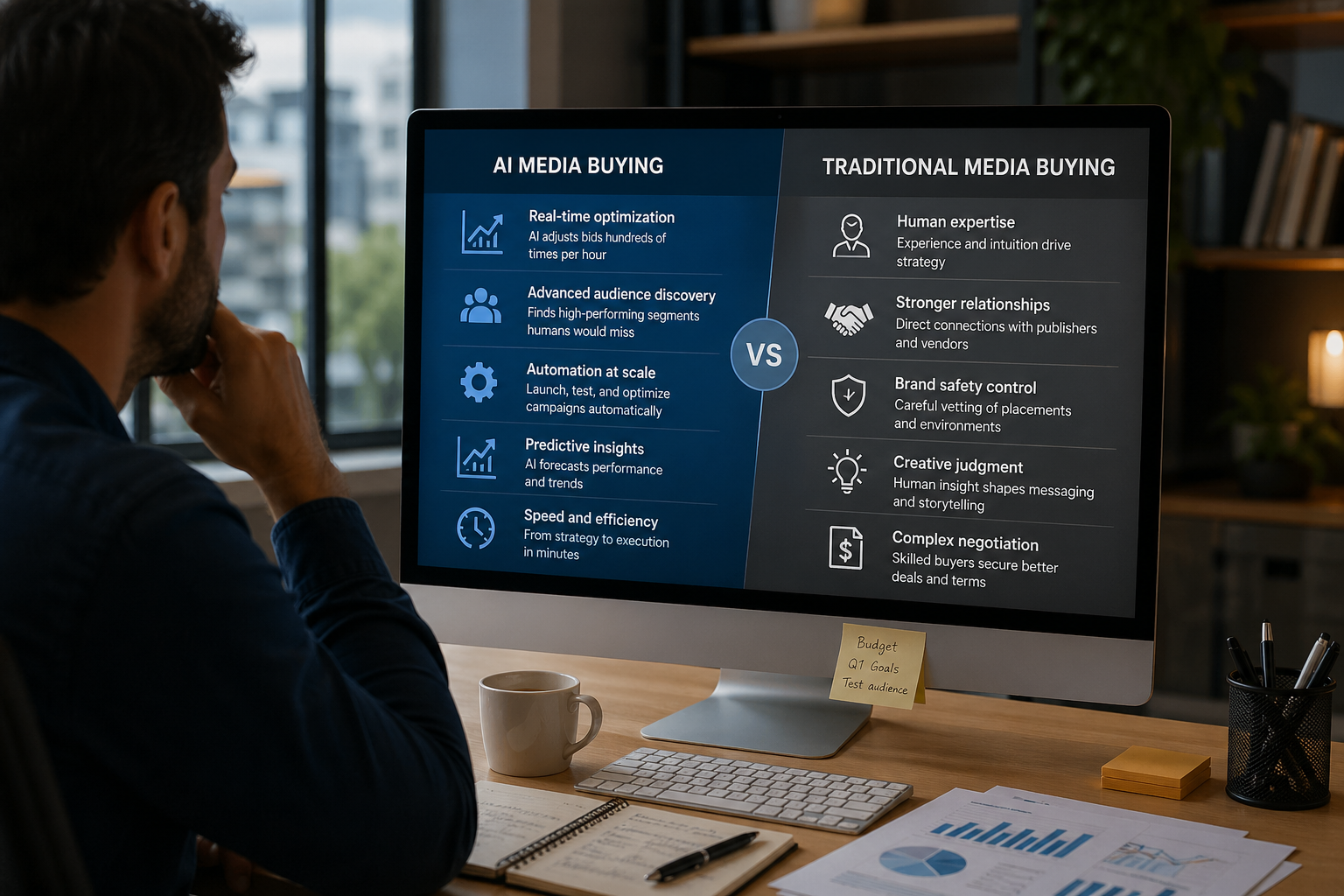
The Way Ad Dollars Get Spent Has Changed Permanently
Not long ago, media buying was a people-driven discipline. A skilled buyer negotiated placements, managed rate cards, analyzed audience demographics, adjusted bids manually, and made judgment calls based on campaign experience and market knowledge. The craft lived in the relationships between buyers and publishers, the instinct developed over years of managing spend, and the human ability to read a market and respond.
That model has not disappeared — but it has been fundamentally disrupted.
Global ad spend is expected to exceed $1 trillion in 2026. At the same time, automation, AI, and platform-level optimization have reduced the value of basic execution. The core function of media buying — placing ads in front of the right audience at the right time — is still fundamental to digital marketing. What has changed is how that function is executed. TrustAnalytica
Traditional media buying required manual negotiations, spreadsheet-based planning, and reactive optimization. Today's AI-powered platforms analyze millions of data points in milliseconds to identify the best inventory at the optimal price. Benly
The question is no longer whether AI is changing media buying. It clearly is. The question is what it actually does better, what it does worse, where human judgment remains irreplaceable, and what a business needs to understand to make smart decisions about how their ad dollars get spent in 2026.
This is the breakdown.
Part I: What Traditional Media Buying Actually Is
Before comparing, it is worth defining what we are comparing against — because "traditional media buying" means different things in different contexts.
In its broadest sense, traditional media buying encompasses the full manual process of planning, purchasing, and optimizing advertising placements. A media buyer analyzes the target audience, identifies appropriate channels and placements, negotiates rates with publishers or platforms, executes the buy, monitors performance, and makes adjustments based on what the data shows.
In the digital era, this has meant a human being making decisions about keyword bids, audience targeting parameters, creative rotation, budget allocation across campaigns, and placement selection — all based on performance data reviewed periodically, typically daily or weekly.
Traditional media buying's strengths are significant. It offers full transparency into every decision: a buyer knows exactly where the budget went, why specific placements were chosen, and what logic drove each optimization. It allows for nuanced brand safety judgments — excluding categories, placements, or contexts that an algorithm might not recognize as problematic. It enables relationship-based buying, particularly for premium inventory that is not accessible through automated channels. And it preserves the institutional knowledge that accrues when a skilled human works the same accounts over time.
Its limitations are equally significant. Human buyers can only process a finite amount of data. They can only adjust campaigns a finite number of times per day. They cannot simultaneously evaluate thousands of audience micro-segments or run real-time bid adjustments across every auction. At scale, the cognitive load of manual optimization eventually exceeds what any team can handle without sacrificing quality.
Part II: What AI Media Buying Actually Is
AI media buying refers to the use of machine learning systems to automate, optimize, and in some cases entirely manage the decisions that human buyers previously made manually. In 2026, it exists across a spectrum — from narrow automation tools that handle single functions like bid management, to fully autonomous systems that control targeting, creative, placement, and budget allocation with minimal human input.
The most prominent examples most advertisers are already interacting with are platform-native AI products: Google's Performance Max, Meta's Advantage+, and The Trade Desk's Koa. These systems use machine learning trained on enormous datasets to make real-time decisions across every dimension of a campaign.
The key difference between AI and traditional automation is learning capability. AI learns from your data, your customers, your patterns, and your results — then optimizes accordingly. Manual media buyers might adjust campaigns once or twice a day. AI does it hundreds of times per hour. Madgicx
AI can cluster audiences, generate lookalike hypotheses, and synthesize campaign-ready targeting plans much faster than manual analysis. Budget pacing and bid optimization — routine adjustments to spend levels, bid strategy, and inventory allocation — are increasingly handled by platform automation and model-driven optimization loops. Bionic-ads
AI-powered tools are significantly reducing the need for manual media planning and buying. Algorithms can now analyze vast datasets, identify audience segments, and allocate budgets across channels in real time. Storyboard18
The direction of travel is clear. Mark Zuckerberg announced in June 2025 that Meta will fully automate ad creation by late 2026. Meta's platform will generate complete ad assets from a business URL — images, videos, copy — select audiences without demographic inputs, optimize placements across Facebook, Instagram, Messenger, and WhatsApp, adjust creatives in real time based on location and context, and allocate budget to best-performing variations automatically. Dataslayer
Part III: Where AI Media Buying Wins
The performance case for AI media buying is real and documented. Understanding where it genuinely outperforms human buying helps businesses allocate the right tool to the right task.
Speed and Scale of Optimization
No human team can match the speed at which AI systems optimize. While a traditional buyer reviews performance and makes adjustments once or twice a day, AI systems adjust bids, reallocate budgets, and shift targeting at the auction level — thousands of micro-decisions per hour that collectively add up to meaningfully more efficient spend. At scale, this speed advantage compounds.
Audience Discovery Beyond Predefined Segments
AI media buying helps teams identify valuable micro-audiences that do not fit predefined segments. Teams can model performance across dozens of budget scenarios before launch, adjust creative content based on predicted performance, and rebalance channel mixes dynamically as market conditions shift. Clutch
A human buyer working with demographic and interest-based targeting can only target what they can define. AI systems find patterns in behavioral data that no buyer would think to specify — and they find them at a scale and precision that manual segmentation cannot approach.
Performance at the Campaign Level
The performance numbers are notable. Meta's existing Advantage+ system shows a $4.52 return per $1 spent — 22% higher than manual campaigns, according to Meta's earnings reports. Dataslayer Meta reports that advertisers who consolidated fragmented campaign structures into unified Advantage+ campaigns have seen CPA reductions of up to 32%. AuditSocials
These are platform-reported numbers and should be interpreted with appropriate skepticism — platforms have obvious incentives to report favorably on their own AI products. But the directional finding is consistent with independent data: for many campaign types, AI optimization outperforms manual management at the execution level.
Lowering the Barrier for Smaller Advertisers
AI also lowers the barrier for smaller advertisers who previously struggled to access high-impact channels. eMarketer A small business that previously lacked the expertise or budget to run sophisticated audience segmentation and real-time bid optimization can now access those capabilities through platform-native AI tools with relatively modest ad spend.
Part IV: Where Traditional Media Buying Wins
The case for human media buying has not evaporated. It has shifted toward the dimensions where AI systems have genuine limitations.
Transparency and Accountability
AI media buying creates a tension between performance gains and advertiser control. Walled garden tools like Advantage+ and Performance Max deliver improved results but limit visibility into targeting decisions and inventory selection. Brands have complained about this lack of transparency and the few learnings they take away from AI-managed campaigns. eMarketer
A well-documented case study showed a Performance Max campaign where Display placements consumed nearly 50% of the budget while generating under 20% of conversions — and the advertiser had no direct lever to reduce Display spend. The channel performance report made the imbalance visible. It did not make it fixable. Seresa
Traditional media buying gives you complete visibility into every decision and the ability to act on what you see. When something is wrong, you can fix it. When you need to explain a campaign decision to a client or stakeholder, you can. When compliance requires documentation of targeting logic, it exists. AI campaigns increasingly give you results without explanations — which is fine until something goes wrong and you need to understand why.
Brand Safety and Contextual Judgment
AI systems optimize for performance signals — clicks, conversions, cost per acquisition. They are not optimizing for whether your brand should appear next to certain content, in certain contexts, or in front of certain audiences from a values standpoint. Those are human judgments, and they matter.
When AI systems make automated decisions, the reasoning behind those decisions may not be transparent or reviewable. If regulators or plaintiffs inquire about specific campaign decisions, advertisers may be unable to provide documentation explaining why particular creative, targeting, or placement choices were made. AuditSocials
For businesses in regulated industries — financial services, healthcare, legal — this accountability gap is not a minor concern. It is a compliance risk.
Premium and Relationship-Based Inventory
Not all premium inventory is accessible through programmatic channels. Sponsorships, custom editorial integrations, podcast host reads, high-profile event placements, and exclusive publisher relationships still require human negotiation and relationship management. AI cannot call a publisher to negotiate a custom content partnership. That capability lives entirely in the human side of the equation.
Strategy, Creative Direction, and Business Context
Execution is automated. Strategy is manual. Creative is central. Data is continuous. The agencies and teams that succeed are the ones that understand all of these components and connect them into a single system. TrustAnalytica
AI does not know your business goals, your brand positioning, your competitive context, your upcoming product launches, or what happened in last quarter's earnings call. It optimizes toward the signal you give it. If the signal is wrong, the AI optimizes efficiently toward the wrong outcome. Setting the right signal, interpreting the results in business context, and making strategic decisions about where to allocate resources — that is human work.
Part V: The Transparency Problem in 2026
The most significant ongoing tension in AI media buying is not performance — it is control and transparency, and it deserves its own section because it affects every business running AI-optimized campaigns right now.
Google, Meta, and Amazon collectively generated approximately $524.4 billion in advertising revenue in 2025. By 2027, walled gardens are projected to control 83% of global digital ad revenue. These platforms control inventory, audience data, attribution models, and reporting dashboards within their own environments. Advertisers buying through Google's DV360, Meta Business Manager, or Amazon DSP are working with proprietary measurement frameworks that cannot be independently verified at a granular level. Aidigital
Google has made progress on the transparency front. Channel-level reporting for Performance Max launched in November 2025. Search term reports are now available across PMax and AI Max. Campaign-level exclusions for PMax now support up to 10,000 entries. These are genuine steps forward. But they do not resolve the core issue: when an AI is making real-time placement decisions across millions of queries and channels, no human is making that call. Trafficguard
Many advertisers have called Advantage+ a black box because you do not see which signals Meta prioritizes or why budgets shift between ad sets. Fraud Blocker™ Meta made Advantage+ the default for Sales, Leads, and App campaigns in 2025, meaning advertisers who do not actively override the default are running AI-managed campaigns whether they intended to or not.
The practical implication for businesses: you need independent measurement infrastructure that does not rely solely on platform-reported data. Run 50/50 splits between AI-managed and manual campaigns. Track externally — do not trust only platform reporting. Dataslayer The AI may be producing the results it claims. It may also be producing results that look good in platform dashboards but do not hold up when measured against actual business outcomes.
Part VI: The Hybrid Model — What Actually Works in 2026
The most sophisticated advertisers in 2026 are not choosing between AI and traditional media buying. They are running both in complementary roles, with clear logic for which approach applies to which function.
Standard Search and Shopping campaigns give you precise control and full keyword transparency. Performance Max adds reach across YouTube, Display, and Discover. The combination consistently outperforms either approach alone, provided your tracking is clean enough to measure the difference. Coby Agency
Allocate 25 to 50% of budget to AI automation while maintaining manual campaigns. This lets you compare performance directly and gives you fallback options if AI underperforms for your specific business. Dataslayer
The division of labor that is emerging looks something like this:
Let AI handle: Real-time bid optimization, audience expansion and lookalike modeling, budget pacing and allocation between proven creative variations, cross-channel reach extension, and routine performance reporting synthesis.
Keep humans in control of: Strategy and campaign architecture, creative direction and brand voice, placement exclusions and brand safety decisions, budget allocation between channels and campaigns at the strategic level, interpretation of results in business context, and all compliance-sensitive decisions.
The competitive advantage will shift toward teams that interpret, direct, and quality-check AI outputs rather than those with the deepest manual buying expertise. The goal is a balance between automation and oversight — defining where automation ends and human judgment begins. eMarketer
Part VII: What This Means for Your Business
If you are a business owner or marketing leader trying to make sense of where to direct your paid media investment in 2026, a few practical conclusions follow from all of this.
Understand what you are running. If you are running Google Ads or Meta campaigns and have not specifically audited your campaign settings recently, there is a significant probability you are running more AI automation than you realize. Advantage+ became the default for Meta campaigns in 2025. Performance Max has been aggressively promoted by Google as the default campaign structure. Know what your campaigns are actually doing before you evaluate whether they are doing it well.
Verify performance independently. Platform dashboards report in ways that favor the platform. Build independent measurement — whether that is Google Analytics 4 with proper conversion tracking, a marketing mix model, incrementality testing, or simply tracking actual revenue against actual spend. The AI may be producing the results it claims. Confirming that independently is non-negotiable.
Invest in creative quality. The AI amplifies what you give it. If your inputs are poor, it scales poor performance efficiently. Trafficguard As AI takes over more of the execution layer, the creative assets — the copy, images, video, and landing pages that feed the AI system — become the primary lever for human differentiation. Poor creative fed into a great AI system produces poor results at scale. Strong creative fed into the same system produces strong results at scale.
Do not outsource strategy. The most dangerous use of AI media buying tools is treating them as a complete solution. A business that hands its URL and budget to a platform and walks away has outsourced not just execution but strategy — to a system that has no knowledge of the business's goals, competitive position, or market context. The businesses that win with AI media buying are the ones that stay deeply engaged with strategy and use AI to execute that strategy more efficiently, not to replace the thinking that produces it.
Conclusion: The Buyer's Role Has Shifted, Not Disappeared
Traditional media buying as it existed in 2015 is largely obsolete. The execution functions — bid management, audience segmentation, real-time optimization — have been automated to a degree that no human team can match in speed or scale. Businesses that are still doing those things entirely manually are leaving performance gains on the table.
But the idea that AI has made media expertise irrelevant is equally wrong. The strategic functions — setting the right objectives, building the right creative, interpreting results in business context, managing brand safety, maintaining compliance, and making decisions that require understanding a business from the inside — have not been automated and will not be any time soon.
Media buying in 2026 is not about placing ads. It is about managing systems. The agencies and teams that succeed are the ones that understand all of the components — execution, strategy, creative, data — and connect them into a single system. TrustAnalytica
The businesses that thrive in this environment are the ones that use AI for what it genuinely does better, keep humans engaged where judgment and accountability matter, and never mistake efficiency for strategy.
Sources
Trust Analytica — Does Media Buying Still Work in 2026? Trends & ROI Insights (trustanalytica.org)
AI Digital — Media Planning and Buying: How They Work in 2026 (aidigital.com)
eMarketer — FAQ on AI Media Buying: Platform Tools, Agency Strategy, and How to Win in 2026 (emarketer.com)
Clutch — How Marketers Use AI to Transform Their Media Buying Strategy (clutch.co)
Madgicx — AI in Media Buying: The Complete 2026 Guide for E-commerce (madgicx.com)
Dataslayer — Meta Plans Full AI Advertising Automation by 2026: What This Actually Means (dataslayer.ai)
Audit Socials — Meta Advantage+ Full AI Automation 2026: Compliance Guide (auditsocials.com)
Fraud Blocker — Should You Turn Off Meta Advantage+? (fraudblocker.com)
Seresa.io — Performance Max 2026: Transparency Without Control (seresa.io)
Traffic Guard — AI Max vs Performance Max: What Advertisers Must Know in 2026 (trafficguard.ai)
Coby Agency — Advanced Performance Max Strategies 2026 (cobyagency.com)
AI Digital — Digital Advertising Transparency: Why It Matters (aidigital.com)
Bionic Ads — How AI Will Reshape Media Planning and Media Buying (bionic-ads.com)
Want help building a paid media strategy that gets the most out of AI tools without losing control of where your budget goes? Let's talk → ritnerdigital.com/#contact
Ritner Digital helps businesses across South Jersey and the greater Philadelphia region run smarter paid media campaigns — with the right balance of AI efficiency and human strategy.
Frequently Asked Questions
What is the difference between AI media buying and traditional media buying?
Traditional media buying is a human-driven process where a buyer manually plans campaigns, negotiates placements, sets targeting parameters, adjusts bids, and optimizes performance based on data reviewed periodically. AI media buying uses machine learning systems to automate those execution-layer decisions — adjusting bids in real time, discovering audience segments, allocating budget dynamically, and optimizing creative rotation at a speed and scale no human team can match. The distinction is not all-or-nothing. Most businesses in 2026 are running some combination of both, with AI handling execution and humans handling strategy.
Is AI media buying actually better than traditional media buying?
It depends on what you are measuring. At the execution layer — bid optimization, audience expansion, real-time budget allocation — AI systems consistently outperform manual management. Meta's Advantage+ reports a 22% higher return than manual campaigns, and CPA reductions of up to 32% have been documented among advertisers who consolidated into AI-managed campaign structures. But performance metrics alone do not tell the whole story. AI buying trades control and transparency for efficiency. You get better numbers in the platform dashboard but less visibility into why those numbers exist, less ability to override specific decisions, and less accountability when something goes wrong. Whether that trade-off makes sense depends entirely on your business's priorities, risk tolerance, and the specific campaign type.
What is Performance Max and how does it differ from traditional Google Ads campaigns?
Performance Max is Google's AI-driven campaign type that runs ads across all of Google's channels — Search, YouTube, Display, Discover, Gmail, and Maps — from a single campaign structure. Unlike traditional Google Ads campaigns where you choose specific keywords, set individual bids, and control placements directly, Performance Max hands those decisions to Google's AI, which optimizes across channels in real time based on your conversion goals. The advantage is reach and optimization speed. The trade-off is control — until November 2025, advertisers could not even see which channels their budget was going to, let alone adjust the allocation. Channel-level reporting has since been added, but the ability to directly control channel spend still does not exist.
What is Meta Advantage+ and should I be using it?
Meta Advantage+ is Meta's suite of AI-powered campaign automation tools that handle targeting, placements, creative optimization, and budget allocation with minimal human input. In 2025, Meta made Advantage+ the default structure for Sales, Leads, and App campaigns — meaning if you have not specifically reviewed your campaign settings, you may already be running it. The performance case is real: Advantage+ Shopping campaigns report a $4.52 return per $1 spent. The limitation is transparency — the system does not show you which signals it is prioritizing or why budget shifts between placements. The practical recommendation for most businesses is to run Advantage+ alongside manual campaigns rather than exclusively, so you can compare performance directly and maintain fallback options.
How do I know if my AI campaigns are actually performing well or just appearing to?
This is the most important question in AI media buying, and the answer requires looking outside the platform's own reporting. Platforms like Google and Meta have financial incentives to report favorably on the performance of their own AI systems, and their attribution models measure in ways that credit platform activity broadly. To verify performance independently, connect your ad spend to actual business outcomes — revenue in your CRM, leads in your pipeline, orders in your e-commerce platform — and compare those numbers against the results the platform is claiming. Marketing mix modeling, incrementality testing, and third-party analytics tools that pull data across platforms give you a less platform-biased view of what your media spend is actually producing. Running 50/50 splits between AI-managed and manually-managed campaigns for the same offer is one of the most reliable ways to measure the true performance difference.
What does "transparency problem" mean in the context of AI media buying?
When you run a traditional campaign, you can see every decision: which keywords triggered impressions, which placements ran, why bids changed, where budget went. When an AI system manages a campaign, those decisions happen inside a machine learning model that does not produce human-readable explanations. You see the outcomes but not the logic. For most performance advertising, this is an acceptable trade-off — if the results are good, the black box produces them efficiently. It becomes a serious problem when results are poor and you cannot diagnose why, when a compliance issue arises and you cannot document the targeting logic, or when the platform's reported results do not match your actual business outcomes and you have no way to audit the discrepancy.
Are there campaign types where traditional manual buying is still clearly better?
Yes. Premium inventory that is not accessible programmatically — sponsorships, podcast host reads, custom editorial partnerships, high-profile events — requires human relationship management and negotiation that no AI system can replicate. Campaigns with significant brand safety requirements, where your brand's appearance next to certain content could cause reputational or legal harm, benefit from human judgment that AI optimization does not naturally apply. Campaigns in regulated industries — financial services, healthcare, legal — where targeting decisions require documented compliance rationale need human oversight because AI systems cannot produce that documentation. And any campaign where the strategic context matters more than algorithmic efficiency — a product launch with a specific positioning narrative, a crisis response, a highly differentiated creative campaign — benefits from human direction that AI buying cannot apply.
What should I give an AI media buying system to make it work better?
The quality of AI media buying outputs is directly proportional to the quality of the inputs. Strong first-party data — your customer list, purchase history, conversion data — gives the AI meaningful patterns to learn from. Clean and comprehensive conversion tracking that captures the outcomes you actually care about, not just the ones that are easy to track, gives the AI the right signal to optimize toward. Diverse, high-quality creative assets — multiple headlines, images, video formats, and copy variations — give the AI more material to test and optimize. Clear audience exclusions and negative keyword lists prevent the AI from spending in clearly wrong places. And realistic conversion goals that reflect actual business objectives, rather than proxy metrics like clicks or impressions, keep the AI optimizing toward outcomes that matter.
How much of my media buying should I hand over to AI versus manage manually?
A commonly recommended starting allocation is 25 to 50% of budget running under AI automation while maintaining manual campaigns for comparison and control. This lets you capture the performance benefits of AI optimization while maintaining the ability to directly measure whether the AI is outperforming your manual approach for your specific business, product, and audience. As you build confidence in how the AI performs for your specific context and develop independent measurement infrastructure to verify those results, you can adjust the allocation accordingly. The important principle is that no allocation — even 100% AI — removes the need for human strategic oversight. Someone still needs to set the objectives, evaluate the results in business context, make decisions about creative direction, and manage the overall investment.
Is full AI advertising automation — where you just give a platform your URL and budget — a good idea?
Not yet, for most businesses. The direction Meta is heading — fully automated ad creation from a business URL with no human creative input required — is a genuine technological development, but it carries significant risks that have not been solved. Brand voice consistency, legal compliance in ad copy, competitive differentiation, and contextual appropriateness all require human judgment that fully automated systems cannot reliably supply. The businesses most likely to be hurt by full automation are those with specific brand standards, legal constraints on their advertising language, or highly differentiated positioning that requires creative nuance. The businesses that may benefit are those running straightforward performance campaigns for commodity products with simple value propositions. For everyone else, the prudent approach is to stay engaged in the creative and strategic layer even as execution becomes increasingly automated.
Want a second opinion on how your current media buying setup — AI, manual, or hybrid — is actually performing? Reach out to Ritner Digital.