Services Business vs. Media Company: Which Is Actually Easier to Monetize?
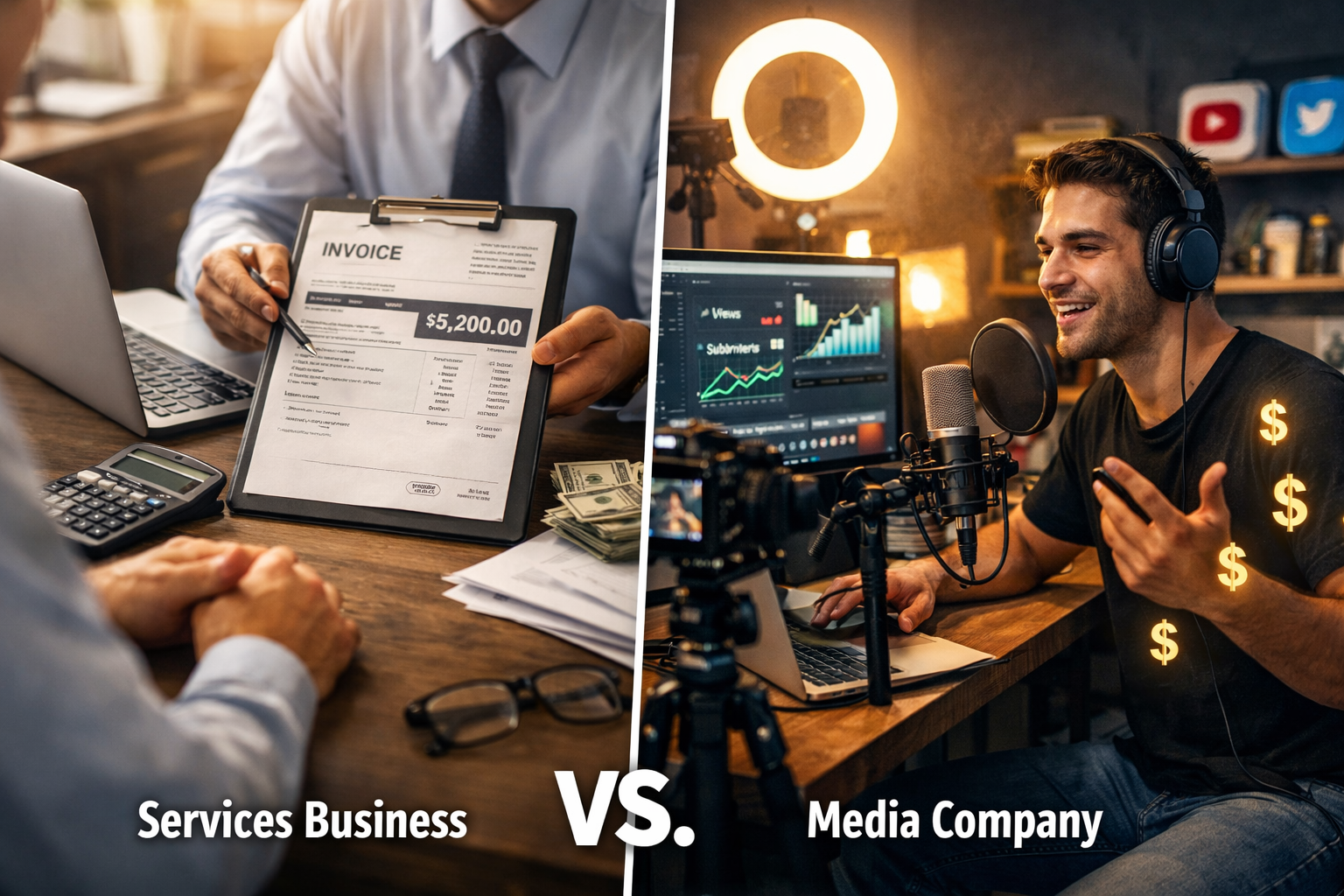
It's one of the most common questions among entrepreneurs who've spent any time building an audience or running a business: should I be selling services, or should I be selling content? Should I be charging for what I do, or charging for what I know?
The honest answer is that neither model is universally easier to monetize. They're hard in completely different ways, at completely different stages, and the right answer depends almost entirely on where you are, what you're building toward, and how you define "easy" in the first place.
Here's what both paths actually look like when you get past the surface-level appeal of each.
What "Easy to Monetize" Actually Means
Before comparing the two models, it's worth being precise about the question. Monetization difficulty isn't a single variable — it breaks down into at least three distinct components that often point in opposite directions.
Speed to First Dollar
How long does it take to go from zero to revenue? This is where the two models diverge most dramatically, and it's the dimension most entrepreneurs are actually asking about when they say "easy."
Ceiling and Scalability
How high can revenue go, and how much does growth cost? A model that produces fast early revenue but hits a ceiling at $500K is a fundamentally different business than one that takes three years to gain traction but can scale to $50M without proportional cost increases.
Sustainability and Leverage
How much ongoing effort does each dollar require to maintain? A business that generates $20,000 a month but requires $18,000 worth of labor to produce it is not the same as one that generates $20,000 a month on a system that mostly runs itself.
With those three dimensions in mind, the comparison looks very different depending on which one you're optimizing for.
The Case for Services: Fast, Predictable, Grounded in Reality
A services business — agency, consultancy, freelance practice, whatever form it takes — has one overwhelming advantage over a media business: the path to revenue is short and the feedback is immediate.
You Can Sell Before You Build
With services, you don't need an audience, a platform, a content library, or a brand with any history behind it. You need a skill that solves a problem someone is willing to pay to have solved, and a way to reach the people who have that problem. That's it. The first client can come in week one. The first invoice can go out before you've built a single piece of infrastructure.
This is not a small advantage. Most businesses die before they find product-market fit, and the primary killer is runway — running out of time and money before revenue materializes. Services businesses can generate revenue fast enough to survive that early period in a way that media businesses almost never can.
The Economics Are Transparent
With services, the relationship between input and output is legible. You do work, you charge for the work, you get paid. The variables are your rate, your utilization, and your client retention. You can model the business on a napkin and the model will be reasonably accurate.
That transparency is genuinely valuable, especially for first-time entrepreneurs who are still learning how businesses work. There are no mysterious audience algorithms to navigate, no platform dependencies to worry about, no advertising market fluctuations to absorb. You are the product, and you can control what the product does.
The Ceiling Is the Problem
Here's where services businesses run into their structural limitation: revenue is tied to time, and time doesn't scale. Whether you're billing hourly or on retainer, whether you're a solo operator or running a team, there is a ceiling determined by how many hours can be worked and how much can be charged for each one.
Breaking through that ceiling requires either raising rates significantly, building a team and managing the margin compression that comes with it, or productizing the service in some way — which starts to look less like a services business and more like a software or media business anyway.
Most services businesses plateau. Not because the founder isn't talented, but because the model has a built-in growth constraint that talent alone can't solve.
The Case for Media: Slow Start, Asymmetric Upside
A media business — newsletter, publication, podcast, content platform — operates on a completely different timeline and logic. The early period is harder. The mature period is potentially much more valuable.
The Audience Has to Come First
Unlike a services business, you cannot sell before you build in the media model. You need an audience before you have something to monetize, and building an audience takes time, consistency, and a tolerance for working without immediate feedback in the form of revenue.
This is where most media businesses fail — not because the model doesn't work, but because the founder underestimates how long the audience-building phase takes and runs out of patience, money, or both before the monetization phase begins. The graveyard of abandoned newsletters and dormant podcasts is enormous. Almost all of them died in the gap between launch and traction.
When It Works, the Leverage Is Extraordinary
But when a media brand does build a genuine audience, the economics flip in a way that services businesses almost never experience. The content that earned an audience last year is still earning it today. The newsletter issue you wrote eighteen months ago is still driving subscribers. The podcast episode from two years ago is still being discovered. The asset appreciates rather than depreciating, and the cost of maintaining it doesn't grow proportionally with the revenue it generates.
This is the leverage that makes media businesses so attractive on paper. A newsletter with 100,000 engaged subscribers can generate sponsorship revenue, course sales, paid memberships, event tickets, and consulting inquiries — simultaneously, from a single asset, largely on autopilot. That's a fundamentally different relationship between effort and output than billing for hours of service work.
Monetization Requires an Audience Worth Monetizing
The critical qualifier is that not all audiences are equal, and building a large audience is not the same as building a monetizable one. A newsletter with 200,000 subscribers in a broad, general interest category might generate less revenue than one with 8,000 subscribers in a specific, high-value niche where the readers have purchasing authority and real problems worth solving.
Media monetization is also less straightforward than service monetization. Sponsorship rates depend on audience quality metrics that take time to establish. Paid memberships require a value proposition clear enough that people will pay for what they could theoretically get for free. Advertising revenue fluctuates with market conditions entirely outside your control. The variables are less legible, and the feedback loop is longer.
Where the Two Models Actually Intersect
The most interesting thing about this comparison is that the cleanest path to building a sustainable, scalable business often involves both models, not one or the other.
Services Fund the Media, Media Elevates the Services
A services business generates the revenue and cash flow needed to invest in building a media brand without starving in the meantime. The media brand, once it has traction, generates the audience and authority that makes the services business easier to sell, justifies higher rates, and reduces dependence on outbound sales.
This is the flywheel that the most durable agency and consultancy businesses are building right now. The services pay the bills while the media compounds. Eventually the media becomes large enough to generate its own direct revenue, and the combined business is more valuable and more defensible than either would have been alone.
The Question Is Sequencing, Not Choosing
For most entrepreneurs, the real decision isn't services versus media. It's which one to lead with, and how to build the bridge between them.
Leading with services makes sense if you need revenue quickly, if you have a specific skill the market will pay for, or if you're still figuring out what your point of view actually is. Services force you to solve real problems for real clients, and that experience is invaluable raw material for the media brand you'll eventually build.
Leading with media makes sense if you already have an audience, if you have an existing platform or distribution channel, or if you have enough runway to survive the traction gap. It also makes sense if the market you're targeting is one where content is the primary way trust gets built — where clients make decisions based on who they've been reading, not who they found in a directory.
The Honest Summary
A services business is easier to monetize in the short term. The path from zero to first dollar is shorter, the feedback is faster, and the model is more legible. If you need revenue in the next ninety days, services is the answer.
A media business is harder to monetize in the short term and potentially far more valuable in the long term. The leverage is real, but it only materializes after an investment of time and consistency that most people underestimate going in.
The entrepreneurs who build the most durable businesses tend to be the ones who use services to get stable and use that stability to build the media brand they always meant to build. Not because it's the fastest path, but because it's the one that produces something worth owning at the end.
The question isn't really which is easier. It's which stage you're in, what you're optimizing for, and whether you're thinking in quarters or in years.
Frequently Asked Questions
Can I Run a Services Business and a Media Brand at the Same Time?
Yes, and many of the best operators do. The key is treating them as distinct businesses with distinct goals, not letting one become a neglected afterthought of the other. The services business needs clients and delivery. The media brand needs editorial consistency and audience growth. Both require focused attention. The entrepreneurs who successfully run both tend to be deliberate about carving out protected time for the media side, because the services side will always feel more urgent in the short term.
How Long Does It Realistically Take to Monetize a Media Business?
Longer than most people expect. A newsletter or podcast with genuine monetization — not just a few affiliate links, but meaningful revenue from sponsorships, paid memberships, or product sales — typically takes one to three years of consistent publishing to develop. Some niches move faster. Most move slower. The entrepreneurs who succeed in media tend to be the ones who decided upfront that they were building a three-year asset, not a six-month revenue stream.
What's the Minimum Audience Size Needed to Start Monetizing a Newsletter or Publication?
There's no universal threshold, but a useful mental model is that quality matters more than quantity at small scale. A newsletter with 2,000 subscribers who are senior decision-makers in a specific industry can command sponsorship rates that a general-interest newsletter with 20,000 subscribers cannot. Early monetization is usually more viable through direct relationships — a small number of sponsors who understand and value the audience specifically — than through programmatic advertising, which requires much larger scale to generate meaningful revenue.
Is a Podcast or Newsletter Easier to Monetize Than a Blog?
Each format has different monetization mechanics. Newsletters monetize well through sponsorships and paid tiers because the relationship with readers is direct and measurable — open rates, click rates, and subscriber counts are concrete numbers advertisers understand. Podcasts monetize through host-read ads and sponsorships, and the intimacy of the format can command premium rates with a relatively small audience. Blogs monetize through search traffic, which requires significant volume and strong SEO to produce meaningful ad or affiliate revenue. For most entrepreneurs starting from scratch, newsletters have the most accessible early monetization path.
If I'm Already Running a Services Business, When Should I Start Building a Media Brand?
The honest answer is earlier than feels comfortable. Most services business owners wait until they feel established — until the client base is stable, the team is solid, the processes are documented. By the time all of that is true, they've lost three or four years of compounding they'll never get back. The better approach is to start small and start early: a simple newsletter, a monthly long-form piece, a consistent LinkedIn presence. You don't need a full publication on day one. You need the habit of publishing, established before you feel like you have time for it.