The Towns That Market Themselves Grow. The Towns That Don't Get Passed Over.
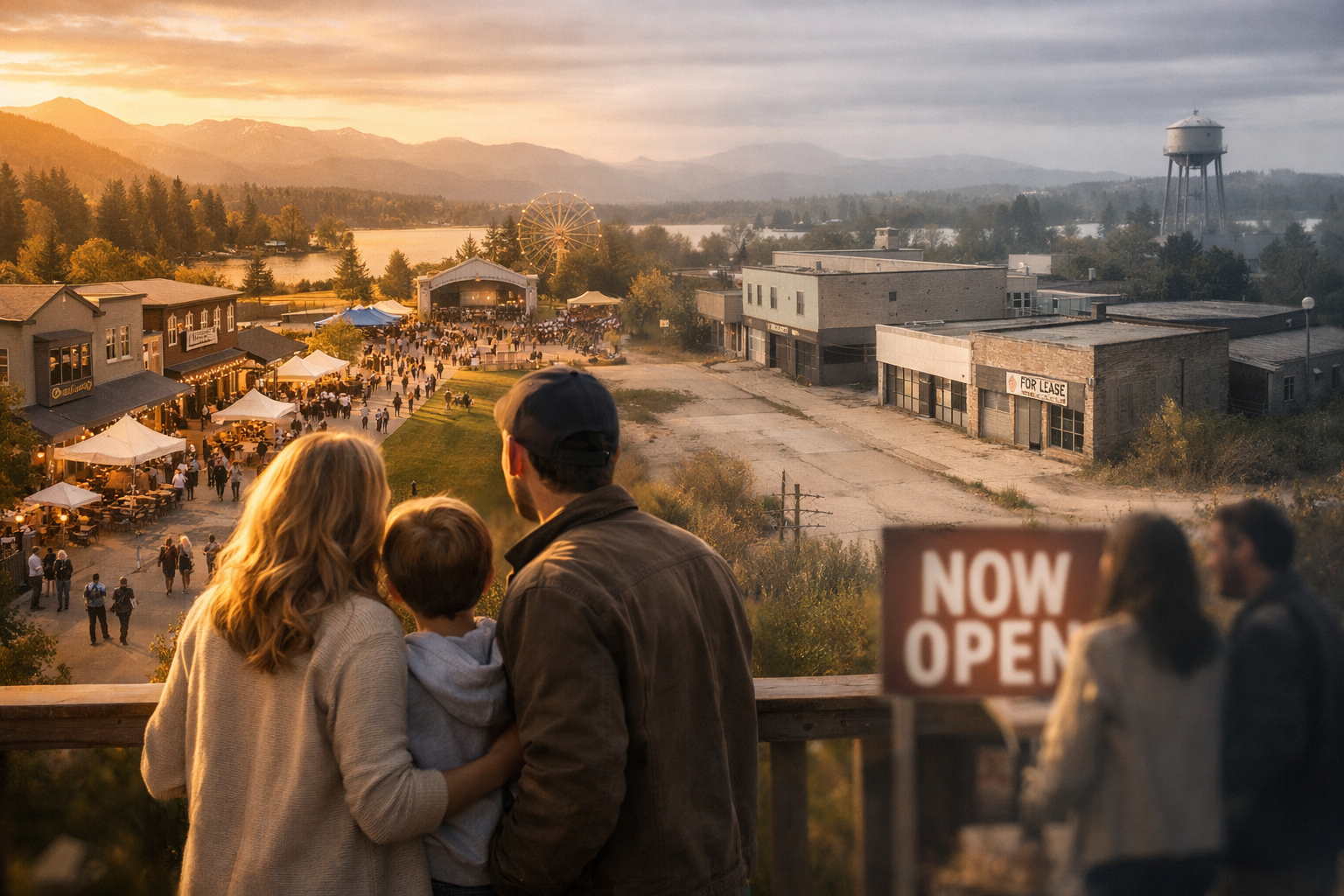
Somewhere right now, a young couple is deciding where to buy their first house. They've narrowed it down to two towns — both in the same county, both with similar commute times, both in the same school district. They're doing what every prospective homebuyer does in 2026: they're Googling.
They search for the first town. They find the municipal website. It has a homepage with the town seal, a scrolling banner of meeting notices, a link to pay taxes, and a PDF of the most recent council agenda. The parks and recreation page lists the names and addresses of the town's parks — no photos, no descriptions, no trail maps. There's no page about the town's restaurants or shops. No page about community events. No "about our town" page that tells them what it's like to live there. The website tells them how to pay a water bill. It tells them nothing about why they'd want to live in a place where they'd have a water bill.
They search for the second town. They find a municipal website that has a dedicated "Living in [Town Name]" page with photos of tree-lined streets, descriptions of the neighborhoods, information about the school system, and links to local businesses. The parks page has individual entries for each park — photos, descriptions of amenities, trail maps, playground information, seasonal hours. There's an events calendar showing a farmers market this Saturday, a summer concert series starting next month, and a 5K charity run in the fall. There's a page about the downtown district with photos and descriptions of local restaurants, shops, and services. The website tells them how to pay a water bill — and it tells them that this town is a place where people raise families, eat well, walk trails, and belong to a community.
The couple picks the second town. Not because it's objectively better — they've never visited either one. Because the second town made it easy to imagine living there. The first town made it easy to imagine paying a utility bill there. That's it. That's the entire difference. And that difference — multiplied across hundreds of families, dozens of businesses, and thousands of visitors making the same kind of decision every year — is the difference between a town that grows and a town that wonders why it isn't growing.
This post is about why municipal websites that go beyond the basics — that invest in dedicated pages for parks, local businesses, community events, tourism, relocation, and economic development — generate measurable returns in resident attraction, business growth, tourism revenue, and tax base expansion. And why most municipal websites fail to do this, leaving their town invisible to the people who are actively looking for a place to live, visit, or invest.
Your Town Is Competing Whether You Realize It or Not
Municipal leaders don't always think of their town as being in competition. Competition is a business concept — companies compete for customers, for talent, for market share. Towns just exist. They provide services to the people who live there. The job of the municipal government is to maintain roads, manage budgets, hold council meetings, and keep the lights on.
But towns are competing. Every day. For residents. For businesses. For visitors. For tax revenue. For state and federal funding. For the attention of developers, investors, and employers who are deciding where to build their next location. And increasingly, that competition plays out online — on Google, on social media, and on municipal websites that either showcase what the town has to offer or fail to mention it at all.
The family deciding where to move is comparing your town to the next town over. The restaurant owner deciding where to open a second location is comparing your downtown to three other downtowns. The company looking for office space is comparing your business district to business districts in neighboring municipalities. The weekend visitor deciding where to spend Saturday afternoon is comparing your parks and shops to the parks and shops in the town fifteen minutes away.
Every one of these decisions has economic consequences for your town. A family that moves in pays property taxes, shops at local businesses, and sends their kids to local schools. A business that opens downtown creates jobs, generates commercial tax revenue, and adds to the vibrancy that attracts more businesses and more residents. A visitor who spends a Saturday in your town spends money at your restaurants, your shops, and your attractions — money that would have gone to the next town over if your town hadn't shown up in their search.
These are the decisions your municipal website either influences or ignores. And right now, most municipal websites ignore them.
What Most Municipal Websites Actually Look Like
Let's be honest about the state of municipal websites in most small and mid-size towns. This isn't a criticism of the people who manage them — municipal clerks, administrators, and IT staff are doing their best with limited budgets, limited time, and limited technical resources. But the result is a category of websites that are, almost universally, among the worst on the internet at communicating the value of what they represent.
The typical municipal website is organized around the internal structure of the government, not around the needs of the people visiting the site. The navigation mirrors the org chart: Mayor and Council. Departments. Planning Board. Zoning Board. Tax Assessor. Building Department. Municipal Court. These are important functions. They should be on the website. But they're organized for the people who work inside the government, not for the people who are trying to learn about the town.
A family considering moving to your town doesn't care about your org chart. They want to know what the town is like. What are the parks like? Are there good restaurants? Is there a downtown? What events happen throughout the year? What's the vibe? Is this a place where people walk around on a Saturday morning with a coffee, or is it a place where you drive through on your way to somewhere else?
A business considering your town doesn't care about your zoning board meeting schedule — not yet. First, they want to know whether your town has the kind of customer base, foot traffic, and community energy that makes a business location viable. They want to see a thriving downtown, an active community, and a local government that's invested in economic development.
A visitor considering a day trip doesn't care about your tax assessor. They want to know what there is to do — parks, trails, restaurants, shops, events, attractions. They want to see photos. They want to know what's happening this weekend.
None of these people — the potential resident, the potential business, the potential visitor — find what they're looking for on the typical municipal website. The site serves the people who already live there and need to interact with their government. It does almost nothing for the people who don't live there yet but might, if anyone gave them a reason.
The Pages That Change Everything
The gap between a municipal website that serves only existing residents and one that actively markets the town to potential residents, businesses, and visitors is a handful of dedicated pages. Not dozens. Not a massive redesign. A focused set of pages that present the town's assets in a way that's compelling, specific, and searchable.
Parks and Recreation Pages (With Actual Content)
Every town has parks. Most municipal websites list them — a name, an address, maybe a bulleted list of amenities. "Riverside Park. 123 Main Street. Baseball field, playground, walking trail." That's it. That's the entire representation of a park that might be one of the best things about your town.
Now imagine a dedicated page for Riverside Park with photos — real photos, not clip art — showing the playground, the trail, the river view, the picnic pavilion. A description that tells the visitor what the park feels like: "Riverside Park is a twelve-acre park along the Raritan River with a paved walking trail, two playgrounds (one for toddlers, one for older kids), shaded picnic areas, and a kayak launch point. The trail connects to the county greenway system, giving walkers and cyclists access to fifteen miles of continuous path." A map showing the park's location, parking, and trail layout. Information about seasonal hours, permit requirements for pavilion rentals, and upcoming events at the park.
That page does something the bulleted list never could: it makes someone want to visit. It makes a prospective resident picture their kids on that playground. It makes a visitor plan a Saturday morning walk along that trail. It makes someone searching for "parks near me" or "kayaking [county name]" or "walking trails [town name]" find your town instead of the next one over.
And that page ranks in Google. A dedicated, well-written page about a specific park with photos, descriptions, and location information ranks for searches like "parks in [town name]," "walking trails [county name]," "playgrounds near [town name]," and dozens of other long-tail queries that real people make when they're looking for something to do or somewhere to live. The bulleted list doesn't rank for any of those searches because it has no substantive content for Google to index.
Multiply this across every park, every trail, every recreation facility in your town. Each dedicated page is an asset — a searchable, shareable, linkable representation of something that makes your town worth visiting or living in.
Local Business and Restaurant Pages
This is the page that most municipal websites don't have at all — and it's one of the most valuable pages a town can build.
A dedicated page (or section) highlighting local businesses, restaurants, and shops communicates something that no amount of government information can: this town has a community. People eat here. People shop here. People open businesses here because they believe in this place. A page showcasing your downtown restaurants with photos, descriptions, and links tells a prospective resident that this is a town with culture and energy. It tells a visitor that this is a destination, not a drive-through. And it tells a potential business owner that this town supports and promotes its commercial community.
This page doesn't need to be a comprehensive directory of every business in town. It can be a curated showcase of the downtown district — the restaurants, the coffee shops, the boutiques, the services that give the town its character. Real photos, not stock images. Descriptions that capture what makes each place distinctive. Links to each business's website or social media. A map showing where everything is located relative to parking, parks, and other attractions.
For the local businesses themselves, being featured on the municipal website is valuable. It's free exposure on a site with inherent authority — municipal .gov and .us domains carry trust in Google's algorithm. It demonstrates that the town government values and promotes its business community. And it creates a resource that residents can share and that visitors can discover through search.
"Visit [Town Name]" Pages
States have tourism boards. Counties have visitor bureaus. Many towns have neither — and assume that tourism marketing isn't their responsibility or that their town "isn't a tourist destination."
Every town is a destination for someone. The town with a historic district is a destination for history enthusiasts. The town with a farmers market is a destination for Saturday morning browsers. The town with a riverside trail is a destination for cyclists and walkers. The town with three good restaurants is a destination for someone looking for a place to have dinner. The town with a Fourth of July parade and a fall festival is a destination for families looking for something to do on a holiday weekend.
A "Visit [Town Name]" page — or even a small section of the website dedicated to visitors — packages these assets together and presents them to people who are searching for things to do. It doesn't need to be elaborate. It needs to exist. A page that says "Here's what you can do when you visit [Town Name]" with sections for parks and trails, dining and shopping, events, and local attractions creates a single resource that ranks for visitor-intent searches and gives people a reason to come.
The economic impact of visitor traffic is direct and measurable. Every visitor who eats at a local restaurant, buys something at a local shop, or pays for parking in the downtown district is contributing to the local economy. Towns that capture even a modest share of regional visitor traffic generate meaningful revenue for their businesses — revenue that supports jobs, generates sales tax, and sustains the commercial activity that makes the town attractive to residents and businesses.
Events Calendar and Community Programming Pages
Events are the heartbeat of a town's community life. Farmers markets, summer concerts, holiday parades, 5K runs, art walks, food festivals, community clean-up days, movie nights in the park — these events are what transform a municipality from a collection of houses and roads into a community where people want to live.
And they're almost always buried in a PDF flyer linked from a generic "News" or "Announcements" page on the municipal website. If they're on the website at all. Many town events are promoted only through social media, flyers posted at town hall, or word of mouth — invisible to anyone who isn't already in the loop.
A well-built events calendar on the municipal website serves multiple audiences simultaneously. Existing residents use it to find out what's happening this weekend. Prospective residents browsing the website see that this is a town where things happen — an active, engaged community with regular programming. Visitors searching for "things to do near [town name] this weekend" or "farmers market [county name]" find the events and make the trip.
The events calendar should be more than a list of dates and titles. Each event should have its own page with a description, photos from previous years, location details, parking information, and links to related resources. These individual event pages rank in Google for event-specific searches and create a library of content that demonstrates the town's community vitality over time. A town with fifty event pages from the past two years looks very different to a prospective resident than a town with a blank events section and a council meeting schedule.
Relocation and "Living in [Town Name]" Pages
The decision to move to a town is one of the biggest financial and lifestyle decisions a person or family makes. And the research process for that decision increasingly happens online — long before anyone contacts a real estate agent, drives through the neighborhoods, or visits the town in person.
When a prospective resident searches for "living in [town name]" or "moving to [town name]" or "[town name] neighborhoods" or "is [town name] a good place to live," they're looking for specific information: What are the neighborhoods like? What are the schools? What's the commute to [nearby city]? What's the tax rate? What's the housing market? What's there to do? What's the town's personality?
If your municipal website has a "Living in [Town Name]" page that answers these questions — with real information, real photos, and a genuine portrayal of what life in the town is like — you've just influenced a relocation decision before the person ever sets foot in your town. You've given them information they couldn't find on a real estate listing or a review site. You've told the story of your community in a way that only the community itself can tell.
This page should include neighborhood descriptions, school information (or links to the school district's website), commute information to nearby employment centers, tax rate information, links to the parks, recreation, events, and local business pages elsewhere on the site, and anything else that a prospective resident would want to know. Photos matter enormously here — not stock photos of generic suburban life, but real photos of your town's streets, parks, downtown, and community events. The goal is to make the reader feel what it would be like to live there.
Economic Development Pages
For towns that want to attract commercial investment — new businesses, developers, employers — a dedicated economic development section of the website is essential. This section speaks to a different audience than the resident or the visitor: it speaks to the business owner or developer who is evaluating your town as a potential location.
This section should include information about commercial real estate availability, tax incentives or economic development programs, the demographic and economic profile of the town and surrounding area, infrastructure and transportation access, the permitting and approval process (presented clearly and accessibly, not as a bureaucratic obstacle course), and success stories of businesses that have opened and thrived in the town.
The tone matters here. A town that presents its economic development information confidently and invitingly — "Here's why businesses choose [Town Name], and here's how we make the process easy" — creates a very different impression than a town whose commercial information is buried in zoning PDFs and planning board minutes. The former says "we want your business." The latter says "good luck navigating our bureaucracy."
The SEO Value: Showing Up When People Are Making Decisions
Every page described above doesn't just serve the person who visits the municipal website directly. Each page is a Google-indexable asset that can rank for searches that real people make when they're deciding where to live, where to visit, where to eat, where to open a business, and where to spend their money.
Municipal websites have a structural SEO advantage that most towns don't realize they possess. Government domains — .gov, .us, and even .org domains used by municipalities — carry inherent authority in Google's algorithm. Google treats government websites as trustworthy, authoritative sources of information. This means that a well-written page on a municipal website can outrank a private blog, a review site, or a real estate listing for the same search query, with less effort than a private site would need to achieve the same ranking.
This authority is wasted on most municipal websites because the content isn't there. A municipal website with nothing but meeting agendas and department contact information has enormous domain authority and nothing to rank for. It's like having a megaphone and nothing to say.
But add substantive pages about parks, local businesses, events, relocation, and economic development — each optimized for the natural language searches that real people make — and that domain authority starts working. "Parks in [town name]" ranks on the first page. "Restaurants in [town name]" ranks. "Living in [town name]" ranks. "Things to do in [town name]" ranks. "Starting a business in [town name]" ranks.
Each ranking is a person finding your town. Each person finding your town is a potential resident, visitor, or business that might never have considered your town without that search result. The cumulative effect of ranking for dozens of local searches is a steady stream of people discovering your town through Google — people who are actively looking for what your town offers but would never have found it without the content to match their search.
The towns that invest in this content capture this traffic. The towns that don't invest lose it — to neighboring towns that do, to review sites that tell someone else's version of the story, or to the void of "no results found" that effectively makes the town invisible to everyone who searches.
The Economic Development Multiplier
Everything described in this post — the parks pages, the business pages, the events calendar, the relocation content, the visitor information — ladders up to a single outcome: economic development. Not in the abstract, policy-paper sense of the term, but in the concrete, measurable sense of more people living in the town, more businesses operating in the town, more visitors spending money in the town, and more tax revenue funding the town's services and infrastructure.
The mechanism is straightforward.
More visibility leads to more visitors. More visitors leads to more spending at local businesses. More spending at local businesses leads to more viable commercial activity. More viable commercial activity attracts more businesses. More businesses create more jobs. More jobs attract more residents. More residents expand the tax base. A larger tax base funds better services and amenities. Better services and amenities attract more residents and more businesses. The cycle continues.
This is not theoretical. This is the observable difference between towns that actively market themselves and towns that don't. The towns with vibrant, content-rich websites and active tourism and relocation marketing grow. They attract young families. They attract entrepreneurs. They attract investment. They become the towns that neighboring towns look at and wonder, "What are they doing that we aren't?"
What they're doing is telling people about themselves. That's it. They're not fundamentally different towns. They have similar parks, similar restaurants, similar schools, similar housing. They just told people about it — on their website, in search results, through dedicated content that showed up when someone was looking for a place to live, a place to visit, or a place to open a business.
The towns that don't do this marketing don't decline because they're bad towns. They stagnate because they're invisible towns. They have every asset they need to attract residents, businesses, and visitors. They just never told anyone.
The "That's Not Our Job" Objection
Some municipal leaders will read this and think: "Tourism marketing isn't our job. Economic development promotion isn't our job. Our job is to provide municipal services to the people who live here."
This perspective is understandable. Municipal governments are not marketing agencies. They have limited budgets, limited staff, and a long list of core responsibilities that don't include content marketing.
But consider the alternative. If the municipal government doesn't tell the town's story, who does? Zillow? Google Reviews? A Reddit thread from four years ago? The real estate agent who covers your town and three competing towns simultaneously?
The municipal government is the only entity with both the authority and the incentive to present a comprehensive, accurate, and compelling picture of the town. The Chamber of Commerce might promote businesses, but they don't represent the full scope of what makes the town attractive. The school district promotes the schools, but not the parks or the downtown. A tourism board, if one exists, might promote attractions, but not the relocation opportunity or the business environment.
The municipal website is the one place where all of these assets — parks, businesses, schools, events, neighborhoods, economic development — can be presented together, under one authoritative domain, in a way that tells the complete story of the town. Nobody else can do that. And if the municipality doesn't do it, it doesn't get done.
The budget concern is real, but the investment is modest relative to the return. A small number of well-built pages — not a complete website overhaul, but targeted content additions — can transform a municipal website from a government services portal into a community marketing asset. The return on that investment comes in the form of new residents who expand the tax base, new businesses that create jobs and generate commercial revenue, and visitor spending that supports local commerce.
This isn't marketing for marketing's sake. It's economic development through digital presence. And for towns competing with neighboring municipalities for residents, businesses, and visitors, it's not optional anymore. It's the cost of being visible in a world where every decision starts with a search.
What a Town That Gets This Right Looks Like
The towns that are doing this well share a few common characteristics. They don't all have big budgets. They don't all have dedicated marketing staff. But they've made a decision to use their website as more than a government services portal — to use it as a tool for community promotion and economic development.
Their websites have clear, intuitive navigation that serves both residents and visitors — government services are easy to find, and so are parks, businesses, events, and relocation information. They use real photography — photos of their actual town, taken by real people, showing what the community actually looks like. Not stock photos of generic families in generic parks. Real images of their specific downtown, their specific trails, their specific events.
Their content is specific and descriptive. Not "Town Park — 5 acres, playground, walking path." Instead: "Town Park is a five-acre green space in the heart of the residential district, with a recently renovated playground, a half-mile paved walking loop, a shaded pavilion available for rentals, and a community garden maintained by local volunteers. The park hosts the town's annual fall festival and weekly summer yoga sessions."
Their events calendars are active and current. They're not showing events from six months ago. They're showing what's happening this week, this month, and this season — and they're presenting events with enough detail and visual appeal that someone who isn't already a resident would want to attend.
Their economic development content is welcoming and practical. It doesn't just describe the regulatory process — it makes the case for why a business should choose this town, with data, testimonials, and a clear point of contact for anyone who wants to learn more.
And their websites are mobile-friendly, fast, accessible, and well-maintained — because the person searching "things to do near me" or "best towns to live in [county name]" is almost certainly searching from a phone, and a slow, broken, desktop-only municipal website loses that person in three seconds.
The Bottom Line
Your town has parks that families would love. Restaurants that visitors would enjoy. Events that would bring people into the community. Neighborhoods that prospective homebuyers would fall in love with. A business environment that entrepreneurs would thrive in.
None of that matters if nobody knows about it.
Your municipal website is the single most authoritative, most searchable, most controllable platform your town has for telling people what makes it worth visiting, worth living in, and worth investing in. Every page you don't build is a story you're not telling. Every search you don't rank for is a person who found the next town instead of yours. Every prospective resident, business owner, and visitor who can't find compelling information about your town online is someone who takes their property tax dollars, their commercial revenue, and their spending money somewhere else.
The towns that market themselves grow. Not because they're better towns — but because they're visible towns. They show up when people search. They tell their story when people are listening. They make it easy to imagine living there, visiting there, and doing business there.
The towns that don't market themselves don't decline overnight. They fade slowly, wondering why the neighboring town is getting all the new restaurants, why young families are choosing the town across the county, why the developer chose to build over there instead of over here.
The answer is almost always the same: the other town showed up. It had the pages. It had the photos. It had the content. It answered the questions that people were asking. It made itself visible to the people who were looking.
Your town can do the same. It starts with a website that does more than manage government. It starts with a website that markets a community.
Frequently Asked Questions
We're a Small Town With a Tiny Budget. Can We Really Do This?
You don't need to do everything at once. Start with the highest-impact pages: a "Living in [Town Name]" page, a parks page with real photos and descriptions, and a local business showcase. Even three or four well-built pages can transform the online impression of your town. The investment is modest compared to what towns typically spend on physical infrastructure and programs — and the return, in the form of new residents and visitor traffic, starts immediately. A single family that moves to your town because they found it online generates property tax revenue that more than covers the cost of building these pages.
Our Website Is Managed by a Vendor on a Government CMS Platform. Can We Add This Kind of Content?
Most government CMS platforms — CivicPlus, Granicus, Municode, and others — support the creation of custom content pages. The limitation is usually not the platform but the content itself. The platform can host a beautiful parks page with photos and descriptions. Someone just needs to create it. If your current vendor or internal staff can add pages to the site, the technical barrier is low. The real investment is in the content: the photography, the writing, the strategic thinking about what to include and how to present it.
Won't Local Businesses Expect Us to Feature All of Them? How Do We Handle That?
There are several approaches. Some towns create a comprehensive business directory that lists all registered businesses, with a separate "featured" or "spotlight" section that highlights specific businesses on a rotating basis. Others focus on geographic areas — showcasing the downtown district or a specific commercial corridor — rather than individual businesses. The key is to set clear, consistent criteria for inclusion and to communicate those criteria transparently. Most business owners will appreciate the town's effort to promote local commerce, even if not every business is individually featured on the first page.
How Do We Get Good Photos Without Hiring a Professional Photographer?
Professional photography is ideal, but smartphone photos taken by town staff or volunteers can be surprisingly effective if they follow a few basic principles: shoot during golden hour (early morning or late afternoon) for the best natural light, photograph real people using the parks and downtown (with permission), avoid empty spaces, and focus on the specific details that make your town distinctive rather than generic wide shots. Many towns organize an annual photo walk or contest where residents submit their best photos of the town — this builds community engagement and produces a library of authentic images that are far more compelling than stock photography.
How Do We Measure Whether This Is Working?
Google Analytics (or whatever analytics platform your CMS provides) will show you how many people are visiting these new pages, where they're coming from (search, social media, direct), and what they do after they arrive. Google Search Console will show you which search queries are leading people to your site. Over time, you can track whether the pages are ranking for the target searches and whether traffic is growing. For economic development impact, the measurement is longer-term: new business inquiries received through the website, new resident inquiries, attendance at featured events, and the qualitative feedback from the business community and residents about the website's usefulness. The most important metric, ultimately, is growth — in residents, in businesses, in visitor activity, and in the tax base that funds everything else the town does.
Related Reads
〰️
Related Reads 〰️
What the Velocity of Money Means for Your Town — and Why Marketing Is the Pump
The velocity of money — how fast a dollar circulates within your community — is the difference between a town that thrives and a town that stagnates. Every local business that's invisible online is a leak in the local economy, sending customer spending to Amazon, national chains, and better-marketed competitors. Marketing is the pump that keeps money moving locally: it makes businesses findable, drives customers in, and creates the growth that generates jobs, spending, and tax revenue. Here's what that means for your town.
Your Outdated Municipal Website Is Sending a Message — And It's Not a Good One
Every day, residents visit your municipal website expecting to find answers — and too many of them land on a site that looks like it was built during the last administration. An outdated website doesn't just make it hard to find information. It sends a message about how your municipality operates, how much it values residents' time, and how seriously it takes transparency. Here's what that message really sounds like and why the cost of waiting keeps getting higher.
When a Local Agency Helps a Local Business Win, Everybody Wins: The Ripple Effect of Regional Marketing Investment in Williamstown, NJ
A restaurant in Williamstown hires a regional marketing agency. New customers find the restaurant online. The restaurant hires a server — a local kid from Williamstown High. The server's paycheck gets spent at local shops. The restaurant buys more produce from local farms. The farms invest in equipment. The block gets busier. Tax revenue goes up. One marketing investment, traced through its full economic impact on Monroe Township and the Gloucester County community.