What the Velocity of Money Means for Your Town — and Why Marketing Is the Pump
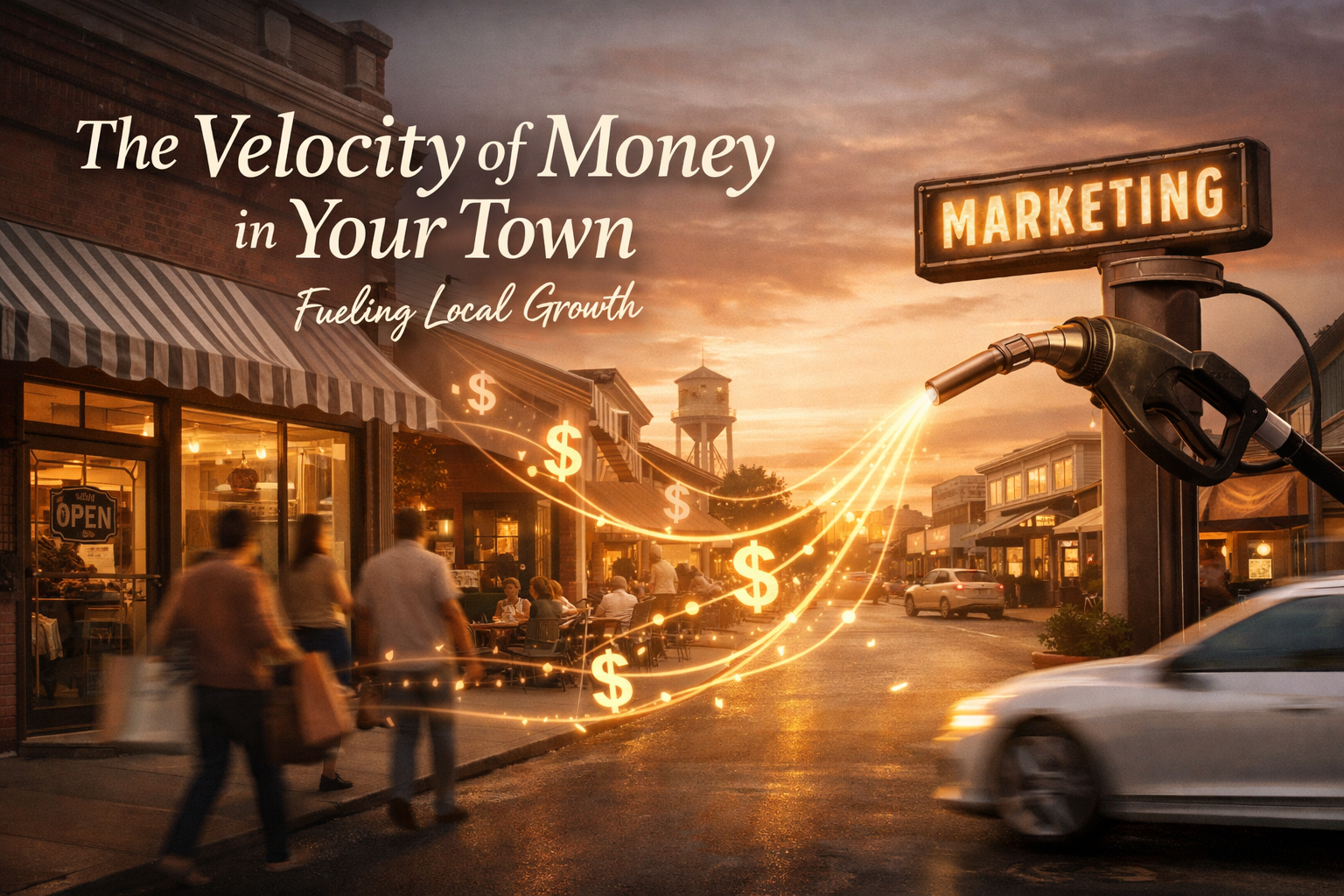
There's a concept in economics that most municipal leaders and local business owners have never heard of — or if they've heard of it, they've never connected it to the practical decisions they make about their town and their businesses every day. The concept is the velocity of money, and once you understand it, you'll never think about local economic development the same way again.
Here's the simplest version: a dollar that moves is worth more than a dollar that sits still. A dollar that circulates within your community — spent, earned, spent again, earned again — generates more economic activity than its face value. A dollar that leaves your community generates zero local economic activity after the moment it leaves. The speed at which money circulates within your town's economy determines how much prosperity that economy produces. Faster circulation means more jobs, more revenue, more tax base, more vitality. Slower circulation means stagnation, store closures, population decline, and the slow erosion of everything that makes a town a community rather than a collection of houses.
This isn't abstract. It's happening right now in your town. Every transaction a resident makes is either keeping money circulating locally or sending it somewhere else. Every business decision — hiring, purchasing, investing — either adds velocity to the local economy or drains it. And the single most controllable factor in whether your local businesses capture and circulate those dollars, rather than losing them to Amazon, to national chains, or to the town fifteen minutes away with better marketing, is whether those businesses are visible to the people who are ready to spend.
That's where marketing comes in. Not marketing as an abstract business concept. Marketing as the pump that keeps local dollars moving — that drives customers to local businesses, that drives revenue through local supply chains, that drives hiring and spending and investment within the community. Without the pump, the water sits still. Without marketing, the money sits still — or flows downhill to whoever made themselves easier to find.
This post is about what the velocity of money means for your town, why it matters more than most economic development strategies acknowledge, how marketing directly accelerates it, and what happens to communities that let the pump run dry.
The Velocity of Money in Plain English
Imagine a hundred-dollar bill. It starts in the pocket of a resident of your town. Here's what happens when it circulates locally:
The resident spends it at the local hardware store. The hardware store owner uses part of it to pay a local employee. That employee spends part of their paycheck at the local diner for lunch. The diner owner uses part of that revenue to buy produce from a local farm stand. The farm stand operator uses part of that to pay for an ad in the local newspaper. The newspaper uses part of that to pay a local delivery driver. The delivery driver spends part of their paycheck at the local hardware store.
That hundred-dollar bill just generated several hundred dollars' worth of economic activity — wages earned, goods sold, services rendered, meals served, products delivered. Each time the money changed hands within the community, it created value. Each transaction supported a job, sustained a business, and contributed to the tax base. The original hundred dollars didn't multiply in a literal sense — the physical bill is still a hundred dollars. But the economic activity it generated was a multiple of its face value, because it kept moving.
Now imagine the same hundred-dollar bill leaving the community. The resident spends it on Amazon. The money goes to a warehouse in another state. It pays a worker in that state. It pays shareholders who live everywhere except your town. That hundred dollars generated exactly zero additional economic activity in your community after the moment it left. One transaction and it's gone. No local employee was paid. No local business earned revenue. No local supplier was engaged. The money didn't circulate — it evacuated.
The velocity of money is the measurement of how many times a dollar changes hands within a defined economy over a given period. Higher velocity means the same pool of money generates more economic activity. Lower velocity means the same pool of money generates less. For a local economy — a town, a county, a region — the velocity of money is one of the most important indicators of economic health, even though it's rarely discussed outside of economics departments.
And here's the thing that municipal leaders and local business owners need to understand: velocity isn't just something that happens to your economy. It's something that can be influenced, accelerated, and deliberately increased through the decisions your town and your businesses make. The most powerful of those decisions is whether you invest in making your local businesses visible to the people who are ready to spend money.
Where the Money Goes When Local Businesses Are Invisible
Every day, residents of your town make spending decisions. Where to eat dinner. Where to buy a birthday gift. Where to get their car serviced. Who to call when the basement floods. Where to buy plants for the garden. Who to hire to build the deck.
These are not trivial decisions. In aggregate, they represent the majority of consumer spending in your local economy. And increasingly, these decisions are made online — through Google searches, social media recommendations, review sites, and map applications. The business that shows up in the search gets the customer. The business that doesn't show up doesn't exist, as far as the searcher is concerned.
When a local restaurant doesn't have a Google Business Profile, doesn't show up in "restaurants near me" searches, and has no website or social media presence, the resident who searches for dinner options finds the Olive Garden instead. That dinner tab — fifty, seventy, a hundred dollars — leaves the local economy. It goes to corporate headquarters in Orlando. It pays a worker in your town (if the chain location is in your town), but the profits, the supply chain spending, and the corporate overhead all leave. The money's velocity within your community drops to near zero after a single transaction.
When a local plumber doesn't have a website and doesn't appear in local search results, the homeowner who Googles "plumber near me" finds a national referral service or a plumber from two towns over. The money leaves. When a local boutique doesn't have an online presence, the resident buys the gift on Amazon. The money leaves. When a local landscaper doesn't show up on Google Maps, the homeowner hires a company from the next county. The money leaves.
Each individual transaction seems small. One dinner. One plumbing call. One birthday gift. But multiply these invisible losses across every category of local spending, across every resident, across every day of the year, and the cumulative drain on the local economy is staggering. Studies on local economic impact consistently show that money spent at locally owned businesses recirculates within the community at two to four times the rate of money spent at national chains or online retailers. When a resident spends a dollar at a local business, roughly fifty to seventy cents stays in the local economy through wages, local supply chain purchases, and owner spending. When a resident spends a dollar at a national chain, roughly fifteen to twenty-five cents stays. When a resident spends a dollar on Amazon, effectively nothing stays.
The difference between fifty cents recirculating locally and zero cents recirculating locally, multiplied across millions of dollars in annual consumer spending, is the difference between a town with a thriving downtown and a town wondering why all the storefronts are empty.
Marketing Is the Pump
If the velocity of money is the measure of economic vitality, marketing is the mechanism that drives it. Not the only mechanism — infrastructure, policy, taxation, and dozens of other factors matter. But marketing is the most direct, most controllable, and most underinvested lever that local economies have for keeping money circulating.
Here's why.
Marketing Makes Local Businesses Findable
The fundamental reason money leaves a local economy is that the local option is invisible. The resident didn't choose Amazon over the local bookstore because Amazon is inherently better. They chose Amazon because they searched for the book, Amazon appeared, and the local bookstore didn't. The decision wasn't made against the local business. It was made in the absence of the local business.
Marketing — a website, a Google Business Profile, local SEO, social media, review management — makes the local business appear in the search. It puts the local option in front of the customer at the moment of decision. It doesn't guarantee the sale. But it ensures the local business is in the consideration set, which is the minimum requirement for capturing the transaction and keeping the money local.
Every local business that invests in its online visibility is effectively plugging a leak in the local economy. Every customer that business captures through search is a customer whose money stays in the community rather than leaving it. The marketing investment doesn't just generate revenue for the individual business — it generates velocity for the entire local economy.
Marketing Drives Customers From Outside the Community In
Velocity isn't just about keeping existing money circulating. It's also about bringing new money into the system. Visitors, tourists, day-trippers, people from neighboring towns who drive to your town because they found a restaurant, a park, a shop, or an event online — these are all sources of new money entering your local economy.
A restaurant in your downtown that has a strong Google presence, good reviews, and an active Instagram account doesn't just capture local residents. It captures diners from surrounding towns who search for "best Italian restaurant near [your town]" and decide to make the trip. That dinner tab is new money — money that entered your local economy from outside and will now circulate through wages, supplier purchases, and owner spending.
A town that actively markets its parks, events, shops, and restaurants — through its municipal website, through its businesses' individual marketing, and through any tourism or chamber of commerce efforts — is bringing outside money in. A town that doesn't market itself is relying entirely on the money already inside the community, which is finite and shrinking every time a transaction leaks to Amazon, a chain, or a competitor in the next town.
Marketing is the pump that brings new water into the system. Without it, the pool only gets smaller.
Marketing Creates the Conditions for Business Growth
When local businesses grow — when the restaurant gets busier, when the contractor gets more calls, when the boutique sells more inventory — the economic effects cascade through the community.
The restaurant that gets busier hires another server. That's a local job. The server's paycheck gets spent locally — rent, groceries, gas, entertainment. Each of those expenditures supports another local business.
The contractor who gets more calls hires a helper. Buys more materials from the local supply house. The supply house orders more inventory. The delivery driver makes more trips. Each step in the chain is local economic activity generated by the original marketing investment that made the contractor's phone ring.
The boutique that sells more inventory restocks from local artisans and regional wholesalers. The artisan buys materials. The wholesaler hires warehouse staff. The staff spends their paychecks locally.
This is the multiplier effect, and it's powered by growth. Stagnant businesses don't hire. They don't expand. They don't increase their purchasing from local suppliers. They maintain — and eventually, they contract. Growing businesses do all of those things, and the growth ripples through the local economy in ways that extend far beyond the individual business's revenue.
Marketing is what drives the growth. A business that's invisible online doesn't grow — it survives, at best. A business that's visible, findable, and compelling online grows, and that growth becomes the fuel for the entire local economic engine.
The Chain Reaction: Following a Marketing Dollar Through the Local Economy
Let's trace a specific example to make this concrete.
A local bakery in your town hires a regional marketing agency to build them a website, optimize their Google Business Profile, manage their social media, and improve their local search visibility. The bakery pays the agency a monthly retainer. Let's follow what happens.
The agency fee itself stays regional. The agency's team members live in the area. They spend their income locally — on housing, food, childcare, entertainment, and services. The agency rents office space locally (or its team members work from local coffee shops and home offices). The agency pays for local services — accounting, internet, office supplies. The marketing fee didn't go to Google's headquarters in Mountain View. It went to people who live and spend in your region.
The agency's work makes the bakery more visible. The new website ranks for "bakery near [town name]." The Google Business Profile shows up in map searches with updated photos and reviews. The social media presence attracts followers who become customers. People who previously drove past the bakery without knowing it existed now stop in. People from neighboring towns who searched for "best bakery near me" make the trip.
The bakery's revenue increases. More customers means more sales. The bakery hires a part-time counter person — a local resident who now has income to spend locally. The bakery orders more flour, sugar, and packaging from their suppliers — some local, some regional. The bakery owner, earning more, spends more locally — dinners out, home improvements, clothes for the kids.
The customers who come to the bakery don't just go to the bakery. They park downtown and walk past other shops. They stop into the bookstore next door. They notice the new restaurant across the street and come back for dinner on Friday. The bakery's increased foot traffic benefits every business in the vicinity — not because those businesses did anything differently, but because more people are walking past their doors.
The increased foot traffic attracts more businesses. The landlord with the empty storefront on the same block notices that foot traffic is up. A prospective tenant — a coffee shop, a gift shop, a yoga studio — notices the same thing. The storefront gets leased. Another business opens. Another set of employees gets hired. Another source of local spending begins circulating.
The increased commercial activity generates tax revenue. Sales tax from the bakery's increased revenue. Property tax from the newly leased storefront. Income tax from the newly hired employees. Revenue that funds the municipal services — the parks, the roads, the schools — that make the town attractive to more residents and more businesses.
All of this — the jobs, the spending, the new business, the tax revenue, the increased vitality of the downtown — traces back to one bakery's decision to invest in marketing. The marketing fee wasn't a cost that left the economy. It was an injection of energy into the local economic system — an investment that generated returns far exceeding the original amount, distributed across the entire community.
What Happens When the Pump Stops
The inverse is equally true, and it's what's happening in towns across the country that haven't connected marketing to economic vitality.
When local businesses don't market themselves, they're invisible online. Customers who would have spent locally spend elsewhere — online, at chains, in neighboring towns. Revenue declines. The businesses cut costs — which means fewer employees, fewer local purchases, less owner spending. The economic velocity in the community slows.
When enough businesses are invisible, the downtown starts to hollow out. Storefronts empty. Foot traffic drops. The remaining businesses see fewer customers. More closures follow. The tax base contracts. Municipal services get cut. The town becomes less attractive to potential residents and businesses. The cycle accelerates downward.
This isn't a hypothetical. It's the story of hundreds of small towns and small downtowns that have lost vitality over the past two decades. The causes are multiple and complex — online retail, changing consumer habits, demographic shifts, policy decisions. But one of the most controllable factors is whether local businesses are visible to local customers. And visibility, in 2026, is a marketing function.
The towns that are thriving — the ones with busy downtowns, growing populations, and increasing commercial activity — aren't thriving because they have inherently better businesses or inherently better geography. Many of them are thriving because their businesses invested in being findable, their town invested in being marketable, and the combination of business-level visibility and community-level promotion created a virtuous cycle of economic activity.
The pump was running. The money was moving. And each dollar that circulated locally generated more activity than the last.
Why "Shop Local" Campaigns Aren't Enough
Every town has had a "shop local" campaign. Banners on the streetlights. A hashtag on social media. A holiday shopping guide from the chamber of commerce. These campaigns are well-intentioned and they're not useless — they raise awareness of the concept of shopping locally and they generate some feel-good community spirit.
But they don't solve the actual problem.
The problem isn't that residents don't want to shop locally. Most people, when given a choice between a local business and a non-local alternative at comparable price and convenience, prefer the local option. The problem is that the local option isn't findable at the moment of decision.
"Shop local" asks the consumer to make a choice. But the consumer can't choose what they can't find. When they search for "coffee near me" and the local coffee shop doesn't appear but Starbucks does, the "shop local" banner on Main Street doesn't help. When they search for a plumber and the local plumber has no website, no reviews, and no Google listing, the chamber's holiday shopping guide doesn't help. When they want to order dinner and the local restaurant has no online ordering while the chain restaurant does, the hashtag doesn't help.
Marketing is the infrastructure that makes "shop local" possible. It's the operational layer beneath the aspirational message. Without it, "shop local" is a slogan without a mechanism. With it, "shop local" becomes the natural outcome — not because consumers are making a patriotic choice, but because the local businesses showed up in the search, looked professional, had good reviews, and made it easy to buy.
The towns that are serious about keeping money circulating locally need to invest not just in campaigns that ask people to shop local but in the marketing infrastructure that makes local businesses findable, competitive, and compelling to the customers who are already searching.
The Role of the Municipality
Municipal governments have a role to play in this that goes beyond traditional economic development — beyond tax incentives and zoning and industrial park construction. Those tools matter. But the most impactful thing many municipalities can do for their local economy in 2026 is help their businesses become visible online.
This can take several forms.
The Municipal Website as a Marketing Platform
As we've discussed in previous posts, the municipal website itself is a marketing tool for the community. Dedicated pages for parks, local businesses, events, dining, shopping, and relocation information bring people to the town — both digitally and physically. Every visitor who discovers the town through a Google search and decides to visit, move, or open a business is injecting new money into the local economic cycle. The municipal website, built with marketing intent, is a direct accelerator of economic velocity.
Small Business Marketing Support
Some municipalities and chambers of commerce have begun offering marketing support for local businesses — subsidized website development, free Google Business Profile optimization workshops, social media training, or partnerships with local agencies that provide discounted services to businesses within the town. These programs recognize that the visibility of individual businesses affects the economic health of the entire community, and they treat marketing investment as a public good rather than a private business expense.
The cost of these programs is modest relative to their impact. Helping twenty local businesses optimize their Google Business Profiles might cost a few thousand dollars in workshop facilitation or agency fees. The increased revenue those businesses capture from improved search visibility — revenue that would otherwise have left the community — can be orders of magnitude larger.
Creating the Conditions for a Marketing Ecosystem
When a town invests in its own digital presence and helps its businesses invest in theirs, it creates an environment where marketing becomes self-sustaining. Businesses see the results — more customers, more revenue — and invest more in their own marketing. The increased business activity attracts more businesses, which invest in their own marketing. The town becomes known as a vibrant, well-marketed community, which attracts visitors and residents, which generates more economic activity.
This is the flywheel effect, and it's the reason some towns seem to build momentum while others seem to stagnate. The towns that invested early in digital visibility — both at the municipal level and the business level — created a cycle of growth that compounds over time. Each year, more businesses are visible. More customers are captured. More money circulates locally. More businesses open. More investment flows in. The flywheel turns faster.
The towns that didn't invest are trying to push the flywheel from a standing start — which is harder, slower, and more expensive than keeping one that's already turning in motion.
The Agency as a Local Economic Participant
There's one more dimension to this that's worth making explicit, because it connects the velocity of money concept directly to the decision of who to hire for marketing services.
When a local business hires a local or regional marketing agency, the agency fee itself is a local transaction. The money stays in the regional economy. It pays the salaries of people who live locally, who spend locally, who support local businesses with their own consumer spending. The agency rents local office space, buys from local vendors, eats at local restaurants, and pays local taxes.
When a local business hires a national agency, uses a DIY platform, or runs all of their marketing through national advertising platforms, the marketing dollars leave the community. Google Ads revenue goes to Mountain View, California. Meta advertising revenue goes to Menlo Park. A national agency's fees go to wherever the agency is headquartered. The money doesn't circulate locally. It doesn't create local jobs. It doesn't support local businesses.
This doesn't mean national platforms and national agencies are always the wrong choice. For certain marketing objectives, they're the best tool available. But the choice of marketing partner has a local economic impact that most businesses don't consider. Hiring a regional agency is a vote for the local economy in the same way that buying from a local supplier is a vote for the local economy. The marketing dollars do double duty — they generate business results for the client, and they circulate within the community as local spending.
For municipal leaders thinking about economic development, this connection matters. Encouraging local businesses to work with regional marketing partners — through referrals, through subsidized programs, through chamber of commerce partnerships — keeps marketing dollars in the local economy while also improving the visibility of local businesses. It's a two-for-one economic development strategy: the marketing investment creates local jobs and local spending, and the marketing results drive more customers to local businesses, creating even more local economic activity.
The Bottom Line
The velocity of money isn't just an economics textbook concept. It's the practical mechanism by which your town either thrives or stagnates. Every dollar that circulates locally generates more economic activity — more jobs, more revenue, more tax base, more community vitality — than a dollar that leaves. And the speed at which money circulates depends, more than most people realize, on whether local businesses are capturing local spending or losing it to invisible alternatives.
Marketing is the pump that keeps the money moving. It makes local businesses findable at the moment of decision. It brings new customers — and new money — into the community from outside. It drives the business growth that creates jobs, generates supply chain spending, and sustains the commercial ecosystem that makes a town worth living in.
Without the pump, the water sits still. Customers who would shop locally can't find the local option. Money that should circulate within the community drains to Amazon, to national chains, and to the better-marketed town down the road. Storefronts empty. Jobs disappear. The tax base shrinks. The town becomes a quieter, poorer version of what it could have been.
The towns that understand this — that treat marketing not as an individual business expense but as a community economic development tool — are the towns that grow. They invest in their own digital presence. They help their businesses become visible. They create programs and partnerships that improve the marketing infrastructure of the entire commercial community. They recognize that a rising tide lifts all boats — and that marketing is what makes the tide rise.
Your town has the businesses. Your town has the customers. Your town has the money circulating through it right now. The question is whether that money stays — whether it circulates fast enough and often enough to sustain growth — or whether it leaks out, one invisible transaction at a time, to communities and companies that made themselves easier to find.
Marketing is the pump. Turn it on.
Frequently Asked Questions
We're a Small Town. Do We Really Lose That Much Money to Online and Out-of-Area Spending?
The numbers are larger than most people realize. National research consistently shows that a significant and growing share of consumer spending has shifted to online retailers and national chains over the past decade. For a town of ten or twenty thousand people, even a modest percentage of consumer spending leaking to non-local sources represents millions of dollars per year that could have been circulating locally. You don't need to capture all of it — even recovering a small fraction of that leakage through improved local business visibility has a meaningful impact on the local economy, precisely because locally spent dollars circulate multiple times.
How Do We Convince Local Business Owners to Invest in Marketing When They're Already Struggling?
The framing matters. Many struggling businesses see marketing as an expense they can't afford — something to invest in when things get better. The reality is the opposite: marketing is what makes things get better. A business that's struggling because it lacks visibility doesn't recover by waiting — it recovers by becoming visible. For municipal leaders trying to encourage business-level marketing investment, subsidized programs can lower the barrier: workshops on free tools like Google Business Profile, partnerships with regional agencies that offer discounted services for local businesses, or grant programs that offset a portion of marketing costs. The most effective approach is often showing real results — when one business in town invests in marketing and visibly grows, other business owners take notice.
Isn't This Just an Argument for Hiring Ritner Digital? What's the Broader Takeaway?
The broader takeaway is that marketing — whoever does it — is an economic development lever, not just a business expense. If a local business owner does their own marketing effectively, that's great for the local economy. If they hire a regional agency, that's also great — and the agency fee itself stays local. If they hire a national agency or rely entirely on national advertising platforms, the marketing might still help the business but the money leaves the community. The principle is that marketing drives economic velocity regardless of who executes it, but the maximum local economic impact happens when both the marketing investment and the marketing results stay within the community. Yes, Ritner Digital provides this service. But the argument for local marketing investment is bigger than any single agency.
Can a Municipality Legally Use Public Funds to Support Private Business Marketing?
Economic development programs that support local businesses are common and legally established across most states. Many municipalities already fund business improvement districts, facade improvement grants, small business development centers, and commercial revitalization programs. Marketing support — whether through workshops, subsidized services, or partnerships — fits within this established framework. The specifics vary by state and municipality, and legal counsel should be consulted for any new program. But the principle of municipal investment in local business development is well-established and widely practiced.
How Do We Measure the Velocity of Money in Our Town?
Measuring velocity precisely at the municipal level is difficult — it's a macroeconomic metric that's typically calculated at the national or regional level. But you can observe proxy indicators: the number of occupied versus vacant commercial storefronts, the trend in sales tax revenue, the number of new business formations, the growth or decline of the residential population, the level of foot traffic in commercial areas, and the volume of building permits for commercial and residential projects. These indicators collectively paint a picture of whether money is circulating faster or slower within your community. If storefronts are filling, population is growing, and commercial activity is increasing, velocity is likely healthy. If the opposite trends are occurring, the pump needs priming.
Related Reads
〰️
Related Reads 〰️

When a Local Agency Helps a Local Business Win, Everybody Wins: The Ripple Effect of Regional Marketing Investment in Williamstown, NJ
A restaurant in Williamstown hires a regional marketing agency. New customers find the restaurant online. The restaurant hires a server — a local kid from Williamstown High. The server's paycheck gets spent at local shops. The restaurant buys more produce from local farms. The farms invest in equipment. The block gets busier. Tax revenue goes up. One marketing investment, traced through its full economic impact on Monroe Township and the Gloucester County community.

The Towns That Market Themselves Grow. The Towns That Don't Get Passed Over.
A family is choosing between your town and the next one over. A restaurant owner is deciding where to open. A visitor is looking for something to do this weekend. They're all Googling — and your municipal website has meeting minutes, a tax payment link, and nothing else. The town with dedicated pages for parks, restaurants, events, and relocation content wins these decisions every time. Not because it's a better town. Because it's a visible town.

Stop Treating Marketing Like a Luxury — Haddonfield's Top-Growing Businesses Treat It Like Payroll
The most successful businesses in Haddonfield, NJ aren't coasting on charm and foot traffic. They're investing in marketing the same way they invest in payroll — consistently, deliberately, and without question. Here's why that mindset shift is the difference between growing and getting left behind.