When a Local Agency Helps a Local Business Win, Everybody Wins: The Ripple Effect of Regional Marketing Investment in Williamstown, NJ
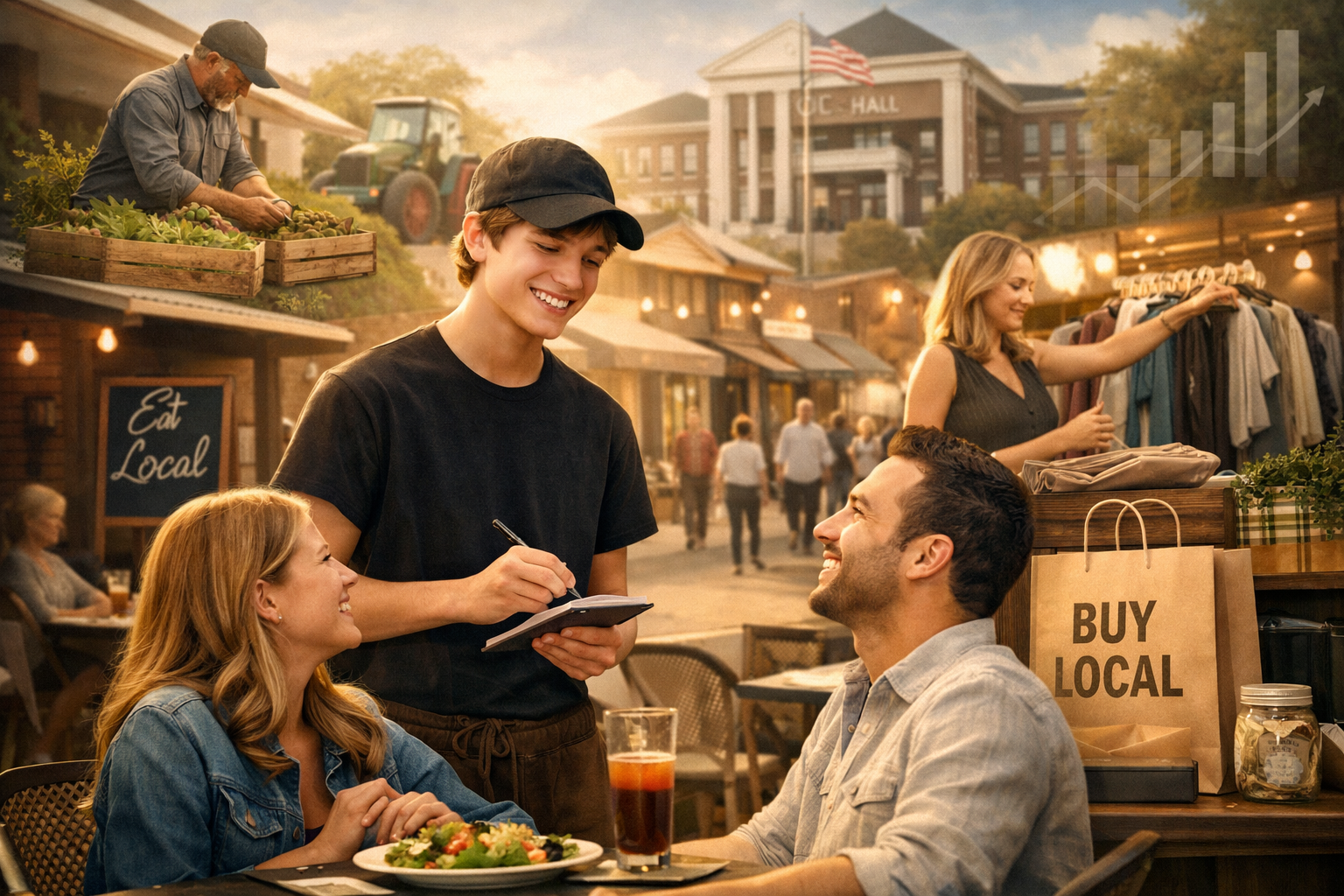
Let's follow a dollar through Williamstown.
Not in the abstract, economics-textbook sense. Let's follow an actual dollar — from the moment a local business owner on the Black Horse Pike decides to invest in marketing, through every hand it touches, every job it supports, every transaction it creates, and every business it sustains as it moves through Monroe Township and the surrounding Gloucester County community. Because the story of that dollar — where it goes, how many times it changes hands, and how much economic activity it generates along the way — is the story of why marketing investment in Williamstown matters far more than most people think.
This isn't a story about click-through rates or conversion metrics. It's about what happens to a community when its businesses grow — and what happens when they don't. It's about the connection between one restaurant's website redesign and the farm stand operator on Route 555 who can finally afford new equipment. Between one contractor's Google Business Profile and the kid from Williamstown High who gets a summer job. Between one shop at the Village Shoppes getting found online and the landlord who doesn't lose a tenant.
These connections are real. They're happening right now in Williamstown and in communities like it across South Jersey. And they're not happening in the communities where local businesses are invisible, stagnant, and slowly losing ground to the Walmarts on Route 322, the chains on the highway, and the Amazon boxes piling up on every porch in every neighborhood in Monroe Township.
This is the ripple effect. And it starts with a single decision by a single business owner who decided to stop being invisible.
The Restaurant
There's a restaurant in Williamstown. It's been open for several years. The food is good — really good. The kind of place where the regulars come every week, where the owner knows their names and their orders, where the kitchen runs on pride and the dining room runs on relationships. It's the kind of restaurant that Williamstown is built on — independently owned, family-operated, part of the fabric of the community in a way that no chain on the Pike ever could be.
But the regulars are the problem. Not the regulars themselves — they're loyal, they're wonderful, and the restaurant wouldn't exist without them. The problem is that almost all of the restaurant's customers are regulars. The restaurant isn't growing. Families moving into the new developments off Fries Mill Road don't know it exists. People driving through on Route 322 on their way to the shore don't know it exists. Couples in Sicklerville or Cross Keys who are searching for a place to eat on a Friday night don't know it exists.
The owner knows why. When someone searches "restaurants near Williamstown NJ" or "best Italian food Gloucester County" or "dinner near me" while sitting in their car at the Wawa on the Pike, this restaurant doesn't show up. The Google Business Profile is incomplete — wrong hours, one blurry photo, a handful of reviews from 2021. The website is a single page that was built by a nephew and hasn't been updated since the menu changed. The Instagram account has twelve posts, the most recent one from Valentine's Day two years ago. When a new family in Monroe Township opens their phone and searches for somewhere to eat tonight, this restaurant is invisible. They find the chain restaurants instead. They drive to Turnersville or Deptford. The money leaves Williamstown.
The owner decides to invest. They hire a regional marketing agency — a small firm based in the area, people who eat at these restaurants, who drive these roads, who understand that Williamstown isn't just a dot on the map but a community with its own character and its own economy. The agency builds a proper website. They optimize the Google Business Profile with current photos of the food, the dining room, the outdoor seating. They set up a content strategy for social media — the daily specials, the kitchen in action, the staff, the story of the restaurant. They implement local SEO so the restaurant appears when someone in Gloucester County searches for what they serve.
The investment is a monthly retainer. It's a meaningful expense for a restaurant operating on restaurant margins. The owner hesitates. It feels like a lot of money for something that isn't a new pizza oven or a walk-in cooler.
But within a few months, things start to change.
The First Ripple: New Customers Walk In
The restaurant starts appearing in Google searches. "Italian restaurant Williamstown NJ." "Best dinner near me." "Restaurants in Monroe Township." The Google Business Profile shows up in the map pack with beautiful photos and a stream of fresh five-star reviews. The Instagram account is posting three times a week — shots of the food that make people stop scrolling.
New customers walk in. Not a flood — a steady trickle that builds week over week. The family that just moved into one of the new homes off Corkery Lane and searched for a dinner spot. The couple from Sicklerville who saw the Instagram post and drove fifteen minutes to try it. The group of golfers from Scotland Run who searched for somewhere to eat after their round and found this restaurant instead of defaulting to the Highlander again. The woman from Clayton who saw a Google review that mentioned the homemade pasta and decided to make the trip.
Each of these customers represents money that would have left Williamstown — or never entered it in the first place — now being spent at a locally owned restaurant on the Black Horse Pike. Not at the Olive Garden in Turnersville. Not at the Applebee's off the highway. Not at a chain where the profits go to corporate headquarters in another state. Here. In Williamstown. At a restaurant where the owner lives in Monroe Township, where the staff are local kids and working adults, where the food is made from scratch and the money that comes in goes right back out into the community.
The Second Ripple: The Restaurant Hires
More customers means the restaurant needs more help. The owner, who's been working the line and managing the front of house simultaneously because they couldn't afford another body, hires a part-time server. Then, a few months later, a prep cook.
The server is a twenty-two-year-old who graduated from Williamstown High and is taking classes at Rowan College. The prep cook is a parent from the neighborhood who needed flexible hours. These are local jobs — created not by a government program or an economic development incentive, but by a restaurant that got busier because it got visible.
The server's paycheck gets spent in Williamstown. Gas at the Wawa. Groceries at the ShopRite. A coffee at one of the local spots. A haircut at the barbershop in town. Each of those transactions is a local business receiving revenue that traces back, through the server's paycheck, through the restaurant's increased revenue, to a marketing investment that made the restaurant findable.
The prep cook's paycheck follows the same path. Rent. Utilities. Clothes for the kids. A birthday dinner at another local restaurant. School supplies from a local shop. Daycare at a facility in Monroe Township. Every dollar of that paycheck that's spent locally creates another transaction, supports another business, and sustains another job.
Two hires. Two paychecks circulating through Williamstown. Created by a marketing investment.
The Third Ripple: The Supply Chain
The restaurant is buying more food. More customers means more ingredients — more produce, more protein, more bread, more everything. The owner, who's always tried to source locally when possible, starts buying more from the farms and markets in the area.
More produce from Danny's Farm Market. More from the vendors at the Williamstown Farmers Market & Village Shoppes — the Pennsylvania Dutch market on the Pike where you can get fresh-cut meats, homemade baked goods, and produce that was picked that morning. The restaurant's increased purchasing supports these local agricultural businesses, which are themselves employers and local spenders.
The farm stand operator who's selling more produce to the restaurant uses that revenue to buy supplies, maintain equipment, and pay seasonal help. The butcher at the Farmers Market who's filling larger orders from the restaurant invests in better equipment. Each of these businesses is growing — modestly, incrementally, but growing — because a restaurant down the road got busier because it got found online.
This is the supply chain ripple. The marketing investment didn't just help the restaurant. It helped every local business that sells to the restaurant. And those businesses, in turn, spend locally — creating another layer of transactions, another round of economic activity, another turn of the dollar through the Williamstown economy.
The Fourth Ripple: The Neighborhood Effect
Here's something that doesn't show up in any marketing analytics dashboard but is one of the most powerful economic effects of a successful local business: the neighborhood pull.
When the restaurant gets busier, it changes the dynamics of the commercial area around it. More cars in the parking lot. More people walking on the sidewalk. More activity, more energy, more life. The businesses nearby — the shops, the other restaurants, the service providers — benefit from the increased foot traffic even though they didn't do anything differently.
The person who came to Williamstown for dinner at the restaurant notices the Village Shoppes and comes back on Saturday to browse. The couple who drove from Cross Keys for a meal decides to grab ice cream at Dairy Fresh on the way home. The family that discovered the restaurant through Google discovers the rest of Williamstown's commercial community by walking around after their meal.
This is the agglomeration effect — the economic principle that businesses benefit from proximity to other successful businesses. A thriving restaurant makes the surrounding businesses more viable. A busier block attracts more visitors, which makes every business on the block busier. The rising tide doesn't just lift the restaurant's boat. It lifts the boats of every business in the vicinity.
And the inverse is equally true. When a business closes — when a storefront goes dark on the Pike — the businesses around it suffer. Less foot traffic. Less energy. Less reason for people to visit that block. The decline of one business creates a drag on every business nearby. That's why losing a local restaurant to invisibility doesn't just hurt the restaurant. It hurts the entire commercial ecosystem around it.
The Fifth Ripple: Tax Revenue and Municipal Services
Every transaction in this chain generates tax revenue. Sales tax from the restaurant's increased revenue. Income tax from the new employees' wages. Property tax from the commercial property that's now more valuable because its tenant is thriving rather than struggling.
This tax revenue funds Monroe Township's municipal services — the parks, the roads, the police, the fire departments, the library. It funds the community programming that makes Williamstown a place where people want to live — the Fall Festival, the Melodies on Main concert series, the Winter Wonderland. It funds the schools that serve the families who chose to move to Monroe Township.
The connection between a restaurant's marketing investment and the township's tax base isn't direct or immediate. But it's real. A thriving commercial sector generates more tax revenue than a declining one. More tax revenue funds better services. Better services attract more residents. More residents expand the tax base further. The cycle is virtuous, and it starts — at the most granular level — with individual businesses being successful enough to generate the revenue that funds the community.
The Sixth Ripple: The Restaurant Tells Its Friends
The restaurant owner talks to other business owners in Williamstown. At the Monroe Township Business Association meeting. At the counter at Geets Diner over coffee. In the parking lot after a township council meeting. They talk about what worked — the website, the Google Business Profile, the social media, the reviews. They share the numbers. They show the before and after.
And other business owners listen. The contractor who's been relying on word of mouth for twenty years hears that the restaurant doubled its new customer traffic in six months. The boutique owner at the Village Shoppes hears that the restaurant is now the first result when someone searches for dinner in Williamstown. The landscaper hears that a Google Business Profile with photos and reviews can generate calls from homeowners who never would have found him otherwise.
Some of those business owners invest in their own marketing. Not all of them — some will wait, some will remain skeptical, some can't afford it yet. But some will. And each one that does starts their own ripple — their own chain of new customers, new hires, new supply chain spending, new tax revenue, new vitality flowing through the Williamstown economy.
This is how a single marketing engagement becomes a community-wide economic event. Not through one dramatic transformation, but through a cascade of small improvements — one business getting visible, then another, then another — each one adding velocity to the local economy, each one making the community a little more vibrant, a little more viable, a little more attractive to the next family considering a move to Monroe Township.
The Ripple That Doesn't Happen
Now imagine the alternative. The restaurant doesn't invest in marketing. The owner decides it's too expensive, or that they'll get to it later, or that their food is good enough and the customers will come.
They don't come. Or rather, the new ones don't. The regulars keep coming — until they don't, because regulars move, regulars age, regulars' habits change. The restaurant's revenue stays flat, then slowly declines. The owner can't afford to hire, so they keep working sixteen-hour days. They can't afford to buy as much from local suppliers, so they switch to cheaper, non-local alternatives. The dining room is a little emptier on weeknights. The parking lot is a little less full.
The server who would have been hired isn't hired. That paycheck doesn't circulate through Williamstown. The prep cook who would have been hired isn't hired. That paycheck doesn't circulate either. The farm stand sells less produce. The butcher fills fewer orders. The businesses nearby see less foot traffic.
Eventually, the restaurant closes. The storefront goes dark. The landlord can't find a tenant to replace a restaurant — restaurants are hard, and who wants to open in a spot where the last one failed? The empty storefront drags down the block. The neighboring businesses feel the loss. Monroe Township loses the sales tax revenue, the jobs, the commercial vitality.
This is the ripple that doesn't happen. It's invisible — you can't see the economic activity that didn't occur, the jobs that weren't created, the transactions that didn't happen, the tax revenue that wasn't generated. But the absence is felt. It's felt in the empty storefronts. In the commercial corridors that feel a little tired. In the "for lease" signs that nobody calls about. In the young families who drive to Deptford or Washington Township for dinner instead of eating in Williamstown because there's nothing to find when they search.
The ripple that doesn't happen is the real cost of local businesses not investing in marketing. Not the cost to the individual business — though that's real too — but the cost to the community. Every business that remains invisible is a leak in the local economy, a place where money that should be circulating through Williamstown drains away to somewhere else.
The Agency's Role in the Chain
There's one more layer to this story that's worth making explicit, because it connects every ripple back to its origin.
When the restaurant hired a regional marketing agency — a firm based in the area, staffed by people who live in the community — the agency fee itself was a local transaction. The money didn't go to a call center in another country. It didn't go to a tech company in Silicon Valley. It went to marketing professionals who live in South Jersey, who spend their income at local businesses, who pay local taxes, who are part of the same economic ecosystem as the restaurant they're helping.
The agency's team members eat at Williamstown's restaurants. They shop at local stores. They get their cars serviced by local mechanics. They hire local accountants and local attorneys. The agency fee circulates through the community just like every other local transaction — creating economic activity at every stop.
And the agency doesn't just help one restaurant. They help dozens of businesses. Each engagement starts another ripple. Each ripple creates jobs, generates supply chain spending, increases foot traffic, produces tax revenue, and makes the community more vibrant. The agency isn't just a vendor — it's an economic multiplier. Every client it makes successful creates a cascade of local economic activity that extends far beyond the client's own revenue.
This is the compounding effect of regional marketing investment. The agency fee creates local economic activity. The agency's work creates business growth. The business growth creates jobs and supply chain spending. The jobs and spending create more local transactions. The transactions support more local businesses. The businesses generate more tax revenue. The tax revenue funds better services. The better services attract more residents and businesses. And the cycle continues — each turn a little faster, each ripple a little wider, each dollar doing a little more work as it moves through the community.
What This Means for Williamstown
Williamstown has everything it needs to thrive. It has a community with character — a town that was here before the glass industry, before the canning companies, before the highways. It has restaurants that people love — Geets Diner, which has been feeding Williamstown since 1942. Ash & Oak, which started as a food truck and became a neighborhood institution. Monalisia, the Library IV, the mom-and-pop spots along the Pike that have loyal regulars and food worth driving for. It has the Williamstown Farmers Market & Village Shoppes, a genuine community market with no chain stores and real local vendors. It has Danny's Farm Market. It has farms and agricultural businesses that have been part of Gloucester County for generations. It has Scotland Run for the golfers. Hospitality Creek for the campers. Parks where families spend weekends. Schools that are improving. A location on Route 322 and Route 42 that puts it within easy reach of half of South Jersey.
What Williamstown doesn't have — what most of its businesses don't have — is visibility. The family that just moved into one of the new developments can't find the restaurants. The visitor driving through on 322 doesn't know there's a reason to stop. The couple in Sicklerville looking for a Friday night dinner doesn't know what Williamstown has to offer. The businesses are there. The customers are there. The connection between them is missing — and that missing connection is costing the community real economic activity every single day.
Marketing is the connection. Not marketing in the abstract, corporate sense. Marketing in the practical, local, get-your-business-found-on-Google sense. A website that shows up in search results. A Google Business Profile with photos and reviews. A social media presence that reminds people you exist. These aren't luxury investments for Williamstown businesses. They're the infrastructure that connects local supply to local demand — the pump that keeps money moving through the community instead of leaking out to chains, to online retailers, and to the better-marketed town down the road.
Every local business in Williamstown that invests in becoming visible starts a ripple. New customers. New hires. New supply chain spending. New foot traffic. New tax revenue. New vitality. And every ripple makes the next ripple easier — because a community with visible, thriving businesses attracts more customers, more residents, and more businesses, each of which starts their own ripple.
The question for Williamstown isn't whether these ripples are real. They are. The question is how many businesses are going to start them.
Frequently Asked Questions
We're a Small Business in Williamstown. Can We Really Afford Marketing Right Now?
The better question is whether you can afford not to. Every day your business isn't showing up in local search results, potential customers are finding your competitors — or worse, finding no local option at all and spending their money outside the community. The marketing investment doesn't need to be massive to start generating results. Even the foundational steps — a properly optimized Google Business Profile, a functional website, a basic social media presence — can meaningfully increase your visibility and your customer base. The revenue those new customers generate pays for the marketing investment and then some. And the economic activity those customers create benefits every business around you.
How Does This Benefit Businesses That Aren't the One Being Marketed?
Through the ripple effects described in this post. When a restaurant gets busier, the businesses nearby see more foot traffic. When a business hires, those employees' paychecks circulate through the community. When a business buys from local suppliers, those suppliers grow and spend locally. The economic ecosystem of a community is interconnected — the success of one business creates conditions that benefit others. This is why investing in local business visibility isn't just good for the individual business. It's good for the entire commercial community.
Why Does It Matter Whether We Hire a Local Agency vs. a National One?
When you hire a regional agency, the marketing fee itself stays in the local economy. The agency's team members live here, spend here, and pay taxes here. When you hire a national agency or rely entirely on national advertising platforms, the fees leave the community entirely. Both approaches might generate business results for you — but only the regional agency creates the double benefit of local economic activity from the fee itself and from the business growth the agency's work produces. It's the difference between one ripple and two.
Is This Really About Williamstown Specifically, or Is It a General Principle?
It's both. The economic principles — velocity of money, the multiplier effect, agglomeration, supply chain ripples — apply to every community. But the specific businesses, the specific geography, and the specific opportunities described here are Williamstown's. This community has real assets that are underleveraged because they're invisible online. The family restaurants, the Farmers Market, the farms, the local shops — these are genuine competitive advantages that Williamstown has over generic, chain-dominated commercial corridors. Marketing doesn't create those advantages. It reveals them to the people who are looking.
What's the First Step for a Williamstown Business That Wants to Start Its Own Ripple?
Claim and optimize your Google Business Profile. It's free, it takes an hour, and it's the single highest-impact action a local business can take for visibility. Add current photos — real photos of your food, your shop, your work. Update your hours, your contact information, your service descriptions. Ask your happy customers to leave reviews. This one step puts you on the map — literally — and starts bringing in the customers who are already searching for what you offer. From there, a website, social media, and a broader marketing strategy can build on that foundation. But the Google Business Profile is where it starts.
Related Reads
〰️
Related Reads 〰️
What the Velocity of Money Means for Your Town — and Why Marketing Is the Pump
The velocity of money — how fast a dollar circulates within your community — is the difference between a town that thrives and a town that stagnates. Every local business that's invisible online is a leak in the local economy, sending customer spending to Amazon, national chains, and better-marketed competitors. Marketing is the pump that keeps money moving locally: it makes businesses findable, drives customers in, and creates the growth that generates jobs, spending, and tax revenue. Here's what that means for your town.
When a Local Agency Helps a Local Business Win, Everybody Wins: The Ripple Effect of Regional Marketing Investment in Williamstown, NJ
A restaurant in Williamstown hires a regional marketing agency. New customers find the restaurant online. The restaurant hires a server — a local kid from Williamstown High. The server's paycheck gets spent at local shops. The restaurant buys more produce from local farms. The farms invest in equipment. The block gets busier. Tax revenue goes up. One marketing investment, traced through its full economic impact on Monroe Township and the Gloucester County community.
Why We Love Working With Family-Owned Businesses
Family-owned businesses are the backbone of local communities—but too many are closing their doors. From outdated websites to low online visibility, great businesses are being left behind. Here’s why Ritner Digital is committed to helping family-owned businesses stay seen, supported, and successful.