Can AI Read Your Listicle? The Myth, the Reality, and What It Actually Means for Your Business
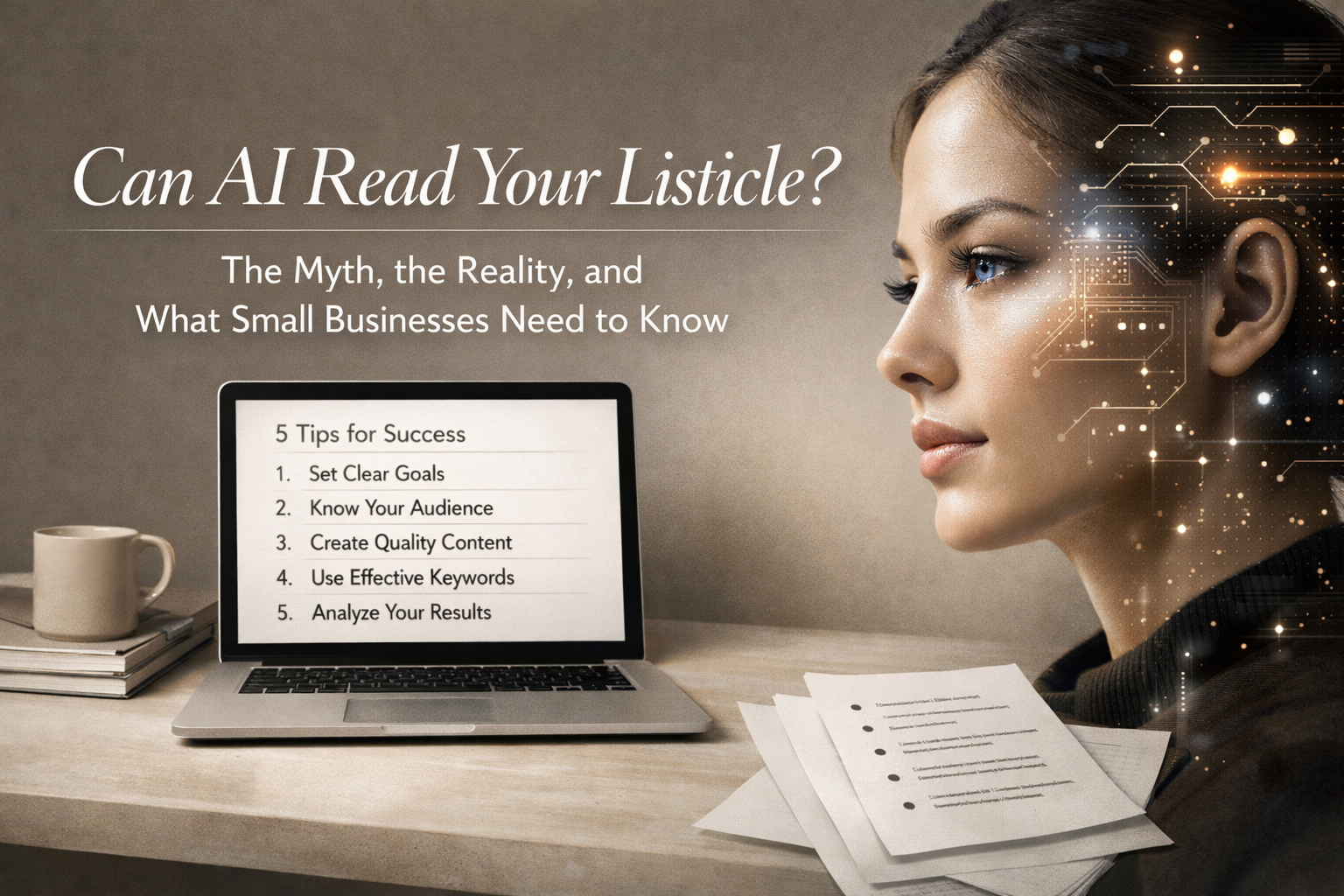
Let's start with the rumor.
Somebody told you that AI can't read listicles. Maybe it was a marketing guru on a podcast. Maybe it was a post on LinkedIn that got four thousand likes and a lot of confident nodding in the comments. Maybe it was your nephew who "works in tech" and mentioned it over Thanksgiving dinner between bites of turkey and you've been thinking about it ever since. Maybe it was another agency — one pitching you on a new content strategy — who said it with enough authority that it felt true.
The claim goes something like this: AI systems — the ones powering Google's search results, the ones behind ChatGPT and Perplexity and all the other tools people are using to find information now — can't read numbered lists. Can't process listicles. Can't parse content that's structured as "7 Best Restaurants in Camden County" or "5 Things to Know Before Hiring a Roofer." The formatting confuses them. The structure trips them up. Listicles are dead, or listicles are invisible to AI, or listicles don't work anymore because the robots can't figure them out.
And if you're a small business owner who just paid someone to write a listicle for your blog — or who was about to — this rumor is enough to make you stop, second-guess everything, and wonder if your entire content strategy is built on sand.
So let's answer the question directly, clearly, and completely. Then let's talk about why the wrong answer is spreading, where the grain of truth is buried inside the misinformation, and what actually matters for your business's visibility in a world where AI is reshaping how people find things online.
The Short Answer
No. The rumor is wrong. AI can read your listicle just fine.
That's it. That's the short answer. If you want to stop here, go write your listicle. It's fine. AI — whether it's Google's crawlers, Google's AI Overviews, ChatGPT browsing the web, Perplexity pulling sources to answer a question, or any other large language model consuming web content — can read numbered lists, bullet points, ordered and unordered HTML list elements, and every other format you'd use to structure a listicle. Listicles are not invisible. Listicles are not broken. Listicles are not being skipped, ignored, or misunderstood by AI systems.
But the short answer, while correct, isn't the whole story. And the whole story is worth understanding, because inside the wrong claim about listicles there are real questions about how AI interacts with your content — questions that actually do matter for how you structure your website, write your blog posts, and think about getting found online. The people spreading the listicle myth are wrong about the specific claim, but they're responding to a real shift in the landscape. And understanding that shift — what actually changed, what it means, and what to do about it — is the difference between a business that adapts intelligently and one that panics itself into paralysis.
So let's get into it.
Where the Myth Came From
Myths don't come from nowhere. They come from real things that get misunderstood, simplified, exaggerated, and repeated until the distorted version replaces the original. The listicle myth has at least three origin points, and each one is worth understanding because each one contains a real thing that got warped into a false conclusion.
Origin Point One: The Structured Data Conversation
In the SEO world — the world of people who spend their professional lives thinking about how Google reads websites — there's been a long, legitimate, technically nuanced conversation about structured data. Structured data is the behind-the-scenes code on a website that tells search engines what the content is about. It's the difference between Google seeing a wall of text and Google understanding that this wall of text contains a recipe with ingredients, cook times, and serving sizes. Or that this page contains a list of businesses with names, addresses, and ratings. Or that this blog post contains an FAQ with questions and answers.
Structured data helps search engines — and now AI systems — understand not just what words are on your page, but what those words mean and how they relate to each other.
Here's where the distortion happened. Some SEO professionals pointed out — correctly — that content with proper structured data markup is easier for AI systems to parse and use. A listicle that uses proper HTML heading tags, proper list elements, and proper schema markup is more clearly understood by both traditional search crawlers and AI systems than a listicle that's just a blob of text with numbers thrown in. This is true. It's a real and useful insight.
But somewhere between the technical SEO conference where this was explained carefully and the LinkedIn post where it was summarized for engagement, the message mutated. "Structured data helps AI understand your listicle better" became "AI can't understand your listicle without structured data" became "AI can't read listicles" became "listicles don't work anymore." Each step in that game of telephone removed nuance and added alarm. By the time it reached the business owner sitting at their kitchen table trying to figure out their marketing strategy, the useful technical insight had been compressed into a completely false binary: listicles broken, AI confused, stop writing them.
The reality is that AI systems are extraordinarily good at reading content in virtually any format. They can read a cleanly coded listicle with perfect HTML structure. They can also read a listicle that's just a Word document copied and pasted into a WordPress blog with no formatting at all. They can read numbered lists, bulleted lists, lists without any markers at all, lists embedded in paragraphs, lists disguised as flowing prose. Large language models were literally built to understand human language in all its messy, inconsistent, imperfectly formatted glory. The idea that they'd be stumped by a numbered list is like saying a professional chef can't figure out what to do with an onion.
Can better structure help? Yes. Is it required for AI to understand your content? No. Not even close.
Origin Point Two: The AI Overview Panic
The second origin point is more recent and more visceral. Google rolled out AI Overviews — those AI-generated summaries that appear at the top of search results, above the traditional blue links, providing a synthesized answer to the searcher's question before they click on anything.
This genuinely freaked people out. And for understandable reasons.
If you're a business owner who invested in a blog post — say, "10 Best Italian Restaurants in South Jersey" — your goal was for people to search that phrase, find your website in the results, click through, read the post, see your restaurant listed, and then visit your restaurant or browse the rest of your site. The blog post was a magnet. It attracted searchers, brought them to your domain, and gave you a chance to convert their attention into a visit, a call, a reservation, a sale.
Now, with AI Overviews, Google might read your listicle, synthesize it with other sources, and present a summary answer right there on the search results page. The searcher gets their answer — or at least a version of it — without ever clicking through to your site. Your blog post still exists. Google still read it. But the click — the visit to your website, the thing that actually mattered to you — might not happen.
This is a real concern. It's not a myth. The introduction of AI Overviews has measurably changed click-through rates for certain types of queries, particularly informational queries where the searcher is looking for a simple answer. If someone searches "what temperature should I cook salmon" and Google's AI Overview gives them the answer right there, they're less likely to click through to the food blog that provided the source information. That's real. That's happening.
But — and this is critical — this has nothing to do with AI being unable to read listicles. It's the exact opposite problem. AI can read your listicle perfectly. It can read it so well that it can extract the key information, synthesize it with other sources, and present a summary that satisfies the searcher's intent. The issue isn't that AI can't process your listicle format. The issue is that AI processes your content so effectively that it can use your information without sending the searcher to your website.
These are two completely different problems. One is a myth. The other is a real strategic challenge. And confusing them leads to exactly the wrong response.
The wrong response is to stop writing listicles. The right response is to understand which types of listicle content are most vulnerable to AI Overview summarization and adjust your strategy accordingly — which we'll get to.
Origin Point Three: The Rendering Problem
There's a third origin point that's more technical and affects fewer businesses, but it's worth addressing because it's the one that has the most legitimate basis.
Some websites — particularly those built with heavy JavaScript frameworks or those that generate content dynamically on the client side rather than the server side — can be difficult for some crawlers and AI systems to fully render and read. If your website loads a listicle through a complex JavaScript application that assembles the content in the user's browser after the page loads, some older crawlers — and potentially some AI scraping systems — might see a blank page or a partially loaded page instead of your content.
This is a real technical issue. But it's a website architecture issue, not a listicle issue. It affects all content on a site built this way, not just listicles. A dynamically rendered paragraph about your company history would have the same problem as a dynamically rendered listicle of your services. The format of the content isn't the issue. The delivery mechanism is.
And even this problem is shrinking rapidly. Googlebot has been capable of rendering JavaScript for years. Most modern AI systems that crawl the web can handle dynamic content. The sites that are truly invisible due to rendering issues are increasingly edge cases — typically custom-built web applications, not standard business websites built on WordPress, Wix, Squarespace, or any other mainstream platform.
If you're a small business with a website built on any standard platform, and you publish a listicle as a blog post using the normal content editor, AI can read it. Full stop.
So What Can AI Actually Do with Your Content?
Now that we've established that AI can read your listicle — and understand why the myth that it can't is wrong — let's talk about what AI actually does with your content when it reads it. Because this is where the conversation gets genuinely important for business owners, and it's where the strategic decisions live.
AI systems interact with your web content in several distinct ways, and understanding the differences is essential for making smart choices about what to publish and how.
Training Data Ingestion
Large language models — the AI systems behind ChatGPT, Claude, Gemini, and others — are trained on enormous amounts of text data. Some of that data comes from the open web. When these models were being trained, their creators crawled vast portions of the internet and used that content to teach the models how language works, what facts exist, and how to generate useful responses.
If your website existed when these training datasets were assembled, your content — including your listicles — may be part of what the AI learned from. This is a one-time event in the past, not an ongoing process. The AI isn't currently reading your site to update its training. It read it once, during training, and whatever it learned from your content is now part of its general knowledge.
This raises legitimate copyright and ethical questions that are being litigated and debated right now. But from a practical business standpoint, it's already happened. Your content is either in the training data or it isn't, and there's nothing you can do about it retroactively. The question that matters now is what happens going forward.
Search Engine Crawling and Indexing
Google's crawlers — and the crawlers of other search engines — read your content to index it and determine where it should rank in search results. This has been happening for decades. It's the foundation of SEO. Your listicle gets crawled, indexed, and ranked based on its relevance, quality, authority, and a hundred other signals.
AI hasn't changed this fundamental process. Google still crawls your site. It still indexes your listicle. It still ranks it in search results. What has changed is what Google does with that information after it crawls it — specifically, whether it uses your content to generate an AI Overview that appears above the traditional search results.
AI Overview Synthesis
This is the new layer. When someone performs a Google search and Google determines that an AI Overview would be helpful, the system reads content from multiple sources — potentially including your listicle — and synthesizes a summary answer. Your content is being read, understood, and used. The AI is extracting information from your listicle, combining it with information from other sources, and presenting a blended answer to the searcher.
This is where the strategic implications live. Not in whether AI can read your listicle — it can — but in what happens after it reads it. Does the searcher still click through to your site? Does the AI Overview include a link or citation to your source? Does appearing as a source in an AI Overview have marketing value even if the click-through rate is lower than a traditional search result?
These are the questions worth asking. And the answers depend on what kind of listicle you wrote and what you were trying to accomplish with it.
AI Chat Retrieval
A growing number of people are skipping Google entirely and asking AI chatbots for recommendations. "Hey ChatGPT, what are the best roofing contractors in my area?" "Hey Perplexity, give me a list of family-friendly restaurants near me." When these AI systems browse the web in real time to answer these queries, they're reading websites — including listicles — and using that content to formulate their responses.
Again, the AI can read your listicle. The question is whether being in a listicle on someone else's site helps you, and whether having listicle content on your own site helps the AI recommend you. The short answer: it can, but not the way most people think. More on that below.
The Listicle Isn't the Problem. The Strategy Might Be.
Here's where we get to the part that actually matters for your business.
AI can read your listicle. We've established that. But that doesn't mean every listicle is equally valuable in an AI-influenced search landscape. The format isn't the issue — the purpose and substance of the content is.
Think about listicles in two broad categories.
Category One: Thin Aggregation Listicles
These are the listicles that compile publicly available information into a numbered list without adding meaningful original perspective, insight, or expertise. "10 Best Pizza Places in South Jersey" where each entry is just a name, an address, and a sentence pulled from the restaurant's own website. "7 Tips for Selling Your Home" where every tip is generic advice that appears on ten thousand other websites.
These listicles were always a bit thin. They worked in the old SEO landscape because Google needed to surface something when someone searched, and a competently written, reasonably well-optimized listicle could rank simply by existing and targeting the right keywords. The competition was other listicles, and the bar for differentiation was low.
AI Overviews have made this category of listicle less effective — not because AI can't read them, but because AI can replace them. If your listicle is just aggregating information that's available everywhere, the AI Overview can aggregate that same information and present it directly to the searcher. The searcher doesn't need to click through to your site to get a generic list of ten restaurants with names and addresses. The AI just gives them the list.
This is the category of content that's most disrupted by AI. And this is probably what the listicle myth is really trying to express — not that AI can't read this content, but that this content is less valuable than it used to be because AI can synthesize the same information without sending the user to your site.
Category Two: Expertise-Driven Listicles
These are listicles that contain real original insight, professional judgment, firsthand experience, or proprietary information. "7 Things I Tell Every Client Before They Remodel Their Kitchen — from a Contractor with 20 Years in South Jersey." "5 Restaurants My Family Actually Goes Back To, and Why." "The 3 Permit Mistakes I See Every Homeowner in Gloucester County Make."
These listicles contain something that AI can't generate on its own: genuine human expertise applied to a specific topic in a specific context. The listicle format is just the delivery mechanism. The value is in the original thought, the professional experience, the local knowledge, the specific recommendations that come from actually doing the work or living in the community.
AI Overviews can summarize these listicles. But they can't replicate the depth, the credibility, or the personal authority that makes someone want to click through, read the whole thing, and then hire the person who wrote it. A contractor who writes a genuinely useful, detailed, experience-based listicle about kitchen remodeling mistakes is creating content that serves a fundamentally different purpose than a generic aggregation post. It's a demonstration of expertise. It's a trust-building document. It's a sales tool disguised as helpful content. And it works whether or not the AI summarizes part of it at the top of Google.
This distinction — thin aggregation versus genuine expertise — matters infinitely more than whether your content is formatted as a listicle, a blog post, a FAQ, or a long-form essay. The format is irrelevant to AI's ability to read it. The substance determines whether it's worth reading — by AI or by humans.
What AI Actually Struggles With (It's Not Listicles)
Since we're dismantling myths, let's replace them with reality. Here's what AI actually does have difficulty with when it comes to reading and understanding web content. None of these are about listicles.
Images Without Alt Text
If your website has beautiful photos of your work — the remodeling job you just finished, the meal you just plated, the storefront you just designed — but those images don't have descriptive alt text, AI can't fully understand what they depict. It can see that there's an image. It can sometimes do basic visual analysis. But it can't fully contextualize an image the way it can process text. If your portfolio is image-heavy with no descriptions, AI knows less about your work than it should.
Content Locked Behind Login Walls or Paywalls
AI crawlers can't log into your customer portal. If you've got valuable content — case studies, testimonials, project galleries — locked behind a login, AI can't read it and can't use it to understand your business or recommend you. Content that's meant to drive discovery needs to be publicly accessible.
PDFs and Non-HTML Documents
AI can read PDFs, but it doesn't always crawl them as thoroughly as HTML web pages. If your best content — your service descriptions, your project case studies, your detailed guides — lives in PDF documents linked from your website rather than in actual web pages, it may be less visible to both traditional search engines and AI systems.
Extremely Complex Site Architecture
If your website requires six clicks to get from the homepage to your actual content — if your blog is buried behind a dropdown menu inside another dropdown menu and the URLs follow no logical structure — crawlers of all kinds have a harder time finding and prioritizing your content. This is a site architecture problem, not a content format problem.
Audio and Video Without Transcripts
The podcast episode where you explained your process for an hour? AI can't listen to it — or at least can't reliably extract all the information from it — unless there's a transcript. The YouTube video where you walked through a completed project? Same thing. If the content lives only in audio or video format without a text counterpart, AI's understanding of it is limited.
None of these issues have anything to do with numbered lists or listicle formats. They're all about how accessible, well-structured, and clearly presented your content is — regardless of whether it's structured as a list, a narrative, a Q&A, or any other format.
What You Should Actually Do
Enough about what's wrong. Here's what's right. If you're a small business owner trying to figure out your content strategy in a world where AI is reading, summarizing, and reshaping how people find businesses online, here's what actually matters.
Keep Writing Listicles — But Make Them Worth Reading
The format works. It's scannable, it's clear, it's easy for readers to consume, and — yes — it's easy for AI to parse and understand. Don't abandon a format that works because someone told you it was broken. It's not. Just make sure what's inside the listicle is actually valuable. Original insight. Professional expertise. Local knowledge. Specific recommendations based on real experience. The bar for content quality is higher than it was five years ago, but that bar applies to all content, not just listicles.
Focus on Content That AI Can't Replace
Ask yourself: could an AI generate this exact blog post by synthesizing other sources? If the answer is yes — if your post is just aggregating publicly available information into a list — it's vulnerable. Not invisible. Not unreadable. Just less differentiated and less likely to generate a click-through when AI can give the searcher the same information directly.
But if your content contains something the AI doesn't have — your professional opinion, your experience with local conditions, your specific pricing insights, your firsthand knowledge of a process, your take on what works and what doesn't in your specific market — then no AI Overview can fully replace it. The AI might summarize part of it. But the summary points back to you, and the reader who wants the full depth still clicks through.
Optimize Your Google Business Profile Before You Worry About AI
For local businesses — restaurants, contractors, shops, service providers — the Google Business Profile remains the single most important piece of digital real estate you own. It shows up in the map pack. It shows up in AI Overviews for local queries. It shows up when someone asks ChatGPT or Perplexity for a local recommendation and the AI browses the web for current information. Your Google Business Profile is not a listicle. It's not a blog post. It's your business's identity in the digital ecosystem, and it's the one thing that AI consistently reads, references, and recommends from.
If your Google Business Profile is incomplete, outdated, or missing reviews, fixing that is ten times more impactful than worrying about whether AI can read your listicle format.
Make Your Website Technically Sound
Not because AI can't read listicles, but because AI — like all crawlers — reads well-structured websites more thoroughly and accurately. Fast loading times. Mobile-friendly design. Clear heading structure. Descriptive page titles and meta descriptions. Alt text on images. A logical site architecture. These are the fundamentals that make all of your content — listicles, blog posts, service pages, everything — more readable by AI and more likely to surface in both traditional search results and AI-generated responses.
Don't Freeze
This is the most important piece of advice, and it's the reason the listicle myth matters more than it should. The real damage done by false claims about AI and content isn't that someone abandons listicles specifically. It's that they abandon content creation entirely. They freeze. They hear that AI is going to eat their content and decide there's no point in creating any. They hear that listicles don't work and decide nothing works. They hear that search is changing and conclude that search is dead.
Search is not dead. Content is not pointless. Listicles are not broken. What's happening is that the landscape is evolving — as it always has — and the businesses that continue to create high-quality, genuinely useful content will continue to be found. The businesses that freeze, that stop publishing, that let their websites go stale and their Google Business Profiles gather dust while they wait for clarity about AI — those businesses become invisible. And invisible businesses don't just hurt themselves. They hurt their communities.
The Real Question Isn't About Listicles
The conversation about whether AI can read listicles is, at its core, a proxy for a much bigger question that small business owners are really asking: does my online presence still matter?
The answer is yes. Emphatically, unequivocally, yes.
How people find businesses is changing. The specific mechanics of search — what appears at the top of Google, whether an AI summary shows up before the links, whether someone asks ChatGPT instead of typing into a search bar — are shifting and will keep shifting. But the fundamental principle hasn't changed: people look for businesses online, and the businesses they find are the businesses that get the customers.
AI hasn't eliminated the need to be found. It's added new ways to be found. Your content can now surface in traditional search results and in AI Overviews and in AI chatbot responses and in voice assistant answers. That's not fewer channels — it's more. And a business with strong, well-structured, genuinely useful content is better positioned across all of those channels than a business with no content at all.
The listicle is fine. Your numbered list is fine. The format isn't broken and the AI isn't confused by it. What matters — what has always mattered and what matters more now — is whether the content inside the format is worth finding. Whether it reflects real expertise, real experience, and real value. Whether it gives the reader — or the AI reading on the reader's behalf — something they can't get from a dozen other undifferentiated sources.
Write the listicle. Make it good. Make it yours. And stop letting myths born from misunderstood conference talks and engagement-bait LinkedIn posts keep you from creating the content that makes your business findable.
The AI can read it. The question is whether you're going to give it something worth reading.
Frequently Asked Questions
So AI Can Definitely Read Listicles? For Sure?
Yes. Large language models, Google's crawlers, AI Overview systems, and AI-powered search tools like Perplexity and ChatGPT can all read, parse, and understand content formatted as listicles. Numbered lists, bulleted lists, and every other standard list format are fully readable. The myth that AI can't process listicles is false. It likely originated from misinterpretations of legitimate technical conversations about structured data and AI Overviews, but the specific claim that AI is unable to read list-formatted content is simply incorrect.
Should I Stop Writing Listicles Because of AI Overviews?
No. But you should think about what goes into them. Thin listicles that just aggregate publicly available information — generic "Top 10" lists with no original insight — are more vulnerable to being fully summarized by AI Overviews, which can reduce click-through traffic. But listicles built around genuine expertise, professional experience, and original perspective remain highly effective. The format isn't the issue. The depth and originality of the content is.
Does the Way I Format My Listicle Affect How AI Reads It?
Proper HTML structure and schema markup can help AI systems parse your content more efficiently, but they're not required for AI to read your listicle. A listicle published as a standard blog post on WordPress, Wix, Squarespace, or any other major platform will be readable by AI. Better structure helps at the margins, but a well-written listicle in a standard format will be read and understood regardless. Focus on content quality first and technical optimization second.
What Kind of Content Should I Focus on If AI Is Changing Search?
Content that contains something AI can't generate on its own. Professional expertise applied to specific situations. Local knowledge. Firsthand experience. Specific opinions and recommendations backed by real-world work. AI is very good at synthesizing publicly available information. It's not good at replicating the judgment, experience, and authority of a professional who's actually done the work. Your content strategy should lean into what makes you — specifically, uniquely you — the expert. That's what AI can't replace, and it's what will drive customers to your business regardless of how search mechanics evolve.
What's More Important — Blog Content or My Google Business Profile?
For local businesses, the Google Business Profile is more immediately impactful. It appears in map results, in AI Overviews for local queries, and in AI chatbot responses when people ask for local recommendations. A complete, optimized, well-reviewed Google Business Profile is the foundation of local visibility. Blog content — including listicles — builds on that foundation by establishing expertise, driving organic traffic, and giving AI systems more information about your business. Both matter. But if you're starting from zero, start with the Google Business Profile.
Related Reads
〰️
Related Reads 〰️
Your Clients Are Telling You What to Write About (And AI Is Listening)
A hardscaping client casually mentioned how the freeze-thaw cycle destroys concrete every winter — something they explain to customers all the time. But there was nothing about it on their website. That gap between what you know and what your website says is one of the biggest missed opportunities in small business marketing. Here's why that kind of content builds real credibility and why AI search platforms are now rewarding businesses that publish it.
Do AI Citations Pass Link Equity? How GEO Compares to Traditional Link Building
When ChatGPT or Perplexity cites your business, does that citation pass link juice like a traditional backlink? The short answer is no. The longer answer is that what AI citations actually pass might be worth more — and the businesses that understand the difference are building a serious competitive advantage.
What Solutions Track Competitor Citations in AI-Generated Search Responses?
When someone asks ChatGPT or Google's AI a question your business should be the answer to, whose name actually shows up? Tracking competitor citations in AI-generated search is a new category — but the tools exist. Here's what's out there and how to start using them.