What Solutions Track Competitor Citations in AI-Generated Search Responses?
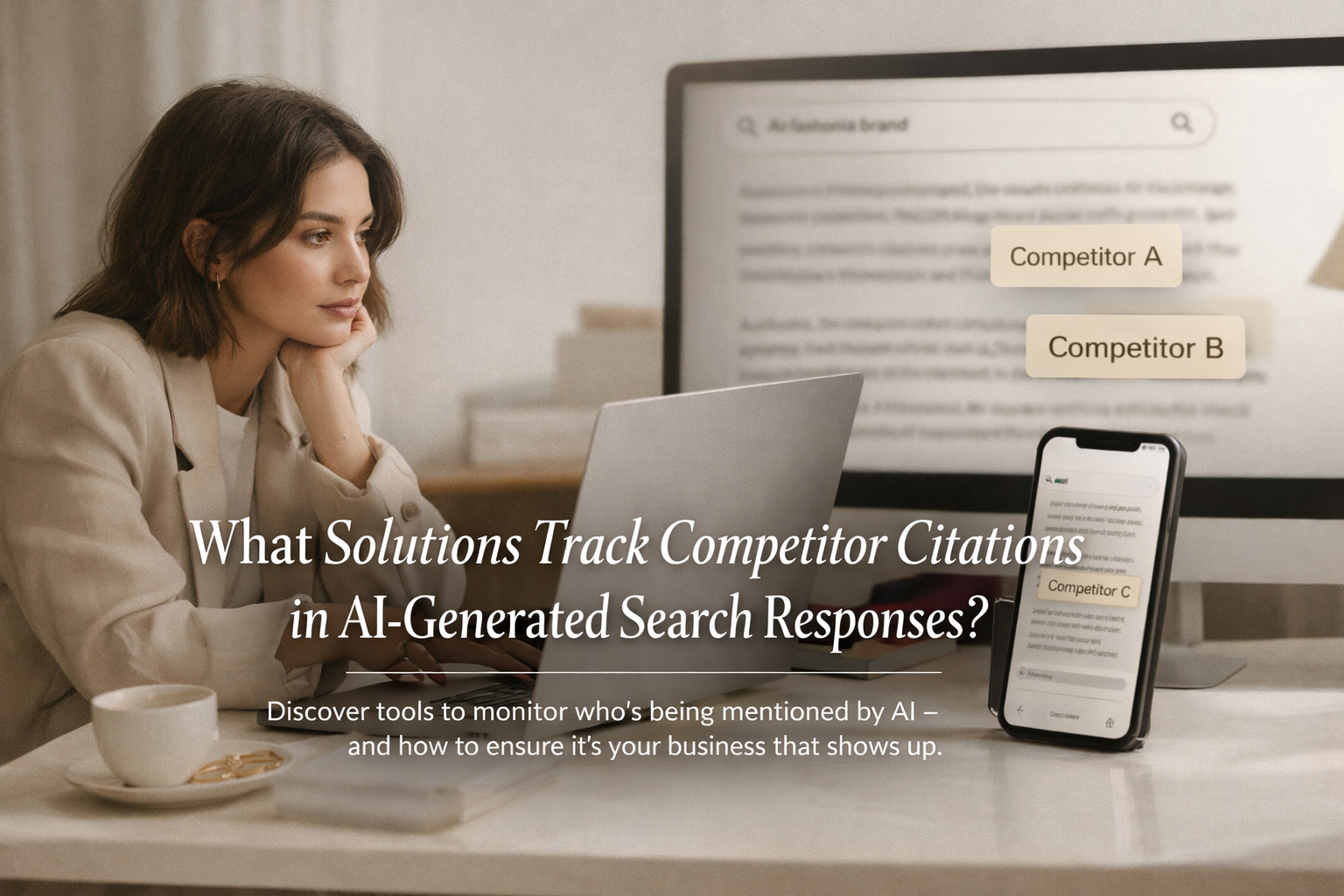
Google's AI Overviews. ChatGPT search. Perplexity. Gemini. Copilot. The way people find and choose businesses is shifting — and the new battleground isn't just the ten blue links on page one. It's whether your brand gets cited inside the AI-generated answer at the top of the page, or whether your competitor does.
You already know this is happening. You've probably searched for something yourself and noticed that the AI summary mentioned a brand, linked to a specific source, or recommended a product — and it wasn't yours. Maybe it was a competitor you've been outranking in traditional search for years. Maybe it was a brand you've never heard of.
The uncomfortable question isn't whether AI-generated search is changing visibility. It's whether anyone is actually tracking it — and what tools exist to tell you who's getting cited, how often, and for which queries.
The short answer: this space is new, evolving fast, and most businesses haven't even started monitoring it. But solutions do exist, and understanding what's out there right now gives you a real competitive advantage while everyone else is still pretending traditional SEO metrics tell the whole story.
Why Tracking AI Citations Is Different from Tracking Traditional Rankings
In traditional search, the metric is straightforward — you rank at position 3 for "best CRM for small business," your competitor ranks at position 1, and you can measure, track, and strategize around that gap. The tools are mature. Semrush, Ahrefs, Moz, and dozens of others have been doing this for years.
AI-generated search responses don't work that way. There's no position 1 through 10. There's an answer — a synthesized paragraph or set of paragraphs — and within that answer, certain brands, websites, and sources get cited. Others don't. The citation might be a direct mention ("According to HubSpot..."), an inline link, a source card at the bottom of the response, or just a brand name dropped into the recommendation without any link at all.
This creates a completely new tracking problem. You're no longer asking "where do I rank?" You're asking "am I mentioned?" And more specifically: "when someone asks the AI a question that my business should be the answer to, whose name is actually showing up?"
Traditional rank trackers don't capture this. They were built for a different architecture. Tracking AI citations requires tools that can query AI platforms directly, parse the generated responses, identify which brands and sources are cited, and do it repeatedly across a meaningful set of queries to spot patterns and trends.
The Solutions That Exist Right Now
This is a young category. Some tools were built specifically for AI search monitoring. Others are established SEO platforms that have added AI tracking features. And some are scrappier, more experimental approaches that fill gaps the bigger tools haven't addressed yet. Here's what's out there.
Otterly.ai
Otterly is one of the earliest purpose-built tools for monitoring brand visibility in AI-generated search. It tracks how your brand (and your competitors) appears across Google AI Overviews, ChatGPT, Perplexity, and other AI search surfaces. You define the queries that matter to your business, and Otterly monitors those queries over time — tracking whether you're cited, how often, which competitors are cited instead, and how citations change as AI models update. It's built specifically for this use case and gives you a clear, ongoing picture of AI search visibility that traditional tools simply don't provide.
Profound
Profound focuses on AI search analytics and competitive intelligence. It monitors how brands appear in AI-generated results across multiple platforms and provides data on citation frequency, source attribution, and brand mention context. Profound is designed for marketing teams and agencies that need to understand not just whether they're showing up in AI answers, but why certain competitors are getting cited and what content is being used as source material.
Peec AI
Peec AI offers AI search monitoring with a focus on competitive tracking. It allows you to track your brand's presence in AI responses alongside competitors, see which sources AI models are pulling from, and identify content gaps that might explain why a competitor is getting cited and you're not. It's particularly useful for content strategy teams that want to reverse-engineer what makes a source "citable" by AI systems.
Semrush (AI Overviews Tracking)
Semrush — one of the most established names in SEO — has added AI Overview tracking to its platform. Within Semrush's position tracking tools, you can now see which of your tracked keywords trigger Google AI Overviews and whether your domain (or a competitor's) is cited as a source within those overviews. It's not a standalone AI citation tracker, but for teams already using Semrush, it adds a meaningful layer of AI visibility data to existing SEO workflows.
Ahrefs (AI Content & Source Monitoring)
Ahrefs has been building out its capabilities around AI search visibility as well. While its core strength remains backlink analysis and traditional rank tracking, Ahrefs is increasingly surfacing data on which pages are being used as sources in AI-generated responses. For teams that want to understand the connection between content authority, backlinks, and AI citations, Ahrefs provides useful context — even if it's not yet a full AI citation tracking tool in the way purpose-built platforms are.
Brightedge
Brightedge, an enterprise SEO platform, has invested heavily in AI search tracking. Its platform monitors brand visibility across AI-generated search results, tracks citation patterns, and provides competitive intelligence at scale. Brightedge is positioned toward larger organizations and agencies managing multiple brands, and its AI tracking capabilities are integrated into a broader enterprise SEO and content performance suite.
Authoritas (GEO Tracker)
Authoritas offers what it calls a "GEO Tracker" — specifically designed to monitor generative engine optimization performance. It tracks how brands appear across AI-generated search results from Google, Bing Copilot, ChatGPT, and Perplexity, with a focus on citation tracking and competitive comparison. For teams that are specifically investing in GEO as a strategy, Authoritas provides focused tooling around measuring the results of that investment.
Manual Monitoring (The DIY Approach)
Some teams — especially smaller ones or those just getting started — track AI citations manually. This means running a set of key queries through ChatGPT, Perplexity, Google (with AI Overviews triggered), and Gemini on a regular cadence, documenting which brands are cited in each response, and tracking changes over time in a spreadsheet. It's tedious and doesn't scale, but it's free, and it gives you a baseline understanding of where you stand before investing in a paid tool.
What These Tools Actually Track
The specific metrics vary by platform, but across the category, AI citation tracking tools generally monitor some combination of the following.
Brand mention presence. For a given query, is your brand mentioned in the AI-generated response? Yes or no, tracked over time.
Citation frequency. Across your full set of tracked queries, how often does your brand appear in AI responses? What percentage of relevant queries include you?
Competitor citation comparison. For the same queries, which competitors are being cited? How does your citation frequency compare to theirs? Are there queries where they consistently appear and you don't?
Source attribution. When the AI cites your brand, which specific page or content piece is it pulling from? This tells you which of your content is "working" in AI search and which isn't being referenced at all.
Citation context. Are you mentioned as a recommendation, a comparison, a source of data, or just a passing reference? Not all citations are equal — being recommended is very different from being mentioned as an alternative.
Platform-level breakdown. How does your citation presence vary across Google AI Overviews, ChatGPT, Perplexity, Gemini, and Copilot? You might be well-cited in one and invisible in another.
Trend tracking. How are your citations changing over time? Are you gaining or losing visibility? Did a content update or link-building effort move the needle?
Why Competitor Citation Tracking Matters More Than Most People Realize
If your competitor is consistently cited in AI-generated search responses for the queries your customers are asking, that competitor is building a form of brand authority that traditional SEO metrics don't capture. They're becoming the AI's "default answer" — and once that pattern is established, it's hard to displace.
This matters for three reasons.
AI answers are becoming the first (and sometimes only) thing people see. Google's AI Overviews appear above the organic results. ChatGPT and Perplexity users may never visit a traditional search results page at all. If you're not in the AI answer, you're not in the conversation — regardless of where you rank organically.
AI citations compound. The more a source is cited, the more authority AI models assign to it, and the more likely it is to be cited again in future responses. This creates a flywheel effect. Early movers who get cited consistently build a structural advantage that late entrants have to work much harder to overcome.
Your competitors might be actively optimizing for this — and you'd never know without tracking. Some brands are already investing in generative engine optimization — structuring content to be more citable by AI models, building the authority signals that influence AI source selection, and monitoring the results. If they're doing this and you're not even tracking citations, the gap is widening in a direction you can't see.
How This Connects to GEO (Generative Engine Optimization)
Tracking competitor citations in AI search is the measurement layer. The strategy layer is GEO — generative engine optimization. GEO is the practice of optimizing your content, your brand authority signals, and your digital presence so that AI models are more likely to cite you in generated responses.
It includes things like structuring content to be easily parseable by AI crawlers, building topical authority through depth and consistency, ensuring your site is technically crawlable by LLM indexing bots, establishing entity recognition signals that help AI models understand what your brand is and what it's an authority on, and earning the kinds of citations, backlinks, and mentions that AI models use as trust signals when selecting sources.
At Ritner Digital, GEO is one of our core service offerings. We help businesses understand where they stand in AI-generated search, identify the gaps between their visibility and their competitors', and implement the structural and content changes that improve citation likelihood over time.
Tracking competitor citations is where that work starts. You can't optimize what you can't measure — and right now, most businesses aren't measuring AI search visibility at all.
Ritner Digital Can Help You Get Ahead of This
We're a full-stack marketing agency based in Philadelphia, and generative engine optimization is one of the fastest-growing parts of our practice — because it's one of the fastest-changing parts of search.
We help businesses monitor their AI citation presence, benchmark against competitors, and build the content and authority foundation that gets them cited more often in AI-generated responses. Whether you need a one-time competitive audit or an ongoing GEO strategy, we bring the tools, the methodology, and the strategic context to make AI search visibility part of your marketing system.
If you've been watching competitors show up in AI-generated answers and wondering how to get there yourself, that's exactly the kind of problem we solve.
Frequently Asked Questions
Are AI citation tracking tools accurate?
They're directionally accurate, but AI-generated responses are inherently variable — the same query can produce slightly different responses depending on timing, location, personalization, and model updates. The best tools run queries repeatedly and track trends over time rather than treating any single response as definitive. The value is in the patterns, not any individual snapshot.
Can I track AI citations without paying for a tool?
Yes, but it doesn't scale. You can manually run your key queries through ChatGPT, Perplexity, Google AI Overviews, and Gemini on a regular schedule and document the results in a spreadsheet. This works for a small number of queries and gives you a baseline. For anything beyond 20 or 30 queries, or for ongoing competitive monitoring, a dedicated tool saves significant time and provides much richer data.
Which AI search platforms should I be tracking?
At minimum, Google AI Overviews and ChatGPT — those two cover the largest share of AI-influenced search behavior right now. Perplexity is growing fast and worth monitoring, especially in research-heavy verticals. Gemini and Copilot are relevant depending on your audience. The right mix depends on where your customers are searching.
How is GEO different from regular SEO?
SEO focuses on ranking in traditional search engine results — the ten blue links. GEO focuses on being cited in AI-generated answers. There's overlap in the foundations (content quality, authority, technical crawlability), but GEO requires additional considerations like entity optimization, LLM crawlability, brand authority signals, and content structure that makes your information easy for AI models to extract and cite. We offer both at Ritner Digital, and they work best as a connected strategy.
My competitor keeps showing up in AI answers and I don't. Why?
There are several possible reasons — they may have stronger topical authority in the AI model's training data, more structured and citable content, better entity recognition, more high-quality backlinks from trusted sources, or they may have been actively optimizing for AI search. A competitive citation audit can identify specifically where and why they're being cited, which gives you a clear roadmap for closing the gap.
How long does it take to improve AI citation visibility?
It varies. Some changes — like improving content structure, adding schema markup, and ensuring LLM crawlability — can influence citations relatively quickly as AI models recrawl and reindex. Deeper authority-building work like earning high-quality backlinks, publishing authoritative content consistently, and establishing entity recognition typically takes three to six months to show measurable citation improvements. It's a compounding investment, similar to SEO.
Do I need to be in Philadelphia to work with Ritner Digital?
No. GEO and AI citation monitoring are entirely remote services. We work with businesses anywhere.
How do I get started?
Get your free audit → We'll assess your current AI search visibility, benchmark your citation presence against key competitors, and give you a clear picture of where you stand — along with a plan to start showing up in the answers that matter.
Related Reads
〰️
Related Reads 〰️
How Semrush's AI Citation Tracking Works (And Why Your Business Needs It)
AI search is changing how customers find brands. Google AI Overviews, ChatGPT, and Perplexity are citing sources in their responses — and if your business isn't being mentioned, your competitors probably are. Here's how Semrush's AI Visibility Toolkit lets you track, measure, and grow your brand's presence in AI-generated answers.
Do AI Citations Pass Link Equity? How GEO Compares to Traditional Link Building
When ChatGPT or Perplexity cites your business, does that citation pass link juice like a traditional backlink? The short answer is no. The longer answer is that what AI citations actually pass might be worth more — and the businesses that understand the difference are building a serious competitive advantage.
Does Your Image File Name Matter for SEO and AI Citations?
You optimize the title, the meta description, and the headers — then upload a featured image called IMG_4782.jpg. That file name is a missed opportunity. Here's why what you name your images matters for SEO, Google Image Search, and how AI systems decide which content to cite.