Does Your Image File Name Matter for SEO and AI Citations?
You spend hours writing a blog post.
You optimize the title tag.
You refine the meta description.
You build internal links.
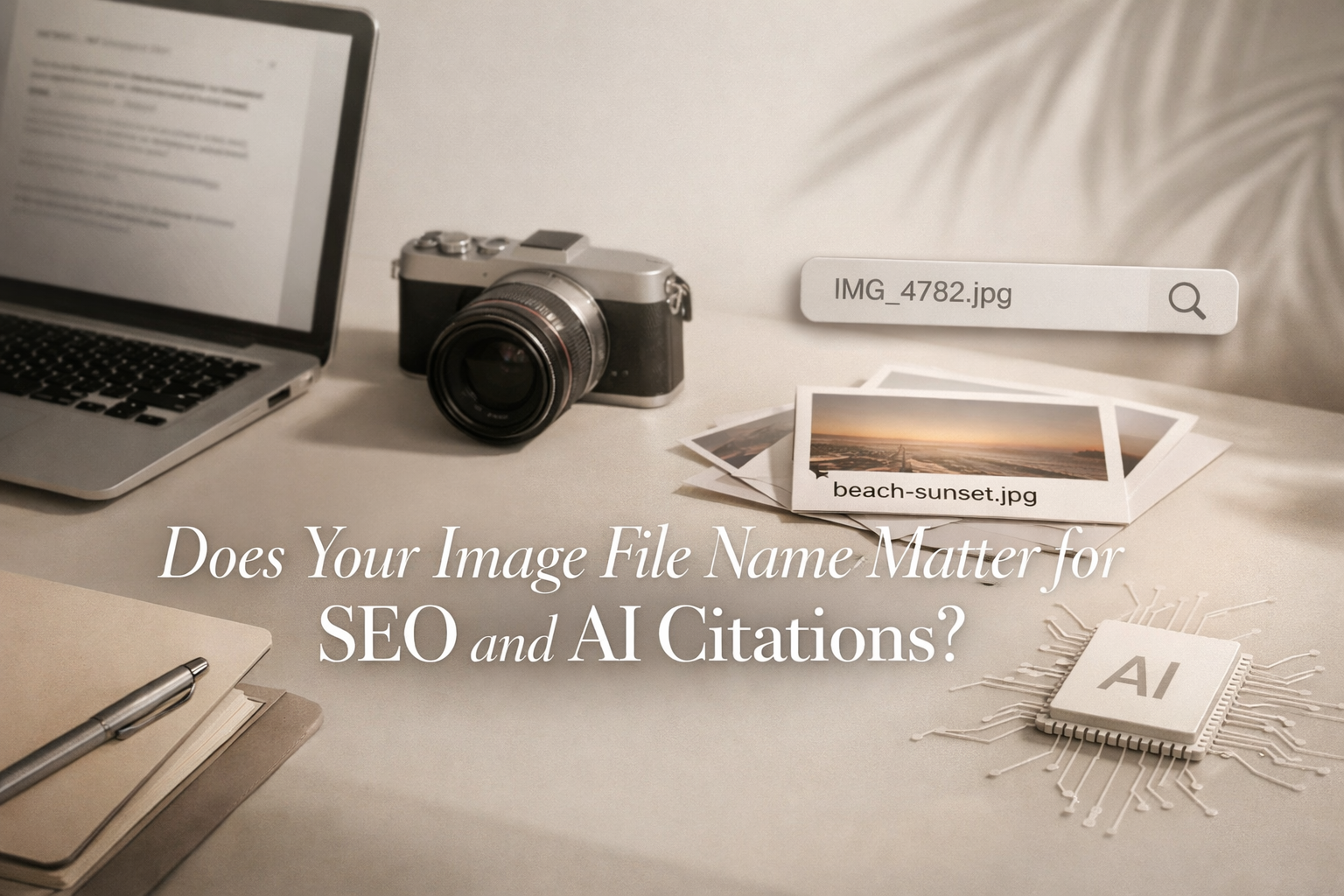
Then you upload a featured image called:
IMG_4782.jpg
And move on.
That file name is a missed opportunity — and almost every business gets it wrong.
The short answer: Yes, image file names matter.
They matter for:
Google Image Search
On-page SEO
AI systems that evaluate and cite content
It’s not the most powerful ranking factor — but it’s one of the easiest to get right. And across an entire site, small optimizations compound.
Why Google Cares About Image File Names
Google can’t “see” images the way humans do.
Computer vision has improved dramatically, but search engines still rely heavily on contextual signals to understand images. The file name is one of those signals.
When Googlebot crawls your page, it evaluates:
The image file name
The alt text
The surrounding text
The caption
The overall page topic
A file named:
IMG_4782.jpg
Tells Google nothing.
A file named:
dental-implant-procedure-philadelphia.jpg
Tells Google:
What the image shows
What topic it relates to
Where it may be relevant geographically
That difference matters in Google Image Search — which drives more traffic than many businesses realize.
Google’s own image SEO documentation explicitly recommends using descriptive file names. This isn’t theory. It’s best practice.
How Image File Names Support On-Page SEO
Every signal on a page contributes to topical clarity:
Title tag
H1
Subheadings
Body content
URL
Internal links
Alt text
Image file names
No single element is a magic bullet.
But together, they create alignment.
If your article is about AC installation costs and your image is named:
ac-installation-cost-breakdown.jpg
That reinforces your page topic.
If it’s named:
photo1-final-v2.jpg
You’ve wasted a relevance signal.
Across hundreds of images and pages, those missed signals add up.
SEO is rarely about one big thing.
It’s about doing a hundred small things consistently.
Image File Names and Google Image Search
This is where the impact becomes measurable.
Google Image Search is a significant traffic source in industries like:
Healthcare
Home services
Real estate
Ecommerce
Restaurants
Design
People search for:
“Before and after dental veneers”
“Modern kitchen remodel ideas”
Product names
Treatment examples
Image file names are a primary indexing factor.
A well-named image dramatically increases the chance of appearing in image results.
And every ranking image is a potential traffic entry point.
It takes seconds to name a file properly.
The traffic benefit can last for years.
Isn’t Alt Text Enough?
No.
Alt text and file names work together.
Alt text:
Lives in HTML
Supports accessibility
Adds contextual meaning
File name:
Is part of the image URL
Is crawlable
Acts as a permanent signal
Google reads both.
Best practice:
File name = what the image literally shows
Alt text = context and meaning within the page
Example:
File name:
roofing-crew-installing-shingles.jpg
Alt text:
Our roofing team installing architectural shingles on a residential home in Cherry Hill, NJ
Different layers of clarity. Same image.
How AI Systems Interpret Image Context
Now it gets more interesting.
Large language models like ChatGPT and Perplexity AI don’t rank images the way Google Image Search does.
But when they retrieve and process web content, they evaluate:
Full page structure
Alt text
Captions
Surrounding copy
And often the image file name as part of page structure
Does a single image file name determine AI citation?
No.
But it contributes to the overall content quality footprint.
AI systems prefer content that appears:
Thorough
Clearly structured
Topically aligned
Authoritative
Well-labeled images support that perception.
One small signal won’t earn a citation.
But consistent clarity across the page increases your odds.
Structured Data and Image Context
Most businesses miss this entirely.
Schema markup (structured data) can include image properties.
If you’re using:
Article schema
Product schema
LocalBusiness schema
Including properly named and described images strengthens machine-readable clarity.
A product page with:
Clean file names
Strong alt text
Schema image properties
Is significantly more likely to appear in:
Rich results
Image search
AI-powered product recommendations
For ecommerce, healthcare, real estate, and other visual industries, image optimization is not cosmetic.
It’s strategic.
Best Practices for Image File Names
This is simple — it just requires consistency.
1. Use lowercase letters
Keep URLs clean.
2. Separate words with hyphens
Google recommends hyphens over underscores.
3. Describe what the image shows
Be literal and specific.
4. Include relevant keywords naturally
No stuffing.
Bad:
best-dentist-philadelphia-top-rated-dentist-philly-dental.jpg
Good:
dental-implant-consultation-philadelphia.jpg
5. Keep it concise
Three to seven words is ideal.
6. Name files before uploading
Renaming after upload can create indexing and caching issues.
7. Apply it everywhere
Not just featured images.
Optimize:
Team photos
Infographics
Product shots
In-content images
Before-and-after photos
Every image is a relevance opportunity.
Does Image Format Matter?
File name affects relevance.
Format affects speed.
Page speed is a ranking factor.
Modern formats like:
WebP
AVIF
Offer better compression than JPEG or PNG.
Faster load times improve:
User experience
Rankings
Engagement
Optimize both file name and format.
The Bottom Line
Renaming one image won’t send you to page one.
But consistent image optimization:
Improves image search visibility
Strengthens topical alignment
Supports structured data
Enhances content clarity
Contributes to AI citation readiness
SEO and GEO are margin games.
Small improvements applied everywhere beat big changes applied rarely.
Image file names are a small detail.
But the businesses that win are the ones that get the details right — consistently.
Frequently Asked Questions
Does Renaming Image Files Improve Rankings?
Not instantly or dramatically.
But across an entire site, descriptive file names strengthen topical relevance signals and improve image search visibility.
The biggest direct impact is usually from Google Image Search traffic.
Should I Rename Images on My Existing Site?
If you have:
High-traffic pages
Important service pages
Poorly named images
It’s worth updating them.
Just make sure to:
Implement redirects for old image URLs
Avoid breaking existing image search equity
For large sites, prioritize key pages first.
Going forward, always name images correctly before uploading.
What’s the Ideal Format?
Lowercase
Hyphen-separated
Descriptive
Three to seven words
Examples:
commercial-roof-repair-south-jersey.jpg
patient-consultation-dental-office.jpg
Avoid:
Underscores
Spaces
Uppercase
Generic names
Is Alt Text More Important Than the File Name?
Alt text is essential for accessibility and adds rich context.
File names are permanent URL signals.
Optimizing both provides the full benefit.
Skipping either leaves value on the table.
Do AI Tools Actually Read Image File Names?
AI systems process the full structure of retrieved pages, which can include image file names, alt text, and captions.
Whether a specific model heavily weights file names isn’t publicly disclosed.
But well-structured, clearly labeled content improves overall content quality — and that increases citation likelihood.
Image optimization isn’t glamorous.
But in SEO and GEO, the businesses that win aren’t the ones chasing hacks.
They’re the ones stacking small advantages — everywhere.
Related Reads
〰️
Related Reads 〰️
Do AI Citations Pass Link Equity? How GEO Compares to Traditional Link Building
When ChatGPT or Perplexity cites your business, does that citation pass link juice like a traditional backlink? The short answer is no. The longer answer is that what AI citations actually pass might be worth more — and the businesses that understand the difference are building a serious competitive advantage.

What Solutions Track Competitor Citations in AI-Generated Search Responses?
When someone asks ChatGPT or Google's AI a question your business should be the answer to, whose name actually shows up? Tracking competitor citations in AI-generated search is a new category — but the tools exist. Here's what's out there and how to start using them.

How Semrush's AI Citation Tracking Works (And Why Your Business Needs It)
AI search is changing how customers find brands. Google AI Overviews, ChatGPT, and Perplexity are citing sources in their responses — and if your business isn't being mentioned, your competitors probably are. Here's how Semrush's AI Visibility Toolkit lets you track, measure, and grow your brand's presence in AI-generated answers.