Social Media Management for Plumbing Contractors
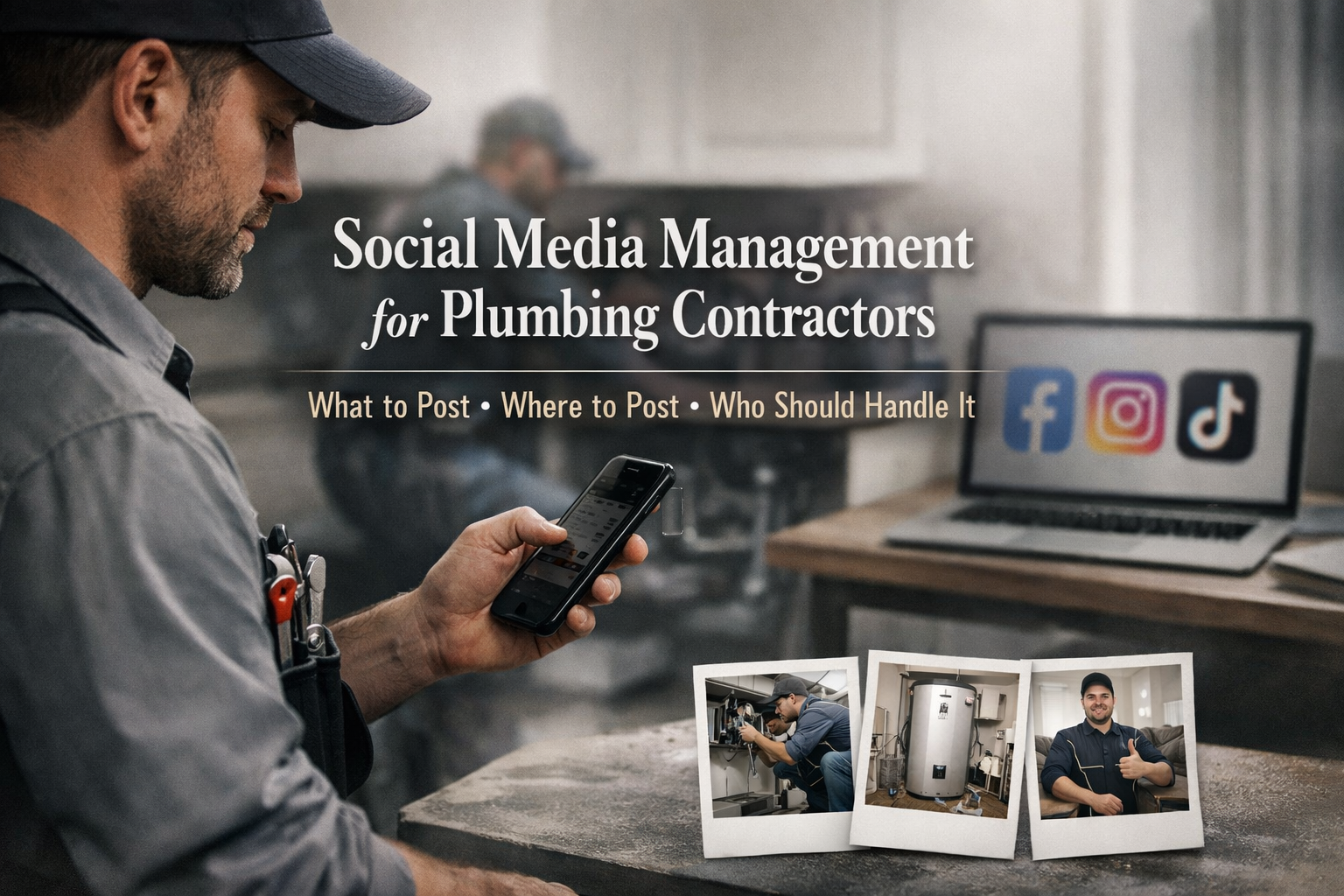
You didn't become a plumber to post on Instagram. You became a plumber because you're good at fixing things, you like working with your hands, and you wanted to build something that puts food on the table without sitting behind a desk all day.
But here you are, being told you need a social media presence. And somewhere between the 6 AM service call and the invoice you still haven't sent, you're supposed to figure out what to post, when to post it, and why any of it matters for a business that runs on word-of-mouth and Google reviews.
Here's the thing — social media can actually work for plumbing contractors. Not in the way it works for fashion brands or tech startups. Not with dance trends or viral memes. It works by doing what your business already does best: showing up, doing the job right, and proving it.
The problem isn't that social media doesn't work for plumbers. The problem is that nobody's explained how to do it in a way that makes sense for the way you actually run your business.
Why Social Media Matters for Plumbing Contractors (Even If You're Already Booked)
Word-of-mouth is still king in the trades. That hasn't changed. But what has changed is where word-of-mouth happens. When someone asks their neighborhood Facebook group "who's a good plumber around here?" and your name comes up, the first thing they do is look you up. If your Facebook page has three posts from 2021 and a blurry logo, that referral just got weaker. If your page shows recent job photos, reviews, and a team that clearly knows what they're doing, that referral just turned into a booked call.
Social media for plumbing contractors isn't about going viral. It's about three things.
Trust. People let you into their homes. They want to know who's showing up before they open the door. A social media presence with real photos of your team, your trucks, and your work tells people you're legitimate, professional, and not going anywhere.
Local visibility. Social platforms are local discovery engines now. Facebook, Instagram, and even TikTok surface local businesses to nearby users. When someone in your service area searches "plumber" or sees a friend interact with your page, you're getting free visibility with the exact audience you want.
Referral reinforcement. Most of your new business probably comes from referrals. Social media makes those referrals easier. Instead of telling a friend "call my plumber, I think his name is..." they can share your page, tag your business in a comment, or forward a post. You become referable in two taps instead of a half-remembered phone number.
What to Actually Post (Without Overthinking It)
The number one reason plumbing contractors abandon social media is they don't know what to post. So they post nothing. Or they post a stock photo of a wrench with a caption that says "Call us for all your plumbing needs!" and wonder why nobody engages.
Here's what actually works — and none of it requires a professional photographer, a copywriter, or more than five minutes of your time.
Before-and-After Photos
This is the easiest, most effective content a plumbing contractor can post. Corroded pipe vs. new copper. Destroyed water heater vs. fresh install. Flooded basement vs. dry floor. Take a photo before you start the job and after you finish. That's the post. People love transformation content, and it immediately demonstrates your competence without you having to say a word.
Job-Site Walk-Throughs
Pull out your phone, hit record, and spend 30 seconds explaining what you're looking at. "So this homeowner called because they had no hot water. Turns out the dip tube in their water heater completely deteriorated — you can see the pieces right here in the line. We're replacing the full unit today." That's it. That's the video. It's educational, it's authentic, and it positions you as the expert.
The Gross Stuff (People Love It)
Plumbing is one of the few trades where the ugly work is actually great content. A root-bound sewer line. A grease-clogged drain. A water heater that hasn't been flushed in fifteen years. The stuff that makes homeowners say "oh my god" is the stuff that gets shared, commented on, and remembered. Don't shy away from it — lean into it.
Team and Truck Photos
People hire people, not logos. Show your crew. Post a photo of the team at the start of the day. Introduce a new hire. Show the inside of a freshly organized service van. These posts don't get the most likes, but they build the kind of familiarity and trust that makes someone choose you over the name they found on Google.
Customer Reviews and Testimonials
When a customer leaves a great Google review, screenshot it and post it. When someone thanks you on the doorstep and you've got a second to ask, take a quick photo together. Social proof is the most powerful marketing tool in the trades, and every review you've earned deserves more visibility than just sitting on your Google Business Profile.
Seasonal Tips and Reminders
"Winter's coming — here's how to protect your outdoor hose bibs from freezing." "Spring is when we see the most sump pump failures — here's what to check." These posts position you as helpful rather than salesy, and they often drive direct messages from people who realize they need exactly the service you're describing.
Community Involvement
Sponsor a little league team? Donate time to a local nonprofit? Show up to a neighborhood event? Post about it. Local businesses that show up in their communities build loyalty that no ad budget can buy.
Which Platforms Actually Matter for Plumbers
You don't need to be everywhere. You need to be where your customers are, and for most plumbing contractors, that's a short list.
This is still the most important platform for local service businesses. It's where neighborhood groups live, where people ask for recommendations, where reviews show up alongside your business page, and where the 35-65 demographic — your core customer base — spends their time. If you're only going to manage one platform, make it Facebook.
Good for before-and-after content, job photos, and short-form video (Reels). Instagram skews a bit younger, which means you're reaching the next generation of homeowners — and the current generation of property managers, landlords, and real estate agents who hire plumbers regularly.
TikTok
Optional, but increasingly valuable. Plumbing content actually performs well on TikTok — gross drain cleanouts, satisfying pipe work, and quick educational clips get real traction. If you or someone on your team is comfortable on camera, TikTok can generate significant local visibility. If not, don't force it.
Google Business Profile
Not technically social media, but it functions like one. Post updates, photos, and offers directly to your GBP. These posts show up in local search results and Google Maps. If you're already investing in SEO and local search, your GBP should be treated as a social channel.
Nextdoor
Heavily used in suburban markets. Homeowners ask for contractor recommendations on Nextdoor constantly. Claiming your business page and staying active with posts and responses puts you in front of a hyper-local audience that's actively looking for exactly what you do.
How Often to Post (And How to Not Let It Take Over Your Day)
Consistency matters more than frequency. Three posts a week, every week, will outperform ten posts one week and then silence for a month.
Here's a realistic cadence for a plumbing contractor who's actually running a business:
Facebook: 3–4 posts per week. Mix of job photos, reviews, tips, and the occasional personal or team post.
Instagram: 3–4 posts per week, with 2–3 Stories mixed in. Reuse your Facebook content — just adjust the format slightly for the platform.
TikTok (if using): 1–2 videos per week. Keep them short, keep them real, don't overproduced.
Google Business Profile: 1–2 posts per week. Photos, service highlights, seasonal promotions.
The key is batching. Take photos and videos throughout the week as you're already doing the work. Set aside 30 minutes on a Sunday night or Monday morning to schedule the week's posts using a free tool like Meta Business Suite or Buffer. That's it. Social media doesn't have to eat your evening — it just has to stay consistent.
When to Hire a Social Media Manager (And What to Look For)
If you've tried doing it yourself and the posts keep falling off, or if your business has grown to the point where your time is worth more on the truck than on your phone, it's time to hand it off.
But hiring the wrong social media manager is worse than doing nothing. Here's what to look for and what to avoid.
What to look for
Experience with local service businesses. Social media for a plumbing contractor is fundamentally different from social media for a restaurant, a clothing brand, or a SaaS company. Your manager needs to understand the trades — the language, the audience, the buying cycle, the platforms that matter.
They ask for raw content from you. A good social media manager doesn't create everything from scratch using stock photos. They build a simple system for you to send job photos, short videos, and quick updates — then they handle the writing, editing, scheduling, and engagement.
They track real metrics. Follower count is vanity. What matters is profile visits, website clicks, direction requests, phone calls, and direct messages. Your social media manager should be reporting on metrics that connect to actual leads.
They respond to comments and messages. Social media management isn't just posting. It's engaging. When someone comments "do you service [neighborhood]?" or DMs asking for a quote, that's a lead. If your manager isn't monitoring and responding (or routing those to you), you're leaving money on the table.
What to avoid
Agencies that sell you a package with 30 posts a month of generic content. If your social media could belong to any plumber in any city, it's not doing anything for you.
Anyone who doesn't ask about your business before they start posting. Your service area, your specialties, your pricing model, your team — all of this shapes the content. If they don't ask, they don't care.
Managers who won't show you the content before it goes live. You should always have approval rights, especially early on. One bad post with incorrect information or an unprofessional tone can undo months of trust-building.
What Ritner Digital Does Differently for Plumbing Contractors
We're a full-stack marketing agency based in Philadelphia, and we work with home service businesses — including plumbing contractors — who are serious about growing but don't have time to figure out social media on their own.
Our social media management for plumbers isn't a generic posting package. We build a content system around your actual business. Real job photos. Real team content. Real customer stories. Posted consistently, optimized for local reach, and tracked against metrics that actually matter — profile visits, inbound messages, quote requests, and calls.
We also connect social media to the rest of your marketing. Your Google Business Profile. Your SEO. Your paid ads. Your email program. Social doesn't live in a vacuum, and we don't treat it like one.
If you're a plumbing contractor who knows social media should be part of the plan but doesn't have the time or the team to make it happen, that's exactly the kind of business we built this for.
Frequently Asked Questions
How much does social media management cost for a plumbing contractor?
It varies depending on the scope — how many platforms, how much content, whether we're handling paid social alongside organic. We don't do cookie-cutter packages. After a free audit, we put together a proposal based on your goals, your budget, and what's actually going to drive results. Most plumbing contractors land somewhere in the range that makes sense for a local service business, not enterprise-level pricing.
Do I need to create all the content myself?
No, but we do need raw material from you. That means job-site photos, short phone videos, and the occasional text about a notable job or customer interaction. We make this as easy as possible — most of our contractors just drop photos and clips into a shared folder or text thread throughout the week, and we handle everything from there.
What if I don't have any social media accounts yet?
We'll set everything up from scratch — Facebook Business Page, Instagram profile, Google Business Profile optimization, and any other platforms that make sense for your market. We handle the full setup including branding, bios, service descriptions, and initial content so you launch with a professional presence from day one.
How fast will I see results?
Social media is a long game, especially organic. You'll see engagement and local visibility start to build within the first month or two, but meaningful lead generation from social typically takes three to six months of consistent posting and community engagement. Paid social (Facebook and Instagram ads) can accelerate this significantly if you want faster results.
Can you run ads too, or just organic posts?
Both. We manage paid social campaigns for plumbing contractors — targeted Facebook and Instagram ads focused on your service area, your core services, and the seasonal demand cycles that drive your business. Paid and organic work best together, and we manage them as a connected strategy.
What platforms do you manage?
For most plumbing contractors, we focus on Facebook, Instagram, and Google Business Profile as the core three. If TikTok or Nextdoor makes sense for your market, we can add those. We'd rather do three platforms well than five platforms halfway.
Do I get to approve posts before they go live?
Yes, always. We use a shared content calendar where you can review and approve everything before it's published. Early in the relationship we lean heavily on approvals. As we learn your voice and preferences, the process gets faster — but you always have final say.
Will you respond to comments and messages on my behalf?
Yes. We monitor and respond to comments, DMs, and inquiries across all managed platforms. For quote requests and service calls, we route those to you or your office immediately. For general questions and engagement, we handle those directly using pre-approved guidelines so your response time stays fast and your tone stays consistent.
I'm not in Philadelphia — can you still help?
Absolutely. We're based in Philly, but we manage social media for service businesses across the country. Plumbing is plumbing — the content strategy, platform approach, and audience behavior are consistent across markets. We adapt the specifics to your service area and local audience.
How do I get started?
Get your free audit → We'll review your current social media presence (or lack of one), look at what your competitors are doing, and put together a plan to start building visibility and trust in your market.
Related Reads
〰️
Related Reads 〰️
The Home Services Marketing Playbook: How HVAC and Plumbing Companies Should Spend Their First $5K/Month
If you’re an HVAC or plumbing company with a $5K/month marketing budget, you don’t need branding fluff — you need booked jobs. This playbook breaks down exactly how to allocate your spend across Google Ads, Local Services Ads, and retargeting to drive predictable local leads.
Why We Use Rella for Social Media Reporting (And Think You Should Too)
Social media reporting shouldn't take an hour every month. Rella generates clean, shareable analytics reports in clicks — no client login required. Here's why it's the reporting and social management tool we recommend most, and how it fits into a workflow that actually scales.
Should My Dealership Be on TikTok or Is It a Waste of Time?
Wondering if your dealership should be on TikTok? This guide breaks down when TikTok can build brand awareness and local visibility — and when you’re better off focusing on search, retargeting, and core marketing systems first.