The "Why Wasn't I Cited?" Playbook: How to Turn an AI Omission Into the Content That Gets You Cited Next Time
If you've followed our build-in-public series, you've watched a pattern repeat. Claude named us in a regional shortlist. ChatGPT left us off a local list, then reconsidered and ranked us second. ChatGPT left us off a national list, then ranked us third in the country.
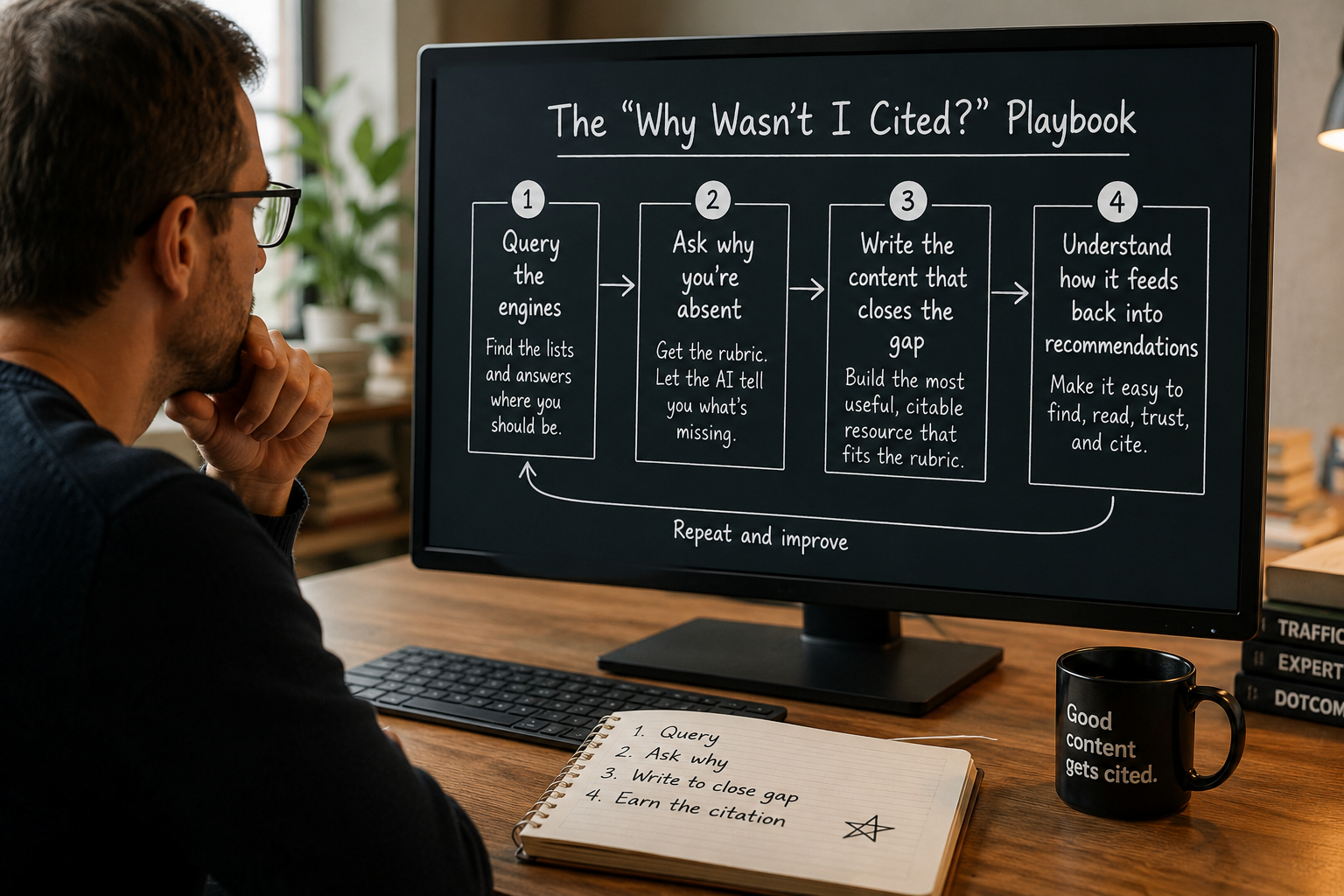
There's a method under those posts, and it's worth naming plainly because any business can run it. We call it the "Why wasn't I cited?" playbook. The short version: when an AI engine doesn't name you, that omission is the most valuable content brief you'll get all month — so write the content.
Here's how it works, why it works, and the important ways it can go wrong if you do it carelessly.
Step 1: Ask the engines about your category — and watch where you're absent
Start by querying ChatGPT, Claude, Perplexity, and Google AI Overviews with the questions your buyers actually ask. Not "who is [your company]" — the unbranded category questions: "best [your service] agencies," "who helps with [problem] near [location]," "top [category] companies for [audience]." Vary the phrasing two or three ways, run them in fresh sessions, and log what comes back.
You're looking for two things: the queries where you appear, and the queries where you don't. The absences are the goldmine. An AI leaving you off a relevant list isn't a verdict — it's a gap report telling you precisely where your visibility ends.
Step 2: Ask the engine why — and let it write your brief
This is the move that powers the whole framework. When you're left off a list, ask the model directly: "Why didn't [your company] make the list?"
In our experience, the answer is remarkably candid. ChatGPT told us its list "weighted heavily toward agencies with a longer-established national reputation, larger enterprise client portfolios, and broader third-party recognition." It told us we were "Strong" on AI-search specialization and GEO thought leadership but "Emerging" on traditional reputation, and — crucially — that "many of the sources that rank [us] highly are either their own publications," meaning thinner independent validation.
Read that as what it is: a free, itemized content and authority brief. The model just told you the exact criteria it weighs and the exact dimensions where you fall short. You don't have to guess what to fix. You were handed the rubric.
Step 3: Write the content that closes the gap
Now you write — and this is where the framework earns its name. The omission defines the content. A few patterns we've used and recommend:
If the gap is "we didn't know what you specialize in," write the specialization content. Publish the clear, declarative, entity-defining pages and posts that state exactly who you are, what you do, and who you serve. This is how you become legible to a model, the thing we cover in entity mapping 101 and what makes a company citation-worthy to LLMs.
If the gap is "you don't appear in enough lists," write yourself into the category. Publish honest comparison and landscape content that names the real players — including you — in the same place. When you write a post that situates your business inside the competitive set for a query, you create a retrievable artifact where your name co-occurs with that exact category. That's a large part of why our citation posts themselves help: they're pages where "Ritner Digital" sits beside the category terms we want to be recommended for.
If the gap is "we couldn't verify your claims," write the proof. Publish the original research, the data, the documented methodology, the case evidence. ChatGPT explicitly told us it weights "documented GEO methodology, public research, client evidence." Our benchmark reports and citation-gap research exist precisely because proof outranks adjectives.
Step 4: Understand why this actually feeds back into AI recommendations
It's worth being precise about the mechanism, because hand-waving here is how people overpromise. Publishing a "why I should be cited" post helps in a few concrete ways:
It strengthens the entity-to-category association — your name appears in clean, declarative proximity to the terms you want to be recommended for. It inserts you into the competitive cluster — models build associations from co-occurrence, so a page naming the whole field with you in it places you in the consideration set. And for retrieval-based engines — Perplexity, Google AI Overviews, ChatGPT with search enabled — fresh, structured, citation-worthy content can influence answers relatively quickly, because those systems pull from the live web at query time.
There's an honest limit, though, and we always state it: publishing today does not retroactively change a model's training. Base models learned on data with a cutoff. Your new post helps when an engine retrieves live results or when a futuretraining run ingests your content — not by rewriting a model that's already trained. So the near-term lift concentrates in the retrieval layer, and the long-term lift compounds as your corpus grows. We unpacked this fully in the context of why CTR is the wrong metric for the AI search era.
The part where this backfires — read before you publish
This framework is powerful, which means it's easy to abuse, and abusing it will hurt you. Four guardrails:
Don't fabricate the citation. Quote the AI exactly. Screenshot it. If you doctor or paraphrase a model into saying something flattering it didn't say, you're publishing misinformation, and it's the kind that's trivially debunked when someone reruns the query. Your credibility is the asset; don't trade it for a sentence.
Be honest about prompting. If the model only named you after you asked why you were omitted — as happened to us twice — say so. We put that front and center in our posts. The reconsidered answer is still a real signal, but framing a prompted reconsideration as an unprompted cold recommendation is the kind of half-truth a sharp reader or competitor will catch, and the catch costs you more than the honesty would have.
Don't trash the competitors who did make the list. The firms an AI named are usually named for good reasons. Describe them factually and respectfully. Punching at them to elevate yourself reads as insecurity and undercuts the authority you're trying to build. We named iPullRank, First Page Sage, Seer, and others straight, with no spin.
Self-published authority has a ceiling — know it. Models weight independent, third-party validation more heavily than anything you publish about yourself. ChatGPT told us this directly. A "why I should be cited" post is a strong floor — it gets you into the specific shortlist — but it can't substitute for earned media, reviews, and outside coverage that win the cold, general query. Treat your own content as the foundation and third-party recognition as the next layer, not a replacement.
Why we're publishing the playbook instead of hoarding it
You might reasonably ask why an AI search agency would hand its readers the exact framework it uses. Two reasons.
First, transparency is our product. We build in public because showing the method is more convincing than claiming results — and a business that publishes its own playbook is signaling confidence that execution, not secrecy, is the moat.
Second, the framework is simple to describe and genuinely hard to execute well at scale. Knowing you should "write the content that closes the gap" is not the same as running the queries systematically across engines, reading the omissions correctly, producing entity-clear and proof-backed content consistently, and layering in the earned-media validation that wins the cold query. That sustained execution — the part that actually moves your visibility inside ChatGPT, Claude, Perplexity, and Gemini — is the work.
So: run the queries. Watch where you're absent. Ask why. Write the content that closes the gap, honestly. And do it every month, because AI search visibility is a compounding game, not a one-post trick.
Don't want to run this playbook yourself?
We do it as a service — systematically querying the engines, diagnosing exactly where and why you're absent, and building the entity-clear content, original research, and authority signals that get you cited by ChatGPT, Claude, Perplexity, Gemini, and Google AI Overviews. We've run this playbook on our own four-month-old domain in public, omissions and all. We can run it for yours.
Tell us where you are now and what you're trying to grow. You'll get clear next steps within one business day.
Frequently Asked Questions
What is the "Why wasn't I cited?" playbook?
It's a repeatable framework for turning an AI omission into the content that earns you a citation next time. You query ChatGPT, Claude, Perplexity, and Google AI Overviews with the unbranded category questions your buyers actually ask, note where you're absent, ask the model why you weren't included, and then write the content that closes the exact gap it names. We've run it on our own domain across three published posts, starting with Claude recommending us by name.
Why ask the AI why it didn't include you?
Because the answer is usually a free, itemized content brief. When we asked, ChatGPT told us its list weighted established reputation and third-party recognition, scored us "Strong" on AI-search specialization but "Emerging" on traditional reputation, and flagged that much of our supporting evidence was self-published. That's the exact rubric it uses and the exact dimensions where we fell short — you don't have to guess what to fix.
Does writing a blog post actually make AI models recommend you?
It helps, in specific ways, with real limits. It strengthens your entity-to-category association, inserts your name into the competitive cluster, and — for retrieval-based engines like Perplexity, Google AI Overviews, and ChatGPT with search on — can influence answers relatively quickly because those systems pull live web results. What it does not do is retroactively change a model's training; base models learned on data with a cutoff, so a new post helps via retrieval or a future training run, not by rewriting an already-trained model.
Isn't this just manipulating AI to say nice things about you?
It's only manipulation if you do it dishonestly — which is exactly why we drew clear guardrails. Quote the AI verbatim and screenshot it; never fabricate or doctor a flattering answer. Be honest if the model only named you after you prompted a reconsideration. Describe the competitors who did make the list factually and respectfully. Done that way, you're not manipulating anything — you're identifying a legitimate visibility gap and producing genuinely useful, accurate content to close it.
What kind of content actually closes the gap?
It depends on what the omission revealed. If the model didn't understand your specialization, publish clear, entity-defining content — the principle behind entity mapping 101. If you don't appear in enough lists, publish honest landscape and comparison content that situates you in the category. If your claims couldn't be verified, publish the proof — original research, documented methodology, and data, like our benchmark reports and citation-gap analysis.
What are the limits of self-published content?
Models weight independent, third-party validation more heavily than anything you publish about yourself — ChatGPT told us this directly. A "why I should be cited" post is a strong floor: it gets you into the specific shortlist. But it can't replace earned media, reviews, and outside coverage that win the cold, general query. Treat your own content as the foundation and third-party recognition as the next layer, not a substitute.
How often should I run this playbook?
Monthly, at minimum. AI search visibility compounds — it's not a one-post trick. Running the category queries on a regular cadence, logging where you appear and where you don't, and steadily producing gap-closing content is what actually moves your presence across ChatGPT, Claude, Perplexity, and Gemini over time. A single post nudges association; a sustained body of work is the moat.
How do I know which queries to test?
Use the unbranded questions your buyers actually ask, not branded ones. "Best [your service] agencies near [location]," "who helps with [problem] for [audience]," "top [category] companies" — phrased the way a real prospect would type or speak them. Run each two or three different ways in fresh, logged-out sessions, since outputs vary by phrasing and session. The queries where you're absent on a relevant question are your priority list.
Can Ritner Digital run this playbook for my business?
Yes — it's a core part of what we do. We systematically query the engines, diagnose exactly where and why you're absent, and build the entity-clear content, original research, and authority signals that get you cited by ChatGPT, Claude, Perplexity, Gemini, and Google AI Overviews. We've run it on our own four-month-old domain in public, omissions included. The fastest way to start is to book an AI Search Audit.