What Is an SEO and AI Search Agency — And Why Your Business Needs One in 2026
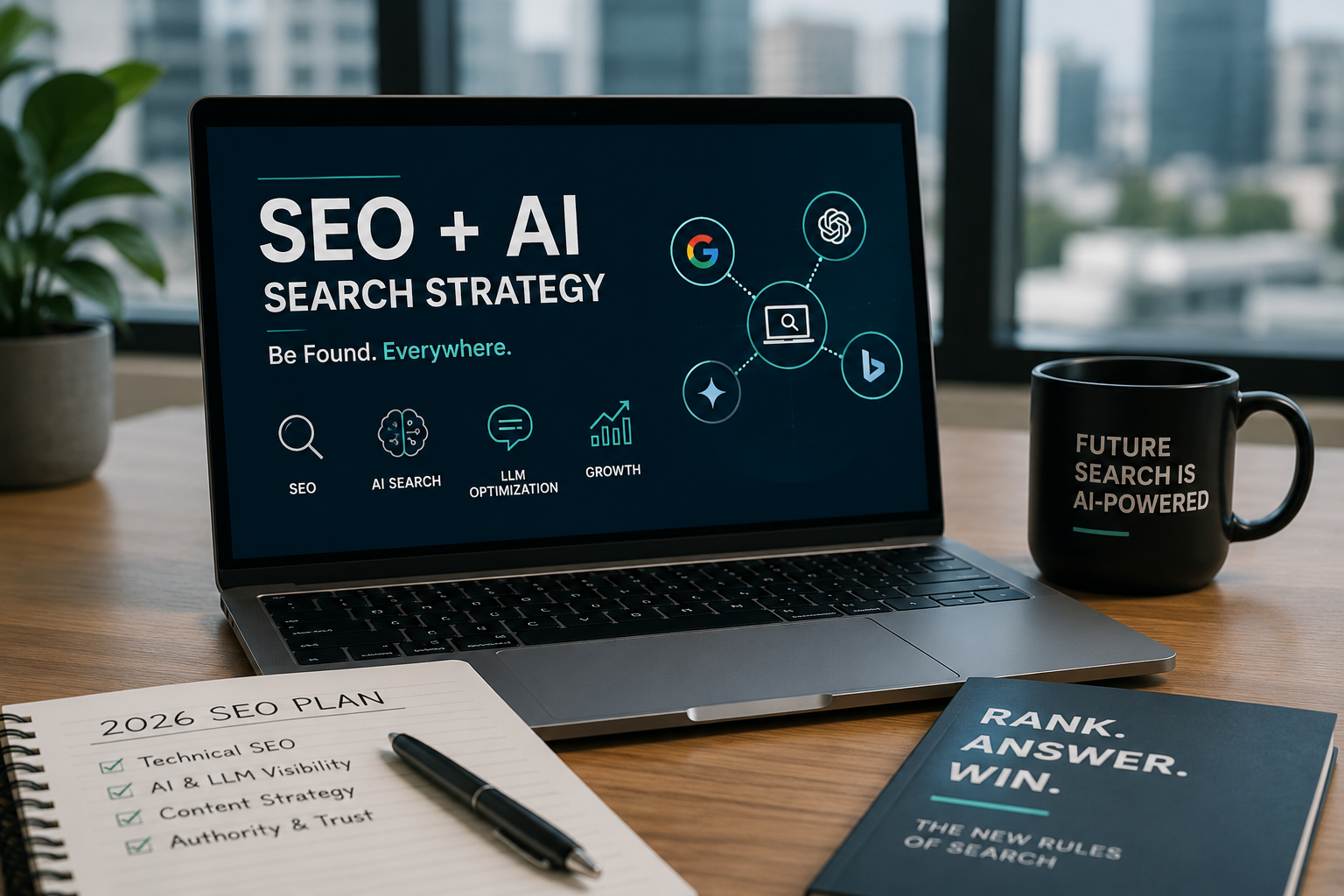
If you have searched for marketing help recently, you have probably noticed that the term "SEO agency" has expanded. Some agencies now call themselves "AI search agencies" or "GEO agencies" or "AEO specialists." Others are adding these terms to their existing service pages without meaningfully changing what they do. The terminology has multiplied faster than most business owners have had time to understand what any of it means.
This post cuts through the terminology and answers the questions that actually matter. What does an SEO and AI search agency do in 2026, specifically? How is it different from what an SEO agency did three years ago? What does your business lose by not working with one? And how do you tell the difference between an agency that genuinely understands this shift and one that has renamed its 2022 playbook with new acronyms?
The answers matter more right now than they have at any previous point in the history of search — because the way buyers find businesses has changed more in the past twenty-four months than it did in the previous decade, and the gap between businesses that have adapted and businesses that have not is widening every quarter.
What Search Actually Looks Like in 2026
Before explaining what an SEO and AI search agency does, it is worth being precise about the environment they are working in — because most business owners are operating with a mental model of search that is three to four years out of date.
The model most businesses have: someone goes to Google, types a few keywords, sees ten blue links, clicks one, lands on a website, and potentially becomes a customer. The SEO job in that model is to make your website one of the ten links and ideally as high up the list as possible.
That model is not wrong. It still describes a meaningful portion of search behavior. But it is now an incomplete description of how buyers actually find and evaluate businesses — and the portion of search it describes is shrinking.
In 2026, businesses need three search strategies running in parallel: classic SEO for Google blue links, AEO for AI chatbot citation in ChatGPT and Perplexity, and GEO for Google AI Overviews and Gemini. Companies optimizing all three capture sixty to eighty percent more organic reach than single-channel competitors. An estimated twenty to fifty percent of informational purchase journeys now touch an AI answer before a search results page ever loads — and seventy-three percent of businesses are completely invisible in ChatGPT today. Onely
Year-over-year growth by channel in 2026: classic SEO organic traffic is up twelve percent — saturated and mature. AEO citation-driven traffic is up three hundred and forty percent — early adopter advantage. GEO through Google AI Overview is up one hundred and eighty percent — rapid growth. Paid search ROI is down eighteen percent — declining efficiency. If you are only doing classic SEO, you are optimizing for the slowest-growing channel while ignoring the two fastest. Evergreen
The buyer behavior shift is real and documented. Around three in four American respondents say they search with AI weekly. The most common use cases are practical guidance, seeking information, and writing — accounting for seventy-seven percent of all ChatGPT conversations. AI Mode has hit seventy-five million users. Outbound referral traffic from ChatGPT to the rest of the web grew two hundred and six percent in 2025. Morrison Foerster
This is the environment an SEO and AI search agency is navigating. Not the ten-blue-links world of 2022. The multi-surface, AI-generated-answers, citation-driven, zero-click-complicated world of 2026.
What an SEO and AI Search Agency Actually Does
The cleanest way to explain what a modern SEO and AI search agency does is to describe the three disciplines it manages simultaneously — and why each one is necessary but not sufficient on its own.
Traditional SEO: The Foundation That Everything Else Builds On
SEO is the foundation. It gets your content indexed, ranked, and discoverable through traditional search. AEO builds on SEO. It structures your content to be selected as direct answers in featured snippets and voice results. GEO extends your reach. It positions your content to be cited by generative AI tools that synthesize answers. Each layer reinforces the others. Launchmind
Traditional SEO is not dead. Organic search drives 53.3 percent of all trackable website traffic — more than paid search, social, email, and display combined. The queries that actually drive leads and sales — local searches, commercial comparisons, transactional searches — are largely unaffected by AI Overviews. Google is still the largest search engine by a significant margin and will be for the foreseeable future. RDLDIGITAL
What traditional SEO covers in a modern agency: technical site health — crawlability, Core Web Vitals, structured data implementation, mobile performance — content strategy built around commercial intent rather than keyword volume, internal linking architecture that builds topical authority, backlink acquisition from genuinely authoritative sources, and local SEO for businesses with geographic service areas.
The difference between a traditional SEO agency and an SEO and AI search agency is not that the latter ignores these fundamentals. It is that the latter treats them as infrastructure for a larger visibility program rather than as the complete program.
GEO: Getting Your Brand Into AI-Generated Answers
Generative Engine Optimization is the practice of structuring your content, technical setup, and brand signals so that AI-powered search systems — Google AI Overviews, ChatGPT, Perplexity, Gemini — accurately represent and cite your brand when users ask relevant questions.
GEO operates on different principles than traditional SEO. Instead of targeting keyword rankings with webpages, GEO is based on semantic relevance of passages within the vector-based retrieval systems that AI platforms use to identify and synthesize information. Successful GEO content engineering focuses on creating information that supports AI reasoning processes rather than just human reading patterns. Content must survive passage-level competition in probabilistic retrieval systems to be effective. Manaferra
In practice, what this means for your business: when a buyer asks ChatGPT which companies in your category are worth considering, or when a prospect uses Google AI Overview to research a problem your product solves, GEO is what determines whether your brand appears in that answer or your competitor's does. In the AI era, the quality and reliability of your content is truly paramount. Unlike traditional SEO where technical optimization sometimes compensated for thin content, in AI-driven search the depth and trustworthiness of your content determines whether you get cited. ALM Corp
A GEO program covers entity clarity — ensuring AI systems can unambiguously identify your brand and what it does — content architecture that makes information extractable by AI retrieval systems, external citation building that gives AI systems third-party validation to cite, and measurement infrastructure that tracks whether your brand is appearing in AI-generated answers and for which queries.
AEO: Winning the Featured Answer Slots
Answer Engine Optimization is the practice of structuring content to be selected as direct answers — in featured snippets, voice search responses, People Also Ask boxes, and AI-generated answer cards that appear above traditional organic results.
AEO focuses on structuring content so search engines and AI tools can extract direct answers. The key distinction for AEO is its focus on speed and single-answer accuracy rather than deep-dive exploration. Writers use FAQ formats and direct definitions that address the specific who, what, where, when, and why of a topic. Integrating AEO into a digital plan helps capture high-intent traffic from users who need immediate solutions. Manaferra
The practical AEO work: identifying the specific questions your buyers are asking at each stage of their research process, structuring content to answer those questions directly and concisely near the top of each page, implementing FAQ schema and How-To schema that make that content machine-readable, and ensuring the technical setup allows AI crawlers to access and extract that content without JavaScript rendering barriers.
What Your Business Loses Without This
The case for working with an SEO and AI search agency is not primarily about gaining something. It is about not losing something that is already at risk.
A personal injury law firm in Chicago ranked number one for its primary keyword and had over fifteen thousand monthly organic visitors. Their lead volume dropped. The brand was leaking clients to competitors that were more visible in AI search engines as search behavior shifted in this niche. The brand did not appear in LLM results for the query despite strong domain expertise. Competitors were mentioned seventy-three percent of the time. The firm's strong traditional SEO was generating impressions that never converted because buyers were forming preferences in AI-generated answers before they ever clicked a traditional result. Procloser
That story is not unusual. It is becoming typical. A business can have excellent traditional SEO performance — page one rankings, strong domain authority, consistent organic traffic — and still be systematically losing consideration opportunities because its competitors are the ones getting cited when buyers use AI assistants to research their options.
The businesses winning in 2026 are working with an SEO agency that understands three disciplines working together: SEO, AEO, and GEO. A digital marketing strategy that treats these as separate initiatives misses how tightly connected they are in practice. Without the foundation of traditional SEO, neither AEO nor GEO delivers consistent results. Without AEO and GEO layered on top, traditional SEO leaves significant discovery opportunities on the table. Manaferra
The specific things your business loses without integrated SEO and AI search strategy:
Buyer consideration before the search funnel begins. An estimated twenty to fifty percent of B2B purchase journeys now touch an AI-generated answer before the buyer ever runs a traditional search. If your brand does not appear in those answers, you are invisible at the stage where buyer shortlists are being formed — before anyone has ever visited your website.
Branded search demand that compounds over time. The businesses that win in 2026 stopped thinking of SEO as a line item and started treating it as infrastructure. A campaign that looks expensive in month three often looks like the best decision you ever made by month eighteen. Organic rankings persist. A piece of content published today can generate traffic, leads, and revenue twelve, twenty-four, or thirty-six months from now with no additional spend. That compounding effect means the true ROI of SEO is almost always understated in short time windows. Authoritysolutions
AI citation authority that self-reinforces. Once a competitor becomes the default recommendation in AI-generated answers for your category, that position compounds. AI systems learn from user behavior and update their citation patterns accordingly. A competitor who is consistently cited today is building a citation moat that will be harder to displace next quarter than it is this quarter. The cost of not competing in this channel is not static — it grows over time.
The ROI Case: What the Numbers Actually Show
The business case for investing in SEO and AI search in 2026 is stronger than it has ever been, despite — or more precisely, because of — the structural changes to search.
With 748 percent ROI and seventy-six percent of B2B traffic coming from search engines, SEO delivers unmatched long-term returns compared to paid channels. Sixty percent of searches now end without clicks due to AI features, which changes where value is captured but does not eliminate it. Clarity Quest
By month twelve, a professional SEO agency investment is generating net returns above its cost each month. By month eighteen to twenty-four, the same investment commonly produces eight thousand to twelve thousand dollars in monthly attributed revenue as rankings compound. The average ROI of a thought leadership SEO campaign for B2B SaaS is 702 percent over a three-year period, according to FirstPageSage SEO ROI statistics 2026. RDLDIGITAL
67 percent of businesses already leverage AI for content and SEO, with 65 percent seeing performance improvements and 68 percent reporting higher ROI from AI-supported workflows. As search results increasingly shift toward AI Overviews, answer engines, and structured LLM-interpretable content, traditional SEO playbooks are no longer enough on their own — but the businesses that have integrated AI search optimization are seeing measurably better returns. Acquiry
The local search dimension is particularly strong for businesses with geographic service areas. 46 percent of all monthly Google searches have local intent, and when a local search is performed on mobile, 18 percent lead to a sale within 24 hours. Local searches with clear commercial intent drive direct inquiries and often convert faster than broad organic traffic. RDLDIGITAL
The ROI calculation is also changing in a way that favors AI-visible brands specifically. When an AI system cites your brand in a generated answer and a buyer acts on that recommendation, the conversion path is shorter and the buyer arrives with more established trust than one who discovered you through a cold organic click. The traffic volume from AI citations is currently small relative to traditional organic — but the conversion quality of that traffic is higher, and the trajectory of AI search adoption suggests the volume gap will narrow significantly over the next two years.
What Separates a Genuine SEO and AI Search Agency From One That Has Just Added New Acronyms
The explosion of "AI SEO agency" claims in the market has made it genuinely difficult to distinguish agencies with real capability from those that have rebranded existing services with new terminology. The screening questions that cut through that noise are specific.
Ask for AI citation evidence, not just ranking reports. A genuine AI search agency can show you where a client's brand currently appears in AI-generated answers for commercial queries in their category — in ChatGPT, in Perplexity, in Google AI Overviews. They can show you how that citation frequency has changed over time as a result of their work. If the only evidence they can provide is keyword rankings and organic traffic, they are doing traditional SEO with AI-adjacent language attached to the service description.
Ask about their measurement infrastructure for AI visibility. A genuine agency tracks AI citation frequency as a regular metric — not through occasional screenshots, but through a structured, repeatable testing protocol across multiple platforms, tracked consistently over time. They can tell you which queries a client is currently cited for, which queries they are not yet cited for, and what the trend looks like over the past ninety days.
Ask about their content approach for AI extraction. A genuine agency structures content specifically for how AI retrieval systems work — leading with direct answers, using structured formats that AI systems can parse, implementing schema markup that makes content machine-readable, and ensuring that content is accessible to AI crawlers that do not render JavaScript. If their content approach is indistinguishable from a standard blog writing service, the GEO capability is cosmetic.
Ask how they connect the work to revenue. Agencies still selling a 2019 playbook — keyword rankings as the primary KPI, informational blog content as the main deliverable — are underperforming. Businesses getting the best returns from SEO agencies in 2026 are targeting commercial intent queries, measuring against revenue outcomes, and treating AI search visibility as a separate measurement track alongside traditional organic. RDLDIGITAL
Why Ritner Digital Does This Work Differently
We have been writing about this shift since before most agencies were taking it seriously. We launched our own blog on January 22, 2026, on a brand new domain with zero authority, and we have published our own Search Console data publicly — every row, every metric, including the uncomfortable numbers — because we believe that the only honest way to sell SEO and AI search services is to show our own results alongside our clients'.
We are a GEO and AI search agency that also does traditional SEO — because you need both, in that order of strategic priority, delivered as one integrated program. Our work covers the full stack: technical SEO foundation, entity authority building, topical content architecture, AI citation optimization, local SEO for geographic markets, and the measurement infrastructure that tracks visibility across both traditional and AI search surfaces.
We have written extensively about the specific dimensions of this work because we believe in documented expertise over claimed expertise. The enterprise SEO alignment problem. The crawl budget issues large sites consistently get wrong. The keyword universe architecture that prevents content sprawl. The reporting frameworks that connect organic search to revenue. The competitive moat thinking that separates durable advantage from temporary position.
That body of work is itself a demonstration of the entity authority and topical depth we build for clients. We are not claiming expertise in AI search. We are documenting it, publicly, in real time, on a domain where you can verify the results.
What to Do Right Now
If your business is currently working with a traditional SEO agency that measures success primarily through keyword rankings and organic traffic — and has not introduced AI citation visibility as a measurement track — you are likely underperforming against the competitive landscape that has developed over the past eighteen months.
The first step is not necessarily to change agencies. It is to understand where your brand currently stands in AI-generated answers for your most important commercial queries. Run those queries yourself in ChatGPT, Perplexity, and Google AI Overview. Note which brands appear. Note whether yours does. That ten-minute exercise will tell you more about your current AI search competitive position than any monthly ranking report.
If your brand is not appearing in those answers and your competitors are, you have a structural visibility problem that a traditional SEO program will not solve on its own. That is the conversation worth having — about what an integrated SEO and AI search program looks like for your specific business, in your specific market, against your specific competitive landscape.
The businesses pulling ahead in 2026 are working with an SEO strategy that understands three disciplines working together. The ones still treating these as separate initiatives — or optimizing for only one of the three — are missing how tightly connected they are in practice and leaving compounding competitive advantage on the table for the businesses that have made the connection. Manaferra
The window where early movers build meaningful advantages that late movers will struggle to close is open now. It will not stay open indefinitely.
Sources cited in this piece:
Optimum Web — SEO, AEO, GEO in 2026: The Three-Channel Search Strategy Every Business Needs
Atak Interactive — SEO vs GEO vs AEO vs AIO: What Actually Matters in 2026
Arc Intermedia — SEO vs GEO vs AEO: Navigating the New Search Landscape for 2026
BOL Agency — What Is GEO and AEO? How AI Is Changing B2B SEO in 2026
Cheenti — How AEO, GEO and SEO Work Together to Boost Rankings in 2026
RankFast — Why Your Business Needs an SEO Agency in 2026: ROI Breakdown
Embarque — 20 AI SEO Agencies Helping Businesses Rank in AI Results in 2026
HubSpot — Answer Engine Optimization Case Studies That Prove the ROI of AEO in 2026
Oliver Munro — 65+ B2B SEO Statistics and Benchmarks for 2026
The HOTH — The Real ROI of SEO: How to Prove the Value of Organic Search in 2026
RevvGrowth — The Ultimate Guide to AI SEO Agencies: What to Expect in 2026
Genix Digital — SEO, AEO and GEO: The New Era of Search in 2026
Internal resources referenced:
If you are not sure where your business stands in AI-generated answers for your most important queries, that is the place to start. Let's find out together. →
Frequently Asked Questions
What is the difference between an SEO agency and an AI search agency?
A traditional SEO agency optimizes your website to rank in Google's traditional blue-link results. An AI search agency — or an SEO and AI search agency, which is the more accurate description of what serious agencies are now doing — does that and also optimizes your brand's presence in AI-generated answers across ChatGPT, Perplexity, Google AI Overviews, and Gemini. The practical difference for your business: a traditional SEO agency is optimizing for the channel where search volume growth is twelve percent year over year. An AI search agency is also optimizing for the channels where growth is one hundred and eighty to three hundred and forty percent year over year. The agencies adding "AI" to their service pages without meaningfully changing their methodology are still doing traditional SEO. The ones worth working with can show you, specifically, where client brands appear in AI-generated answers for commercial queries — and how that has changed as a result of their work.
Do I still need traditional SEO if AI search is growing so fast?
Yes, and this is one of the most important things to understand about the current search landscape. Traditional SEO is the foundation that AI search visibility builds on. Google is still the largest search engine by a significant margin and drives more referral traffic than all AI platforms combined. The commercial queries that actually drive leads and sales — local searches, category comparisons, transactional searches — are still heavily influenced by traditional organic rankings. Beyond that, the signals that earn AI citations — topical authority, entity clarity, external validation, E-E-A-T — are the same signals that traditional SEO builds. An agency that is genuinely good at AI search visibility is almost always doing excellent traditional SEO underneath it, because without the technical foundation, the crawl architecture, and the content depth that traditional SEO requires, the AI search optimization has nothing to build on.
What is GEO and how is it different from regular SEO?
GEO — Generative Engine Optimization — is the practice of structuring your content, technical setup, and brand signals so that AI-powered search systems accurately represent and cite your brand when users ask relevant questions. Regular SEO is about winning positions in a ranked list of links. GEO is about becoming a trusted source that AI systems synthesize answers from — which is a fundamentally different optimization objective. Where traditional SEO optimizes for keyword relevance and backlink authority, GEO optimizes for entity clarity, content extractability, citation patterns across authoritative external sources, and the kind of factual specificity that AI systems can confidently quote. The two disciplines overlap significantly — strong traditional SEO is a prerequisite for strong GEO — but they diverge enough in their specific tactics that treating one as a substitute for the other produces mediocre results in both channels.
What is AEO and why does it matter for my business?
AEO — Answer Engine Optimization — is the practice of structuring content to be selected as direct answers in featured snippets, voice search results, People Also Ask boxes, and AI-generated answer cards. It matters because a growing share of buyer research happens in environments where users ask a full question and receive a direct answer without clicking through to any website. If your content is not structured to be that answer, your competitor's content is. The practical AEO work involves identifying the specific questions your buyers ask during their research process, writing content that answers those questions directly and concisely near the top of each page, implementing FAQ and How-To schema that makes the content machine-readable, and ensuring AI crawlers can access and extract that content without JavaScript rendering barriers. AEO is not a replacement for traditional SEO — it is a layer that sits on top of a solid technical and content foundation.
How long does it take to see results from SEO and AI search optimization?
The honest answer is that the two channels have different timelines and different definitions of what results look like. Traditional SEO produces measurable position improvements within three to six months for most businesses, with meaningful organic traffic growth compounding over twelve to twenty-four months. AI citation visibility is faster in some dimensions — Perplexity typically cites new content within one to two weeks, Google AI Overview within two to four weeks — but slower in others, because building the entity authority and topical depth that earns consistent AI citations across commercial queries requires the same sustained content investment that traditional SEO does. The important thing to understand about both timelines is that the returns compound in a way that paid advertising does not. A piece of content or an entity signal built today continues generating visibility and citations months and years later. The business case gets stronger the longer the program runs, not weaker.
How do I know if my business has an AI search visibility problem?
Run the ten-minute test yourself. Take the five commercial queries that your buyers are most likely to use when researching your category — not queries that include your brand name, but category queries about the problem your product or service solves. Run each one through ChatGPT, Perplexity, and Google AI Overview. Note which brands appear in the generated responses. Note whether yours appears, and in what context if it does. If your competitors are consistently appearing in those responses and your brand is absent, you have an AI search visibility problem that your traditional organic rankings will not fix on their own. If your brand appears but is described inaccurately or in a context that does not represent your actual positioning, you have an entity clarity problem that is suppressing the quality of your AI citations. Either way, the test takes ten minutes and produces more actionable competitive intelligence than most monthly SEO reports.
My business already ranks well on Google. Why would I need AI search optimization on top of that?
Because strong Google rankings and strong AI search visibility are related but distinct. The personal injury law firm case illustrates this precisely — ranking number one for their primary keyword with over fifteen thousand monthly organic visitors, while simultaneously being completely invisible in AI-generated answers for the same category queries. Competitors were mentioned seventy-three percent of the time in those AI responses. The lead volume dropped because buyers were forming preferences in AI-generated answers before they ever clicked a traditional search result. Strong traditional rankings are a useful input into AI citation probability — pages that rank in the top ten organically are significantly more likely to be cited by AI systems than pages that rank outside the top twenty. But ranking alone is not sufficient for AI citation, because the specific content structure, entity signals, and external validation that AI systems require for confident citation go beyond what traditional ranking algorithms weight most heavily.
How much should I expect to invest in SEO and AI search services in 2026?
Investment levels vary significantly based on the competitiveness of your market, the size of your site, and how much ground you need to make up relative to established competitors. For small to mid-sized businesses, professional SEO and AI search services typically range from fifteen hundred to five thousand dollars per month depending on scope. For mid-market and enterprise organizations with complex technical environments or competitive markets requiring aggressive content and authority building, the investment ranges from five thousand to twenty-five thousand dollars per month or more. The ROI framework to apply is straightforward: what is the average value of a customer your business wins, what is your current close rate on qualified leads, and what would a meaningful increase in qualified organic pipeline be worth annually? For B2B businesses with average contract values above ten thousand dollars, a professional SEO and AI search program typically produces a return that exceeds its cost within twelve months and compounds significantly beyond that. The businesses that struggle to justify the investment are almost always the ones measuring it against short-term traffic metrics rather than revenue contribution over a twelve to twenty-four month window.
What should I actually look for when evaluating an SEO and AI search agency?
Three things that most agency evaluation processes miss entirely. First, ask to see AI citation evidence for an existing client — not traffic reports, not keyword rankings, but documented proof that content they produced for a client is appearing in ChatGPT, Perplexity, or Google AI Overviews for commercial queries in that client's category. If they cannot produce that evidence with specific examples, they are doing traditional SEO with new language. Second, ask how they measure AI visibility as an ongoing metric — not through occasional manual checks, but through a structured, repeatable testing protocol that produces trend data over time. Third, ask how they connect SEO and AI search work to revenue outcomes specifically. An agency that measures success primarily through rankings and traffic is optimizing for signals that have become increasingly disconnected from business outcomes as AI Overviews absorb informational query traffic. The agency worth hiring measures organic pipeline contribution, commercial intent impression share, and AI citation frequency alongside traditional metrics — and can explain clearly how each one connects to your bottom line.
Is AI search optimization relevant for local businesses or just large companies?
Highly relevant for local businesses, and in some ways more immediately impactful than for large enterprises. Local search behavior is shifting toward conversational AI queries — someone asking a voice assistant or ChatGPT where to find the best plumber in their area, or which dentist near them has the best reviews, or what contractor handles the specific type of work they need. Forty-six percent of all monthly Google searches have local intent, and AI-generated answers for local queries are drawing on exactly the same entity signals — Google Business Profile completeness, consistent NAP information across directories, review volume and recency, local citation presence — that local SEO has always focused on. A local business with a well-optimized Google Business Profile, consistent entity signals across local directories, and structured content that answers the specific questions local buyers ask is well-positioned for both traditional local SEO and AI-generated local recommendations. The difference in 2026 is that the AI layer is an additional surface that requires deliberate attention, not an automatic extension of good local SEO practice.
What happens if I wait another year before addressing AI search visibility?
The competitive disadvantage compounds. Citation patterns in AI search are self-reinforcing — the brands that AI systems cite consistently today are building the track record of user engagement, external references, and brand recognition that makes them more likely to be cited tomorrow. A competitor who is already the default recommendation in AI-generated answers for your category is using this year to extend that lead further. The organic timeline for building equivalent citation authority is measured in months to years. If you wait a year, the gap you are trying to close is a year wider and the competitor you are chasing has had another year to build the proprietary content, external validation, and entity authority that make their citation moat harder to displace. The businesses that are investing in AI search visibility now are not investing in a future capability. They are closing a gap that is already costing them buyer consideration opportunities every week.