Why Your Meta Engagement Campaign Is Attracting Fake-Looking Accounts (And What to Do About It)
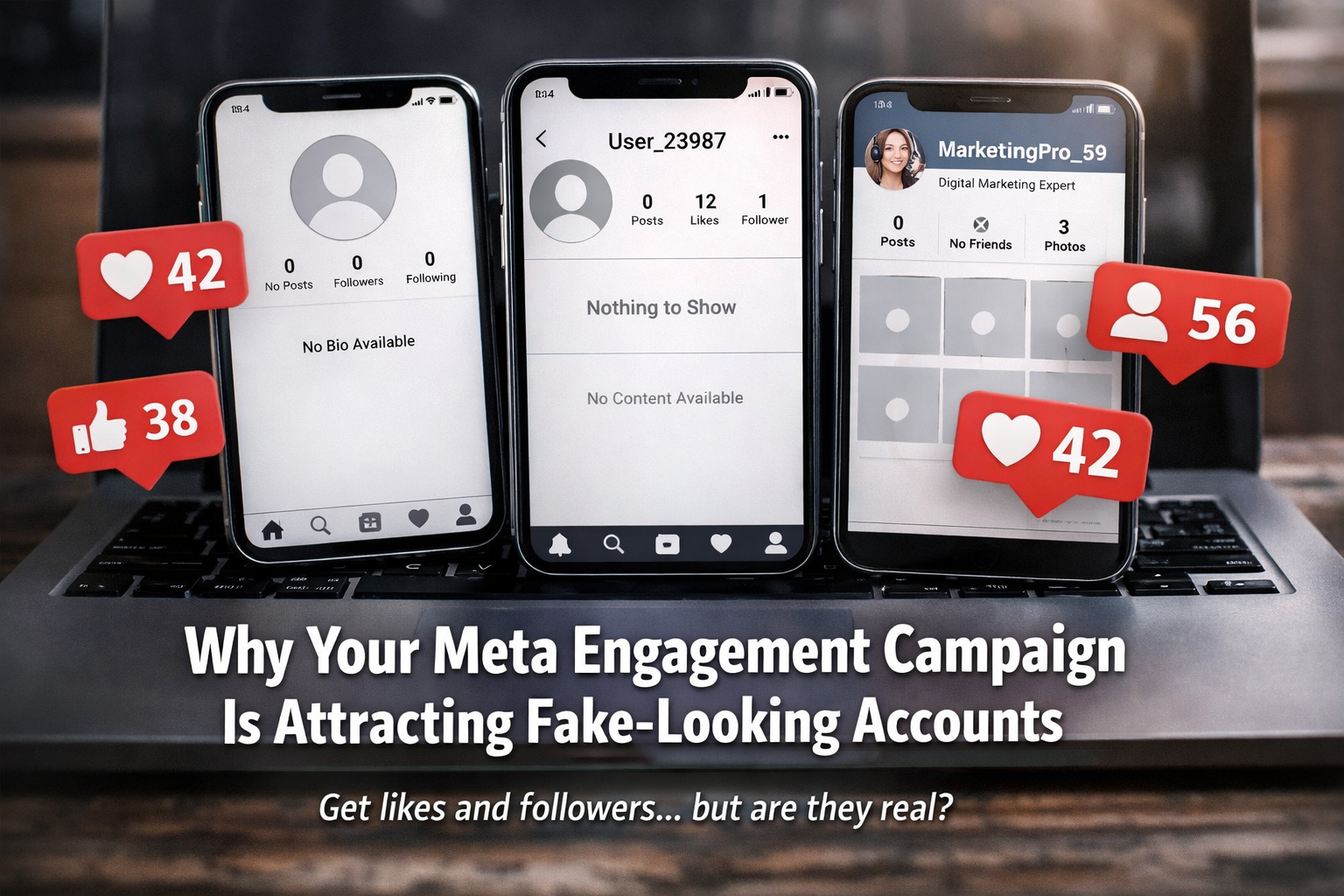
You set up a Meta paid ad campaign, targeted it carefully, and now accounts with no profile pictures are liking your posts. Here's what's actually happening.
You Did Everything Right. So Why Does Your Engagement Look Like This?
You spent time on the creative. You dialed in the targeting — specific job titles, fields of study, industries. You set the campaign objective to engagement because you wanted real people interacting with your content, building social proof, maybe even following the page.
Then the results came in.
Likes from accounts with no profile picture. Profiles that are three years old with two posts. Names that don't quite read like real people. Accounts from countries that have nothing to do with your audience. All of them technically fitting your targeting parameters on paper, somehow ending up in your notifications anyway.
This is one of the most frustrating and least talked-about problems in Meta paid advertising — and it's not a glitch. It's a feature of how the engagement objective actually works.
What the Engagement Objective Actually Optimizes For
Here's the thing Meta doesn't put in big letters on the campaign setup screen: when you select engagement as your objective, you are telling Meta's algorithm to find people most likely to engage with your ad. Not people most likely to buy. Not people most likely to care about what you're selling. People most likely to tap, like, react, or comment — full stop.
Meta's algorithm is extraordinarily good at its job. And its job, when you choose engagement, is to drive engagement volume at the lowest possible cost per interaction. The way it does that is by identifying users whose behavior patterns indicate they engage with ads frequently — and those users are not always who you think they are.
Low-quality accounts, dormant profiles, and users in lower-cost markets are disproportionately represented in cheap engagement. The algorithm doesn't know or care that an account has no profile picture or hasn't posted since 2021. It knows that account clicks on ads, and it's been asked to find people who click on ads.
Your targeting parameters narrow the pool. They do not guarantee the quality of who shows up inside it.
The Detailed Targeting Problem Nobody Talks About Enough
Meta's interest and demographic targeting — job titles, fields of study, employer, education level — sounds precise. In practice, it is significantly less precise than it appears.
Meta doesn't verify user-provided profile information. Job titles are self-reported and often outdated. Fields of study are pulled from what users entered when they created their accounts, potentially years ago. A person who listed "Marketing Manager" as their job title in 2018 and hasn't touched their profile since is still targetable under that job title today, even if they've changed careers twice.
This means that when you build an audience targeting "Operations Directors" or "MBA graduates," you are targeting people who at some point typed those words into a form. The alignment between that label and the actual human sitting behind the account is not guaranteed — and in many cases, it's loose at best.
Stack that on top of an engagement objective that's hunting for low-cost clicks, and the combination explains exactly what you're seeing in your notifications.
Why This Matters Beyond the Vanity Metrics
You might be tempted to shrug this off. Likes are likes, right? Who cares if a few ghost accounts inflate the count?
It matters more than it looks like it does.
It contaminates your custom audiences. If you're building a retargeting list based on people who engaged with your content, and a meaningful portion of those engagements came from low-quality accounts, your retargeting pool is polluted. You're now paying to reach fake signal on top of fake signal.
It tanks your relevance data. Meta uses post-interaction behavior to inform how your ad is performing. Low-quality engagement that doesn't lead to any downstream action sends weak signals back into the algorithm, which can affect your ad's distribution over time.
It gives you a false read on your creative. If an ad is pulling strong engagement but the accounts look suspicious, you can't actually use that engagement data to evaluate whether the creative is resonating with your real target audience. The feedback loop is broken.
It wastes your budget. Every impression delivered to an account that was never going to become a customer is a cent you didn't spend on someone who might have.
What You Can Actually Do About It
The good news is that this is a solvable problem — not perfectly, but meaningfully.
Reconsider the engagement objective for B2B or niche audiences. Engagement campaigns work well for top-of-funnel brand awareness when your audience is broad and the goal is reach. They work poorly when you need quality signal from a specific professional audience. If you're trying to reach decision-makers, traffic or conversion objectives will force the algorithm to optimize for behavior that requires more intent — clicking through to a website, filling out a form — which tends to filter out low-quality accounts naturally.
Use audience exclusions aggressively. Exclude countries and regions that have no realistic path to becoming customers. This alone can meaningfully reduce the proportion of low-cost, low-quality engagement in your results. It feels like you're shrinking your audience, but you're really just removing noise.
Layer Lookalike Audiences on top of real customer data. If you have an existing customer list, a CRM export, or a website custom audience built from actual converters, a Lookalike Audience built from that source will skew toward real behavior patterns rather than demographic labels. It's not perfect, but it uses actual demonstrated intent as the seed rather than self-reported job titles.
Block suspicious engagers from your audience manually. On the organic side, you can remove fake-looking accounts from your page's followers and block them from seeing your content. It's labor-intensive at scale but worth doing for the accounts that stand out most obviously.
Audit your engagement audience before retargeting. Before you push any engagement-based custom audience into a retargeting campaign, look at the quality of who's in it. If your engagement campaign pulled a significant volume of low-quality accounts, your retargeting list reflects that. Clean it up or start from a better source.
The Bigger Picture: Meta's Incentives Are Not Your Incentives
This is worth saying plainly: Meta's business model is built on ad spend, and its algorithm is optimized to spend your budget in a way that produces results it can report back to you. Engagement is easy to produce at volume. Conversions are harder and slower.
When you choose an engagement objective, you are asking Meta to show you a metric it can reliably deliver cheaply. It will do exactly that. The question is whether cheap engagement is the outcome you actually needed — and for most businesses trying to reach a specific professional audience and move them toward a real action, it isn't.
This isn't an indictment of Meta advertising. Meta's ad platform remains one of the most powerful audience-targeting tools available, with reach and behavioral data that no other platform can match at scale. But it rewards advertisers who understand how its incentive structure works and set up their campaigns accordingly — not advertisers who assume that targeting parameters alone will filter out low-quality traffic.
The accounts with no profile pictures showing up in your likes aren't a bug in the system. They're the system working exactly as designed for the objective you selected. Change the objective, and the system starts working for you instead.
Ready to Run Meta Ads That Actually Convert?
At Ritner Digital, we build paid social campaigns around the outcomes that matter — qualified traffic, leads, and customers — not vanity metrics that look good in a screenshot. If your Meta campaigns are burning budget without real results, let's talk.
Get in touch with Ritner Digital →
Frequently Asked Questions
Why am I getting likes from accounts with no profile pictures on my Meta ads?
This is one of the most common side effects of running a Meta campaign with the engagement objective. When you choose engagement, Meta's algorithm is tasked with finding people most likely to interact with your ad at the lowest possible cost per engagement. That optimization process doesn't filter for profile quality, account activity, or genuine interest in your product — it filters for click behavior. Accounts that engage with ads frequently, including low-activity and low-quality profiles, get served your ad because they're cheap to reach and statistically likely to tap. Your targeting narrows the pool. It doesn't guarantee who shows up inside it.
Does Meta's targeting actually work the way it says it does?
Partially. Meta's targeting options — job titles, fields of study, employer, interests — are real signals, but they're built on self-reported, unverified user data. Someone who listed "Project Manager" as their job title four years ago and hasn't updated their profile since is still targetable under that label today. Meta doesn't confirm whether that information is current or accurate. So when you build what feels like a precise professional audience, you're actually targeting people who typed certain words into a form at some point in the past. The audience is real. The alignment between the label and the actual person is variable.
Is engagement a bad campaign objective?
Not categorically — but it's the wrong tool for a lot of situations where people reach for it. Engagement campaigns can work well for broad brand awareness, content amplification, and top-of-funnel reach when audience quality is less critical. They work poorly when you're trying to reach a specific professional or niche audience and generate meaningful signal from them. If your goal is qualified traffic, leads, or customers, the engagement objective is optimizing for the wrong behavior. Traffic and conversion objectives force the algorithm to find people whose behavior indicates intent beyond just tapping a button, which tends to produce a cleaner audience even if volume is lower.
Will fake or low-quality engagements hurt my ad performance?
Yes, in a few ways that aren't immediately obvious. If you're building retargeting audiences from people who engaged with your content, low-quality engagements pollute that pool — you end up retargeting accounts that were never real prospects. Weak post-engagement behavior also sends poor signals back into Meta's algorithm, which can affect how your ad is distributed over time. And at the most basic level, you can't trust engagement data to evaluate your creative if a meaningful portion of that engagement came from accounts that weren't your audience. The feedback loop breaks down.
Why does Meta allow this to happen?
Meta's platform is optimized to spend your budget in a way that produces reportable results. Engagement is a metric Meta can deliver reliably and cheaply at volume. The algorithm does exactly what you ask it to do — it finds engagement. It's not trying to find the right engagement, or the most valuable engagement, or engagement from people who might actually become customers. That alignment between what the algorithm optimizes for and what your business actually needs is your responsibility to set up, not Meta's. Understanding that gap is the difference between campaigns that produce metrics and campaigns that produce outcomes.
What's the best way to target a professional audience on Meta specifically?
A few approaches work better than relying on Meta's interest and job title targeting alone. Lookalike Audiences built from your actual customer list or CRM data use real demonstrated behavior as the seed, which tends to produce higher-quality matches than demographic labels. Website custom audiences built from converters — people who filled out a form, made a purchase, or completed a meaningful action — are similarly stronger signals. If you're targeting a true professional or B2B audience, LinkedIn's targeting is more reliable for job-level accuracy, even though the costs per click are higher. Meta is better suited for B2C or broader B2B awareness plays where some audience noise is acceptable.
Should I be excluding certain locations from my Meta campaigns?
Yes, almost always. If you're running a campaign for a U.S.-based business targeting U.S. customers, there is no reason to serve your ads to users in markets with no realistic path to conversion. Engagement campaigns in particular tend to pull heavily from lower-cost markets where clicks are cheap. Explicitly excluding regions that are outside your serviceable area is one of the simplest ways to improve audience quality without touching your creative or offer. It feels counterintuitive because you're shrinking your audience, but you're removing noise, not potential customers.
How do I know if my engagement campaign results are actually worth anything?
Look past the engagement count and ask what happened after the tap. Did those people visit your website? Did they spend time on it? Did any of them convert? If your engagement numbers are strong but downstream metrics — website traffic, leads, sales — are flat or nonexistent, the engagement is not generating real business signal. Set up your Meta pixel properly, track post-click behavior in Google Analytics or your analytics platform of choice, and evaluate campaign performance based on the actions that actually matter to your business. Likes and reactions are not a proxy for pipeline.
Want Meta campaigns built around real outcomes instead of inflated metrics? Talk to Ritner Digital.