Why Some Brands Get 800K Followers and Others Get 444: What Actually Builds Brand Traction Online
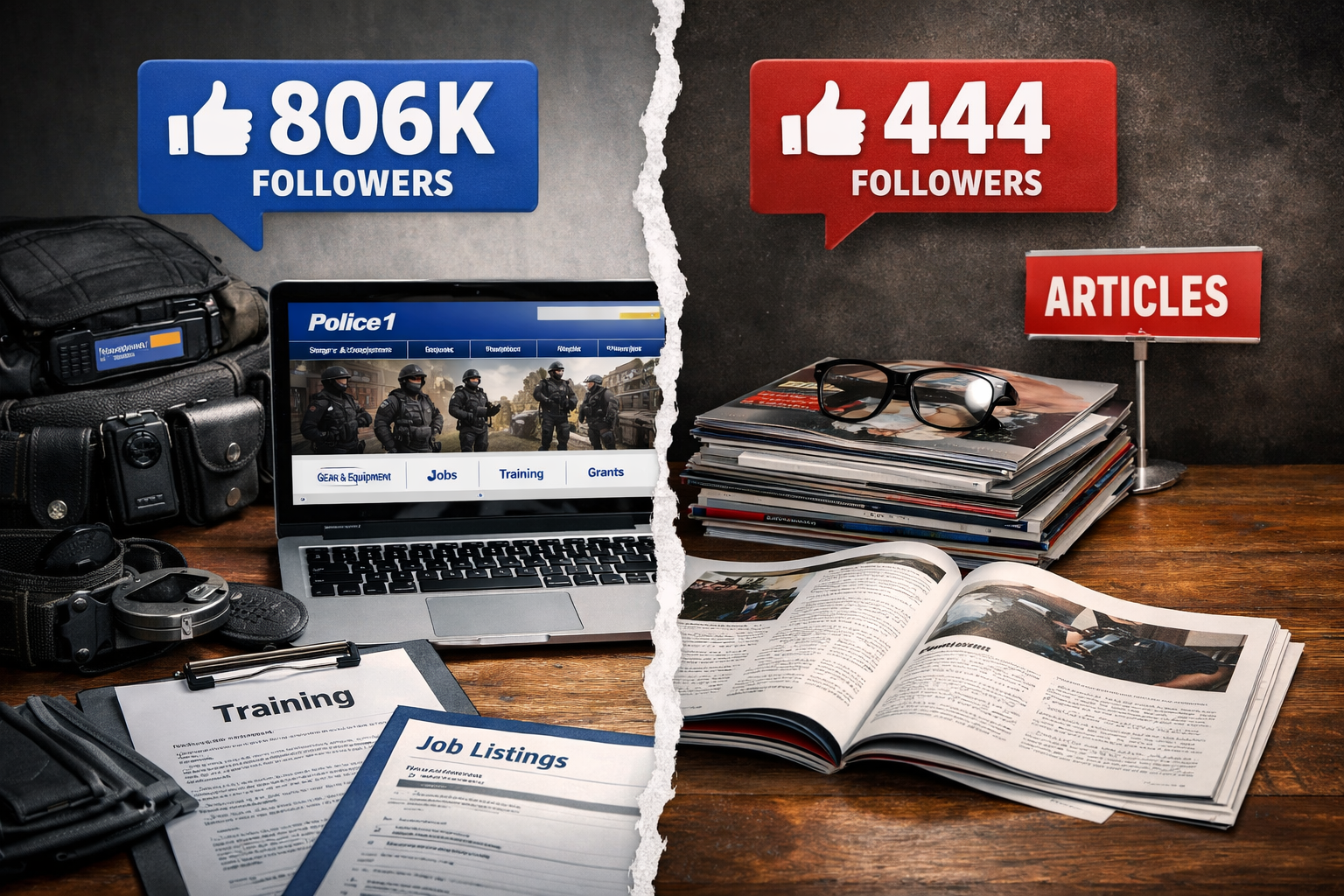
Two publications covering the exact same audience. One has nearly a million followers. One has 444. The difference isn't budget — it's everything that happens before the ads.
Same Niche. Same Audience. Completely Different Results.
Police1 and Police Magazine cover the same professional audience: law enforcement officers, commanders, departments, and the broader public safety community. On paper, the competitive set is identical.
Police1 has 806,000 followers on Facebook. Police Magazine has 444.
Spend five minutes on each and the gap makes complete sense — but not for the reason most people assume. It's not that Police1 had a bigger ad budget or a more aggressive social media posting schedule. It's that Police1 built something fundamentally different from a publication. And that difference is visible in every single layer of what they've built.
What Police1 Actually Built
Go to police1.com right now and what you find is not a magazine website. It's a full professional ecosystem.
There's daily news and analysis. There's a product directory covering dozens of equipment categories — weapons, body cameras, fleet, drones, dispatch technology, medical supplies — all with buyer's guides. There's a job board. There's a grants center. There's a continuing education program directory. There's an off-duty section covering fitness, personal finance, retirement planning, and entertainment. There are two active podcasts. There are regularly scheduled webinars — multiple per month — on topics ranging from drone deployment to AI-powered reporting tools to recruitment strategy. There are special coverage hubs with dedicated editorial series. There are downloadable resource libraries.
Police1 is not a publication that officers occasionally read. It is the professional infrastructure of American law enforcement digital life. The brand is embedded in how officers research gear purchases, find jobs, access training, and follow news in their field.
That is what 806,000 followers reflects. Not a social strategy. An ecosystem.
What Police Magazine Built
Police Magazine, by contrast, appears to be exactly what its name says — a hard copy and online magazine covering law enforcement. The content may be perfectly solid. The journalism may be credible. But the brand exists as a publication in a world where the most powerful brands in every niche have stopped being publications and started being platforms.
When a law enforcement officer is looking for gear research, Police1 has a product directory with buyer's guides. When they're looking for a job, Police1 has a job board. When they want professional development, Police1 has webinars and training resources. When they want news, Police1 has that too. Police Magazine has articles.
The follower gap isn't a mystery. One brand gave its audience reasons to come back daily across multiple dimensions of their professional life. The other gave them reasons to come back when there's a new issue.
The Core Principle: Destination vs. Publication
This is the most important strategic distinction for any brand trying to build real traction in a niche — and it applies far beyond media companies.
A publication produces content. A destination provides ongoing utility. Publications get bookmarked and forgotten. Destinations become habitual. Publications compete with every other publication covering the same topic. Destinations become the default infrastructure of a community — the place people go first, refer colleagues to, and think of as part of the fabric of their professional world.
Police1 understood early that officers don't just need news. They need gear research tools. They need career resources. They need training pathways. They need community. Every time the platform added a layer of utility, it deepened the reason for officers to return — and deepened the trust that made those returns valuable.
That compounding utility is what social growth reflects. Every follower on a mature brand page like Police1's is the result of someone deciding the brand is worth staying connected to. At 806,000 people, that's not a marketing outcome. It's a trust outcome.
Three Things That Actually Build Brand Traction
The Police1 vs. Police Magazine case is a clean illustration of principles that apply to any brand in any niche trying to build real presence.
1. Depth of Utility Determines Depth of Loyalty
The brands that build irreplaceable followings don't just cover their niche — they serve it. There's a difference between a brand that reports on what's happening in an industry and a brand that actively helps people operate within it. Police1 helps officers buy equipment, find jobs, access grants, complete training, and follow news — all in one place. That breadth of utility creates a level of loyalty that content alone cannot generate.
Ask honestly: does your brand help your audience do things, or does it just tell them things? The brands that get traction are almost always doing both.
2. Consistency of Presence Creates the Trust That Follows Reflect
Police1 publishes daily. Multiple times daily. Webinars run on a regular schedule. Podcasts drop consistently. Special coverage series run on defined timelines. The audience knows what to expect and when to expect it — and that predictability is not incidental to the brand's authority. It is the mechanism through which authority compounds.
A brand that posts when it has something to say, goes quiet for two weeks, and returns with an apology post about being busy is not building familiarity. It's asking its audience to forgive inconsistency on a recurring basis. Trust doesn't accumulate under those conditions. It resets.
3. Social Proof Is an Outcome, Not a Strategy
The 806,000 followers on Police1's Facebook page are not the result of a follower-growth campaign. They are the accumulated record of a brand that earned trust with a specific professional community over a long period of time. The number itself now functions as social proof — it signals to any officer who encounters the page that this is the brand their peers follow, which makes them more likely to follow it too.
This is why shortcuts backfire. Buying followers, inflating engagement, or running campaigns designed to manufacture the appearance of a large audience produces a number without the trust behind it. Professional audiences — especially tight-knit communities like law enforcement — are good at detecting the difference between a brand with real authority and a brand with purchased signals. The gap between Police1 and Police Magazine isn't just follower count. It's the credibility differential that follower count reflects.
Where Paid Media Fits Into This
Paid advertising is not irrelevant to brand building — but it plays a specific role, and it's not the first role.
Police1 almost certainly runs paid campaigns. At 806,000 followers and the infrastructure of a Lexipol-backed media operation, they're using paid amplification to extend the reach of content that already earns genuine engagement. That's the sequence that works: build something worth amplifying, then amplify it.
The sequence most struggling brands use is the reverse — spend on paid before the organic foundation is real, generate metrics that don't reflect genuine interest, and wonder why the follower count doesn't move or why the engagement looks suspicious. We've written separately about why Meta engagement campaigns in particular tend to attract low-quality interactions when the underlying brand has nothing sticky to pull people toward. Paid media fills a bucket. If the bucket has a hole in it — no clear identity, no consistent value, no reason for your audience to care — the budget runs out and you're back where you started.
The question before any paid media conversation is: if someone encounters your brand for the first time through this ad, what are they arriving at? Is there something there that earns a follow, a bookmark, a return visit? If not, the ad spend is renting attention rather than building it.
The Honest Audit Most Brands Need
Before the next campaign, before the next boosted post, before the next conversation about why the follower count isn't moving — the questions worth asking are structural.
Does your brand have depth of utility, or just content? Is your audience finding you when they need to accomplish something in their professional life, or only when you push something into their feed?
Is your presence consistent enough that your audience can predict you? Or do you disappear and reappear on a schedule driven by internal capacity rather than audience expectation?
Is there a clear reason — one specific, honest sentence — why someone in your target audience should follow your brand instead of every other brand covering the same space?
Police1 didn't end up at 806,000 followers and Police Magazine didn't end up at 444 by accident. Both outcomes are the result of choices — made over years, compounding in one direction or the other. The gap between them is a strategy gap. And strategy is something you can change.
Ready to Build a Brand That Actually Gets Traction?
At Ritner Digital, we help brands build the organic foundation and paid strategy that compound together — not one at the expense of the other. If your presence isn't reflecting the quality of what you actually do, let's fix that.
Frequently Asked Questions
What's the difference between a brand being a publication vs. a destination?
A publication produces content on a schedule. A destination provides ongoing utility that gives its audience reasons to return across multiple dimensions of their professional or personal life. Police1 is a destination — officers use it to research gear, find jobs, access grants, follow news, complete training, and attend webinars. Police Magazine is a publication — it produces editorial content and not much else. The strategic difference is that destinations create habitual return visits driven by need, not just interest. A publication competes with every other publication in its niche. A destination becomes the default infrastructure of its community, and that position is extraordinarily difficult for a competitor to displace once it's established.
Can you build a following this large with paid ads alone?
No. Paid media can accelerate growth that's already happening organically, but it cannot manufacture the trust that a following like Police1's represents. At 806,000 followers in a niche professional community, every one of those follows is the result of someone in law enforcement deciding the brand was worth staying connected to. That decision is made based on repeated positive experiences with the brand over time — not because an ad appeared in their feed. Paid campaigns can introduce your brand to new people. What happens after that introduction is entirely determined by what your brand actually is when they arrive. If there's nothing there worth following, paid spend produces impressions, not loyalty.
Why does consistency matter so much for brand growth?
Because trust is built through repeated, predictable, positive contact over time — not through occasional impressive moments. A brand that shows up reliably trains its audience to expect it, and that expectation is the foundation of habitual engagement. When Police1 publishes daily, runs webinars on a regular schedule, and drops podcast episodes consistently, officers learn that the brand is always there when they need it. That reliability is what makes a brand feel like part of the fabric of someone's professional life rather than a resource they vaguely remember exists. Inconsistency resets that relationship. Every gap in presence is an opportunity for a competitor to fill the space your brand vacated.
Our content is good. Why aren't we getting traction?
Good content is necessary but not sufficient. The brands that build real traction combine good content with three other things: clear identity that makes them instantly recognizable and distinct in their niche, consistent presence that trains their audience to expect them, and depth of utility that gives their audience reasons to return beyond just reading. If your content is strong but your growth is flat, the most likely culprits are one of those three. Either your positioning isn't differentiated enough for your audience to choose you over alternatives, your presence is too inconsistent to build familiarity, or your brand is a content source when it needs to become a resource. Often it's a combination of all three.
How long does it actually take to build brand traction?
Longer than most brands want to hear, and shorter than it would take if you started a year from now. Police1 has been building since 1999. That's not a discouraging fact — it's a clarifying one. The compounding dynamic of brand trust means that the early investment pays off disproportionately later. The brands that try to compress the timeline with paid spend usually find themselves frustrated because they're trying to buy an outcome that only accumulates through time and consistency. A realistic horizon for meaningful organic traction in a niche — not 800K followers, but a presence that your audience genuinely recognizes and returns to — is two to four years of consistent, focused effort. The brands that get there are the ones that committed to the process before they could see the results.
What is social proof and why does it matter for brand growth?
Social proof is the signal that other people in your audience already trust your brand. Follower counts are one form of it. Shares, citations, mentions by respected voices in your space, and appearing in organic search results are others. It matters because trust is partially transferred — when someone new encounters your brand and sees that 800,000 of their peers already follow it, that number does persuasive work before a single piece of content is evaluated. The compounding effect works in both directions. A large, authentic following attracts more followers because the number itself signals credibility. A small following creates friction because the number signals that the brand hasn't yet earned widespread trust. This is why manufactured social proof — bought followers, inflated engagement — is actively counterproductive in tight-knit professional communities. The audience detects the inauthenticity, and it damages trust more than a small following would have.
Should we focus on organic growth or paid ads first?
Organic foundation first, paid amplification second — in that sequence, the two reinforce each other. If your brand identity is clear, your content is consistently useful, and your organic presence is already earning genuine engagement from your real audience, paid media compresses the timeline by putting what's already working in front of more of the right people. If the organic foundation isn't real yet — unclear positioning, inconsistent presence, content that isn't earning genuine engagement — paid spend produces metrics without momentum. You rent attention you can't hold. Get to a place where your best content earns real engagement organically, then use paid media to scale that signal. That's the sequence Police1's growth reflects, whether it was explicit strategy or not.
What should a brand actually do this week to start building traction?
Three things that cost nothing but discipline. First, write one honest sentence that answers why someone in your specific target audience should follow your brand instead of every other brand in your space. If you can't write it, your positioning isn't clear enough yet — and that's the root cause of most brand growth problems. Second, audit the last ninety days of your content and ask whether it was consistently useful to that specific audience, or whether it was content you produced because you felt like you should be posting something. Third, identify one dimension of utility your audience needs that no one in your space is providing well — and start building toward owning that. Those three steps, done honestly, will surface exactly where the real work is.
Want to build a brand presence that actually compounds over time? Talk to Ritner Digital.