You Can Be a 50-Year-Old Business and Still Be Digitally Invisible

Reputation doesn't automatically translate to rankings. Here's why established companies disappear online — and what to do about it.
Your company has been around for decades. You've got loyal customers, a strong reputation, trucks on the road, yard signs in neighborhoods, and a name people trust. You've earned every bit of that credibility the hard way — through years of showing up and doing great work.
But here's the uncomfortable truth: none of that matters to Google.
A homeowner in Washington, D.C. whose furnace just died at 11 p.m. isn't flipping through the Yellow Pages. They're grabbing their phone and typing "HVAC repair Washington DC." And if your business doesn't show up in that moment — right there, in the top results — you don't exist to that person. Period.
The Simple Test Every Business Owner Should Try
Here's something that takes about 15 seconds and might change the way you think about your marketing spend. Open Google. Type in a service you offer and a location where you offer it. Something like "plumber in Arlington VA" or "commercial roofing Baltimore" — whatever matches your business.
Now look at the results.
First, you'll see the Map Pack — that block of three businesses with the map, star ratings, and phone numbers. This is the most valuable real estate on the page. The vast majority of clicks go to these three results, especially on mobile. If you're not one of them, most people looking for your service will never see your name.
Below that, you'll see organic search results — the traditional blue links. Being fourth, fifth, or sixth here might sound close, but it's not. Most searchers never scroll past the first few results. If you're buried below the Map Pack and you're not in the top organic positions, you're essentially invisible to the people who are actively looking for exactly what you sell.
If you had to scroll to find yourself — or worse, you didn't find yourself at all — you have a problem. And it's a problem that's costing you real money every single day.
Why This Happens to Good Companies
This isn't about your reputation being bad. It's about the gap between offline credibility and online visibility. There are a few common reasons established businesses end up digitally invisible.
Your Google Business Profile Is Neglected
The Map Pack is driven largely by your Google Business Profile. If it hasn't been updated in months, if you have a handful of old reviews with no responses, if your service categories are vague or incomplete — Google has no reason to feature you over a competitor who's actively managing theirs. The businesses that show up in the top three aren't always the best. They're the ones who've given Google the clearest, most consistent signals.
Your Website Isn't Built for Search
Many service businesses had a website built years ago and haven't touched it since. It looks fine. It has your phone number. But it's not structured in a way that tells Google what you do, where you do it, and why you're the best choice. Without dedicated service pages, location-specific content, and proper technical foundations, your site is just a digital business card sitting in a drawer nobody opens.
Your "Agency" Is Running on Autopilot
This is the one that stings. A lot of business owners are paying an agency $1,500, $3,000, sometimes $5,000 a month — and they couldn't tell you what they're actually getting for it. They get a monthly report full of charts and metrics that look impressive but don't connect to the one thing that matters: are new customers finding you?
If you're paying for digital marketing and you can't find your own business on Google, something is fundamentally broken.
Here's what often happens. The agency sets things up in month one, maybe runs a few basic optimizations, and then coasts. They send automated reports. They "monitor" your campaigns. But nothing meaningful changes month to month. Your rankings don't improve. Your phone doesn't ring more. You're paying for maintenance on a machine that was never built properly in the first place.
And because most business owners are busy actually running their business — managing crews, handling customers, keeping operations tight — they don't have time to audit what the agency is doing. They trust the process. The problem is, there often isn't much of a process to trust.
What Digital Visibility Actually Requires
Showing up in the Map Pack and ranking well organically isn't magic, and it isn't a set-it-and-forget-it situation. It takes deliberate, consistent work across a few key areas.
Your Google Business Profile needs to be fully optimized and actively maintained — accurate categories, fresh photos, regular posts, and a strategy for earning and responding to reviews. Your website needs to be technically sound, fast, mobile-friendly, and built with content that clearly communicates your services and service areas. And your broader online presence — directory listings, citations, backlinks — needs to be consistent and authoritative.
Most importantly, it requires someone who's actually paying attention. Someone who looks at where you rank this month versus last month. Someone who identifies what's working and what isn't. Someone who treats your marketing budget like it's their own money — because for a family-owned business, it basically is.
The bottom line: ranking well locally isn't about tricks or shortcuts. It's about doing the right work, consistently, and being transparent about the results. If your current partner can't clearly explain what they did this month and how it moved the needle, that's a red flag you shouldn't ignore.
Your Hard-Earned Money Deserves a Partner That Gets It
You didn't build your business by cutting corners. You built it by showing up every day, doing quality work, and taking care of your customers. Your marketing partner should operate the same way.
If you've been paying an agency month after month and you're still not showing up where it counts — in the Map Pack, in the top organic results, in front of people who are actively searching for your services — it might be time for a different conversation.
Not a harder sell. Not a flashier pitch. Just an honest look at where you stand, what it'll take to fix it, and a partner who values the money you're investing because they understand what it took to earn it.
Let's Find Out Where You Really Stand
Stop wondering if your marketing is working. Let's take an honest look at your digital visibility together — and build a plan that actually moves the needle.
Frequently Asked Questions
How do I know if my business is "digitally invisible"?
The easiest way is to search for it yourself. Open Google, type in a service you offer plus the location where you offer it — like "HVAC repair Washington DC" — and see where you land. If you're not in the top three of the Map Pack and you have to scroll to find yourself in the organic results, there's a good chance most potential customers aren't finding you either.
I've been paying an agency for months. Why am I still not ranking?
Unfortunately, not all agencies operate with the same level of accountability. Some do strong initial setup work and then shift into a maintenance mode that doesn't actually move the needle. If your agency can't clearly tell you what they did this month, how it impacted your rankings, and what the plan is for next month, you may be paying for activity that isn't producing results.
What is the Google Map Pack and why does it matter so much?
The Map Pack is the block of three local business listings that appears at the top of Google search results alongside a map. It shows the business name, star rating, address, and phone number. For local service searches — especially on mobile — the Map Pack captures the majority of clicks. If you're not in those top three spots, most searchers will choose someone who is before they ever scroll down to find you.
What's the difference between the Map Pack and organic search results?
The Map Pack is powered primarily by your Google Business Profile and local signals like reviews, proximity, and category relevance. Organic results — the traditional blue links below the Map Pack — are driven by your website's content, structure, authority, and technical health. Ideally, you want to show up in both. If you're missing from the Map Pack and buried in organic results, you're losing visibility from two directions.
Can a well-known local business really be invisible online?
Absolutely. Offline reputation and online visibility are two completely different things. You could be the most trusted name in your market with 50 years of history, but if your Google Business Profile is outdated, your website isn't optimized, and your online presence hasn't been actively managed, a two-year-old competitor with a better digital strategy will outrank you every time.
What does it actually take to rank in the Map Pack?
It comes down to a few core areas: a fully optimized and actively maintained Google Business Profile, consistent and accurate business listings across the web, a steady flow of genuine customer reviews with responses, and a website that reinforces your services and service areas. None of it is magic — it just requires consistent, deliberate effort from someone who knows what they're doing.
How do I know if my current agency is actually doing the work?
Ask them directly. What specific actions did you take this month? How have my rankings changed? What's the plan going forward? If the answers are vague, full of jargon, or just a PDF of charts you don't understand, that tells you something. A good partner should be able to explain your progress in plain language and tie their work back to real outcomes — like whether your phone is ringing more.
How long does it take to improve local search rankings?
It depends on where you're starting. If your foundation is solid but neglected, you can sometimes see meaningful improvement within a few months of focused work. If there are deeper issues — like a poorly built website, inconsistent citations, or penalty-worthy problems — it may take longer. The key is that progress should be measurable and visible month over month. If nothing's changing after several months of paying someone, that's a problem.
What should I look for in a new digital marketing partner?
Look for transparency, accountability, and a genuine understanding of local service businesses. They should be able to explain their strategy in terms you understand, show you exactly what they're doing each month, and tie their work to outcomes that matter to you. Bonus points if they treat your budget like it's their own money — because for a family-owned business, it practically is.
I'm ready to talk. What's the next step?
Reach out here → We'll take an honest look at where your business stands online, walk you through what's working and what isn't, and talk about what it would take to actually get found by the customers who are searching for you right now.
Related Reads
〰️
Related Reads 〰️

Why Familiar Brands Feel Safer (Even When They’re Worse)
We’ve all stuck with a brand that disappointed us—slow shipping, bad UX, or frustrating support—simply because it felt familiar. This post breaks down the psychology behind why consumers trust known brands over better alternatives, how familiarity lowers perceived risk, and what challenger brands can do to win anyway.

Why Organic Traffic Is the Most Sustainable Growth Strategy in 2026
Paid ads deliver short-term results. Organic traffic compounds. Learn why SEO and content marketing are the most sustainable growth strategies for businesses in 2026 — and how to build traffic that converts long after campaigns end.
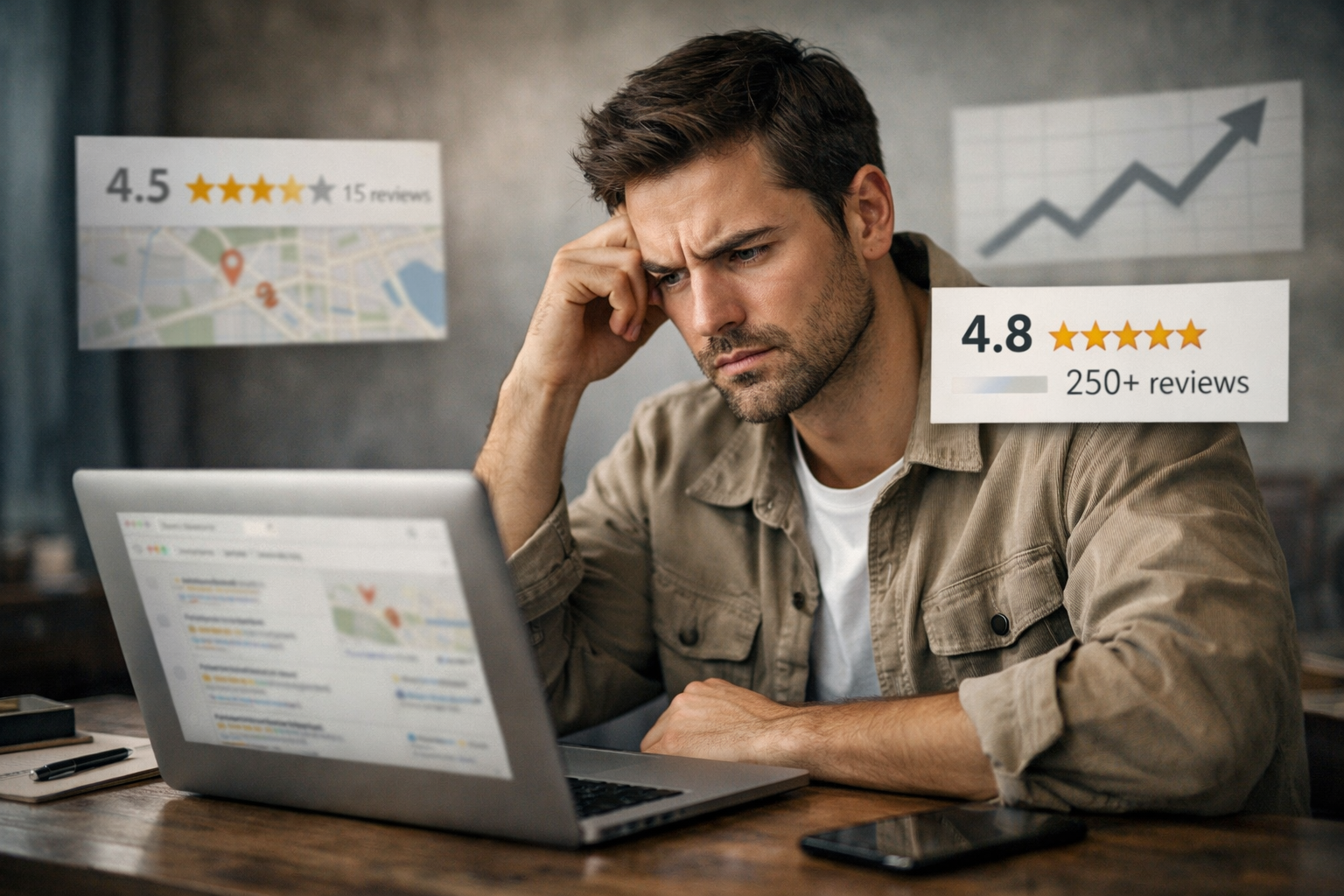
You Have 400 Reviews. They Have 50. They're Still Outranking You.
There's a special kind of frustration that hits when you Google your own company, your trade, and your town — and you're not at the top. You've got hundreds of reviews. The competitor above you has a fraction of that. So what gives? It comes down to how Google actually ranks local businesses, and review count alone isn't enough to win.